Ask any gua sha manufacturer a single question before you sign a wholesale order: do you run one quality system, or two? If the answer is “one,” that is your first warning sign. A jade or quartz blade sits around 7 on the Mohs hardness scale, according to the International Gem Society, while a stainless steel blade is judged by tensile strength instead — 304-grade steel must clear a minimum of 515 MPa under ASTM A240. Those are two separate sciences, tested with two separate toolkits, yet plenty of factories still run them through one checklist to save time on gua sha production. That shortcut is exactly where cracked stone, sharp steel edges, and failed nickel-release tests slip past inspection. You are not buying “a gua sha tool.” You are buying either a graded natural mineral or an engineered metal part, and the gua sha qc behind each one should look almost nothing alike. This article walks through where the two systems diverge, what each is built to catch, and which questions actually separate a documented gua sha factory from one that is guessing.
- Why a Careful Gua Sha Manufacturer Keeps Them Separate
- How a Responsible Gua Sha Manufacturer Verifies Every Blade
- The Metal Testing Bench: What a Gua Sha Manufacturer Should Measure Before Steel Becomes a Blade
- What a Gua Sha Manufacturer's Production Floor Actually Looks Like, Step by Step
- Compliance and Risk Disclosure: What a Gua Sha Manufacturer Should Tell You Before You Sign
- How to Vet a Gua Sha Manufacturer Before You Commit to a Wholesale Order
Why a Careful Gua Sha Manufacturer Keeps Them Separate
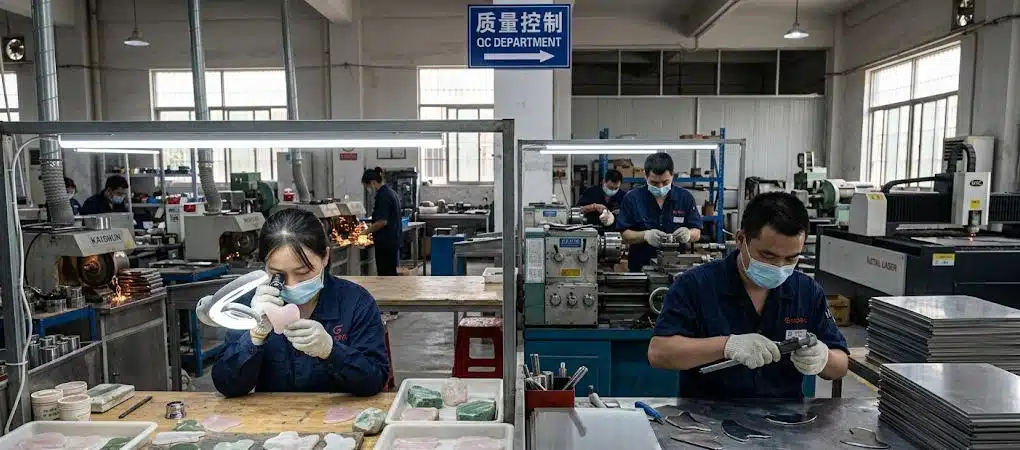
Stone and steel fail in opposite directions, and that single fact is the entire reason gua sha production cannot run on one checklist. Natural stone — jade, rose quartz, black obsidian, agate — carries stress from the mountain it came from long before it ever reaches a cutting wheel. A hidden fissure inside a rose quartz blank does not announce itself; it waits until the beveling stage, then splits without warning. Stainless steel carries a completely different risk profile centered on dimensional tolerance, edge burrs, and plating adhesion, not internal cracking. A gua sha qc protocol written for one material is close to useless on the other, which is exactly why asking a supplier “do you check for cracks?” without specifying the material gets you an answer that tells you nothing useful.
This means you can screen out a weak supplier in under two minutes just by asking whether their quality manual has one section or two — a single combined checklist is usually the tell.
The Stone Risk Line: What Nature Doesn’t Disclose Upfront
Every block of rose quartz, jade, or black obsidian carries a geological history that no spec sheet can capture. Color banding, mineral inclusions, and micro-fissures form under pressure over thousands of years, and no two blocks behave identically once a blade or grinding wheel touches them. A stone gua sha wholesale shipment can look flawless under normal light and still hide a fracture line that only a strong-light lamp or a 10x loupe will reveal — the same 10x magnification standard the GIA uses for clarity grading on colored gemstones. Skip that step, and the crack tends to surface after your customer has already used the tool once or twice, not during your incoming inspection. This means your return-rate exposure on stone gua sha sits almost entirely in what happened to the material before it ever reached a lathe, not in anything your packaging team did.
The Steel Risk Line: Where a Machine Still Needs a Human Check
Stainless steel removes the geological guesswork, but it brings in a different kind of risk — one measured in millimeters and microns instead of mineral grade. A stainless steel gua sha wholesale order depends on whether the mill actually shipped 304 or 316 as certified, whether sheet thickness matches the drawing, and whether the edge was deburred enough to pass a bare-hand safety pass without being polished so much that it loses massage pressure. None of that is guesswork — it is measurable with a caliper, a micrometer, and a roughness gauge. You are not trusting an artisan’s eye on this side of the line; you are trusting a number on a mill certificate, and that number is only as reliable as whoever actually checked it before signing off. This means a five-minute review of a mill test certificate tells you more about steel batch consistency than an hour of visual inspection ever could.
How a Responsible Gua Sha Manufacturer Verifies Every Blade
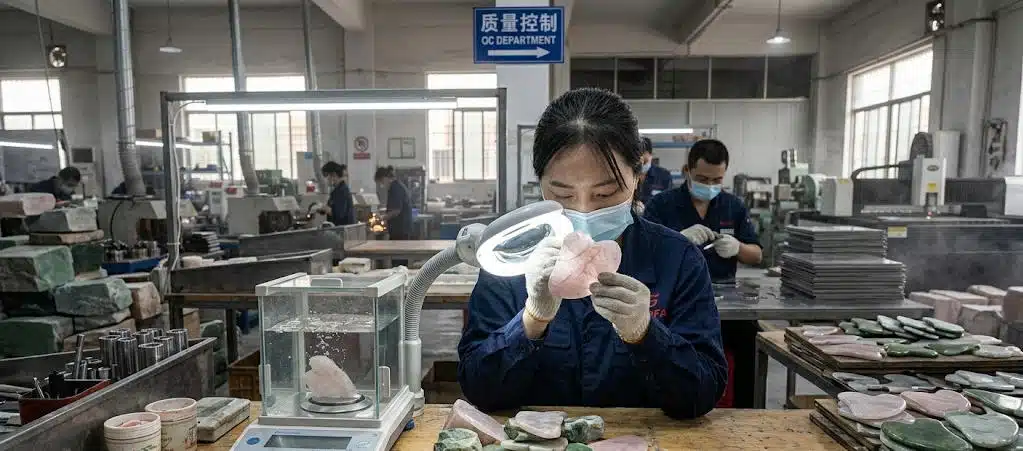
A gua sha qc bench for stone starts with three instruments, and none of them are exotic or expensive. The first is a strong-light lamp or a small transillumination light box: shine it through a rose quartz or amethyst blank and internal fissures, voids, and inclusion clusters show up as shadows that no amount of surface polish will ever hide. The second is a 10x loupe, the same magnification level GIA uses for gemstone clarity grading, which catches hairline cracks and near-surface flaws that a strong light alone can miss on darker or more opaque stones like black obsidian. The third is a simple pairing of an electronic scale and a water-displacement density tester, which does two jobs at once — it flags resin-composite fakes passed off as natural mineral, and it keeps weight variation inside a controlled range across a production batch.
This means you can ask any stone gua sha wholesale supplier for a batch density spread report before shipment, and a wide spread on that single number is often the first sign that a “jade” lot is not what the label claims.
Why Hardness Data From GIA and IGS Belongs on Your Spec Sheet
Hardness is not a marketing detail — it is a production variable. According to hardness charts published by the International Gem Society, quartz varieties sit around 7 on the Mohs scale, nephrite jade runs closer to 6 to 6.5, and black obsidian falls near 5 to 5.5. That spread changes which polishing wheel grit a gua sha factory should be using, how quickly a tool blunts during grinding, and — just as importantly — how well the finished blade resists scratching once it is sitting in a customer’s bathroom drawer for a year. Softer stone polishes to a high shine faster and at lower cost, but it also scratches sooner, which shows up later as a warranty complaint rather than a factory defect. For unusually high-value or rare material, some suppliers send sample batches to an independent gemological lab such as the Swiss Gemmological Institute SSEF for origin or treatment verification, though this step is normally reserved for premium runs rather than standard wholesale volume.
This means your spec sheet should state a hardness class, not just a stone name, because that single figure quietly sets your polishing cost, your defect curve, and how the product ages in daily use.
The Metal Testing Bench: What a Gua Sha Manufacturer Should Measure Before Steel Becomes a Blade
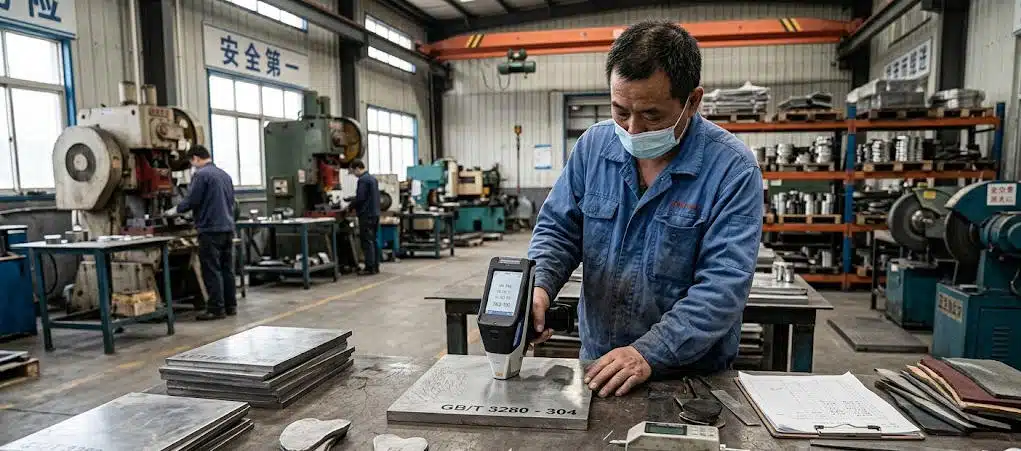
Steel testing does not depend on trained eyesight the way stone does — it depends on numbers you can independently check yourself. The central instrument on a metal QC bench is a PMI, or Positive Material Identification, analyzer. It is a handheld scanner that reads chromium, nickel, and molybdenum content in a few seconds and confirms whether the raw sheet is genuinely 304 or 316 as certified, rather than a cheaper alloy stamped with the wrong grade to save cost per kilogram. ASTM A240, the specification that governs chromium-nickel stainless steel plate and sheet, sets the chemical composition and mechanical property limits that a mill certificate should match line for line. A stainless steel gua sha wholesale order without a matching PMI reading and mill certificate is, in practice, an order based on trust alone rather than verified data.
This means you can request the PMI report alongside the shipment and cross-check it against the certificate in under five minutes, which closes off one of the easiest places for a supplier to quietly substitute material.
PMI Testing and Why 304 vs 316 Isn’t Just a Label
The 304-versus-316 decision is a real cost lever, not a cosmetic choice, and it belongs in your gua sha production brief from day one. Grade 304 carries roughly 18% chromium and 8% nickel and covers most everyday corrosion resistance needs at a lower material cost. Grade 316 adds 2 to 3% molybdenum, which meaningfully improves resistance to pitting and chloride exposure — relevant if your product line sees regular contact with facial oils, sweat, or humid bathroom storage. A gua sha factory running PMI checks on every incoming coil, not just the first sample, is the difference between a supplier who quotes 316 and ships 304 once volume ramps up, and one whose material stays consistent from the first order to the fiftieth.
Roughness, Plating, and the Ra Value Buyers Rarely Ask About
A mirror-polished surface is not a visual judgment call once you have the right tool — a surface roughness gauge measures it as an Ra value, a single number that tells you objectively how fine the polish actually is rather than relying on how it looks under a showroom light. For plated or PVD-coated pieces, gua sha qc adds a coating thickness gauge and a cross-hatch tape adhesion test: a grid is cut into the coating, tape is pressed on and pulled off, and any flaking tells you the plating will likely fail early in real-world use, not just in the lab. This matters because mirror-finish stainless steel shows every scratch and defect far more visibly than a brushed or matte surface, so stainless steel gua sha wholesale buyers carrying premium mirror-finish SKUs are exposed to more return risk from a weak coating than from almost any other single defect category.
This means a coating that passes the tape test in your incoming inspection is far less likely to peel after three months of contact with skin oils, which is exactly where most plating complaints actually originate.
What a Gua Sha Manufacturer’s Production Floor Actually Looks Like, Step by Step
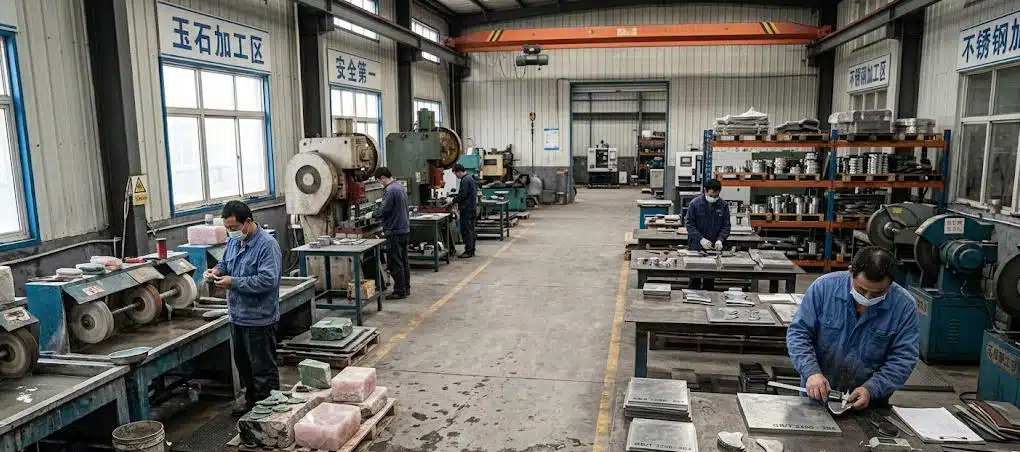
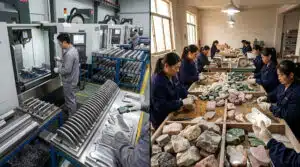
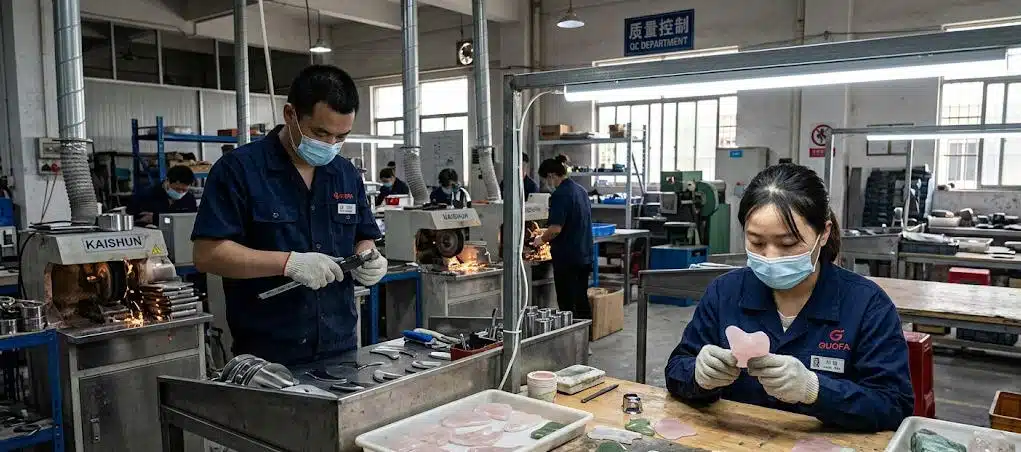
Reading a spec sheet tells you what a supplier promises. Walking the actual gua sha production line tells you what they check at each stage, and that is where most quality gaps either get caught or get shipped out the door. The two material lines never merge — they run in parallel, each with its own checkpoints, and a factory that cannot describe both in detail is probably only closely watching one of them.
Stone Gua Sha Production: The Checkpoints Between Rough Block and Finished Tool
A stone blade moves through roughly eight stages: rough block, slicing, rough shaping, fine shaping, beveling, polishing, cleaning, and packing. At the slicing stage, the check is simple — does the cut introduce a new crack, does the edge chip, and is the slice thickness consistent across the batch, since an inconsistent slice throws off every downstream step. Beveling is the stage where most safety complaints originate: under-beveled edges can cut skin or chip further during shipping, while over-beveled edges round off so much material that the tool loses the pressure needed for an effective scraping motion. Polishing is checked last, under a dedicated light source against a black backdrop, looking for sand marks, pitting, and uneven polish lines — natural stone will never reach the glass-like uniformity of a mirror-polished metal surface, and a gua sha manufacturer who claims otherwise on stone is overselling the material itself, not describing a real production outcome.
This means you can walk any stone gua sha wholesale production line and ask to see the beveling station specifically, since that single checkpoint predicts more skin-safety complaints than any other stage in the process.
Stainless Steel Gua Sha Production: Where CNC Precision Meets a Human Check
Steel follows a different sequence: sheet stock, stamping or CNC cutting, edge trimming, grinding, mirror polishing, optional plating, cleaning, and packing. Dimensional checks run continuously here — length, width, thickness, curve profile, and hole position are measured against the drawing at multiple points along the line, not just at final inspection, because a stamping die can drift out of tolerance gradually rather than failing all at once. Edge safety is checked by hand as well as by instrument: no burrs, no sharp corners, and a continuous smooth line along every curve, since the single biggest safety risk in stainless steel gua sha wholesale production is not breakage but a sharp edge that slipped past inspection. Surface quality gets the same dedicated-light-source treatment as stone, checking for scratches, pits, and polish-line consistency, but on a mirror-finish steel surface even a microscopic defect becomes visible almost instantly under the right angle of light.
This means a gua sha factory worth working with should be able to tell you, without hesitation, at which exact stage — stamping, grinding, or final polish — most of last quarter’s rejects were caught, because that answer only exists if someone is actually tracking it.
Compliance and Risk Disclosure: What a Gua Sha Manufacturer Should Tell You Before You Sign
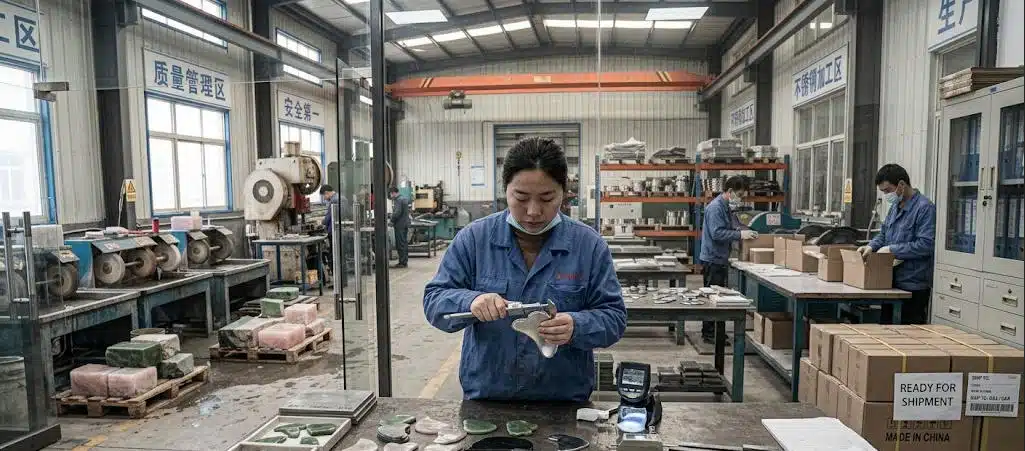
Quality control and legal compliance overlap, but they are not the same conversation, and a gua sha manufacturer who only talks about polish and packaging is leaving out the half of the discussion that can actually get a shipment held at customs or a listing pulled from a marketplace.
The Nickel Release Standard Your Stainless Steel Order Should Meet
Metal skin contact has its own dedicated European test method: EN 1811, which measures how much nickel leaches from a product during simulated prolonged skin contact and sets a release limit of 0.5 micrograms per square centimeter per week, as documented by the Nickel Institute. Under EU REACH restrictions, articles intended for direct and prolonged skin contact cannot legally be placed on the EU market unless they meet that release threshold, which makes an EN 1811 test report a real market-access document for stainless steel gua sha wholesale shipments headed to European buyers, not an optional nice-to-have. In the United States, the picture is different but still relevant — California’s Proposition 65 program flags nickel as a substance that can trigger a warning label requirement on steel products sold in that state, according to the state’s own OEHHA fact sheet, unless the seller can show testing data that supports skipping it.
Natural stone does not face the same nickel-release testing, but stone gua sha wholesale buyers carry a different compliance risk — mislabeled material, such as dyed dolomite or resin composite sold under a genuine jade or quartz name, which is closer to a truth-in-advertising problem than a lab-test problem, and the density and hardness checks covered earlier are exactly what catches it before the label ever gets printed.
This means the actual compliance question to ask a gua sha manufacturer is not “is your steel safe,” but “can you produce an EN 1811 report for this specific batch,” since that is the document a customs office or a marketplace compliance team will actually request.
The Real Cost of Skipping QC: A Risk-and-ROI Breakdown
The instruments described earlier in this piece — a PMI analyzer, calipers, a loupe, a roughness gauge — represent a small, largely one-time cost spread across years of gua sha production volume. A held shipment, a marketplace delisting, or a chargeback wave from a bad batch does not spread out; it lands all at once, often during your highest-volume selling season. Consider the simple math on a mid-sized wholesale order: even a modest defect rate translates into hundreds of returned units once you scale past a few thousand pieces, and each of those returns typically costs more in reverse logistics and refunded margin than the unit’s original manufacturing cost. A gua sha factory that runs inline QC absorbs that cost gradually, in small rejected pieces on the production floor, where a bad blank costs almost nothing to scrap. A factory that skips it pushes that same cost downstream to you, where the same defect now carries freight, duty, storage, and customer-service costs stacked on top of it.
This means the QC budget is not really a cost at all — it is a decision about which stage of the supply chain absorbs the cost of a bad piece, and that stage should never be the one closest to your customer.
How to Vet a Gua Sha Manufacturer Before You Commit to a Wholesale Order
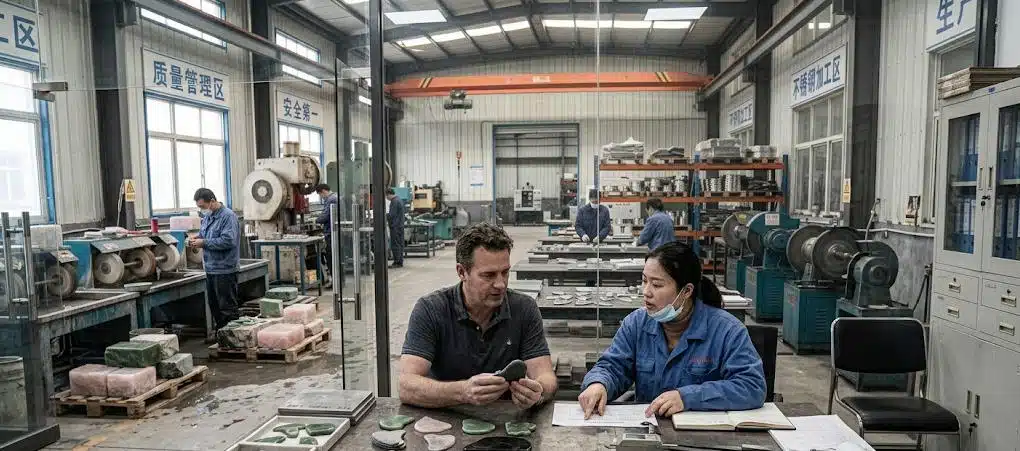
Everything covered so far turns into a short conversation once you are actually on a call with a gua sha manufacturer. You do not need a factory audit to start filtering candidates — you need the right five questions for each material, asked in the first conversation, before a deposit changes hands.
Five Questions for Any Stone Gua Sha Wholesale Supplier
Start with how the raw block gets graded: ask how rough stone is sorted before cutting even begins, and listen for a real answer involving light or loupe inspection rather than a vague reference to “experienced workers.” Ask directly whether every single piece is checked for cracks, or only a sample percentage, since stone gua sha wholesale buyers absorb the cost difference between those two answers on every return. Ask how the factory defines its A-grade versus B-grade material, and request the written standard rather than a verbal description. Ask how beveling is verified for safety, specifically what tool or test confirms an edge is smooth enough for daily skin contact. Finally, ask for a rough breakage or rejection rate from the last full production run — a supplier who tracks this number will usually give it to you without much hesitation, and one who cannot produce any number at all is telling you something too.
Five Questions for Any Stainless Steel Gua Sha Wholesale Supplier
Open with the material question directly: is this batch 304 or 316, and can the mill certificate be provided alongside a PMI reading for this specific shipment, not a generic reference sample from a previous order. Ask what the mirror-polish standard actually is, ideally as a numeric Ra value rather than a description like “high shine.” Ask whether every unit is checked for surface scratches or only a sampled batch, since stainless steel gua sha wholesale defects concentrate almost entirely in the visible mirror finish. Ask directly how burrs are controlled at the edge-trimming stage, and whether that check happens by hand, by instrument, or both. Close with a compliance question: can the factory supply an EN 1811 nickel-release test report for pieces headed to EU buyers, since that single document answers a question a customs office may eventually ask anyway.
A gua sha factory that answers all ten questions specifically, with numbers and named tests rather than reassurance, has almost certainly been through this conversation many times before — and that history is worth more than any single sample piece you could hold in your hand during a video call.