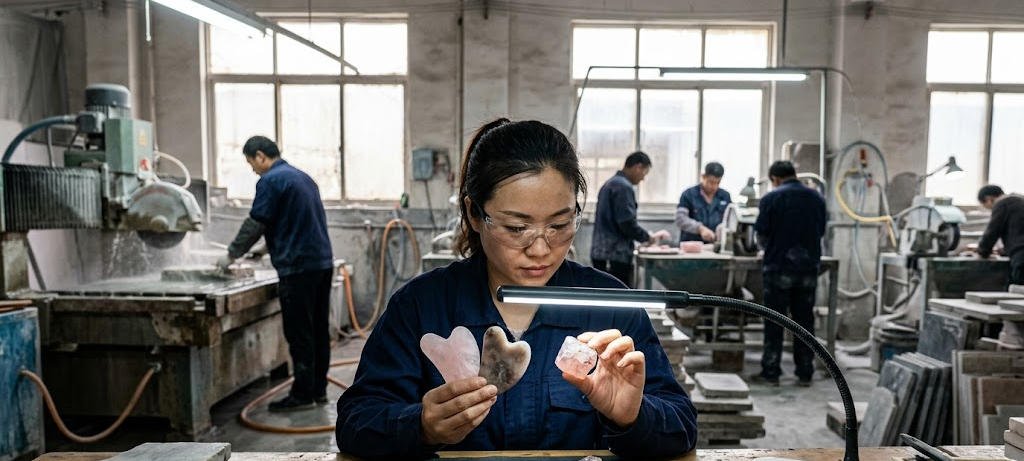
If you’ve ever opened two boxes of Rose Quartz Gua Sha tools from the same order and noticed one piece looks pale and glassy while the other looks cloudy and almost white, you’ve already run into the single hardest problem in natural stone production. Ask any experienced gua sha tool manufacturer and you’ll get a consistent answer: color consistency, not crack detection, not polishing, sits at the top of the difficulty ranking, rated the highest-risk variable across the six production stages that factory quality control tracks on every run. That ranking isn’t a guess. It comes from comparing how often each variable causes rejected batches, delayed shipments, or customer complaints across real production data. Mineral composition decides the final color before a single tool gets cut, and no amount of machine precision can override what the raw stone already carries inside it. Understanding this order changes how you evaluate a gua sha supplier, because it tells you which questions to ask before you place a deposit, not after a shipment arrives looking different from the sample you approved.
- Color Consistency in Natural Stone Manufacturing: The First Wall Every Gua Sha Tool Manufacturer Hits
- Crack Control: The Highest-Risk Step for Any Gua Sha Tool Manufacturer
- Appearance Consistency: Why Machines Can't Finish the Job for a Gua Sha Tool Manufacturer
- Polish and Luster: Same Process, Different Stone, Different Result
- Two Ways to Rank the Risk: Factory Stability vs. Customer Complaints
- What This Means for How You Choose a Gua Sha Tool Manufacturer
Color Consistency in Natural Stone Manufacturing: The First Wall Every Gua Sha Tool Manufacturer Hits
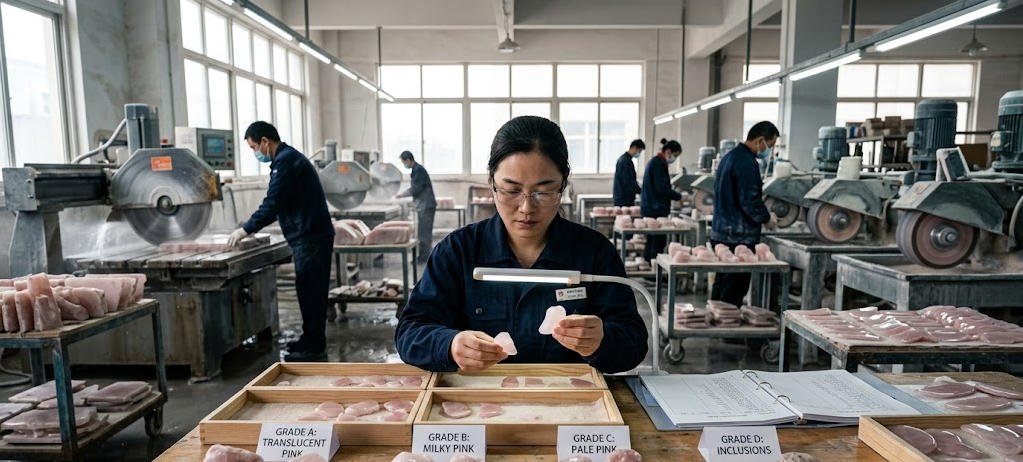
Rose quartz gets its pink tone from trace amounts of titanium, iron, or manganese sitting inside the crystal structure, plus microscopic fiber-like inclusions that GIA’s own gemological research links directly to the stone’s hazy, uneven appearance (GIA, Rose Quartz Quality Factors). None of that is something a factory adds or corrects afterward. It’s built into the mineral before it ever reaches a cutting table, which is exactly why two bags of rough labeled identically by the same mine can still produce visibly different finished pieces once they’re shaped into gua sha boards.
A single batch of rose quartz rough sourced from one supplier can still yield pieces ranging from a nearly clear, high-transparency pink through pale rose, milky pink-white, and even a faint lavender cast, depending on which layer of the deposit each piece came from. Stone pulled from the same mine but extracted months apart can carry a noticeably different tone, too. Picture two production runs both correctly labeled “Rose Quartz Gua Sha”: one batch comes out pale pink with high clarity, the next comes out cloudier with visible white streaking running through it. Both are genuine rose quartz. Neither is defective. That’s the part buyers most often misread as a quality failure when it’s actually a mineralogical fact about how the stone formed underground.
This means you can stop treating every shade variation as a manufacturing defect and start asking a more useful question: how does your gua sha supplier grade raw material before it enters production? A facility that skips grading will mix five different shades into a single order without telling you. A facility that grades material by tone, clarity, and transparency before cutting can tell you in advance which grade tier your order falls into, and hold that grade consistent from piece one through piece one thousand.
How a Gua Sha Tool Manufacturer Grades Raw Material Instead of Chasing Uniformity
No properly run gua sha tool manufacturer promises 100% color uniformity on natural stone, and it’s worth treating any claim of perfect uniformity with some suspicion. What a disciplined facility does instead is sort incoming rough into tiers before cutting starts, typically separating stone with even tone, high transparency, and minimal visible inclusions from material with lighter or slightly uneven coloring, and again from rough carrying obvious banding or heavier internal texture. Orders then get filled from a single tier rather than blending tiers together at random. IGS’s clarity classification framework follows similar logic industry-wide, grouping colored gemstones into clarity types before individual grading even starts, precisely because expecting uniform clarity across a natural material ignores how that material actually forms (International Gem Society, GIA Gem Clarity Grading Codes).
This means you can specify a grade tier when you place a gua sha wholesale order instead of hoping for consistency you can’t verify until the box lands on your desk. Ask for tier-matched production instead of a vague promise, and color control shifts from a guessing game into a documented specification both sides can point back to. At Deyi Gems, incoming rose quartz, agate, and jade rough gets sorted into grade tiers before a single piece touches a cutting wheel, and a customer’s purchase order gets tied to one tier for the full run, not a rotating mix. That single change is often the difference between a reorder that matches the first shipment and one that quietly doesn’t.
Crack Control: The Highest-Risk Step for Any Gua Sha Tool Manufacturer
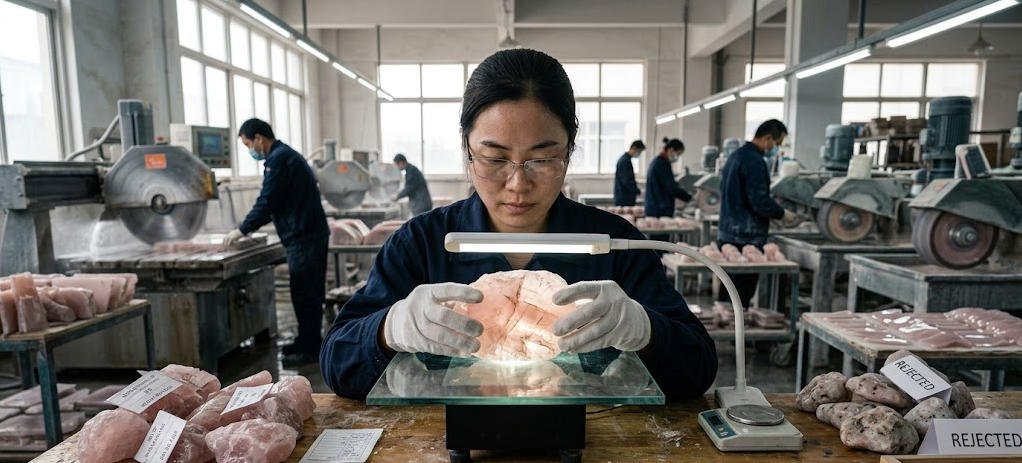
How much of a factory’s rejected inventory is actually a hidden crack problem wearing a different label? Cracks cause more scrapped inventory than any other single defect category in natural stone gua sha production, and the frustrating part is that most of them aren’t visible until it’s too late to do anything but discard the piece. A rough stone can look completely clean on the outside, pass a casual visual check, and still reveal a hairline internal fracture the moment it gets sliced open. Sometimes the crack doesn’t even show up during cutting. It shows up weeks later, after polishing is finished, during transport, when vibration from shipping finally causes a hidden weak point to fail.
That failure pattern is exactly why crack control ranks as the single highest-risk step from a factory floor perspective, even above color matching, once a gua sha tool manufacturer starts measuring risk by potential batch loss instead of by complaint volume alone. A cracked piece isn’t a cosmetic issue you can grade around and still sell. It’s dead stock, full cost, zero revenue. This means you can expect crack-related rejection rates to be one of the most closely tracked internal metrics inside any serious production facility, even if that number rarely gets shared outside the factory walls.
Raw Material Cracks vs. Processing Cracks
Cracks generally come from two different places, and knowing the difference matters if you’re ever troubleshooting a quality issue with your gua sha supplier. Raw material cracks form naturally, long before mining happens. Crystal growth under geological pressure, tectonic movement, and repeated heating and cooling cycles all leave internal stress marks inside the stone, showing up later as internal fractures, ice-like cracking patterns, or fine hairline splits running through the crystal. Processing cracks are different. These get introduced during manufacturing itself, usually starting as a microscopic fracture caused by excessive cutting pressure, then widening during later steps like CNC shaping, drilling, edge beveling, or polishing, until what started invisible becomes a visible break.
Durability in gemstone materials doesn’t scale evenly with surface hardness, and that distinction matters here. IGS’s research on gemstone hardness and wearability notes that tenacity, meaning how well a stone resists breaking, chipping, or cracking under stress, varies significantly between mineral types independent of how hard the surface tests (International Gem Society, Gemstone Hardness and Wearability). Two stones with similar surface hardness ratings can behave completely differently under a cutting wheel for exactly this reason, which is why a cutting program built for one material can quietly damage another. This means the settings that work perfectly for one stone type can silently produce microfractures in a different one, so asking your guasha manufacturer whether cutting speed and pressure get adjusted per material, rather than run on one fixed setting for everything, tells you a lot about how much hidden scrap you’re indirectly paying for.
What a Careful Gua Sha Tool Manufacturer Checks Before the Saw Ever Touches the Stone
Before rough material goes anywhere near a cutting blade, a careful gua sha tool manufacturer runs it through inspection built specifically to catch what a quick glance misses. Strong directional lighting held against and through the stone reveals internal fracture lines that flat overhead lighting hides completely. Water immersion testing does something similar, making internal cracks visibly darker and more defined against the surrounding clear material. Backlighting a stone and watching how light travels through it flags cloudy zones and hairline splits before a single cut is made, letting high-risk pieces get pulled from the line instead of getting discovered halfway through a batch, or worse, after it ships.
Once cutting starts, control shifts to the machine side. Blade speed, coolant flow rate, grinding wheel pressure, and how much material gets removed in a single pass all get adjusted specifically to avoid inducing new microfractures. Coolant flow matters more than most buyers expect here. Insufficient cooling creates thermal stress right at the cutting edge, and that stress is exactly the kind of hairline damage that shows up three weeks later as a broken piece sitting inside a customer’s shipment. At Deyi Gems, rough intended for gua sha production gets checked under directional and transmitted light before it’s approved for cutting, and any piece showing a suspected internal line gets pulled and reclassified rather than pushed through on a hope. This means when you’re comparing guasha tools wholesale quotes, a lower price paired with no mention of pre-cut inspection or adjustable cutting parameters is worth a direct question, because that gap in process is usually where crack-related returns come from later.
Impurity Control: Where Natural Character Ends and Defect Begins
Natural stone’s defining feature is that impurities aren’t a flaw bolted onto an otherwise perfect material. They’re part of how the stone formed in the first place. Clear quartz can carry black mineral specks or cotton-like clouding, amethyst can show iron deposits or color banding, and agate’s stripes and layered structures are, in fact, the entire reason people find agate visually interesting. None of that is a processing error, and pretending otherwise sets buyers up for expectations no honest guasha manufacturer can meet.
The real question was never whether a piece contains impurities, because virtually every natural stone does at some magnification level. GIA’s own gemological classification splits colored stones into clarity types precisely because some species are almost always found with visible internal features, and grading them against a flawless standard would be meaningless (International Gem Society, GIA Gem Clarity Grading Codes). The real question is whether a specific impurity affects how the piece looks or how structurally sound it is. A small area of cloudiness, a natural vein pattern, or a scattering of tiny mineral points sits well inside acceptable range for most gua sha wholesale buyers. A crack that penetrates through the piece, a large dark inclusion sitting directly on the working surface, or any feature that compromises how safely the tool can be used against skin does not, and gets rejected regardless of how the rest of the piece looks.
This means you can build a simple, workable acceptance standard with your supplier instead of an all-or-nothing definition of “clean” that no natural stone can realistically hit. Define what’s cosmetically acceptable, define what triggers automatic rejection, and put both in writing before production starts. That single document does more to prevent disputes over a finished order than almost any other step in the sourcing process, and it turns a subjective argument about “quality” into an objective checklist both sides already agreed on. At Deyi Gems, acceptance criteria for impurities are written into the production spec before cutting starts, rather than decided piece-by-piece on the line, which is the kind of detail worth asking any guasha manufacturer to confirm before you sign off on a large run.
Appearance Consistency: Why Machines Can’t Finish the Job for a Gua Sha Tool Manufacturer
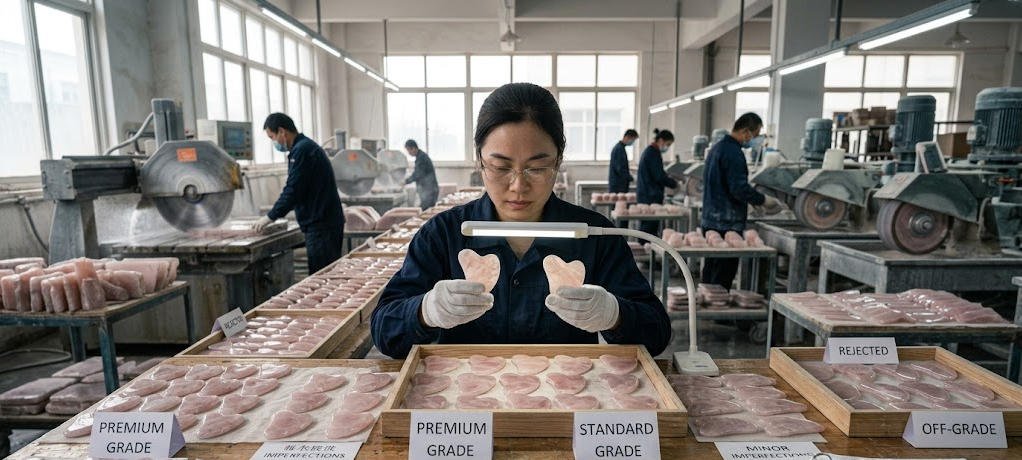
Appearance covers more ground than color alone. It includes texture, transparency, overall shape impression, and how clean the edges look once a piece is finished. Machines handle some of this well: a caliper checks dimensions, a scale checks weight, and thickness gauges hold tight tolerances without much argument. What machines still can’t reliably judge is whether one finished piece looks visually consistent sitting next to five hundred others from the same order, because that judgment depends on human pattern recognition, not a single measurable number.
Take an order of a thousand rose quartz gua sha pieces as an example. Equipment can confirm every piece matches on size, thickness, and weight within tolerance, and that data looks perfect on a spec sheet. None of it tells you whether piece 340 looks noticeably paler than piece 341 when they’re photographed side by side for a retail listing, and that gap is exactly what customers notice first when a shipment arrives. This means a gua sha tool manufacturer relying purely on automated measurement will pass an order that fails on shelf appeal, even though every number on the inspection report checked out fine.
The Multi-Stage Inspection Behind Every Gua Sha Wholesale Order
Higher-grade orders typically need multiple rounds of human eyes on the material, not just one final check at the end of the line. Raw material gets a first visual sort before cutting even begins, separating obvious color and clarity groups from each other. A second appearance grading happens once pieces are roughly shaped, catching anything that slipped through the first pass or emerged only after cutting exposed a new surface. Manufacturing continues, and a further round of sorting happens after polishing, when the finished surface finally shows the true, final color and clarity. A last check happens immediately before packing, catching shipping-stage scuffs, dust residue, or the rare piece that somehow drifted from its assigned grade tier along the way.
This layered process is slower and costs more labor than a single automated pass, and any gua sha supplier who claims otherwise is likely skipping a stage somewhere in the middle. This means you should expect appearance-graded orders to carry a longer lead time and a higher unit cost than ungraded, mixed-tone stock, and that difference in the quote isn’t padding. It’s the labor cost of a person actually looking at every piece more than once before it reaches your warehouse. A guasha manufacturer running four sorting passes on a thousand-piece order is spending real labor hours you’re paying for indirectly, and that cost is easier to accept once you understand what it’s actually buying you: a shipment where piece 340 and piece 341 genuinely look like they belong together. At Deyi Gems, this multi-stage sort runs on every graded order by default, not as an extra step reserved for the highest-priced tier.
Polish and Luster: Same Process, Different Stone, Different Result
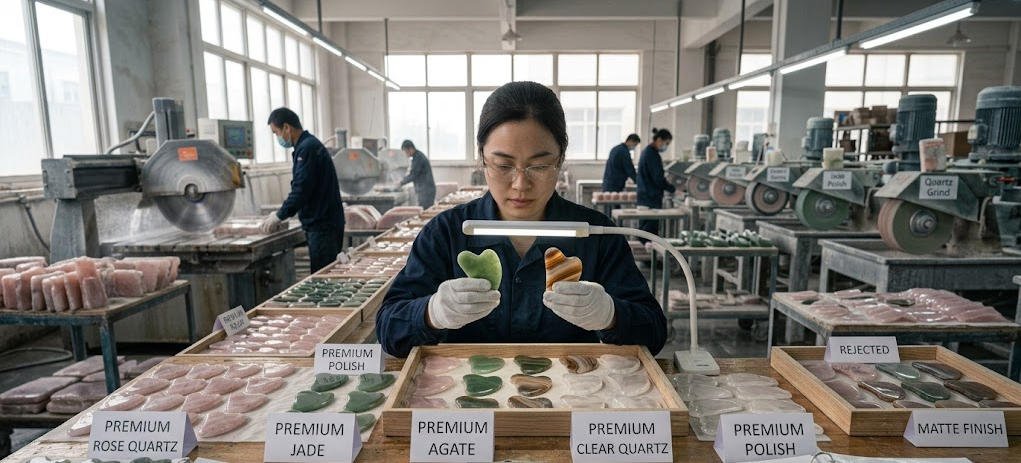
Why does one supplier’s white quartz gua sha gleam under store lighting while another’s looks dull no matter how long it’s buffed? Polishing looks like a simple, almost mechanical final step from the outside, but the results it produces swing dramatically depending on which stone is under the wheel. Clear quartz and rose quartz both take a bright, glassy shine relatively easily, which is why these two materials dominate most guasha tools wholesale catalogs. Agate behaves similarly, responding well to standard polishing compounds and holding its shine after handling. Jade sits in the middle, requiring more attention to reach the same result, and it’s one of the materials Deyi Gems runs on a separate, longer polishing program rather than the standard quartz cycle. Fluorite and calcite are noticeably harder to bring to a consistent high shine, and both are prone to surface haze if the process isn’t dialed in correctly for that specific material.
Hardness Differences You Should Ask Your Guasha Tools Wholesale Partner About
Surface hardness plays a direct role in how well a stone holds polish over time, and it’s worth understanding roughly where common gua sha materials sit. Quartz-family stones, including rose quartz and clear quartz, register around 7 on the Mohs scale, agate sits close by in the same range, jade typically falls between roughly 6 and 7 depending on whether it’s jadeite or nephrite, and fluorite drops down to around 4, a meaningful gap that changes how the material responds to abrasive contact (International Gem Society, The Mohs Hardness Scale and Chart for Select Gems). A lower number on that scale means the surface scratches more easily during handling, storage, and everyday use, which directly affects how long a polished shine survives once the tool leaves the factory.
Uneven luster on a finished piece usually traces back to one of two causes. Different regions of the same stone can carry slightly different micro-hardness, so a uniform polishing pass produces an uneven shine across the surface, especially on material with visible banding or mixed texture. Surface haze, on the other hand, typically comes from insufficient polish time, undetected microfractures reflecting light unevenly, or leftover fine abrasive residue that wasn’t fully cleaned off before the piece left the line. This means a guasha manufacturer working with harder-to-polish material like fluorite needs a longer polishing cycle and tighter process control than one working purely with quartz, and that difference is a legitimate reason for a price gap between product lines, not a sign that one supplier is cutting corners while the other isn’t.
Thickness Consistency: The One Variable a Gua Sha Tool Manufacturer Can Actually Promise
After five sections built around variables a factory can only manage rather than fully control, thickness is a welcome exception. Modern CNC cutting combined with precision grinding routinely holds tolerances around plus or minus 0.1 millimeters, which is tight enough that an order specified at 8mm thick typically arrives measuring somewhere between 7.9mm and 8.1mm, comfortably inside normal acceptable range for the category. This is the one production variable where machine capability, not raw material behavior, sets the outcome.
That said, ask any experienced gua sha supplier and they’ll tell you natural material still occasionally overrides even this. Some rough pieces need a slightly adjusted final thickness specifically to cut around an internal crack line or avoid an inclusion sitting too close to the working surface, meaning the finished thickness shifts slightly to protect structural integrity rather than to save material or cut corners. This means when a gua sha tool manufacturer quotes tight thickness tolerances, you can generally take that number at face value, because thickness control sits almost entirely within equipment capability rather than being limited by what the raw stone allows. It’s the one line item on a spec sheet where “we can hold this tolerance” is rarely an exaggeration.
Two Ways to Rank the Risk: Factory Stability vs. Customer Complaints

Risk in natural stone gua sha production doesn’t rank the same way depending on whose seat you’re sitting in, and that distinction is worth understanding before you finalize a spec sheet. From a factory floor perspective, focused on keeping large orders stable and minimizing scrapped material, the order runs cracks first, then color consistency, then appearance consistency, then impurities, then polish, then thickness last. Cracks sit at the top here because a cracked piece is a complete loss with zero salvage value, while a color mismatch can often still be sold into a different grade tier or a different market segment instead of being thrown away entirely.
From a customer complaint perspective, the order shifts. Color differences generate the highest complaint volume by a wide margin, since color is the first thing anyone notices in a product photo or when unboxing a shipment, followed by appearance differences, then cracks and breakage, then polish issues, then impurities, with thickness variation generating the fewest complaints of any category. Neither ranking is wrong. They’re measuring different things: one measures what threatens a factory’s output, the other measures what threatens a buyer’s satisfaction and repeat orders. A gua sha tool manufacturer managing both rankings at once, rather than optimizing for just one, is generally the more dependable long-term partner, because that facility is controlling for both production loss and customer experience at the same time instead of treating them as separate problems.
A Practical Checklist Before You Place a Gua Sha Wholesale Order
Before committing budget to a large gua sha wholesale order, a short set of direct questions saves far more time than it costs to ask them upfront. Does the supplier grade raw material into tiers before cutting, and can they commit your order to a single tier in writing? Do they run pre-cut inspection for internal cracks using light or immersion testing, or do they rely purely on a visual glance? How many rounds of human appearance sorting happen between raw material and final packing, and at which stages exactly?
Getting clear, specific answers to those three questions tells you more about expected consistency than any product photo or sample piece ever will, because a sample represents one piece while these questions describe the system producing every piece after it. Most guasha manufacturer operations will answer these questions honestly if you ask directly, and hesitation on any one of the three is usually a better predictor of future quality issues than anything printed on a spec sheet. This means you can walk into a sourcing conversation with a guasha tools wholesale partner already knowing which process gaps to probe, rather than discovering them the hard way after a container has already shipped and the invoice is already paid.
What This Means for How You Choose a Gua Sha Tool Manufacturer
Natural stone gua sha manufacturing will never produce perfectly identical pieces, and any supplier promising otherwise is either misunderstanding their own material or hoping you won’t ask enough follow-up questions to catch it. What separates a dependable gua sha tool manufacturer from an inconsistent one isn’t the absence of natural variation. It’s whether that variation gets managed through documented grading, layered inspection, and material-specific processing, or left to chance and sorted out only after a customer complains. Independent gemological institutions like GIA and SSEF apply this same underlying philosophy at a much higher stakes level, running detailed testing and clarity classification on individual gemstones specifically because natural material never behaves uniformly and needs a structured system to make sense of that variation (SSEF, Jewellery Testing). A factory-level operation is solving a smaller version of the same underlying problem, just at production volume instead of single-stone scale.
Where Deyi Gems Fits Into This Picture
Deyi Gems has spent more than twelve years processing, designing, and manufacturing natural jade and crystal gua sha and guasha tools at the source, and the grading, inspection, and material-specific processing described throughout this piece reflects how that production floor is actually run, not a marketing description written after the fact. Every gua sha wholesale and guasha tools wholesale order gets tied to a documented grade tier before cutting starts, giving you a written reference point to check a shipment against instead of relying on memory or a single sample photo, and the same tier-matching applies whether you’re placing a small trial order or a full-container guasha tools wholesale run. If you’re evaluating a gua sha supplier for an upcoming order, a direct conversation about raw material grading, crack inspection, and appearance sorting stages will tell you more in fifteen minutes than a week of catalog browsing ever could.
Frequently Asked Questions
1. How do I reduce color complaints on a large gua sha wholesale order?
Specify a grade tier in your purchase order rather than just a product name, and confirm in writing that your entire order will be filled from that single tier, not blended across tiers to fill quantity faster.
2. Is a hairline crack in a natural stone gua sha tool a safety issue?
It can be, particularly along a working edge, since it raises the chance of breakage during use. A responsible guasha manufacturer should reject any piece where a crack compromises structural integrity, not just pieces where it happens to be cosmetically visible.
3. Why does one guasha tools wholesale quote cost more than another for what looks like the same product?
Price differences usually trace back to inspection stages: whether raw material is graded before cutting, and how much human appearance sorting happens versus relying purely on automated measurement. Fewer inspection stages at a lower price usually means more variation reaching your final shipment.
4. What compliance or documentation should a gua sha supplier provide for natural stone material?
At minimum, expect written grade-tier specifications tied to your purchase order, and be willing to ask whether internal inspection methods like directional lighting or water immersion testing are part of standard pre-production screening, since that process detail affects both crack-related returns and how consistent your reorders will look over time.