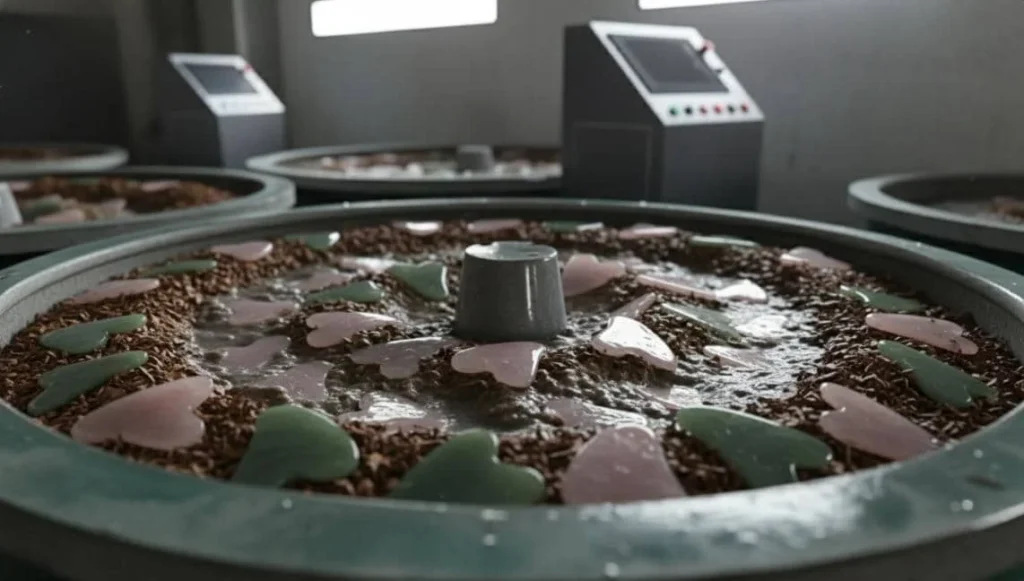
If you’ve ever compared two natural crystal gua sha tools that look identical in photos but feel completely different in your hand, the difference almost never comes down to the raw material. It comes down to gua sha polishing. A competent gua sha manufacturer builds quality into a sequence most buyers never see: a grit progression that typically runs through six or more stages, from 400 grit rough grinding up to 5000 grit before a final polish. Skip a stage, rush the timing, or push it too far, and the same rose quartz or jade blank can end up dull, warped, or carrying hairline stress it didn’t have going in.
This isn’t a cosmetic detail. It’s the single gua sha production variable most responsible for whether a batch clears inspection or comes back as a claim. As a source-factory gua sha supplier that has run polishing lines for natural stone tools for more than a decade, Deyi Gems wants to walk you through exactly where this process goes right, where it goes wrong, and what you should be asking any gua sha manufacturer before your next order leaves the workshop floor.
- What Every Gua Sha Manufacturer Learns About Polishing Time the Hard Way
- The Grit Progression a Reliable Gua Sha Factory Should Never Skip
- Material-Specific Polishing Standards Inside a Gua Sha Supplier's Workshop
- Quality Control Parameters That Separate a Gua Sha Manufacturer From a Workshop
- Cost, Risk, and ROI: What Polishing Discipline Actually Means for Your Order
- Industry Risk Disclosure: What a Responsible Gua Sha Manufacturer Discloses
What Every Gua Sha Manufacturer Learns About Polishing Time the Hard Way
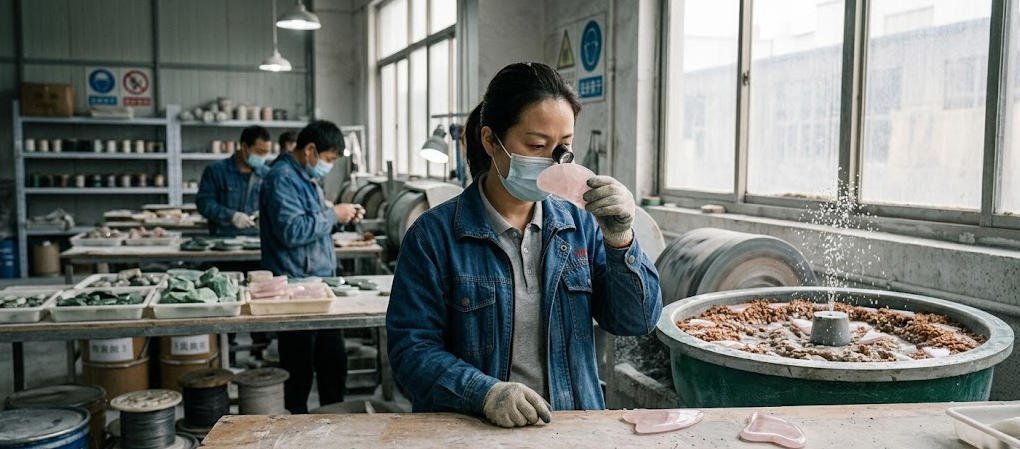
Polishing sits at the very end of the production line, right after rough shaping, and it’s the step that decides whether a stone tool reads as refined or unfinished. The physics behind it is simple enough: coarse grinding leaves microscopic scratches and a sugary, sandblasted texture across the surface. Gua sha polishing removes that texture layer by layer until light passes through cleanly instead of scattering off every scratch mark. But timing this step is a balancing act, not a fixed formula, and that balance is exactly where the gap between an experienced gua sha manufacturer and a general lapidary shop becomes obvious. Get it wrong in either direction, and the real cost of the mistake shows up later — either in a return shipment or in an OEM client’s rejected batch from an underprepared gua sha factory.
Under-Polishing: The Silent Defect Gua Sha Buyers Discover Too Late
When polishing time runs short, the fine scratches left by grinding never fully disappear. They sit just below a thin gloss layer, so a piece can look acceptable under warehouse lighting yet turn cloudy, grey, or streaky the moment it reaches daylight or a customer’s hand. This effect shows up most in translucent materials like clear quartz, rose quartz, and amethyst, where light is supposed to travel into the stone and bounce back rather than scatter off a rough surface. Gemological references from the International Gem Society confirm that surface finish quality affects how a stone reads visually, independent of the material’s intrinsic color and clarity — a point any experienced gua sha manufacturer will tell you matters more than the raw carat weight of the rough.
There’s a second, less obvious cost too: under-polished edges feel gritty against skin, which matters enormously for a tool designed to glide across a face or neck. This means you can end up with a tool that photographs fine for a product listing but fails the moment a real customer runs it across their jawline — and that gap between sample and shipment is precisely what erodes repeat orders with your gua sha supplier over time.
Over-Polishing: When a Gua Sha Manufacturer Trades Quality for Speed
The opposite mistake during gua sha polishing is less visible on a spec sheet but often more expensive. Every extra minute under a polishing wheel removes material, so pushing the process too far shaves thickness, drops weight, and drifts the tool’s dimensions away from the original drawing. For OEM orders where a gua sha board has to sit flush inside a printed box insert or match a paired accessory, even a small dimensional shift means packaging that no longer closes cleanly. A gua sha manufacturer that skips this check on a full production run is the one absorbing the repacking cost later, not you.
Edges and curves soften too, so the crisp lapidary profile a gua sha manufacturer originally cut gets rounded off, and piece-to-piece consistency across a gua sha production run starts to slip. For jade and other stones prized for a soft, oil-like luster rather than a mirror finish, over-polishing pushes the surface toward an artificial glassy shine that reads as lower quality to an experienced buyer, not higher. This means longer polishing cycles don’t automatically protect your order — past a certain point, they actively work against it, adding labor cost while degrading the exact dimensional accuracy your specification called for.
Where a Gua Sha Manufacturer Draws the Line
So how does a reliable gua sha manufacturer find the right stopping point? In practice, it’s rarely a single fixed time. It’s a target defined by material hardness, piece size, and the finish level a given order calls for, checked against the physical piece rather than the clock. A quartz gua sha board destined for a premium retail line needs a longer, more controlled polish than a basic wholesale set meant to move in bulk through a busy gua sha factory. Rushing either one to hit a shipping date is how defects slip through, and stretching either one past its target burns labor hours without adding value. This is the judgment call that defines a serious gua sha manufacturer, order after order, far more than any single machine on the floor.
If a gua sha manufacturer can’t explain why their polishing time is set where it is for a specific material, that’s usually a sign they’re running one generic process across every stone type. That’s the first thing worth asking about before you commit volume to an order.
The Grit Progression a Reliable Gua Sha Factory Should Never Skip
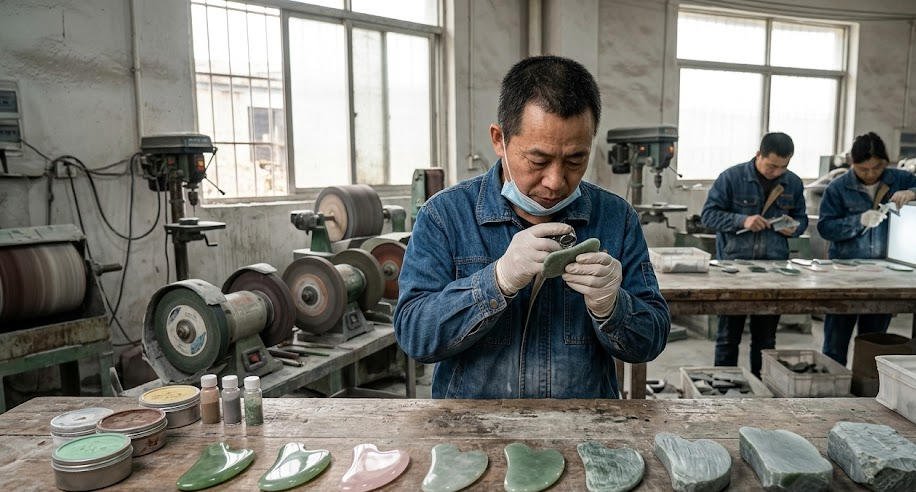
Polishing time is only half of the equation. The other half is sequence — the order and spacing of abrasive grit sizes used to move from a rough-cut blank to a finished surface. A typical gua sha production line moves through roughly six to eight stages, and skipping steps to save time is one of the most common shortcuts a rushed gua sha factory takes when order volume spikes and deadlines tighten. A disciplined gua sha manufacturer treats this sequence as a fixed engineering standard, not a variable to compress whenever a shipping date gets tight.
The Standard Sequence From Rough Grinding to Final Polish
Most workshops follow a progression that starts at rough grinding, then steps up through 400, 600, 800, and 1200 grit before moving into fine polishing stages at 3000 and 5000 grit, finishing with a cerium oxide or diamond powder compound for the final shine. Each stage exists to remove the scratch pattern left by the one before it, and skipping stages leaves deeper marks that the next grit level simply isn’t coarse enough to fully erase. The International Gem Society’s guidance on polishing quartz and beryl makes a similar point directly: a strong pre-polish stage has to be complete before moving to a finer lap, because later stages are not designed to remove material — only to refine what’s already there.
The table below shows how this plays out differently across two common product tiers that any guasha tools manufacturer typically runs side by side on the same production floor.
| Product Tier | Typical Grit Sequence | Primary Goal |
|---|---|---|
| Wholesale gua sha tools | 400/600 → 800 → 1200 → polish | No visible scratches, smooth handling, stable shine |
| Premium quartz gua sha tools | 600 → 1000 → 2000 → 3000 → 5000 → fine polish | Higher transparency, deeper internal luster, minimal haze |
This means a wholesale-tier tool and a premium-tier tool can start from the exact same rough blank and still end up worlds apart in feel, purely because of how many grit stages separate rough grinding from the final buff. Ask a gua sha manufacturer which of these two sequences applies to your order, and the answer tells you almost everything about where that batch is headed.
What Happens When Grit Levels Jump Too Far
Skipping directly from 400 grit to 3000 grit looks efficient on a production schedule, and it does save real time on paper. But high-grit compounds are only designed to polish an already-smooth surface, not to erase the deep scratch pattern left by coarse grinding. The result is a stone that looks bright under direct light while hiding faint waviness, hazy patches, and uneven texture just beneath that surface shine — something workshop staff at a careless gua sha factory often call a false polish.
On clear quartz and other transparent materials, this flaw is nearly impossible to hide, because the eye catches the internal distortion even when the surface itself looks glossy. This means a batch that passes a quick visual check on the production line can still fail a closer inspection once it reaches a retail shelf or a discerning end customer, and by then the cost of the mistake has already multiplied through packaging, shipping, and customer service time. A careful gua sha manufacturer catches this at the polishing station, not at the customer service desk.
Why More Grit Stages Don’t Always Help a Gua Sha Manufacturer
The opposite instinct — adding more grit steps in tight increments, like 400, 500, 600, 700, and 800 — doesn’t reliably improve the outcome either. Past a certain point, extra grit stages mainly add labor time, machine hours, and energy use without a proportional gain in surface quality. A well-run gua sha manufacturer treats grit selection as an engineering decision, not a box-checking exercise: enough steps to fully clear the previous scratch pattern, and no more than that.
This is one area where experience matters more than a printed procedure, since the right jump size between stages depends on the specific hardness and internal structure of the material being processed. Why does this distinction matter to you as a buyer? Because a guasha tools manufacturer that pads its process with unnecessary steps is often billing you for time that never shows up in the finished product at all.
Material-Specific Polishing Standards Inside a Gua Sha Supplier’s Workshop
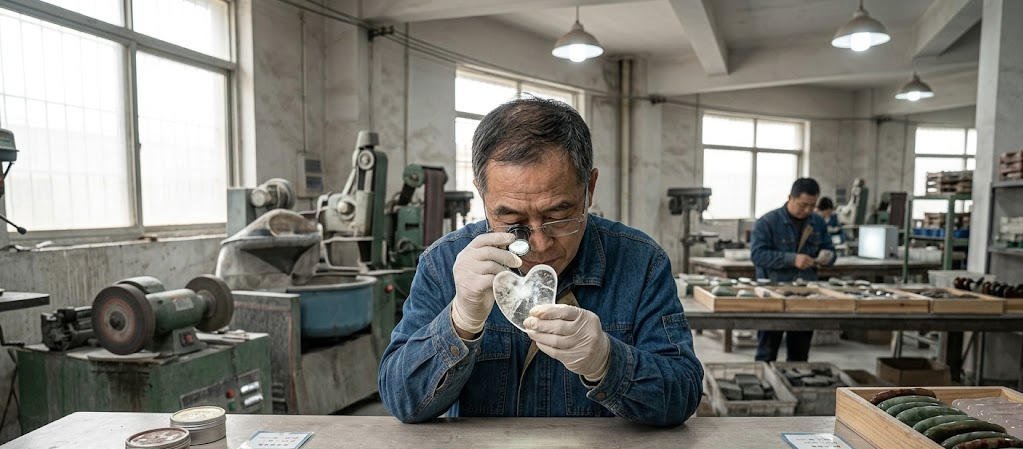
Not every stone responds to polishing the same way, and treating all raw material with one identical process is one of the fastest ways a guasha tools manufacturer ends up with inconsistent batches. Hardness, internal structure, and heat sensitivity all shift the ideal approach, so a gua sha manufacturer that genuinely understands its materials sets a different plan for each stone type rather than running a single default cycle across everything that comes off the cutting saw.
Clear Quartz and Rose Quartz: What a Gua Sha Manufacturer Controls
Clear quartz sits at roughly 7 on the Mohs hardness scale, the same reference system used across the gemstone trade and documented by GIA to compare how easily different minerals scratch against one another. That hardness makes quartz well suited to high-precision, longer gua sha polishing cycles, because the material holds a sharp finish without breaking down quickly under the wheel.
Rose quartz, chemically similar but structurally softer in practice, needs generous fine-grit time specifically to avoid a milky, fogged appearance — a defect that shows up constantly in rushed batches and remains one of the most common quality complaints a gua sha manufacturer hears about pink stone tools. This means the extra minutes spent on fine polishing for rose quartz aren’t wasted labor; they’re the only thing standing between a clear, glassy piece and a cloudy one that gets returned to the gua sha supplier who shipped it. A gua sha manufacturer that treats rose quartz on the same clock as clear quartz will see this complaint far more often than one that doesn’t.
Amethyst
Amethyst brings a different risk entirely: heat. GIA’s own care guidance confirms that abrupt temperature changes can cause amethyst to fracture, and separate heat-treatment research on the material shows its purple color itself begins shifting once the stone crosses roughly 300°C. High-speed polishing generates friction heat at exactly the surface layer being worked, so an experienced gua sha manufacturer deliberately controls both pressure and wheel speed on amethyst to keep the piece well below that threshold throughout the cycle.
Skip that control, and you risk two failures at once — a color shift that can’t be reversed, and micro-cracking that only becomes visible weeks after the piece has already shipped, long after a rushed gua sha manufacturer has moved on to the next order. That’s an expensive lesson to learn on a full production run rather than a small test batch, which is exactly why amethyst gets a slower, cooler process than harder stones at Deyi Gems and at any other careful gua sha manufacturer.
Agate, Jade, and Softer Stones
Agate is harder and takes a mirror finish relatively easily, making it one of the more forgiving materials on a polishing line. Jade sits at the opposite end philosophically: buyers value its soft, oil-like luster over a hard glassy shine, and pushing jade toward a glass-like polish actually works against what makes the stone desirable in the first place — a mistake a gua sha manufacturer with jade experience learns to avoid early. The Swiss Gemmological Institute, SSEF, notes that serious jade assessment relies on strict mineralogical and structural evaluation rather than a single visual shortcut — the same discipline a careful gua sha manufacturer applies when deciding how far to take a jade piece’s polish before stopping.
Fluorite and calcite sit lower on the hardness scale and need reduced pressure throughout, since both are prone to chipped edges and surface damage under a force level that quartz tolerates without issue. Running one polishing pressure setting across all four of these materials is a shortcut that shows up as inconsistency the moment a client lines pieces up side by side, and it’s usually the fastest way to tell a careless guasha tools manufacturer from a careful one.
Quality Control Parameters That Separate a Gua Sha Manufacturer From a Workshop
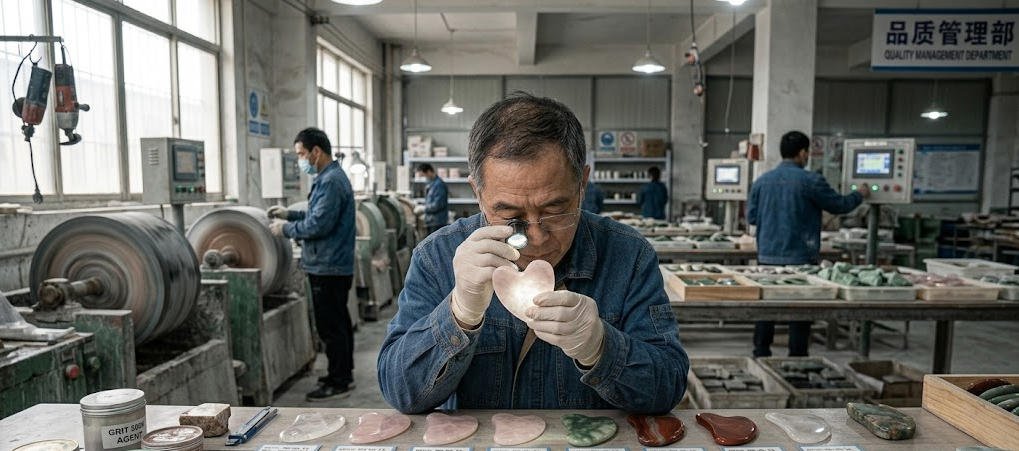
Consistent polishing outcomes come down to controlling three variables at once: pressure, polishing media, and batch-level variation in the raw stone itself. Any gua sha factory can hit a good result on a single sample piece; the real test for a gua sha manufacturer is holding that same result across a five-thousand-unit order without the quality drifting from the first carton to the last. A gua sha manufacturer without that consistency is, in practice, just a workshop with better product photography.
Pressure Control
Too much pressure against the wheel raises surface temperature quickly, and that heat is what drives crack expansion and chipped edges, especially in brittle materials. Too little pressure just slows everything down, stretching cycle time without meaningfully improving the finish. The right pressure setting isn’t a single number written once and forgotten — it shifts by material hardness, piece thickness, and even by how humid the workshop is that particular week, which is exactly why pressure needs to be checked at the machine level rather than assumed from a written manual.
This means the person running the gua sha production line matters just as much as the equipment itself, since a skilled operator adjusts pressure in real time in a way a fixed automated setting simply cannot replicate. A gua sha manufacturer that automates this step without human oversight is usually optimizing for the wrong kind of consistency, and it’s one of the first things a careful guasha tools manufacturer trains new operators to feel for by hand before trusting them on a full batch.
Polishing Media Selection
Cerium oxide, diamond micro-powder, and aluminum oxide are the three compounds you’ll find across most gua sha production lines, and each one suits a different material and finish target that a trained gua sha manufacturer matches by hand rather than by a single default setting. Cerium oxide is the standard choice for quartz-family stones because it cuts fine scratches efficiently without excessive heat buildup. Diamond powder handles harder or denser material more aggressively and is often reserved for final-stage precision work where surface control matters most. At Deyi Gems, this matching happens per material batch rather than per order, since two batches of the same stone can still call for slightly different treatment.
Aluminum oxide tends to show up in earlier, coarser stages where raw cutting speed matters more than surface refinement, and a gua sha manufacturer that keeps all three compounds stocked and labeled by stage is signaling a level of process control worth noticing. Matching the wrong compound to the wrong stone doesn’t just slow the process down — it can leave a surface texture that looks fine under factory lighting but reads as inconsistent once photographed under natural light for a product listing, and it’s the kind of mismatch a careless gua sha factory repeats across an entire order before anyone notices.
Batch Consistency: How a Gua Sha Manufacturer Controls Variation
Here’s the part most buyers never think about: even stone cut from the same rough block isn’t identical piece to piece. Natural hardness, internal structure, and micro-inclusions vary across a single batch, which means a fixed polishing time applied uniformly across a thousand pieces will always produce some strong results and some marginal ones. A dependable gua sha manufacturer builds a staged check into the process instead: grading raw material first, assessing hardness variation, screening for visible defects, adjusting grit stages by sub-batch, and running a final gloss check before packing. Deyi Gems runs this staged check on every OEM order regardless of size, because skipping it on a small order is exactly how the habit carries over into a large one.
Does that sound like more work than running one timer for the whole order? It is. But it’s also the only reliable way a gua sha supplier can keep a five-thousand-piece OEM order from arriving with a visible quality spread between the best and worst pieces in the box — and that spread is usually what triggers a client’s first formal complaint against a gua sha manufacturer.
Cost, Risk, and ROI: What Polishing Discipline Actually Means for Your Order
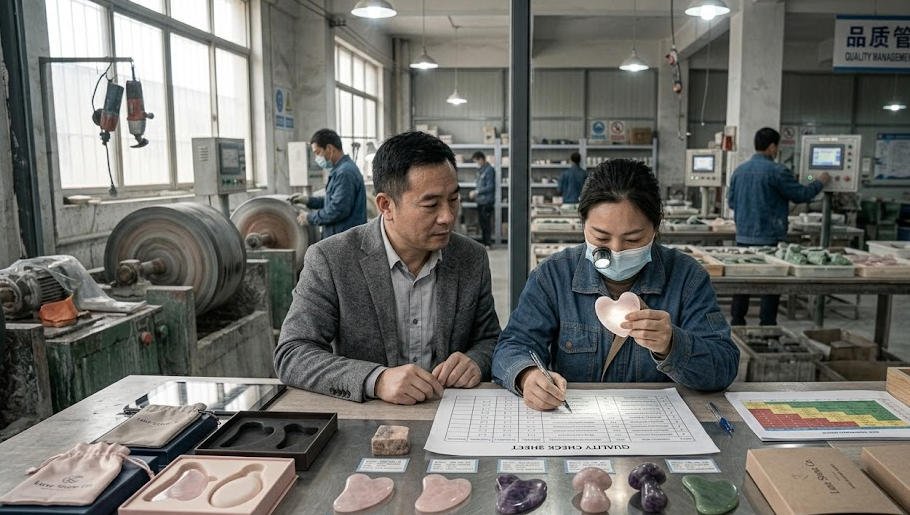
The Hidden Cost of a Rushed Gua Sha Production Run
Cutting gua sha polishing time might look like an easy way to hit a shipping deadline, but the math rarely works in your favor once you account for what happens after the pieces leave the workshop. Say a rushed process shaves ninety seconds off polishing time per piece across a ten-thousand-unit order — that’s roughly two hundred fifty labor hours saved on paper. Now weigh that against a return or rework rate that climbs even slightly, because under-polished pieces that pass a quick visual check on the line tend to get caught later, either by an end customer or by a retail buyer doing a closer inspection.
A single container of returned stock, plus the shipping and relabeling cost required to fix it, can easily erase whatever time was saved during production. This is the calculation a serious gua sha manufacturer runs before ever agreeing to compress a gua sha production schedule: the hours saved on the line are rarely worth more than the cost of a failed batch reaching a client’s warehouse. If your current gua sha supplier can’t walk you through this tradeoff when you ask about faster turnaround, that’s worth noting before your next purchase order goes out to that gua sha factory. Any gua sha manufacturer that has processed one returned container over a rushed polishing schedule tends not to make that trade twice.
How to Evaluate a Gua Sha Manufacturer Before You Place an Order
Before committing volume to any gua sha manufacturer, it’s worth asking a few direct questions rather than relying on sample photos alone. Start by asking what grit sequence they run for the specific material in your order, and whether that sequence changes between wholesale and premium product lines — a vague answer here is usually a sign of one-size-fits-all processing rather than a documented standard at that gua sha factory.
Next, ask how they handle batch variation, since natural stone hardness differs piece to piece and a gua sha supplier with no answer for this is likely running a single fixed timer across everything regardless of material. Finally, request a sample pulled from an actual gua sha production batch rather than a hand-picked showroom piece, and check it under natural daylight instead of warehouse lighting, since that’s exactly where the results of rushed gua sha polishing tend to hide, and any established guasha tools manufacturer should be comfortable sending that kind of unpolished sample without hesitation. This means a fifteen-minute conversation before you place an order can save you weeks of dispute after a shipment arrives, and any gua sha manufacturer confident in their own process should be able to answer all three questions without hesitation.
Industry Risk Disclosure: What a Responsible Gua Sha Manufacturer Discloses
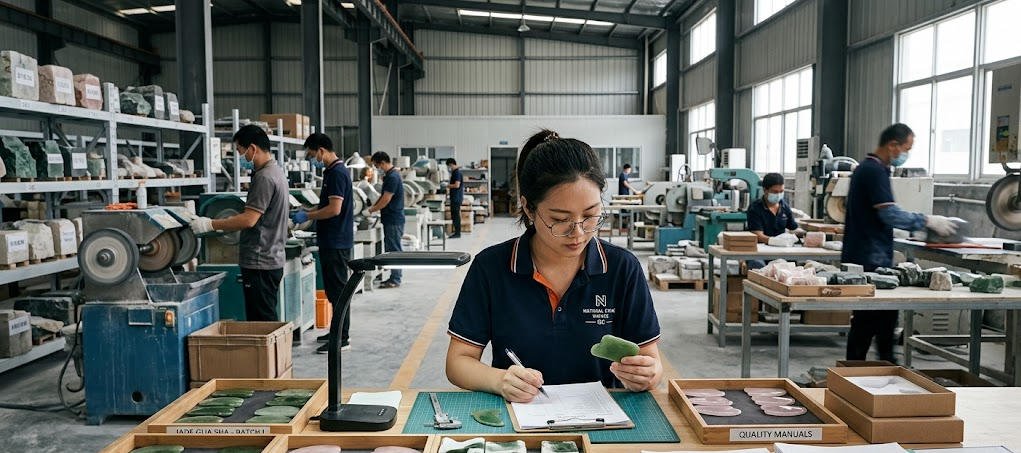
None of this means every polishing defect is avoidable, and it’s worth being direct about that. Natural stone carries inherent variation that no amount of process discipline eliminates completely — a small percentage of pieces in any large order will fall outside target spec purely because of how the raw material formed underground long before it ever reached a cutting wheel. Any gua sha manufacturer who claims zero variation across a bulk order is either working with an unusually small batch or not being fully transparent with you about the process. What separates a dependable gua sha manufacturer from an unreliable one isn’t the absence of variation — it’s whether that variation gets caught before shipment through staged quality control, or discovered afterward by your own customers.
Deyi Gems has run polishing lines for natural crystal and jade gua sha tools for more than twelve years, covering design, cutting, gua sha polishing, and packaging under one roof rather than outsourcing stages to third-party workshops. That structure gives you direct visibility into exactly where in the process your order sits, instead of relying on a trading company’s secondhand updates. As a source-factory guasha tools manufacturer, Deyi Gems documents grit sequence, polishing time targets, and batch-level checks by material type, so you can ask specific questions and get specific answers rather than general reassurances about quality.
If you’re evaluating a gua sha manufacturer for an upcoming order — wholesale volume or a premium OEM line — the questions raised throughout this article are a reasonable starting point for that conversation, and any gua sha manufacturer worth ordering from should welcome them rather than dodge them. Ask about grit sequence. Ask about batch consistency checks. Ask to see a sample pulled from a real gua sha production run rather than a showroom piece. A gua sha manufacturer that welcomes those questions, rather than deflecting them, is one worth building a long-term order relationship with, and Deyi Gems is glad to walk through its own process in that same level of detail whenever you’re ready to compare a gua sha supplier against what’s described here. As a guasha tools manufacturer built around visible process rather than promises, Deyi Gems would rather earn that comparison than avoid it.