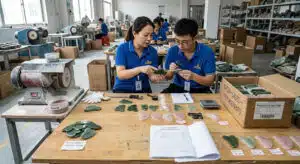
Two gua sha tools can leave the same gua sha factory, pass the same visual inspection, and still not match each other under raking light — and that gap is not a defect, it is physics. Quartz sits at Mohs 7. Fluorite sits at Mohs 4. A three-point spread on that scale is wide enough that no polishing recipe, however carefully tuned, forces two different stones to reflect light the same way. After 12 years of gua sha production, this is the first thing Deyi Gems puts in writing for buyers before a single unit ships: identical process does not guarantee identical surface. You can lock in consistent quality. You should not expect identical gloss across different stones, and any gua sha manufacturer who tells you otherwise is skipping a conversation you deserve to have before you sign a purchase order.
- Can Every Gua Sha Factory Really Deliver Identical Polish? A Risk Disclosure
- The Mohs Hardness Data Behind Every Gua Sha Factory's Polish Ceiling
- Same Grit, Different Result: A Hidden Risk in Guasha Wholesale Orders
- Crystal Structure and Light: The Variable Every Gua Sha Factory Manages Differently
- Inside Barrel Polishing: A Step-by-Step Look at Gua Sha Production Risk
- Material-Specific Standards: How a Responsible Gua Sha Factory Sets Benchmarks
- The Gua Sha Polishing Ranking: What Your Wholesale Budget Is Actually Buying
- Industry Experience Disclosure: 12 Years Inside a Gua Sha Factory
- The Bottom Line for Your Next Gua Sha Wholesale Order
Can Every Gua Sha Factory Really Deliver Identical Polish? A Risk Disclosure

What “Identical Polish” Means Inside a Gua Sha Factory
Run the same tumbling barrel, the same abrasive compound, the same cycle time, and the same operator across ten different stone types, and you will still get ten slightly different results. Mineral composition, hardness, crystal structure, porosity, toughness, and transparency all shift from one material to the next, and each of those variables pushes the finished surface in a different direction. A quartz gua sha board and a fluorite gua sha board processed on the identical line will not carry the identical shine, no matter how tightly the workflow is controlled. This means you can specify one polishing procedure across your whole purchase order, but you should not write “identical finish across all materials” into that same purchase order, because no gua sha factory can deliver on both promises at once.
A more useful definition, and the one Deyi Gems works from, is this: different materials can reach the same grade of surface quality without ever looking or feeling the same. Grade refers to whether pitting, scratch lines, and dull patches have been removed to a consistent standard. Look and feel refer to gloss level, transparency, and hand-feel, which are governed by the stone itself rather than by the polishing line. Buyers who ask for “the same grade” get a specification a gua sha manufacturer can actually hold to. Buyers who ask for “the same look” are asking mineralogy to behave like paint.
Where Buyer Expectations Diverge From Production Reality
A common scenario in guasha wholesale sourcing looks like this: a buyer receives one polished obsidian sample, loves the mirror-black finish, and asks for the entire catalog — jade, aventurine, agate — to match that sample exactly. On paper this sounds like a simple ask. On the shop floor it is not achievable, and a gua sha factory that says “yes” without qualification is setting up a rejection dispute three weeks before container loading. The GIA’s own material on gemstone durability makes a related point for jewelry buyers: hardness, toughness, and stability work together to determine how a stone performs, and treating any single number as the whole story leads to bad predictions. The same logic applies on a polishing line, not just on a finger.
This means you can avoid that dispute entirely by asking your gua sha factory for material-specific reference photos at the quotation stage, not after production. A gua sha factory that hands you eight different reference images for eight different stones, instead of one universal photo, is not being difficult — it is being accurate. That accuracy is what keeps your QC pass rate high and your chargebacks low once the shipment lands.
The Mohs Hardness Data Behind Every Gua Sha Factory‘s Polish Ceiling

Hardness Numbers Straight From the Workshop Floor
Every gua sha factory runs into the same ceiling: hardness. The Mohs scale, developed in 1812, ranks how easily one mineral scratches another, and it is not evenly spaced — the jump from a 7 to a 9 is far larger than the jump from a 1 to a 3. On the workshop floor, the numbers that matter for gua sha production are narrower and more practical: quartz, rose quartz, and amethyst all sit at Mohs 7, agate and jadeite sit around 6.5 to 7, and fluorite drops to Mohs 4. That four-point range, from fluorite to quartz, is the entire reason a single polishing standard cannot cover a full stone catalog.
A harder stone holds a fine-grit finish far longer under the same abrasive load, which is why quartz varieties reach a glass-like gloss with real depth, while fluorite tends toward a frosted surface and shows fine scratch lines even under gentle handling. This means you can expect quartz, rose quartz, and amethyst tools from any competent gua sha manufacturer to hold a bright, glassy finish through normal use, while fluorite pieces need gentler handling instructions printed right on your packaging insert.
Why No Gua Sha Manufacturer Can Polish Around Hardness
Hardness is not a defect to engineer away, and no amount of extra buffing time changes a stone’s position on the scale. A softer stone processed for triple the standard cycle time will not catch up to a harder stone’s gloss — it is more likely to overheat, develop micro-fractures, or lose definition at the edges. This is a real cost line, not a theoretical one: extending cycle time on soft stone by even 20 percent to chase a harder stone’s shine typically raises scrap rate instead of closing the gloss gap, which is the opposite of what a guasha wholesale buyer is paying for.
This means you get better economics by accepting a material-appropriate finish standard than by demanding one universal gloss target. A gua sha factory that quotes you a lower price for matching fluorite to quartz gloss is quoting a result it cannot consistently produce, and the gap usually shows up later as a return-rate problem instead of a line item on the invoice.
Same Grit, Different Result: A Hidden Risk in Guasha Wholesale Orders

What Grit Number Actually Controls
A grit number on a purchase order looks precise, and that precision is misleading if you read it as a promise about the finished surface. Grit only describes the size of the abrasive particle used at a given production stage — 400 grit, 800 grit, 1200 grit — and it tells a gua sha factory how fine the scratch pattern will be at that step, nothing more. It says nothing about how that scratch pattern will read once it interacts with a specific mineral’s internal structure. Two stones finished on identical grit sequences can leave the line looking like they came from two different specs, and both are correct against the process sheet.
This matters most in guasha wholesale contracts that specify grit level as the sole quality metric, because grit alone cannot be the enforcement mechanism for gloss or clarity claims. A gua sha factory can hit every grit number on the sheet and still deliver a duller-than-expected piece if the underlying stone was never going to reach a glassy finish, because grit describes the gua sha polishing input, not the mineral’s optical output. This means you get a stronger contract by pairing grit specification with a gloss-level or reference-photo requirement per material, not grit numbers alone, so you and your gua sha factory are measuring the same outcome.
Quartz vs Jade Under One Gua Sha Factory Polishing Line
Run quartz and jade through the same gua sha polishing sequence and the divergence becomes obvious fast. Quartz varieties — clear quartz, rose quartz, amethyst — carry a strong glass-like luster, visible reflection, and a jump in apparent transparency once the final stage is complete. Jade moves in the opposite direction: reflections stay soft, the surface reads as oil-rich rather than mirror-bright, and clarity does not increase the way it does with quartz, because jade was never chasing a mirror result in the first place. Buyers who expect jade to “clean up” like quartz at the final polishing stage are comparing two different optical targets, not two quality levels.
This means you should request separate acceptance criteria for quartz-family and jade-family items in the same order, because a single pass/fail photo cannot honestly represent both. A gua sha manufacturer who agrees to write two standards into one contract is protecting your QC process, not complicating it — and it usually prevents the kind of dispute that costs both sides a container’s worth of goodwill.
Crystal Structure and Light: The Variable Every Gua Sha Factory Manages Differently

Ordered vs Interwoven Mineral Structures
Underneath the grit numbers and the barrel cycles sits the real explanation: crystal structure decides how light behaves once it hits a polished surface, and this is where gua sha polishing stops being purely mechanical and starts being mineralogical. Quartz forms a regular, ordered crystal lattice, so light entering the stone travels in a predictable path, reflecting and refracting cleanly back toward the eye. That order is what produces the glass-like brightness buyers associate with top-shelf quartz gua sha tools, and it happens regardless of how skilled the polishing operator is, because the physics is already built into the mineral.
Jade tells a different story. Its structure is a dense network of interlocking micro-crystals or fine fibers rather than a single ordered lattice, and the Swiss gemological lab SSEF describes jade in these terms when grading finished pieces for the trade. Light entering that interwoven structure scatters in many directions instead of bouncing back in one clean path, and scattered light reads to the human eye as warmth and softness rather than sharp reflection. This means you can market a jade gua sha tool on its warm, skin-like finish with total accuracy, instead of apologizing for a shine level it was never built to hit.
How to Read a Sample Before You Approve It
When you evaluate a pre-production sample, tilt it under a single directional light source rather than flat overhead lighting, and watch how the reflection moves across the surface. A quartz-family sample should throw a tight, bright highlight that shifts sharply as you rotate the piece. A jade-family sample should show a broader, softer highlight that barely moves, and that is a pass, not a defect, once you know what you are looking at. Any gua sha factory worth ordering from should be able to explain this difference to you in under two minutes, without reaching for marketing language.
This means your sample-approval meeting becomes shorter and more useful once everyone is judging each stone against its own optical ceiling instead of a single ideal photo pulled from a catalog cover.
Inside Barrel Polishing: A Step-by-Step Look at Gua Sha Production Risk

The Three-Stage Process Every Gua Sha Factory Should Explain to You
Most gua sha production runs through three barrel stages — coarse grinding, fine grinding, and final polishing — and each stage carries a different risk profile depending on the stone loaded into it. Coarse grinding removes saw marks and shapes the profile, fine grinding closes the surface and removes visible scratch lines, and final polishing brings up whatever gloss the mineral is capable of holding. For a buyer sourcing through guasha wholesale channels, understanding these three stages matters because a rushed fine-grinding stage is the single most common cause of a disappointing final polish, more common than a problem at the polishing stage itself.
Quartz-family stones tolerate this three-stage sequence with relatively wide margins for cycle time and abrasive load, which is one reason quartz gua sha polishing has a reputation for consistency across large orders. Jade-family stones need tighter control at every stage, because the same aggressiveness that quartz shrugs off can chip an edge or leave a shadow line in jade that only shows up once the piece is fully dry. This means you should ask your gua sha factory which stage takes the longest for each material in your order, because the honest answer — longer fine-grinding time for jade, shorter for quartz — tells you whether that gua sha factory actually differentiates its process or runs one recipe for everything.
Where Soft Stones Fail Inside the Barrel
Fluorite and other Mohs-4-to-5 materials cannot run the same barrel intensity as quartz or agate without real damage risk. Push the vibration intensity or cycle time too high on a soft stone and you typically see one of two failure patterns: a hazy, frosted “fog” across the surface, or a texture the trade calls orange-peel, where the finish stays uneven at a microscopic level no matter how long polishing continues. Neither failure shows up on a spec sheet written in grit numbers alone, which is exactly why grit-only contracts under-protect buyers ordering softer materials.
A gua sha factory that has run enough volume to know this in advance will lower vibration intensity and extend timing specifically for soft-stone batches, rather than applying a fixed recipe across the whole order. This means your softer-stone SKUs should cost slightly more in processing time, and a quote that prices fluorite identically to quartz processing is a quote that has not accounted for this risk — worth flagging before you commit to a purchase order, not after the shipment fails inspection.
Material-Specific Standards: How a Responsible Gua Sha Factory Sets Benchmarks

The Deyi Gems Material Standard Table
The compliant answer to “what polish level should I expect” is not a single number. It is a table, and Deyi Gems builds one for every material category rather than forcing every stone toward one universal brightness target. Clear quartz, amethyst, and rose quartz are held to a mirror glass-gloss standard. Obsidian is held to a deep black mirror standard, distinct from quartz because the base color changes how mirror gloss reads to the eye. Agate is held to a high, even brightness standard rather than a mirror standard. Jade is held to a soft, oil-rich luster standard, and aventurine is held to a satin, gently lit standard that keeps its natural sparkle inclusions visible instead of polishing them into a flat glare.
This structure exists because a single gloss number applied across eight mineral types would fail on at least six of them, and it would fail for reasons rooted in mineralogy rather than in factory competence. This means you can request a written, material-by-material spec sheet from any gua sha manufacturer before you place a guasha wholesale order, and a gua sha factory that already has one on file — rather than improvising it during your call — is telling you something real about how its gua sha production is organized.
Why “One Standard for All” Is a Compliance Red Flag
Contracts that require identical gloss across an entire mixed-material product line are, in practical terms, unenforceable, and that creates compliance exposure for both sides. If a quality clause references one gloss benchmark for a shipment containing quartz, jade, and fluorite, either the gua sha factory over-promises to win the order, or the buyer ends up rejecting stock that actually meets a fair, material-appropriate standard. Neither outcome serves the relationship, and both are avoidable with a spec sheet built at the material level instead of the shipment level.
This means your compliance and QC teams should ask any gua sha factory for its written per-material polishing standard as part of vendor onboarding, the same way they would ask for a hardness chart or a certificate of material origin — because a gua sha factory without one is quoting gloss promises it has not actually tested against its own equipment.
The Gua Sha Polishing Ranking: What Your Wholesale Budget Is Actually Buying

Mirror Gloss Ranking, Material by Material
Buyers comparing quotes across a guasha wholesale catalog usually want one thing first: which materials deliver the most visible shine for the money, and which ones cost more to reach a lower peak gloss. Ranked purely on achievable mirror brightness, evenness, and how consistently a gua sha factory can repeat that result across a full production run, the order looks like this:
| Rank | Material | Mohs Hardness | Polish Ceiling |
|---|---|---|---|
| 1 | Clear quartz, amethyst, rose quartz | 7 | Glass-mirror, high transparency |
| 2 | Obsidian | 5.5 | Deep black mirror, volcanic glass |
| 3 | Agate | 6.5–7 | High, even brightness |
| 4 | Jade / jadeite | 6.5–7 | Soft oil-rich luster, not mirror |
| 5 | Aventurine (dongling jade) | 6.5–7 | Satin gloss with visible sparkle inclusions |
| 6 | Serpentine jade | 2.5–6 | Waxy, gentle sheen |
| 7 | Lapis lazuli | 5–5.5 | Rich color, complex internal structure |
| 8 | Fluorite | 4 | Color-forward, gloss hardest to hold |
Reading this table by hardness alone would be misleading, which is exactly the risk disclosure at the center of this piece: obsidian sits lower on Mohs than agate yet out-polishes it on raw mirror darkness, because obsidian is volcanic glass with no crystal grain to interrupt the reflection. This means your gloss expectations should track the polish-ceiling column, not the hardness column by itself, when you are choosing which SKUs to price at the top of your catalog.
Cost and ROI: Where Guasha Wholesale Money Goes Furthest
Here is the number that actually affects your margin: materials at the top of the gua sha polishing ranking are not automatically the most expensive to process, and materials at the bottom are not automatically the cheapest. Quartz-family stones process efficiently because they tolerate standard cycle times and deliver a reliable finish on the first pass, which keeps rework low and throughput high. Fluorite and other soft stones sit at the bottom of the gloss ranking but often cost more per finished unit, because they need slower cycles, closer monitoring, and a higher scrap allowance — the opposite of what a lower shelf price would suggest.
This means the best return on your sourcing budget usually comes from leading your catalog with quartz, obsidian, and agate SKUs, where gua sha production is efficient and the finished gloss matches customer expectations without extra handling cost, and treating jade and aventurine as a distinct pricing tier built around feel rather than shine. A gua sha manufacturer that prices every material identically per piece is either absorbing a real cost difference somewhere in the margin, or cutting a corner you will meet later as an inconsistent shipment.
Industry Experience Disclosure: 12 Years Inside a Gua Sha Factory
About Deyi Gems as a Source Gua Sha Factory
Deyi Gems has spent more than 12 years cutting, shaping, and polishing crystal and jade gua sha tools at the source, which means every claim in this article comes from a production floor rather than a marketing brief. That distinction matters when you are comparing a trading company’s price list against an actual gua sha factory‘s capacity, because only one of those two can show you a barrel mid-cycle and explain, on request, why a jade batch is running slower than the quartz batch next to it. You get shorter sampling cycles and fewer translation gaps in your spec sheet when your gua sha production partner is also the gua sha factory holding the equipment.
Deyi Gems runs both crystal and jade lines under one roof, which is a narrower specialization than it sounds — most guasha wholesale suppliers subcontract one material category or the other, splitting your order across two gua sha factories with two different quality languages. You avoid that split entirely when a single gua sha manufacturer owns both processes, because your quartz and jade SKUs are held to standards written by the same quality team instead of reconciled after the fact.
How to Vet Any Gua Sha Manufacturer Before You Wholesale
Before you commit a guasha wholesale budget to any gua sha factory, ask for the material-specific polish standard described earlier in this article, not just a general product catalog. A real gua sha factory will have hardness data, tumbling parameters, and rejection criteria written down per material, because that documentation is what its own QC team uses daily — it is not something assembled for your benefit. If a gua sha factory cannot produce that documentation on request, treat that gap as your answer, not as an oversight you should overlook.
You should also ask to see samples of the same material at different points in the barrel cycle — coarse, fine, and final — rather than only the finished piece. This means you can judge whether a gua sha manufacturer actually controls its gua sha production stage by stage, or whether it is showing you a best-case finished sample and hoping the rest of the run matches it. A gua sha factory confident in its process will show you the middle of the process, not just the end.
The Bottom Line for Your Next Gua Sha Wholesale Order
No stone matches another stone’s polish exactly, and the sooner that fact sits in your contract instead of your dispute log, the fewer surprises your next container holds. What you can control is which gua sha factory writes material-specific standards, documents its gua sha production stages, and prices soft-stone handling honestly instead of folding it into a flat per-piece rate. Deyi Gems built this disclosure because a buyer who understands the physics behind gua sha polishing places better orders, rejects less stock, and spends fewer hours arguing about a gloss level that was never physically achievable in the first place.