
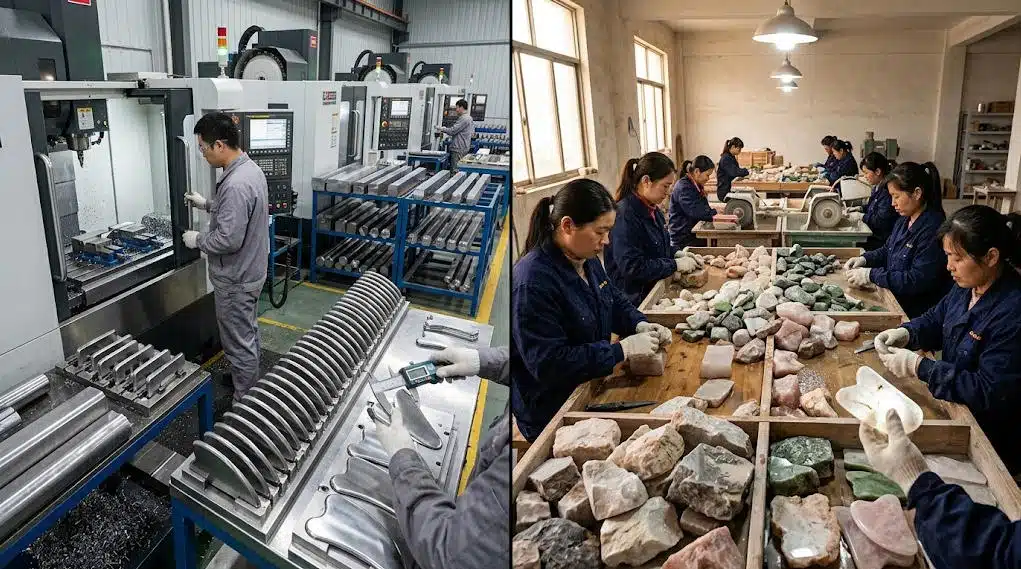
If you’re comparing quotes from a stainless steel gua sha manufacturer and a natural crystal supplier, you’re not comparing two versions of the same factory — you’re comparing two different manufacturing systems that happen to produce a similar-looking tool. A steel workshop can hold ±0.10mm across 5,000 pieces using CNC and stamping dies, while a stone gua sha manufacturer working the same order size might see color and clarity shift piece to piece, batch to batch, because the raw material itself was never designed to be identical. This single fact — engineered material versus natural material — decides almost everything else in your sourcing decision: your MOQ, your lead time, your quality control checklist, and how much room you should leave in your budget for rejects. Before you sign a purchase order with any gua sha factory — whether it’s a single sample run or a full gua sha wholesale shipment — it helps to understand which system you’re actually buying into, because the questions you should ask a metal workshop are not the questions you should ask a stone workshop.
- The Core Difference: What a Stainless Steel Gua Sha Manufacturer Builds vs. What a Stone Factory Selects
- Raw Material Is Where a Stainless Steel Gua Sha Manufacturer and a Quartz Guasha Manufacturer Part Ways
- Tolerance, Color, and Why a Stainless Steel Gua Sha Manufacturer Hits ±0.10mm When a Jade Gua Sha Manufacturer Can't
- Yield Rate and Cost: What Your Next Gua Sha Wholesale Order Will Actually Cost
- Compliance on Paper: What a Stainless Steel Gua Sha Manufacturer and a Stone Gua Sha Manufacturer Must Each Prove
- Customization Boundaries: Engineering Specs vs. Visual Standards
- Questions to Ask Before You Order from Any Gua Sha Factory
- Risk Disclosure: Why One Supplier Sells Both Products, and What Goes Wrong If You Assume a Stainless Steel Gua Sha Manufacturer Can Behave Like a Stone Factory
The Core Difference: What a Stainless Steel Gua Sha Manufacturer Builds vs. What a Stone Factory Selects
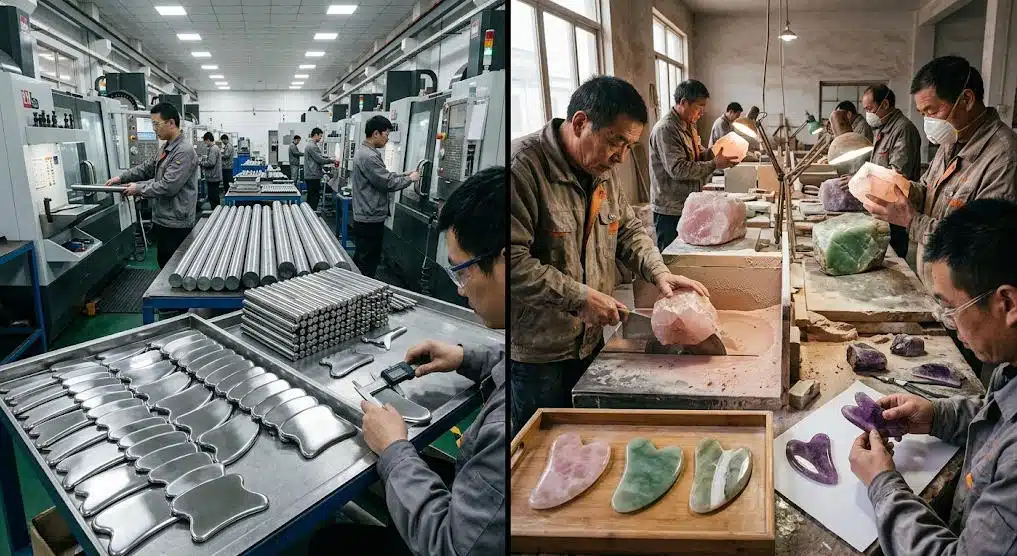
Look at a stainless steel gua sha board and a rose quartz gua sha board side by side, and they can appear nearly identical — same curve, same edge, same size. But walk into the two factories that made them, and you’d see almost nothing in common. A metal workshop runs what is essentially an engineering operation: 316L sheet or bar stock goes in, and CNC machining, stamping, laser cutting, and precision grinding turn it into an identical shape thousands of times over. A quartz guasha manufacturer or jade gua sha manufacturer runs a selection-and-shaping operation instead: rough rose quartz, jade, or amethyst comes in with its own color, its own internal fractures, its own density of inclusions, and the job is to cut around those variables until the finished piece looks close enough to an agreed reference sample. Neither approach is better than the other — they’re solving completely different problems. This means you should expect two different sets of trade-offs from the two supply chains, not two versions of the same trade-off dressed up in different marketing language.
Where the Cost Structure and Order Terms Split
Because a metal workshop buys a standardized input, its cost model is comparatively easy to build: material price per kilogram, machine-hour cost, and a yield rate that barely moves between batches. A stone workshop’s cost model has to absorb the price of rough material that was purchased before anyone knew exactly how much usable, gem-quality area was hiding inside it, so cost per finished piece can only be estimated once cutting and grading are already underway. Dimensional control follows the same split: stamping dies and CNC toolpaths keep steel parts inside a tight, repeatable band, while a crystal’s internal cracks and color zoning can force a cutter to change direction mid-cut and sacrifice material nobody planned to lose. Surface and material QC diverge too — steel inspection checks for burrs, scratches, and deformation against a fixed spec sheet, while stone inspection checks for fractures, color drift, and inclusions against a physical reference sample, because no spec sheet can fully describe a natural gemstone’s appearance. So what does this mean for you as a buyer? It means the same purchase order template does not work for both product types on a gua sha wholesale contract, and asking a stone supplier to quote like a steel supplier — or the reverse — sets up a conflict before production even starts.
Raw Material Is Where a Stainless Steel Gua Sha Manufacturer and a Quartz Guasha Manufacturer Part Ways
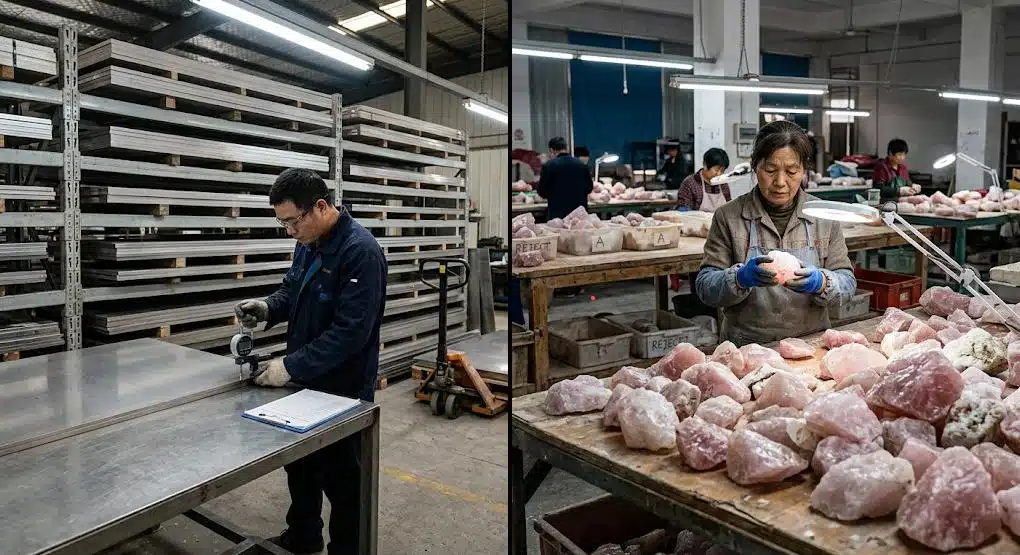
The single biggest driver of every downstream difference — tolerance, yield, QC, price — traces back to one decision made before either factory touches a tool: what raw material did they start with? Such a workshop typically works from certified 316L stock, an alloy whose chemical composition, hardness, and mechanical properties are already fixed by international specification before it ever reaches the workshop floor. According to the ASTM A240 specification, chromium-nickel stainless plate and sheet must meet defined chemistry and mechanical-property windows for each named grade, which is exactly why two coils of 316L bought a year apart still behave the same way under a stamping press. That predictability is what lets a metal workshop promise you the same product on order fifty that you approved on order one, whether that order is a single trial batch or a full gua sha wholesale shipment.
316L Steel vs. Natural Rose Quartz: Two Different Starting Points
A quartz guasha manufacturer starts from the opposite position. Even within a single variety like rose quartz, rough material can vary in tone, cloudiness, cotton-like inclusions, ice cracks, and color banding — differences the Gemological Institute of America documents as typical for this stone, since its pastel pink color and hazy translucence come from microscopic mineral inclusions that no two rough pieces share in exactly the same pattern. A jade gua sha manufacturer faces a similar reality with jade’s internal texture and natural color bands. This is not a processing flaw; it is the physical nature of a mineral that formed underground over geologic time rather than in a rolling mill. This means that when you order 1,000 pieces of rose quartz gua sha, you are not ordering 1,000 identical units — you are ordering 1,000 units cut from material a factory has pre-sorted to fall within a color and clarity range you agreed to in advance.
That sorting step is invisible on a spec sheet but consumes real time and real material inside any gua sha factory working with rough stone. A steel workshop’s process reads simply: stock in, stamp, grind, polish, inspect, ship. A stone workshop’s process reads: rough in, sort, cut, sort again, shape, inspect for cracks, polish, inspect again — because a flaw invisible at the rough stage can surface only after grinding removes several millimeters of material. Rejecting a piece late in that chain costs far more than rejecting bad steel stock early, which is one reason natural-material pricing carries a wider built-in buffer than metal pricing does. If a supplier quotes you a stone gua sha manufacturer‘s price with no allowance for this sorting loss, that number is either wrong, or it’s hiding the loss somewhere else in the contract.
Tolerance, Color, and Why a Stainless Steel Gua Sha Manufacturer Hits ±0.10mm When a Jade Gua Sha Manufacturer Can’t
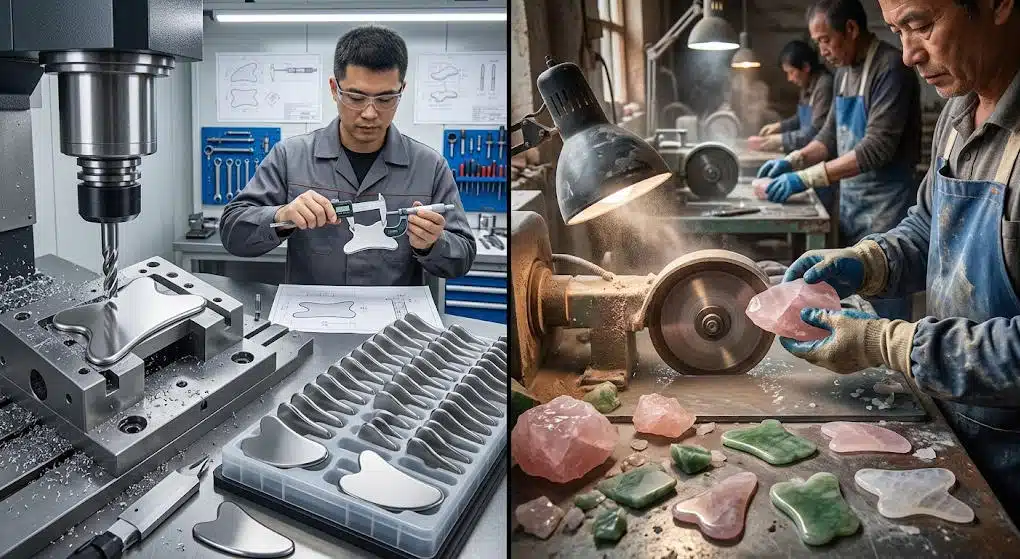
Ask a metal workshop to hold a 100 × 50 × 8mm board to ±0.10mm across a 5,000-piece order, and a competent operation will treat that as a normal spec, not a stretch goal. CNC toolpaths, stamping dies, and precision grinding wheels don’t get tired or distracted, and general machining tolerance frameworks like ISO 2768 exist precisely because this kind of repeatability is achievable and expected in metal fabrication. As long as tooling and cutting parameters stay constant, piece 4,999 should measure almost identically to piece 1. That predictability is exactly what lets a steel workshop quote a single tolerance figure on paper and mean it for the entire production run.
What Happens When a Crack Sits Inside the Rough Stone
A quartz guasha manufacturer or jade gua sha manufacturer, or any natural-stone workshop, cannot make the same promise, because the material itself sometimes refuses to cooperate. If a hidden fracture, void, or mineral inclusion sits exactly where the cutting line needs to go, the cutter has to reroute around it, shrink the usable dimensions, or discard that section of rough entirely — and no amount of operator skill changes the physics of where a crack happens to run through a stone. Color adds a second layer of difficulty: the same rose quartz variety can shift from near-white to medium-dark pink within a single mining lot, a range gemologists document under standard clarity and color grading frameworks used across the gem trade. So a stone factory isn’t just controlling a machine — it’s controlling a machine and negotiating with the rock at the same time. This means that when a supplier quotes a tolerance or color-match commitment for natural crystal, you should ask what percentage of rough gets rejected to hit that promise, because that rejection rate is quietly baked into your unit price whether it’s stated on the quote or not.
Buyers sometimes assume “natural” automatically means “less precise” across the board, but that’s not quite accurate either — a mature jade gua sha manufacturer or rose-quartz workshop can hold a tighter length-and-width tolerance than a poorly equipped metal shop running worn tooling. The real variable isn’t natural versus synthetic; it’s whether the raw material’s own physical limits, rather than the machine’s limits, set the ceiling on precision. Steel hits a ceiling set by the CNC spindle and the die. Stone hits a ceiling set by wherever the mineral decided to grow its cracks millions of years ago. Knowing which ceiling you’re actually up against tells you which tolerance number in a quote is realistic and which one is aspirational.
Yield Rate and Cost: What Your Next Gua Sha Wholesale Order Will Actually Cost
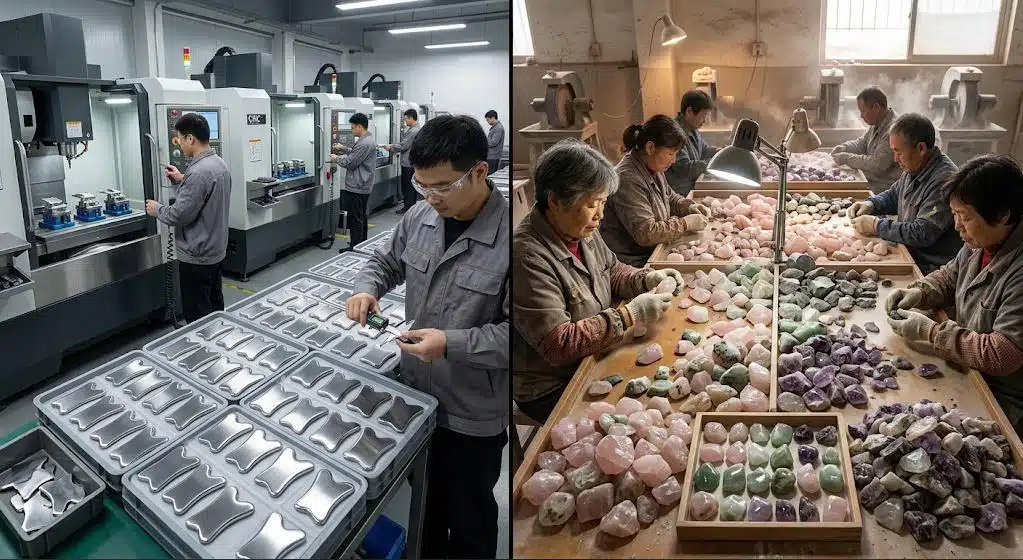
If you’re placing a gua sha wholesale order and comparing quotes, the number that matters more than the unit price is the yield rate behind it, because yield is what determines whether that unit price survives contact with a real production run. A steel workshop’s yield tends to sit in a narrow, repeatable band — commonly in the mid-90s percent range batch after batch — because rejects come from a small, controllable set of causes: scratches, deformation, or a stamping miss. That stability is exactly why a steel-focused gua sha factory can build a cost model today that still holds true on your fifth reorder eight months from now.
Why a Stainless Steel Gua Sha Manufacturer Ships Bulk Orders Faster Once Tooling Is Approved
Sample timing tells an almost backwards story compared to what most buyers expect. Such a manufacturer typically needs longer to deliver a first sample — often two weeks or more — because CNC programming, die-making, and surface-finish trials all have to happen before a single approved part exists. A stone workshop can often turn a sample around faster, sometimes within ten days, by hand-shaping an existing piece of rough that’s already close to spec. But that ranking flips once bulk production starts: the steel workshop’s engineering work is already paid for and repeatable, so a 5,000-piece run doesn’t take proportionally longer than a 500-piece run, while the stone workshop still has to source, sort, and grade enough qualifying rough material for every single unit in the order, and that sourcing step doesn’t get faster just because the order got bigger. This means that if your timeline is tight, you should ask which stage — sampling or bulk — is actually your bottleneck, because the answer is different for steel and stone, and a generic “lead time” number on a quote sheet usually hides which one you’re really waiting on.
This is also where a gua sha wholesale buyer’s price expectations need adjusting. A steel quote that looks flat across 500, 2,000, and 5,000 pieces isn’t a sales trick — it reflects a real production curve where fixed engineering costs get spread over more units. A stone quote that rises in cost-per-piece as the color-matching requirement gets stricter isn’t a markup either — it reflects a shrinking pool of rough that qualifies. If you push a stone gua sha manufacturer hard on an exact color match, expect the yield to drop and the price to rise together, because tightening the acceptance window necessarily throws out more rough that would otherwise have passed inspection.
Compliance on Paper: What a Stainless Steel Gua Sha Manufacturer and a Stone Gua Sha Manufacturer Must Each Prove
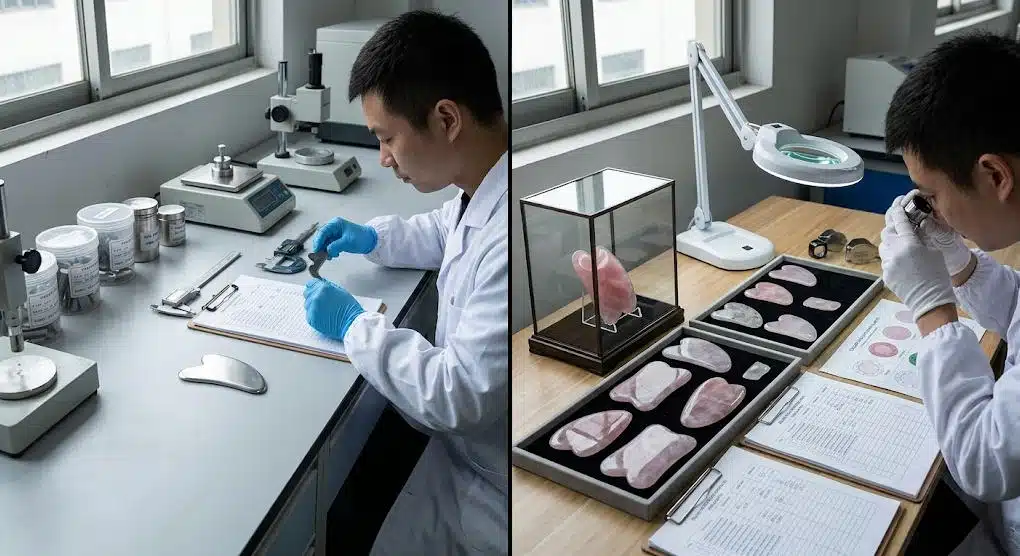
Compliance documentation is one area where you should never accept a verbal assurance, because the two product categories are regulated through completely different testing frameworks. A metal workshop selling into markets that enforce skin-contact rules needs to show nickel release results, not just a material grade name on an invoice. Under EU REACH regulation, Annex XVII entry 27 sets a migration limit of 0.5 micrograms per square centimeter per week for articles in prolonged skin contact, tested using the EN 1811 method. That’s not a marketing claim — it’s a specific, testable number a lab either confirms or doesn’t.
Nickel Release Testing and the 0.5 μg/cm²/Week Rule
So what does that number actually mean for your shipment? It means that if you’re selling into the EU, UK, or any market that references this standard, you need a dated lab report tied to the actual alloy batch in your order, not a generic certificate copied from a previous shipment. A mill test report confirming 316L chemistry under ASTM A240 is a useful starting point, but it isn’t the same document as a nickel release test — one confirms what the metal is, the other confirms what actually migrates off the surface during simulated wear. You should ask for both, and ask for the heat number that ties the report to your specific production batch, because a certificate that can’t be traced to your batch isn’t proof of anything.
How a Stone Gua Sha Manufacturer Documents Color, Clarity, and Batch Consistency
Stone compliance works on a different axis entirely for a quartz guasha manufacturer or jade workshop, since there’s no chemical migration limit for a piece of quartz or jade — the risk you actually face is receiving product that doesn’t match what you approved. This is where gemological reference standards matter even for a non-gem tool like a gua sha board: the same clarity and inclusion vocabulary that labs such as the Swiss Gemmological Institute SSEF use for colored stones — assessing transparency, inclusions, and color zoning — gives a stone gua sha manufacturer and a buyer a shared language for describing what “acceptable” looks like before production starts. A mature stone workshop translates that shared language into a Golden Sample and a written acceptance range, rather than leaving “good quality” undefined on the contract.
A Golden Sample — the single physical piece that both sides sign off on — becomes the real specification for a natural-material order in a way that no written color code ever could, since human eyes and a physical reference resolve disagreements that a written description cannot. This means that before you approve any stone production run, you should insist on a physical Golden Sample and a written note on how much a finished batch is allowed to drift from it, because “similar to the sample” and “within the agreed variation range of the sample” are two very different contracts.
Customization Boundaries: Engineering Specs vs. Visual Standards
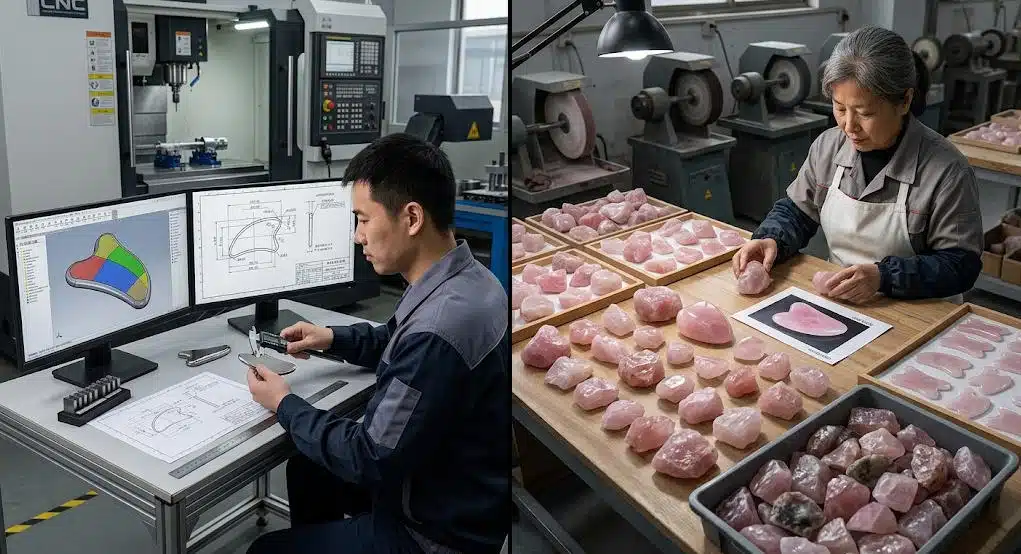
Customization requests split cleanly along the same steel-versus-stone line at any gua sha factory, and knowing which side your request falls on saves everyone a round of frustrated emails. A metal workshop can turn a request for a specific curve radius, wall thickness, laser-etched logo, or precise weight into a CAD file, a 2D drawing, and a stated tolerance — and once that drawing is approved, the part is essentially locked in. This is engineering customization: measurable, drawable, and repeatable once the tooling exists.
Why “Make It a Little More Pink” Is a Legitimate Production Instruction
Visual customization works through a different mechanism entirely, and dismissing it as vague actually misunderstands how natural-material sourcing works. Requests like wanting a piece more transparent, wanting less visible cotton, or wanting the color closer to a reference sample are completely reasonable asks — they just can’t be resolved with a CAD file alone. A capable quartz guasha manufacturer translates these requests into sourcing instructions: which rough batches to pull from, which grading bin a piece needs to sit in, and what the Golden Sample looks like once everyone agrees on it. This means the more specific your visual reference is — an actual photo or physical sample rather than a description like “nice pink” — the more accurately a factory can sort rough material to match it, and the fewer surprises you’ll see when the finished batch ships. Engineering customization gets more reliable the more precisely you specify numbers; visual customization gets more reliable the more precisely you pair those numbers with a physical reference.
There’s a practical implication buyers often miss: engineering customization on steel can usually be applied to a new order with no cost penalty, since the CAD file doesn’t degrade over time. Visual customization on stone effectively resets with every new sourcing cycle, because the rough lot that produced last quarter’s approved sample may already be gone by the time you reorder. If a supplier promises to match last year’s crystal color exactly on a fresh order, that promise is only as strong as their remaining inventory of the original rough — worth confirming directly rather than assuming it still holds.
Questions to Ask Before You Order from Any Gua Sha Factory
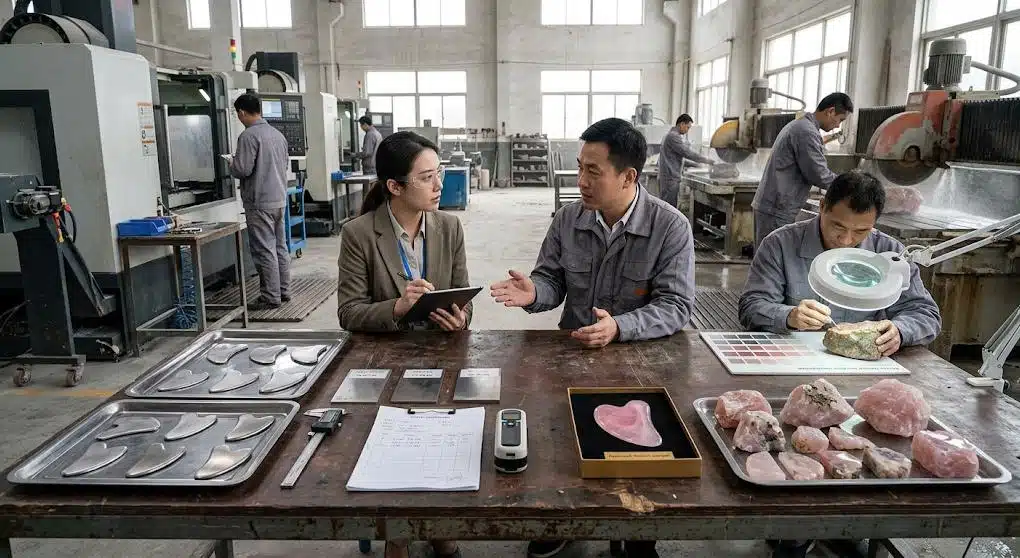
The single most useful habit you can build as a buyer is asking process questions instead of yes-or-no questions, since “do you manufacture this yourselves” tells you almost nothing about whether a gua sha factory can actually control quality on your order. A better opening question is simply: who performs each step, and what happens when that step produces a reject?
What to Ask a Stainless Steel Gua Sha Manufacturer vs. What to Ask a Stone Factory
For a metal order, the useful questions center on traceability and testing: which grade is it — 304, 316, or 316L — and can that be confirmed with a mill certificate tied to a heat number? What tolerance is being held, and under which standard? Has nickel release been tested under EN 1811, and can you see the dated report? How is surface consistency checked across a large run, and what’s the documented reject rate on comparable past orders? For an order placed with a jade gua sha manufacturer or quartz guasha manufacturer, the questions shift toward sourcing and grading: where does the rough material come from, and how is it pre-sorted before cutting begins? How is color variation controlled batch to batch, and how is a Golden Sample managed and updated? What percentage drift from that sample counts as acceptable before a batch gets rejected, and what does the documented yield rate look like on comparable orders? A supplier that answers with specifics — numbers, standards, sample photos — is telling you something a generic “yes, we can do it” never will.
Notice that none of these questions ask whether the same gua sha factory owns every machine involved. That’s deliberate, because ownership isn’t actually the variable that determines whether your order arrives correctly — process control is. A supplier who can answer specifically for both a metal workshop’s testing protocol and a stone workshop’s grading protocol, even when two different production floors are involved, is demonstrating more real capability than one who claims to personally run every machine but can’t produce a single test report or Golden Sample record on request. Push for documents, not declarations, and you’ll filter out most of the sourcing risk before a single unit ships.
Risk Disclosure: Why One Supplier Sells Both Products, and What Goes Wrong If You Assume a Stainless Steel Gua Sha Manufacturer Can Behave Like a Stone Factory
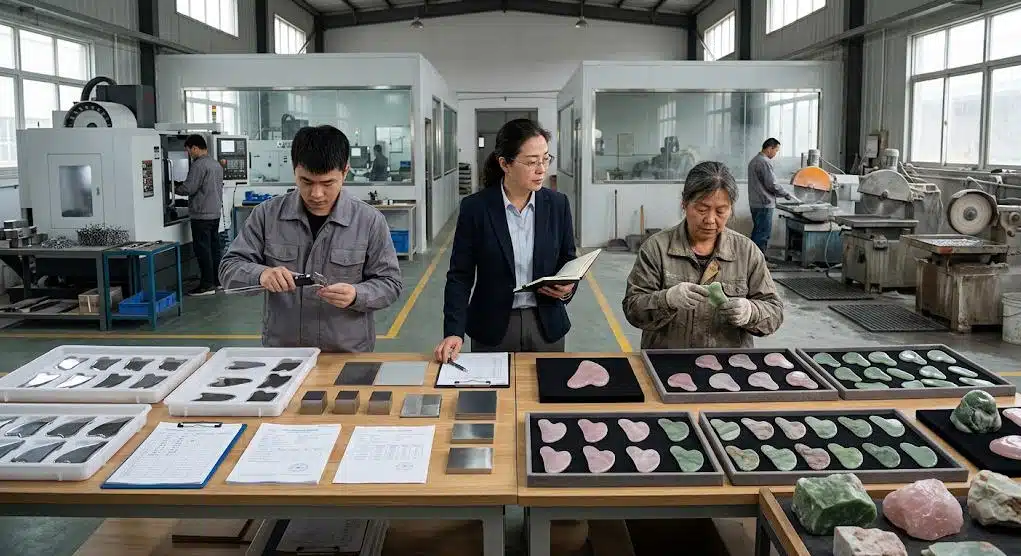
Here’s something worth disclosing plainly, since it changes how you should read every supplier’s product catalog: a business that lists both stainless steel and natural crystal gua sha tools is not necessarily overstating its capability just because it isn’t itself a complete gua sha factory for both material types. Building a full metal-fabrication line and a full stone-cutting line under one roof means carrying two sets of fixed assets, two sets of specialized labor, two inventory systems, and two separate QC disciplines — a cost structure that rarely makes economic sense for a mid-sized gua sha business, even when it’s technically achievable for a very large one. In our own experience coordinating orders across both material categories, the workshops that try to do everything in-house are rarely the ones with the tightest quality control on either product line.
Supplier Is Not the Same Word as Factory
A far more common — and, frankly, more efficient — structure is specialization plus partnership: a stone gua sha manufacturer with deep expertise in natural stone sourcing, cutting, and grading partners with a dedicated jade gua sha manufacturer or metal workshop to fulfill the portion of an order outside its core skill. When you place an order for 1,000 stone pieces and 1,000 steel pieces with a single point of contact, that contact may be coordinating two specialized production floors rather than personally running both — and that’s a supply-chain structure, not a shortfall in capability. This means the right due-diligence question isn’t “do you own every machine,” but “do you control quality and take responsibility across the whole order,” because that’s the commitment that actually protects your purchase order.
The Real Cost of Assuming Natural Material Behaves Like Engineered Material
The actual risk in this category of sourcing doesn’t come from supply-chain specialization — it comes from buyers and suppliers who blur the line between the two manufacturing logics instead of naming it clearly. A buyer who expects natural-crystal batch-to-batch consistency equal to CNC-machined steel is setting up a dispute before production even starts, because no amount of skilled sorting eliminates the physical variation inherent in mined rock. Equally, a buyer who accepts a stone-level color tolerance on a precision steel component risks receiving a part that doesn’t fit its intended assembly. So what should you actually do with this disclosure? Put the acceptance criteria in writing for each material category separately, request the specific documents named earlier in this article — mill certificates, nickel release reports, Golden Samples, written drift tolerances — and treat a supplier’s willingness to produce those documents, not their factory floor space, as the real signal of how much manufacturing risk you’re taking on.
None of this makes one manufacturing system better than the other — a stainless steel gua sha manufacturer and a stone workshop are simply solving different problems with different materials, and your job as a buyer is to match your expectations, your contract language, and your quality checklist to whichever system is actually producing your order. Ask for the right documents, request a physical Golden Sample for anything made from natural stone, and confirm nickel release and material certification for anything made from metal. Do that consistently, and the biggest sourcing risks in this category — mismatched expectations and undocumented claims — mostly disappear before your first gua sha wholesale shipment ever leaves the factory floor.