
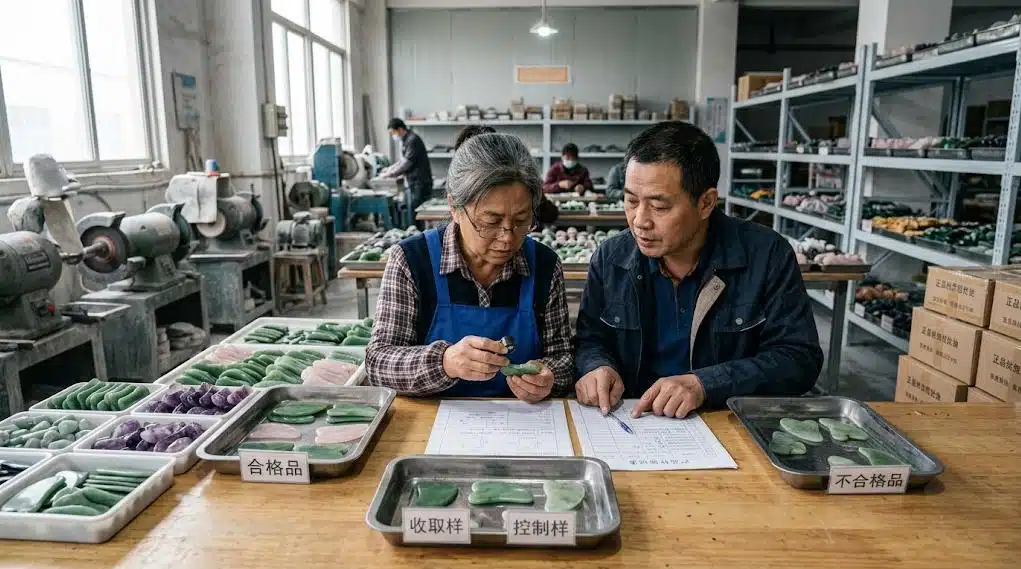
A gua sha manufacturer should offer you one of four written remedies when a batch goes wrong: refund-only, current-order replacement, return and refund, or next-order replacement. Take a 500-piece order with 20 confirmed defects at $4 per piece, and the refund comes to $80, not the full $2,000 invoice. A clear guasha after sale process also puts a clock on the case, with receipt confirmed within 2 working days and a first investigation result within 5 working days after your documents are complete.
This guide shows you how each option works, who pays in each case, and what to write into your purchase order before a gua sha manufacturer starts production. The numbers come from more than 12 years of jade and crystal gua sha production at Deyi Gems, so treat them as working examples rather than legal conclusions. If you buy gua sha wholesale, a few minutes spent on these rules can save you weeks of back-and-forth later.
- Four Remedies a Gua Sha Manufacturer Can Offer After Your Order Arrives
- Who Pays When Gua Sha Arrive Damaged? How a Gua Sha Manufacturer Assigns Responsibility
- How a Gua Sha Manufacturer Investigates a Claim: Four Steps You Can Follow
- Natural Crystal and Jade Variation: What a Gua Sha Manufacturer Can and Cannot Call a Defect
- Claim Process and Cost: How a Gua Sha Manufacturer Closes a Case in Six Steps
- Preventing Disputes: A Gua Sha Manufacturer's Risk Disclosure Checklist
- FAQs About Guasha After Sale and Your Gua Sha Manufacturer
Four Remedies a Gua Sha Manufacturer Can Offer After Your Order Arrives

Most after-sales disputes start because nobody agreed on the remedy before the shipment left the dock. A gua sha manufacturer that works from a written menu of options spares both sides from improvising under pressure. In a typical gua sha wholesale order, four remedies cover nearly every case, and each one fits a different mix of defect count, urgency and shipping cost. Pick the wrong one and you pay for it in money or in lost selling time.
Refund-Only: How a Gua Sha Manufacturer Settles Partial Damage
Refund-only fits the case where some pieces are unusable and shipping them back would cost more than the pieces are worth. The refund follows one formula: confirmed damaged quantity multiplied by the agreed refund unit price. If 20 pieces out of 500 fail because of a manufacturing defect and you agreed on $4 per piece, you receive $80 and keep selling the other 480. Compare that with a $2,000 full-invoice refund and you can see why partial settlement protects both your cash flow and the relationship.
Watch the unit price, though. A gua sha manufacturer may set the refund price below the original purchase price when a piece is only partly damaged and still sells at a discount. Spell out whether freight, tax and duties sit inside or outside the refund, so the same loss never gets counted twice. This means you can close a small claim in a single email thread, without paying return freight on pieces worth a few dollars.
Current-Order Replacement From a Gua Sha Factory
Replacement works best when the defect is clear and you still need the units on your shelf. Typical triggers include a confirmed manufacturing defect, a missing carton, a wrong item or a shortage found after transport. If 30 pieces in a 1,000-piece order are confirmed defective, the gua sha factory ships 30 replacements once both sides sign off on the count. Before anything ships, confirm the size, color, packaging and delivery date, and name who pays reshipping freight and import duty. This means you can restore your stock within one shipping cycle instead of waiting for a refund to clear.
Return and Refund: When Will a Gua Sha Manufacturer Take Goods Back?
Return and refund is reserved for serious problems: the batch is far off the agreed specification, or sorting and rework cannot fix it. Your request alone does not oblige a gua sha manufacturer to accept the whole shipment back, because the contract, applicable law and the scale of the problem decide the scope. Agree in writing whether only the faulty pieces or the entire lot returns, who pays freight, insurance and customs, and how returned goods will be inspected. Trade terms such as the ICC Incoterms 2020 rules define where cost and risk shift between seller and buyer, so name the one your contract uses. This means you can avoid a return bill that outweighs the claim itself.
Next-Order Replacement and the Guasha After Sale Clock
Next-order replacement suits small defect counts, a steady buying relationship and no rush. The gua sha manufacturer ships the agreed number of free pieces with your next purchase, so you share one freight charge instead of paying for two. A guasha after sale promise with no expiry date becomes a liability, so record the quantity, the specification, the freight payer and a deadline for what happens if you never reorder. Nobody should make you wait for your next purchase when the fault is the supplier’s and you need stock today. This means you can ask for a written end date and refuse an open-ended promise.
Who Pays When Gua Sha Arrive Damaged? How a Gua Sha Manufacturer Assigns Responsibility

Responsibility should follow the contract and the evidence, not the loudest email. A single photo rarely proves who caused a problem, and a blanket “it’s natural stone” excuse rarely holds up either. A fair gua sha manufacturer fixes the agreed standard first, finds the step where the damage happened, and then splits the cost by proof. Here is how that plays out in the cases you will meet most often.
Size, Thickness and Polish: Defects a Gua Sha Manufacturer Usually Owns
When a board exceeds the agreed thickness tolerance, or its polish falls short of the approved sample, the investigation starts at the gua sha factory. Measured dimensions, final inspection records and production batch notes decide the outcome. Natural material is no excuse for wrong dimensions, because dimensions come from machining, not from the stone. A gua sha manufacturer that keeps these records can often close such claims in days, not weeks. This means you can expect a fact-based answer on size and finish complaints instead of an argument about opinions.
Transit Breakage in a Gua Sha Wholesale Shipment: Who Pays?
Cracked corners found after sea or air freight follow a different path. Under FOB, risk passes to you once the goods are on board the vessel, while under DAP the seller carries it until the goods are ready for unloading at the named destination. Your contract’s trade term, defined in the ICC Incoterms 2020 rules, therefore tells you where to look first. After that, the carrier’s records, outer carton photos, inner packing photos and your insurance policy decide who pays. Do not assume the carrier will reimburse you automatically, because claim deadlines and insurance conditions apply to every gua sha wholesale shipment. This means you can protect a carrier claim by photographing every carton before you open it and keeping the packaging until the case closes.
Buyer-Side Causes: Misuse and Unapproved Changes
A gua sha manufacturer cannot carry the cost of use outside the instructions, or of specifications that never appeared in your order. If you change the color, size or packaging after the sample was approved, the party who asked for the change normally pays the added cost. The supplier may still offer paid rework or a paid replacement, but that is a commercial deal and not an admission of a defect. This means you can get help on a changed requirement without paying for a quality fault that never existed.
Why One Photo Never Settles a Guasha After Sale Case
The proof you bring decides how fast your claim moves. Under Article 39 of the UN Convention on Contracts for the International Sale of Goods, a buyer generally has to notify the seller of a non-conformity within a reasonable time, and no later than two years after the goods were handed over, unless the contract sets a different warranty period. Whether that treaty applies depends on the countries involved and on your contract, so check yours rather than assume. A solid guasha after sale file holds a full-batch photo, close-ups of each defect, a piece count and the carton photos. This means you can submit once, get a first result within the 5-working-day window, and skip several rounds of requests for more evidence.
How a Gua Sha Manufacturer Investigates a Claim: Four Steps You Can Follow

A claim that gets investigated in the same order every time gets settled faster. A gua sha manufacturer with a fixed routine does not need to guess, argue or stall, and you can see exactly where your case stands. The routine has four steps, and you can prepare for each one before you write to your supplier. Skip a step and you invite delays that cost both sides money.
Step 1: How a Gua Sha Manufacturer Checks the Agreed Standard
Every investigation starts with paper, not with the product. The supplier opens your purchase order, the technical specification, the approved sample and any written packaging or finish requirements. A gua sha manufacturer cannot fairly reject a piece for a trait that was never agreed, and you cannot fairly claim for one either. A tolerance that appears only in a chat message after production is a weak basis for any claim. This means you can win or lose a case on one clear line in the order, so write your standards down before you pay the deposit.
Step 2: Collect Your Evidence in One Package
Send a full-batch photo, a close-up of each defect, a count by defect type, and photos of the outer carton and inner packing. Add video, caliper readings or a sampling record when the claim involves size or surface finish. In a gua sha wholesale order with thousands of pieces, sort the goods by defect type first, then draw a sample with a recognized scheme such as ISO 2859-1 acceptance sampling. Ask the gua sha manufacturer to list every missing item in a single message, so you never answer five separate requests. This means you can document, for example, 40 defects in 2,000 pieces through a sample instead of unpacking every carton.
Step 3: Trace Where the Defect Began at the Gua Sha Factory
Next, the gua sha factory compares your photos with its final inspection records, production batch numbers, packing records and shipping documents. The goal is to name the stage where the problem started: raw material, machining, inspection, packing, transit, or handling after arrival. Do not assume the number you found is the number that counts. If 30 defective pieces point to a process deviation, a responsible gua sha manufacturer widens the check to the rest of the batch instead of stopping at 30. This means you can trust a result that covers the whole lot, not just the cartons you happened to open.
Step 4: Three Written Outcomes for a Guasha After Sale Case
Every guasha after sale case should end in one of three written conclusions: the manufacturer is responsible, another party is responsible, or the evidence is not enough yet. The third outcome is not a refusal, because it means more checking, and a gua sha manufacturer should not promise a refund or a replacement before that checking is done. A workable service pace is 2 working days to confirm receipt and 5 working days to deliver a first finding once your file is complete, with a notice if a complex case needs longer. Those windows are internal service standards, not legal deadlines. This means you can plan your own customer promises around a known schedule instead of waiting for an answer.
Natural Crystal and Jade Variation: What a Gua Sha Manufacturer Can and Cannot Call a Defect

Natural stone makes every piece a little different, and that fact causes more arguments than any other topic in this business. A gua sha manufacturer who answers every complaint with “it’s natural” is dodging, and a buyer who calls every pattern a flaw is stretching. The fair line sits where the approved sample and your written standards end. Here is where that line falls for color, cracks, size and polish.
Color and Texture: When Is a Gua Sha Manufacturer Not Liable?
Take rose quartz. GIA’s rose quartz buyer’s guide describes microscopic inclusions that make the stone hazy and color zoning that shows up from piece to piece, while the International Gem Society photo gallery displays how far shade and translucence vary inside the same variety. Jade works the same way, and GIA’s jade quality factors lists color, texture and transparency as separate variables a buyer has to weigh. If you approved a sample and the delivered boards sit inside the agreed range of shade and pattern, a gua sha manufacturer normally carries no liability for the difference. Disputes start when that range was never written down. This means you can avoid a color claim altogether by approving a sealed sample and a written shade range before mass production begins.
Cracks in Natural Stone: Raw Material, Machining or Shipping?
A crack is not automatically the stone’s fault, and it is not automatically the factory’s either. Internal fractures in raw material, damage from cutting or grinding, and impact during transit leave different marks. Natural risk does not excuse the gua sha factory from every crack, since a gua sha manufacturer controls machining and final inspection. Quartz rates 7 on the Mohs scale, yet it still chips when a loaded carton drops, because hardness is not the same as toughness. Check where the crack sits, how the edge looks and whether the carton shows impact; these clues point to a cause but do not prove one. This means you can sort a raw-material fault from a transit hit before you file, using the crack location and your packaging photos.
Thickness and Polish: Where Natural Stone Gives No Excuse
Natural stone changes a pattern, not a measurement. If boards come out thicker or thinner than the tolerance in your order, compare caliper readings with the production record. Weak polish or visible machining marks call for a review of the polishing step and the final inspection log against the approved sample. For a new shape, ask for packing and drop-test records, which show whether the carton gave enough protection. This means you can hold a supplier to the numbers in your order while still accepting that no two stones share a pattern.
Treatments and Reports: What a Gua Sha Wholesale Buyer Should Ask For
Disclosure is the compliance side of natural stone. GIA’s jade buyer’s guide states that jade can be dyed, bleached, heated, waxed and impregnated, and the trade labels A, B and C describe treatment status rather than grade. A trade article in Jewellery Business names FTIR spectrometry as the most reliable way to detect enhancement and advises buyers to require gemmological reports from suppliers, and SSEF explains the science behind treatment testing in its Introduction to Jade course. Before you place a gua sha wholesale order, ask the gua sha manufacturer in writing whether the material is untreated, waxed, dyed or otherwise enhanced, and request a lab report when value depends on the answer. Then copy that wording into your product page and check the disclosure rules in each market you sell to. A guasha after sale dispute over an undisclosed treatment is much harder to settle than one over a chipped corner. This means you can sell with a paper trail that backs every material claim you make.
Claim Process and Cost: How a Gua Sha Manufacturer Closes a Case in Six Steps

Cost is where after-sales talk gets real. A gua sha manufacturer that works from six fixed steps and a few formulas lets you predict what a claim will cost before you place the order. The sections below walk through the steps, then run the numbers on a 500-piece order so you can compare each remedy side by side.
What Your Gua Sha Manufacturer Needs From You in the First Request
Your request starts the clock. Send the order number, product model and batch, the date you received the goods and the date you spotted the problem, the number of defective pieces against the whole order, photos or video, a short note on how the problem affects use or sale, and the remedy you prefer. For transit damage, add photos of the outer carton, the inner packing and the broken pieces, and keep the packaging. A gua sha manufacturer that receives all of this in one message can usually log a case number and confirm receipt within 2 working days. Incomplete files stall because each missing item triggers another round of emails. This means you can save days by filling in a request form before you write, instead of answering questions one at a time.
How the Case Moves From Review to a Written Offer
After receipt, the supplier checks your order standard, your evidence and its batch records, then states the finding in writing. That reply should name what was confirmed, who is responsible and why, which remedy applies, how the refund or replacement number was calculated, who pays freight, and when the work will be done. In the example service standard, the first finding arrives within 5 working days of a complete file, and a complex case may take longer if you are told why. Both sides then confirm the chosen remedy in writing, the money or goods move, and the result is recorded. A guasha after sale case closes only when the refund lands, the replacement arrives, the return is complete, or both sides sign another solution. This means you can mark a claim as finished by a document instead of a verbal promise.
Cost Comparison: Four Remedies on One 500-Piece Order
Run the numbers on the earlier example: 500 pieces at $4 each make a $2,000 order, and 20 confirmed defects mean a 4% defect rate. Refund-only pays $80, which is 4% of the order value, with no freight at all. Now assume, for illustration, that you resell each piece at $12. Replacement of the 20 defective pieces puts $240 of sellable stock back on your shelf, so it is worth $160 more to you than the $80 refund, provided you can sell the units. Returning the full lot would refund $2,000 but remove 480 sellable pieces worth $5,760 at that resale price, which is why return and refund suits only serious, unfixable problems. In gua sha wholesale buying, next-order replacement adds one more saving, because the 20 pieces ride with a shipment you were sending anyway. This means you can pick the remedy that protects your margin, not just the one that returns the most cash.
Formulas a Gua Sha Factory Uses for Refunds and Replacements
Two formulas cover most cases. Refund equals confirmed damaged quantity multiplied by the agreed refund unit price, so 20 pieces at $4 give $80. Replacement quantity equals the defective quantity both sides confirm, so 30 confirmed defects in a 1,000-piece order mean 30 replacement pieces. A gua sha factory should also ask whether the defect points to a process deviation, because a 3% rate on a 10,000-piece batch could mean about 300 faulty pieces, not the 30 you found first. State whether freight, tax and duty sit inside or outside the amount, so one loss is never paid twice. This means you can check any offer with a calculator in two minutes and ask for corrections before you sign.
Preventing Disputes: A Gua Sha Manufacturer’s Risk Disclosure Checklist

The cheapest claim is the one that never happens. Every rule in this guide works better when it is agreed before production, not after the cartons arrive. A gua sha manufacturer that discloses its risks openly gives you the chance to price them, test them or reject them early. Use the checklist below before your next order.
Write the Acceptance Standard Into the Purchase Order
Put five items in writing: the dimensions with a tolerance, the approved sample, the surface finish, the packaging method, and the accepted range of natural color and pattern. Add a claim window that states when the clock starts and how long you have to report problems, and say how hidden defects found later will be handled. Without these lines, every complaint turns into a debate about opinions. With them, 20 defective pieces in a 500-piece order become a quick calculation of $80, not a negotiation. Ask the gua sha manufacturer to confirm all five items in the quote. This means you can settle most claims by pointing to a clause instead of arguing about what each side meant.
Records a Gua Sha Manufacturer Should Keep for You
Ask your supplier to keep a sealed sample, batch-by-batch inspection results, notes on natural variation, and photos of the goods and packing before shipment. For a new shape, request a transport test record, since it shows whether the carton protects the board. The ISO 9001 quality management standard describes a framework for consistently meeting customer and regulatory requirements and for improving processes, so a gua sha manufacturer that follows it should be able to show records on request. Certification does not guarantee a defect-free batch, so treat it as a sign of discipline and not as a promise. This means you can ask for the exact file behind any claim and expect an answer in days, not weeks.
Compliance Notes for Gua Sha Wholesale Buyers
Compliance depends on the material and on the market where you sell. For natural stone, the main duty is accurate disclosure of treatments such as dyeing, wax or resin, as covered earlier. For stainless steel tools, European buyers should read entry 27 of REACH Annex XVII, which limits nickel release to 0.5 µg/cm² per week for articles in direct and prolonged skin contact; the ECHA conditions of restriction set out the details. Whether a particular gua sha tool counts as an article in prolonged contact depends on its intended use and on the authority’s view, so ask a testing laboratory before you assume either way. Treat the 2-day and 5-day response windows as supplier service standards, not legal deadlines, and confirm with a lawyer which law governs your contract. This means you can avoid a compliance surprise at customs by asking the gua sha manufacturer for test evidence before your first gua sha wholesale shipment leaves.
How a Gua Sha Factory Turns Repeat Claims Into Fixes
A gua sha factory should track four repeat problems: thickness deviation, polish defects, cracks in natural stone and transit breakage. For each one, it records the batch, the confirmed cause and the change made, such as a recalibrated grinder, an added polish check or thicker inner packing. A guasha after sale record that nobody reviews teaches nothing, but one reviewed after each closed case lowers the claim rate on the next order. If you reorder often, ask for a short summary of these actions once a quarter. This means you can see whether your supplier fixes causes or only pays for symptoms.
Your Next Step Before the Next Order
Send your supplier a draft of the five order lines, the four remedies and the three-outcome rule before you pay the deposit. Prepare a claim form with the order number, model, defect and total quantity, dates, evidence and preferred remedy, and mark it urgent only when your sales or delivery are at risk. A gua sha manufacturer that answers these points clearly is telling you how it will behave when something breaks. Deyi Gems has produced jade and crystal gua sha tools for more than 12 years, and you can request its written guasha after sale terms with your next quote. Ask the gua sha factory to confirm each point, compare the answers with this guide, and your gua sha wholesale decision will rest on facts instead of hope.
FAQs About Guasha After Sale and Your Gua Sha Manufacturer
1. What Does a Gua Sha Manufacturer Do When Your Pieces Arrive Defective?
A gua sha manufacturer should confirm receipt, compare your evidence with the order standard, and offer one of four remedies: refund-only, current-order replacement, return and refund, or next-order replacement. The right choice depends on how many pieces failed and how soon you need stock. This means you can expect a written offer with numbers, not a verbal promise.
2. How Much Is the Refund if 20 of 500 Gua Sha Are Defective?
At $4 per piece, the refund is 20 × $4 = $80, not the full $2,000 invoice. The formula is confirmed damaged quantity multiplied by the agreed refund unit price. Check whether freight and duties sit inside the amount, so the same loss is never paid twice.
3. How Do You File a Guasha After Sale Claim?
Send the order number, model and batch, the receiving and discovery dates, the defect count against the total, photos or video, and your preferred remedy in one message. A complete guasha after sale file lets the gua sha factory log the case and confirm receipt within 2 working days, with a first finding within 5 working days. This means you can avoid several rounds of emails by sending everything at once.
4. Is Natural Color Variation a Defect Under a Gua Sha Manufacturer’s Terms?
Usually not, when the pieces sit inside the shade and pattern range you approved on the sample. A gua sha manufacturer cannot fairly treat natural variation as a defect, and you cannot fairly claim it as one, unless the range was never agreed. Thickness, size and polish are different, because they come from machining, not from the stone. This means you can prevent a color dispute by approving a sealed sample before production starts.
5. Who Pays for Transit Breakage in a Gua Sha Wholesale Order?
The answer depends on your trade term and your evidence. Under FOB, risk passes to you once the goods are on board the vessel, while under DAP the seller carries it until the goods are ready for unloading at the named place. In a gua sha wholesale shipment, carrier records, carton photos and your insurance policy then decide the claim, and the carrier does not pay automatically. Photograph every carton before you open it.
6. Can a Gua Sha Manufacturer Make You Wait for Next-Order Replacement?
No, not when the defect is the supplier’s fault and you need stock now. A gua sha manufacturer can offer next-order replacement for small defect counts and steady buyers, but the offer needs a written quantity, specification, freight payer and expiry date. Without an expiry date, the promise becomes an open-ended liability for both sides.
7. What Records Should a Gua Sha Manufacturer Keep for You?
Ask for a sealed sample, batch inspection results, natural variation notes, pre-shipment photos of goods and packing, and a transport test record for new shapes. With these files, a gua sha manufacturer can trace a defect to raw material, machining, inspection, packing or transit. This means you can request the exact file behind any claim and get a fact-based answer.