
If you are sourcing natural gua sha wholesale orders, one number should change how you read every quotation: Mohs 3. That is roughly the hardness of calcite marble, the material often sold as Afghan White Jade, while true nephrite sits at 6–6.5 according to GIA. A second number matters just as much. Two stones quoted at RMB 100 per kg end up costing RMB 105 and RMB 133 per kg of sellable output when yield is 95% and 75%, a 27% gap that never appears on a price list.
This risk disclosure draws on more than 12 years of processing jade and crystal tools at Yan Cheng, a gua sha manufacturer that cuts, polishes and inspects stone every day. It shows where material names mislead you, where hardness fails as a quality test, and what to write into a contract so your margin and your brand stay protected.
- Is the Stone Really What the Label Says? Material Risk in Natural Gua Sha Wholesale
- Does Higher Hardness Mean Better Gua Sha Quality? Mohs Scale vs. Toughness
- What Does a Qualified Piece Really Cost in Natural Gua Sha Wholesale? Yield, Loss and ROI
- How Does a Stone Gua Sha Factory Control Quality in Three Stages?
- How Do You Keep Batch Consistency From Sample to Bulk Order?
- What Should You Ask Before Placing a Natural Gua Sha Wholesale Order? Questions and Compliance Documents
- Which Five Mistakes Cost Buyers the Most in Natural Gua Sha Wholesale?
- Which Stone Is Worth Buying? Final Recommendation for Natural Gua Sha Wholesale Programs
Is the Stone Really What the Label Says? Material Risk in Natural Gua Sha Wholesale

Material identity is the first risk you face, and it costs the most when it goes wrong. In natural gua sha wholesale, a single product name can cover three different minerals with three different prices and three different breakage profiles. So ask your gua sha supplier what the stone is before you ask what it costs.
How Afghan White Jade Turned Into a Marble Problem
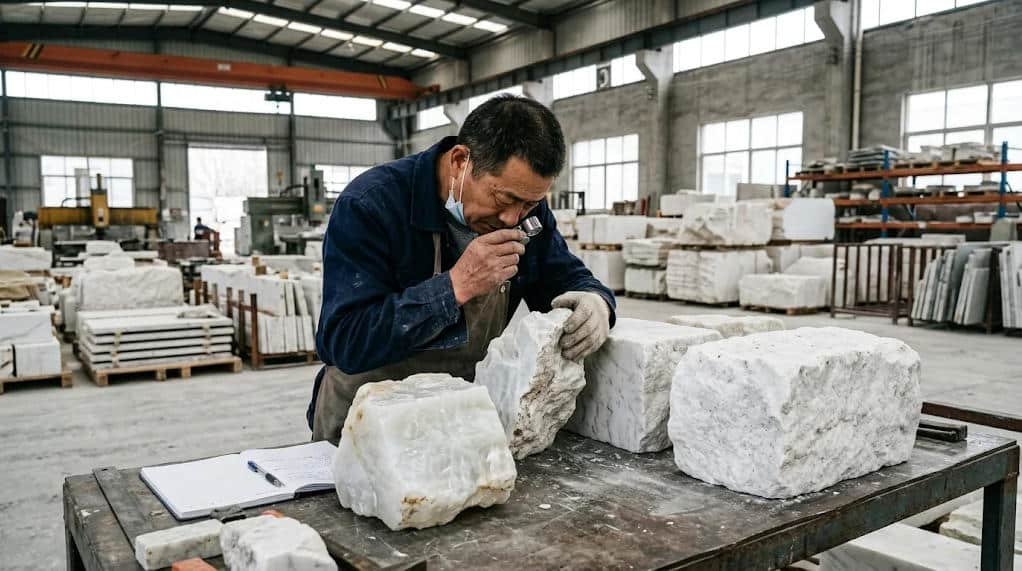
Trade names describe color, not mineralogy. In natural gua sha wholesale listings, White Jade can be nephrite, quartzite or marble, Green Jade is frequently serpentine, and Purple Stone may be a dyed or naturally purple marble. Afghan White Jade is commonly calcite-based marble rather than nephrite, so the name alone proves nothing.
The hardness gap is large. Calcite sits near Mohs 3, serpentine ranges from roughly 2.5 to 5.5 depending on its composition, and nephrite holds 6–6.5. The International Gem Society notes in its hardness and wearability lesson that gems softer than quartz scratch from everyday dust, and marble sits far below that line. This means you can expect a marble blade to dull and show scratches under normal handling, which is where complaints about worn finishes tend to start.
How to Verify Stone Material Before Your Natural Gua Sha Wholesale Contract
You do not need a laboratory for every order, but you do need a paper trail. Before you approve a deposit on a natural gua sha wholesale order, work through four steps:
- Ask for the mineral name in writing, such as “Nephrite”, not “White Jade”.
- Request photos of the raw blocks together with the batch number.
- Send disputed samples for refractive index, Raman or infrared testing.
- Copy the mineral name and the test method into your purchase order.
Gemological laboratories including GIA and SSEF issue jade identification reports that name the species and flag treatment. A report costs far less than a rejected container, and a gua sha manufacturer that welcomes the test is telling you something useful. This means you can hold the contract to a mineral definition instead of a color.
Natural or Treated? Dye, Filler and Skin-Contact Risks
GIA points out on its jade care page that jade may be dyed, bleached, impregnated, coated or heat treated. A gua sha tool touches skin every day, so an unknown filler or leftover polishing compound is more than a cosmetic issue. Have you asked your gua sha supplier in writing whether the stone is natural or treated?
Request a one-line declaration for each batch that says “untreated” or names the exact treatment used. Check surface cleanliness on arrival too, because oil and polishing residue show up as a greasy film on the stone. This means you can reject a shipment on documented grounds, and it protects the gua sha quality your customers judge the moment they pick the tool up.
Does Higher Hardness Mean Better Gua Sha Quality? Mohs Scale vs. Toughness

Hardness is the number buyers quote most often and understand least. The Mohs scale ranks resistance to scratching, while breakage depends on internal structure, thickness and flaws. Most natural gua sha wholesale inquiries open with a hardness question, yet hardness gives you only half the answer.
Why a Mohs 7 Rose Quartz Gua Sha Can Still Snap
The International Gem Society lists rose quartz at Mohs 7 with no cleavage and a conchoidal fracture, which means it breaks in curved, glassy chips once stress exceeds its limit. Add one hairline fissure inside the block, a thin edge or a deep groove, and the tool can snap in a customer’s hand. A stone gua sha factory sees this most often at thin edges, notches and curve transitions, because stress concentrates exactly there. This means you can ask for fissure checks and minimum thickness values instead of relying on a hardness figure.
Nephrite behaves differently. GIA’s Gems & Gemology describes a fibrous, interlocking felted structure that gives nephrite the toughness so important to jade, and the GIA buyer’s guide states that nephrite and jadeite are both very resistant to breaking or chipping. That holds even though nephrite measures only 6–6.5 on the Mohs scale. For a natural gua sha wholesale line with slimmer blades and finer detail, this means you can choose nephrite where a quartz blade would need extra thickness.
Which Stone Fits Which Natural Gua Sha Wholesale Tier?
Match the stone to your price tier and design thickness before you compare quotes. The table below summarizes where each material usually fits.
| Stone | Mohs (reference) | Best fit | Watch for |
|---|---|---|---|
| Rose quartz | 7 | Volume orders, private label | Internal fissures, batch color shift |
| Amethyst | 7 | Purple series | Color banding, cutting yield |
| Nephrite | 6–6.5 | Upper-tier jade line | Authenticity, rough grade |
| Serpentine | about 2.5–5.5 | Budget green line | Wide range between lots |
| Marble | about 3 | Low-cost decorative items | Scratches, edge chipping |
A natural gua sha wholesale program built on rose quartz suits high-volume private label, while nephrite fits a collection where breakage claims would hurt the brand. Serpentine and marble can work for budget lines, but only if you accept softer surfaces and tighten edge inspection. Tell your gua sha supplier the thickness and use case up front, and a stone gua sha factory can then propose the right stone instead of the cheapest one. This means you can compare quotes on the same material definition, which sets up the real cost question in the next chapter.
What Does a Qualified Piece Really Cost in Natural Gua Sha Wholesale? Yield, Loss and ROI

Price per kilogram of rough stone is the easiest number to compare and the least useful one. What you actually pay for is a piece that passes inspection. In natural gua sha wholesale, the gap between those two numbers decides whether an order makes money. (main #1)
How to Calculate Cost per Qualified Piece
Use one formula on every quotation: actual cost equals raw material cost plus processing cost plus loss cost, divided by the number of qualified pieces. Loss cost covers blanks that crack during cutting, chip on a CNC pass or fail at polishing, because the stone and the machine hours were already spent. Ask your gua sha supplier to show yield for each stage, not just one final percentage. This means you can see which stone punishes the process and which one forgives it. (main #2: below; supplier #1)
Run the same formula across every natural gua sha wholesale quotation on your desk, and the cheapest line often drops to second or third place. A quote that lists only a unit price hides the loss line completely. (main #2)
Why 95% vs. 75% Yield Changes Your Natural Gua Sha Wholesale Margin
Take two stones that both cost RMB 100 per kg. At 95% yield, each kg of qualified output costs about RMB 105, while at 75% it costs about RMB 133, which is 27% more on material alone. Scale it up: to receive 10,000 qualified pieces in a natural gua sha wholesale order, a factory must start with roughly 10,526 blanks at 95% yield and 13,333 at 75%. Those 2,807 extra blanks absorb stone, cutting time and polishing time. This means you can treat a 20-point yield gap as a price difference of about a quarter.
Here is the break-even logic. A stone that yields 75% must be about 21% cheaper per kg than a stone that yields 95% just to match it on material cost, before you count extra machine hours. A 10% discount on the weaker stone still leaves you paying roughly 14% more per qualified kg, which is the opposite of what the quotation promised.
How Much Rejection Should You Expect From a Stone Gua Sha Factory?
No single rejection rate applies to every stone, because rose quartz, nephrite and serpentine break in different places and for different reasons. The useful question is how a stone gua sha factory measures its own rate, and whether it records loss at raw inspection, cutting, CNC and polishing separately. Ask for last quarter’s figures by material, and ask what changed after the worst batch. A gua sha manufacturer that tracks these numbers can quote you a stable price and stable gua sha quality, while one that cannot is guessing. This means you can use rejection data as a screening tool before the first sample ships, and in natural gua sha wholesale that tool is worth more than a catalog.
How Does a Stone Gua Sha Factory Control Quality in Three Stages?

Gua sha quality at a stone factory is built through gates, and each gate catches a different kind of failure. Inspect only the finished piece and you pay for every earlier mistake. Whether you run a natural gua sha wholesale program or a small private-label line, the three stages below show what you can ask to see on a video audit or a site visit.
Stage One: Raw Material Inspection Before Any Cutting
Inspection starts at the block. Operators confirm the stone type against your gua sha supplier’s material description, check each block for cracks, impurities and voids, and judge color, pattern and translucency. They then run a trial cut to measure real processing loss. SSEF reminds clients that a gemmological report describes the stone only at the time of testing, so a certificate for one sample does not cover the next block. This means you can ask that every report be tied to a batch number and that trial-cut results reach you before bulk cutting starts on your natural gua sha wholesale order.
Stage Two: In-Process Checks for CNC Chipping and Thin Edges
After cutting, each blank is checked for new cracks before it moves to the CNC. During machining, the trouble spots are thin edges, grooves, sharp corners and curve transitions, where stress concentrates and chips appear. A blank that survives machining can still fail at polishing if a hidden fissure opens, and the International Gem Society makes the same point about hardness in general: even a Mohs 10 diamond can shatter. A gua sha manufacturer that pulls flawed blanks at each step keeps polishing cost off stones that were never going to pass. This means you can expect a low final rejection because the expensive failures were removed early.
Stage Three: How to Run Final Inspection on a Natural Gua Sha Wholesale Batch
Final inspection covers every finished piece, not a sample. Inspectors examine appearance, measure length, width and thickness against the drawing, check surface smoothness and edge roundness, and compare color and pattern with your approved Golden Sample. Drop and transport tests round it out, and each test should state the drop height, floor material, number of drops and pass criterion. This means you can write “100% visual inspection” and a defined drop test into your natural gua sha wholesale purchase order, then verify both with inspection records.
Defect or Natural Pattern? What to Reject in Natural Gua Sha Wholesale Lots
Natural stone is never uniform, so not every band, cloud or mineral inclusion is a defect. A pattern is acceptable when it does not weaken the structure, and a defect is any feature that does: through-cracks, internal fissures, large voids, loose inclusions that can fall out, and porous zones. Notice the logic here, which is to reject on strength and safety first and on appearance second. Which would you rather argue about with a supplier, “I don’t like this cloud” or “this inclusion is loose”? This means you can accept honest natural variation in your natural gua sha wholesale lots while still rejecting any piece that can fail in use.
How Do You Keep Batch Consistency From Sample to Bulk Order?

A beautiful sample proves one thing: the factory can make one good piece. Bulk orders go wrong when color, texture and dimensions drift between the first piece and the ten-thousandth. Three tools keep that drift inside limits you set: a Golden Sample, written tolerances, and test conditions that anyone can repeat. Your gua sha supplier can only meet a standard that exists on paper.
What a Golden Sample Does in Natural Gua Sha Wholesale Acceptance
A Golden Sample is an approved piece that both sides sign, photograph and keep. Natural stone varies from block to block, so the sample defines a range, not a single look. In natural gua sha wholesale, that range should state how much color shift, translucency change, banding and visible inclusion you will accept. This means you can reject drift using a reference both sides signed, instead of arguing about taste after the container arrives.
Ask your gua sha manufacturer to seal one twin at the factory and ship the other to you. Photograph both under the same light, because a pink that looks even under a warehouse lamp can look banded by a window. Agree at the same time how many pieces will be pulled from each lot for checking and what happens to pieces that fail. A stone gua sha factory that agrees to this before production is showing you how it will behave during production.
Which Tolerances to Write Into a Natural Gua Sha Wholesale Purchase Order
Numbers settle disputes that adjectives cannot. The table below shows a reference set that works as a starting point for an internal acceptance standard. These values are not a universal industry standard, so adjust them to your drawing, stone and blade size.
| Inspection item | Reference criterion |
|---|---|
| Length and width | ±1 mm, confirmed against the drawing |
| Thickness | ±0.5 mm, confirmed against the drawing |
| Visible scratches | Not accepted |
| Through-cracks | Not accepted |
| Loose or detachable inclusions | Not accepted |
| Pits deeper than 0.5 mm | Not accepted, refined by position and grade |
| Sharp or burred edges | Not accepted |
| Uneven polish | Not accepted |
| Color and pattern | Within the range of the Golden Sample |
Look at what the numbers mean on a real blade. On a 60 mm blade, ±1 mm is 1.7% of the length, while ±0.5 mm on a 6 mm thickness is 8.3%, so thickness is where tolerance bites hardest. Thickness drives both the feel in the hand and the strength at the edge, and thin zones are where breaks start. This means you can put your tightest check on thickness and let length and width run on the looser limit, which keeps gua sha quality high without inflating your rejection rate.
How to Write a Drop Test That Can Be Measured
“Passed the drop test” is not a result until it names its conditions. Write the height, the floor material, the number of drops, the orientation, whether the piece is bare or packed, and what counts as a pass. A usable sentence looks like this: “Drop each sampled piece from [height] onto [floor material], [number] times, in [packed or bare] state; pass means no through-crack and no chip larger than [size].” You choose the numbers, and the point is that they are written down before production starts.
A stone gua sha factory can run such a test in minutes, so the delay is never the test itself. The delay is agreeing on the numbers late, after pieces are already cut. This means you can lock the test into your purchase order on day one and avoid a pass-or-fail argument at shipping.
What Should You Ask Before Placing a Natural Gua Sha Wholesale Order? Questions and Compliance Documents

Good questions shorten the sourcing cycle by exposing capability early. Before any natural gua sha wholesale deposit leaves your account, put the same set of questions to every gua sha supplier on your shortlist and compare the answers side by side. A supplier who answers with figures and photos is easier to trust than one who answers with adjectives.
Eight Questions to Put to Your Gua Sha Manufacturer
The table pairs each question with what the answer reveals. Send it as written, because identical wording makes replies comparable.
| Question | What it tells you |
|---|---|
| What is the exact stone material? | Whether the mineral name matches the sample |
| Is the stone natural or treated? | Dye, filler or other treatment status |
| What is the typical material hardness? | Reference data for wear resistance |
| How do you inspect internal cracks? | Strength of raw-material screening |
| What is your material rejection rate? | Real loss behind the quoted price |
| Do you inspect every finished piece? | Whether final checking is 100% or sampled |
| Can you maintain batch consistency? | Control of color and texture across lots |
| Can you provide material identification reports? | Evidence behind the mineral name |
Pay attention to how each answer arrives. Vague replies to the rejection-rate and crack-inspection questions usually mean the numbers are not tracked, and a gua sha manufacturer that does not track them cannot hold a price steady across reorders. This means you can eliminate weak candidates before you spend on samples.
Which Documents Keep a Natural Gua Sha Wholesale Order Compliant?
Request six documents for each order: a material identification report, raw-block photos with batch numbers, the Golden Sample, the defect standard, the dimensioned drawing, and the finished-goods inspection record. Add a per-batch statement on treatment status, since an undeclared treatment is the quickest route to a dispute over gua sha quality. Together these files let you reconstruct what was made, from which stone, and how it was checked.
Naming is also a compliance matter. In May 2025, the Laboratory Manual Harmonisation Committee (LMHC) updated its Information Sheet on jade, and a report on the update says it clarifies that the trade name “jade” covers aggregates composed mainly of jadeite, omphacite, kosmochlor or nephrite. Marble is none of those, so a marble blade sold as White Jade invites a naming challenge. Rules for gua sha tools in your destination market, such as labeling, skin-contact and customs paperwork, differ by country and by how you position the product. Confirm them with your importer of record or a compliance advisor, because this article is not legal advice. This means you can protect your natural gua sha wholesale listing by using mineral names that match the documents.
How to Write Material and Inspection Terms Into the Contract
Four clauses carry most of the protection. State the material by mineral name, name the test method and who pays for third-party testing, attach the acceptance table as an appendix, and agree the remedy for nonconforming pieces, whether replacement, credit or rework. Keep each clause to a sentence or two so that nobody can read it two ways. This means you can enforce quality through terms both parties have already accepted, which is the cleanest route in any natural gua sha wholesale relationship.
Which Five Mistakes Cost Buyers the Most in Natural Gua Sha Wholesale?

Every mistake below swaps a measurement for a shortcut. In natural gua sha wholesale, shortcuts get expensive because one wrong assumption repeats across thousands of pieces. Read this section as a pre-order checklist and tick each item before you pay a deposit.
Mistakes One and Two: Trusting Color and Trusting Hardness
The first mistake is buying on color without confirming the mineral. In natural gua sha wholesale, a pink or white blade tells you the shade and nothing about composition, and a marble blade near Mohs 3 can be sold under a name that suggests nephrite at 6–6.5. That gap shows up in the first month of handling as dull, scratched surfaces. This means you can remove the largest source of disputes by requiring your gua sha supplier to state the mineral name in writing on every quotation.
The second mistake is believing that harder always means better. Rose quartz measures Mohs 7 but breaks along curved fracture surfaces, while the GIA buyer’s guide states that nephrite resists breaking and chipping despite a lower number. Hardness answers “will it scratch?” and says little about “will it snap?”. This means you can put thickness limits and fissure checks on your natural gua sha wholesale specification, next to the hardness figure, so both failure modes are covered.
Mistakes Three and Four: Fearing Natural Pattern and Checking Only the Sample
The third mistake is treating every cloud, band and mineral inclusion as a flaw. In natural gua sha wholesale, a pattern that does not weaken the structure is simply what natural stone looks like, and demanding a spotless surface pushes rejection up and your price with it. Reject on strength and safety first and on looks second, and you protect gua sha quality where customers can feel it. This means you can keep more of each block inside your accepted range, which lowers your cost per qualified piece.
The fourth mistake is approving a single sample and trusting the bulk order to match. A sample is one piece, while a natural gua sha wholesale order of 10,000 pieces gives color, translucency and thickness 10,000 chances to drift. Stone from a different block can look different even when the mineral name is identical. Keep the Golden Sample, set a lot-sampling rule, and ask your gua sha manufacturer to send inspection records for every lot. This means you can catch drift in the first lot instead of the last.
Mistake Five: Comparing Stone Price Instead of Qualified Cost in Natural Gua Sha Wholesale Quotes
The fifth mistake costs the most because it hides in plain sight. Put RMB 100,000 of stone and processing into a process that yields 95% and you receive RMB 95,000 worth of qualified output; put the same amount into a 75% process and you receive RMB 75,000, a RMB 20,000 shortfall on identical spend. In natural gua sha wholesale quotes, that shortfall appears as a “cheap” unit price from a gua sha supplier whose scrap is either built into the price or pushed back to you as delays and short shipments. Ask for the cost per qualified piece and the yield by stage. This means you can compare quotes on the number that actually reaches your margin.
Which Stone Is Worth Buying? Final Recommendation for Natural Gua Sha Wholesale Programs

No stone wins on every measure. The right pick depends on your price tier, blade thickness and cost per qualified piece, and a natural gua sha wholesale program that fits those three will outperform one that chases the highest hardness or the lowest quote. The table gives the short answer.
Material Recommendation by Product Positioning in Natural Gua Sha Wholesale
| Stone | Best-fit positioning | What to control |
|---|---|---|
| Rose quartz | Volume orders, private label, custom branding | Internal fissures, batch color difference |
| Nephrite | Mid-to-upper natural jade line | Authenticity of material, rough grade |
| Amethyst | Purple series, differentiated beauty tools | Color consistency, rough cost, cutting yield |
| Serpentine | Budget green series | Exact mineral composition, wear resistance, structure |
| Marble | Low-cost decorative items | Wear, edge chipping, intended use |
Read the last column before the first, because that is where each stone’s risk sits. Rose quartz is the practical choice for volume since supply is mature and the surface takes a clean polish, provided you control fissures and color shift between lots. Nephrite suits a jade line where breakage claims would hurt the brand, provided you verify authenticity and grade. For a natural gua sha wholesale starter range, rose quartz plus nephrite covers both ends of the table with two materials. This means you can send two candidates to sampling instead of six and spend the saved budget on testing.
What a Stone Gua Sha Factory Can Offer You
A stone gua sha factory earns trust by showing process, not by describing itself. Yan Cheng, a gua sha manufacturer with more than 12 years of jade and crystal tool processing, runs raw-block screening, trial cuts, in-process checks and final inspection, and you can ask for the records of each stage. Send your drawing, stone choice and quantity, and you can request a yield estimate and an inspection plan before you commit to a natural gua sha wholesale order. This means you can judge a factory on documents and numbers instead of promises.
Limits of This Guide
Mohs values in this article are reference ranges for common minerals. Many stones are rocks made of one or more minerals, so real hardness, toughness, density and machining behavior shift with mineral ratio, grain structure, fissures and treatment. Where a commercial name and the actual material may differ, the result of professional identification prevails. The tolerance and appearance values are internal reference figures, not a universal industry standard, and the compliance notes are not legal advice. Treat this guide as a checklist for your next natural gua sha wholesale inquiry, then replace each reference value with the numbers your product, market and customers require.