
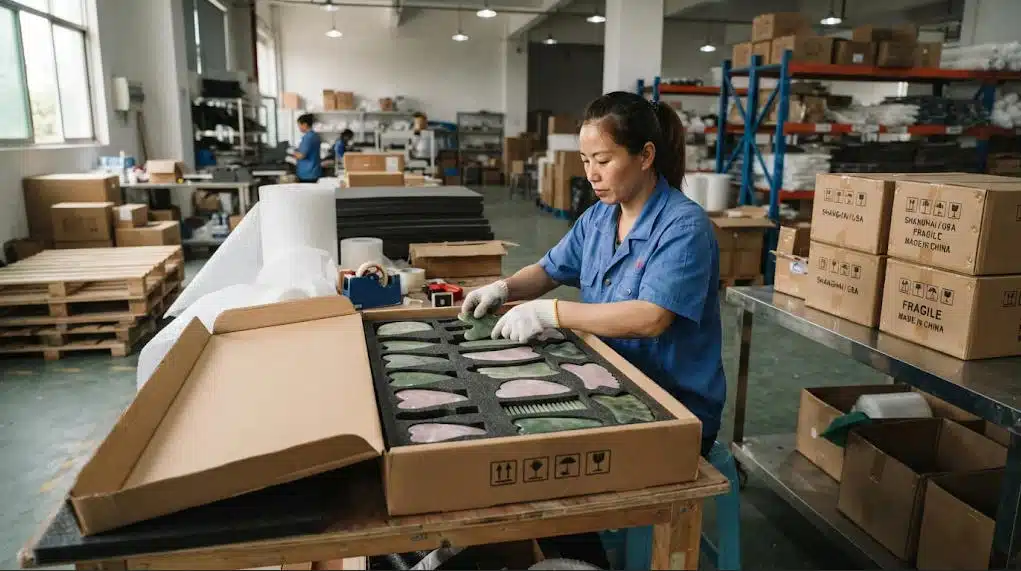
Breakage on a gua sha wholesale order drops when you combine four protective layers with pre-shipment testing: foam slots matched to each board’s thickness, a carton rated for the load, sealed top and bottom seams, and a stable pallet. In an illustrative 2,000-piece example, spending $0.10 more per piece on gua sha packaging ($0.25 instead of $0.15) cuts expected damaged pieces from 60 to 10. That is $200 of extra spend against 50 saved pieces, so the plan pays back whenever one broken piece costs you more than $4.00 in replacement, freight and gua sha after sale handling. Inside a gua sha factory, the fix starts at the packing table, and production-line experience from any guasha manufacturer points the same way: more foam alone rarely solves the problem. The sections below show you how to make your cargo gua sha shipping safe, one layer at a time. (All cost and breakage figures in this article are illustrative assumptions, not measured shipment statistics.)
- How Much Can Better Gua Sha Packaging Save on a Gua Sha Wholesale Order?
- How Do You Verify a Gua Sha Wholesale Shipment Is Gua Sha Shipping Safe Before It Leaves the Factory?
- How Should Foam Inserts Be Designed for Gua Sha Packaging in a Gua Sha Wholesale Order?
- What Carton Strength and Sealing Does a Gua Sha Wholesale Shipment Need to Stay Gua Sha Shipping Safe?
- How Do You Secure Corners and Pallets So a Gua Sha Wholesale Container Arrives Intact?
- What Risks Remain Even After Packaging Upgrades on a Gua Sha Wholesale Order?
- What Is the Gua Sha After Sale Process If Damage Still Occurs on a Gua Sha Wholesale Order?
How Much Can Better Gua Sha Packaging Save on a Gua Sha Wholesale Order?

Packaging cost is easy to see on a quote, while breakage cost hides in later invoices. If you compare only the per-piece packaging line, the cheaper carton usually wins the quote and loses the shipment. The figures below are built around a 2,000-piece order, so you can see where the break-even point sits. Any gua sha wholesale buyer can run this math in five minutes, and you can replace the inputs with your own product value and freight rates.
Is Reinforced Packaging Worth $0.10 More Per Piece on a Gua Sha Wholesale Order?
Take two options for the same 2,000 pieces. Plan A uses standard packing at $0.15 per piece, which totals $300, and assumes 3% breakage, or 60 damaged pieces. Plan B uses reinforced packing at $0.25 per piece, which totals $500, and assumes 0.5% breakage, or 10 damaged pieces. Both breakage rates are assumptions chosen to demonstrate the arithmetic, not statistics from a specific shipping lane.
The extra spend is $200 and the saving is 50 pieces, so the break-even value is $4.00 per damaged piece ($200 ÷ 50). If one replacement costs you more than $4.00 once production cost, second freight and handling time are added, Plan B is the cheaper plan. On a gua sha wholesale order of natural crystal or jade boards, that threshold is worth checking against your own cost sheet. This means you can judge any packaging quote by total expected loss instead of by the line item alone.
Hidden Costs Beyond the Carton: Replacement, Freight and Gua Sha After Sale Handling
A damaged piece triggers more than one expense. You pay for a replacement board, a second shipment (often by air, because your restock date has not moved), and the staff time spent on photos, claims and customer replies. Your own retail buyers may also pause reorders after a chipped delivery, and that cost never appears on an invoice.
Which of these items is already in your budget? Often, none of them is, which is why gua sha after sale terms matter before the order ships, not after. A guasha manufacturer that writes down its packing specification and breakage-handling steps in advance lets you price the risk instead of discovering it later. This means you can agree on a replacement budget and a claim process before production starts.
Matching Packaging Spend to Your Gua Sha Wholesale Route and Product Value
Not every shipment needs the same specification. Long sea routes with several transfers, heavy cartons and natural stone boards justify the reinforced option, while a short run of low-value pieces may not. Material matters too: GIA describes both jadeite and nephrite as very tough, and IGS points out that hardness alone does not predict how a stone wears, because tenacity and cleavage also count. Quartz, for example, has no cleavage but breaks with a shell-shaped conchoidal fracture, the same pattern seen in glass.
In practice, a thin finished board with sharp corners concentrates stress even when the raw material is tough. A gua sha factory that tests each shape separately, rather than applying one packing plan to every SKU, spends reinforcement money only where the risk sits. Ask for the packing specification by SKU, and ask how each one is made gua sha shipping safe for your route. This means you can fund stronger packaging on the products that carry the risk and keep the rest lean.
How Do You Verify a Gua Sha Wholesale Shipment Is Gua Sha Shipping Safe Before It Leaves the Factory?

A package that looks sturdy proves nothing until it has been shaken, dropped and loaded. Testing turns packing opinions into pass-or-fail records you can read. For a gua sha wholesale shipment, the goal is to prove the carton is gua sha shipping safe: boards stay put, cartons keep their shape, and seams stay closed. Here is how you can check each point yourself or ask your supplier to show it.
Six Pre-Shipment Checks for Every Gua Sha Wholesale Carton
Six checks cover the failure points that matter most, and each one answers a different question about the carton.
| Check | What it tells you |
|---|---|
| Shake and vibration | Whether boards move inside their foam slots or touch each other |
| Drop | Whether the carton and foam absorb a handling fall |
| Stacking | Whether the carton holds its shape under repeated load |
| Compression | Whether the box keeps protective space when pressed |
| Seal inspection | Whether top and bottom tape seams are fully bonded |
| Pallet stability | Whether wrap, corner boards and straps hold the load together |
The International Safe Transit Association (ISTA) publishes standard test procedures for this work. Its Procedure 3A simulates parcel shipments for packaged products up to 70 kg (150 lb), and Procedure 3E covers unitized loads such as pallets. A factory can run the first four checks in-house, but a published procedure gives you and your supplier the same pass-or-fail language. This means you can write “passes ISTA-style drop and vibration checks” into your gua sha wholesale purchase terms instead of “well packed.”
How to Run a Simple Shake-and-Drop Test on a Gua Sha Wholesale Sample Carton
Start by packing one carton exactly as it will ship, with the real board count, real foam and real tape. Next, shake it hard in all directions for a minute or two, open it, and check whether any board has shifted or whether two boards touched. Then drop the carton on a corner, an edge and a flat face from a height that matches your carrier’s handling, and reopen it after each drop. Finally, place a load equal to your planned pallet stack on top for 24 hours (a practical starting point) and measure how much the box has bowed.
ISTA’s procedures encourage repeating the test five or more times with new samples, so one lucky pass should never close the file. A single failed sample is also useful, because it shows exactly which slot or corner gave way. This means you can catch loose slots and weak corners on one sample carton before the same flaw repeats across a full container.
Matching Test Plans to Thickness, Shape and Material
Different boards fail in different ways, so one test plan rarely fits every SKU. Thin boards, pointed tips and curved edges deserve their own sample cartons and their own inspection after each test. Material shapes the plan too: GIA notes that jade may be dyed, bleached or impregnated, and independent labs such as SSEF identify gem materials and treatments, so you should know what each board is made of before you choose a test. ISTA also expects the shipper to decide in advance what counts as damage, so write down whether a hairline chip on an edge is a fail.
Keep a record for every test: date, SKU, carton specification, photos and result. A gua sha factory that files these records can trace a complaint back to a specific packing specification, which keeps gua sha packaging changes based on evidence rather than guesses. The same file speeds up any gua sha after sale review, because both sides look at the same photos. This means you can ask your guasha manufacturer for the test record of the exact SKU in your gua sha wholesale order, not a generic one.
How Should Foam Inserts Be Designed for Gua Sha Packaging in a Gua Sha Wholesale Order?

Foam is the layer closest to the product, so its fit decides whether a board stays still or hits its own edge for the whole journey. A slot that is too wide lets the board slide, and each slide is a small impact. Good gua sha packaging removes that movement without squeezing the stone. In a gua sha wholesale carton, the foam layout is one of the cheapest changes you can make, which is why it comes first among the protective layers.
Why Thickness-Matched Slots Matter for Gua Sha Wholesale Boards
In a gua sha wholesale range, boards often differ in thickness. As an example, if your range runs from 5 mm to 9 mm and every board sits in a 9 mm slot, the thinnest board has up to 4 mm of play. That gap lets it tilt and knock against the foam wall each time the carton is lifted, tipped or vibrated. Cutting a separate slot width for each thickness band closes the gap. This means you can cut edge impacts at the source instead of adding more foam around the problem.
Give each shape its own slot as well. Two boards sharing one cavity can click together, and a click between two stones is an edge chip waiting to happen. Ask your guasha manufacturer for the slot drawing by SKU, showing the thickness each slot is built for. This means you can check the match with a caliper when the sample carton arrives.
Why a Tighter Foam Slot Is Not Always Safer
It is tempting to answer loose slots with very tight ones. A slot narrower than the board, however, forces the stone against compressed foam as the lid closes, and the carton then passes outside pressure straight into the product. Natural crystal and jade boards carry stress at the edge, so squeezing them adds risk instead of removing it. The target is a light contact fit: the board holds its position, yet lifts out without force.
Fracture behavior supports this caution. IGS explains that fracture is a separate property from hardness and toughness, and notes that corundum, one of the most durable gems, breaks with the same shell-shaped fracture as glass. A hard stone, then, can still chip when load concentrates at one point. This means you can use “snug but not squeezed” as the pass mark when you review a foam sample.
Protecting Thin Edges and Sharp Tips in Gua Sha Wholesale Cartons
Thin edges, pointed tips and raised parts of a board take the first hit. Add a deeper pocket or a foam lip at those points so the vulnerable area never touches the cavity wall. A thin foam sheet over the top layer also keeps boards from pressing against the carton flap. Inside a gua sha wholesale carton, these small details matter more than total foam thickness.
A gua sha factory that inspects these exact points after every shake and drop test, using the records described in the previous section, finds weak spots early. This means you can hold the gua sha shipping safe standard at the places where chips actually start.
What Carton Strength and Sealing Does a Gua Sha Wholesale Shipment Need to Stay Gua Sha Shipping Safe?

Foam protects the board, but the carton protects the foam. When a box bows under a stack, its walls push inward and shrink the space your foam was cut to hold. DHL Express states that using adequate packaging remains the sender’s responsibility, so carton choice belongs on your gua sha wholesale checklist. In practice, the carton rules you meet first are your carrier’s guidelines, so check the current version before you fix a specification.
Single-Wall or Double-Wall: Matching Carton Strength to Your Gua Sha Wholesale Weight
DHL’s guide ties carton construction to parcel weight. Cartons carrying up to 10 kg are listed as single wall with an edge crush rating of 4.5 kN/m, those from 10 to 20 kg move to double wall at 7 kN/m, and 20 to 25 kg cartons rise to 8 kN/m with a 1,200 kPa burst rating. The same guide recommends double-wall construction for fragile or heavy items, and it warns that under-filled boxes can collapse while over-filled ones can burst. Suppose a filled master carton of gua sha wholesale boards weighs 12 kg (an illustrative figure); it would sit in the double-wall band. This means you can pick the wall count from the packed weight and avoid paying for strength you do not need.
What to Ask Your Guasha Manufacturer About ECT and Burst Ratings
DHL defines the edge crush test (ECT) as a measure of stacking strength, while the burst (Mullen) test measures how well a box resists rupture during rough handling. Ask your guasha manufacturer for both numbers on the exact carton used for your order, and have them written into the gua sha packaging specification. DHL also advises reading the box maker’s stamp, which shows construction type and strength, and avoiding reused boxes that have lost rigidity. A gua sha factory that can show you the stamp and the ratings has already done part of the verification. This means you can compare two gua sha wholesale quotes on carton rating instead of carton thickness.
DHL’s express guidance also asks for at least 6 cm between the contents and every wall, a rule written for parcel networks. For sea freight, ask your supplier what clearance their carton design keeps between inner boxes and the outer wall. This means you can keep a crush zone around the foam instead of packing the carton edge to edge.
How to Seal a Gua Sha Wholesale Carton with H-Taping, Step by Step
Start with the tape: DHL recommends pressure-sensitive polypropylene tape at least 48 mm wide and lists kraft paper tape, cellophane tape and masking tape as tapes to avoid. Next, run one strip along the center seam and one strip across each of the two edge seams, which forms an H, and add more strips on heavier cartons. Then repeat the pattern on the bottom, adding a cross strip over the main seam when the load is heavy, because a bottom that opens under weight drops the whole carton. Finally, drop-test one sealed sample and check every seam for lifted tape. This means you can fix a tape failure, which is cheap to prevent, and keep the carton gua sha shipping safe before it leaves the dock.
One caution applies to express parcels: DHL does not endorse strapping on parcels under 25 kg, because bands can damage sorting machinery and the package itself, so the carton must carry the load on its own. This means you can save straps for pallet loads, which the next section covers.
How Do You Secure Corners and Pallets So a Gua Sha Wholesale Container Arrives Intact?

Once cartons leave the packing table, corners and pallets decide how the load behaves in handling. Corner guards protect the box, and pallet building protects the stack. Both are supporting layers of your gua sha packaging, so they work best on top of the foam and carton choices from earlier sections. Here is how to decide what your gua sha wholesale pallets need.
When Corner Guards Help a Gua Sha Wholesale Carton, and When They Do Not
A carton has eight corners, and they take the hardest knocks during forklift moves, warehouse stacking and unloading. Hard plastic guards on all eight corners absorb a direct hit, spread the force over a wider area and help the box hold its shape, which keeps the foam space intact. They are worth adding for high-value natural crystal or jade orders, long sea routes and shipments with several transfers. This means you can protect the weakest part of the carton without redesigning the whole box.
Guards have limits, though. They do not replace a carton rated for the load, and they cannot cancel every outside impact. If a carton is under-rated, corner guards only hide the weakness until the first heavy stack. This means you can treat guards as an add-on for risk-heavy orders instead of a fix for a weak carton.
Building a Stable Gua Sha Wholesale Pallet: Load Pattern, Height and Wrap
Start with the load pattern: place cartons so the weight sits near the center of the pallet, and avoid overhang at the edges. Then set the stack height by the carrier’s limits and the pallet’s stability, because a taller load raises the center of gravity. Stacking load matters as well. In an illustrative pallet of 5 layers with 8 cartons each at 12 kg per carton, the bottom carton carries the 4 cartons above it, or 48 kg. That is the load your carton’s edge crush rating has to carry for the whole journey, and it is the reason to settle the pattern before you settle the carton.
Wrap comes next. Use industrial stretch film in several layers, and start low so the film covers the base of the cartons and the pallet together, which links load and pallet into one unit. On taller or heavier pallets, add corner boards and strapping. Film adds no carton strength and cannot cure an unbalanced stack, so use it alongside the load pattern, not instead of it. This means you can keep the load gua sha shipping safe by letting the pallet move as a single block, so cartons never rub or slip against each other.
Because pallet behavior depends on the full stack, ask your gua sha factory whether the pattern has been checked against a unitized-load procedure such as ISTA 3E. A test record shows the pattern was checked, not assumed. This means you can request the pattern and its record together with each pallet quote.
Is Your Pallet Compliant? ISPM 15 Rules for Wooden Pallets
Wooden pallets, crates and dunnage fall under ISPM 15, the international standard for wood packaging in trade. Under it, wood packaging is treated by heat or fumigation and carries an official mark, and many importing countries require that mark. FAO’s guide to the regulation of wood packaging material explains the mark and the approved treatments, and APHIS lists the countries that require ISPM 15 compliance. Because country lists change, confirm your destination’s current rule before booking the container. Ask your guasha manufacturer to state in writing whether the pallets are ISPM 15 marked. This means you can avoid discovering a pallet problem at the destination port.
What Risks Remain Even After Packaging Upgrades on a Gua Sha Wholesale Order?

Honest packaging advice includes its limits. The cost and breakage figures in this article are examples, and no specification removes risk completely. Knowing what stays uncertain helps you set realistic terms for a gua sha wholesale order, so this section lists the residual risks and how to plan around them.
Why No Packaging Specification Can Promise Zero Breakage in Gua Sha Wholesale Shipping
Even in the favorable example earlier, Plan B still assumed 0.5% breakage, which is 10 damaged pieces on a 2,000-piece order. Test procedures such as ISTA 3A simulate typical parcel conditions, but a real route adds its own drops, delays and stacking. ISTA also expects the shipper to decide in advance what counts as damage and what tolerance is allowable, so a “pass” depends on the standard you set. This means you can read any “zero breakage” promise on a gua sha wholesale quote as a warning sign and ask for a defined damage tolerance instead.
How Material Differences Change the Risk Profile of Crystal and Jade Boards
Material shifts risk in both directions. GIA calls jadeite and nephrite very tough, while IGS notes that quartz has no cleavage yet fractures the way glass does. Jade can also be treated: GIA’s buyer’s guide describes “B” jade as jadeite that has been bleached with acid and impregnated with polymer resin, so you should confirm material identity before you assume any toughness data applies. Thin edges and sharp tips add risk to every material. This means you can ask your guasha manufacturer for the material name and, on high-value lots, a lab report from an institute such as SSEF or GIA.
Every gua sha packaging layer also has a price beyond its unit cost. Extra foam and double-wall cartons add weight and volume, which can raise freight charges, and a foam slot cut too tight can press on a board instead of protecting it. The remedy is to test each trade-off on a sample instead of adding material by habit. This means you can weigh each upgrade against freight and fit before you approve it.
What Stays Outside a Gua Sha Factory’s Control
A factory controls the foam, the carton, the seal and the pallet pattern, but not the forwarder’s handling, port transfers, storage conditions or carrier delays. DHL’s packing guide lists humidity among the factors that shape packaging needs, which is one more reason a route-specific specification beats a generic one. Put the claim steps into your gua sha after sale terms before the shipment leaves, including the photo evidence required at arrival and the time window for reporting damage. Clear gua sha after sale terms do not prevent damage, but they limit the cost and the argument when it happens on a gua sha wholesale order. This means you can have both sides working from the same facts on day one of a claim.
What Is the Gua Sha After Sale Process If Damage Still Occurs on a Gua Sha Wholesale Order?

Even a well-packed shipment can arrive damaged, and what happens next decides how much the incident costs you. A clear gua sha wholesale claim process turns a dispute into a short checklist. The steps below show what to capture, what to compare and what to agree in writing.
1. How to Document Damage on Arrival for a Gua Sha Wholesale Claim
Photograph the pallet before you unwrap it, then the carton exterior, then the opened carton, and then each damaged piece beside its foam slot. Keep the cartons, foam and tape until the claim closes, and note any damage remarks on the carrier’s delivery receipt. Send the photos together with the order number and SKU, because a report without them is hard to match to a packing specification. This means you can give your supplier what it needs to decide a gua sha wholesale claim in one message instead of several.
2. How Test Records Speed Up a Gua Sha After Sale Review
Damage patterns point to causes. Chips along an edge usually trace back to board movement, which sends you to the slot width; crushed corners point to carton rating or corner guards; and lifted tape points to the seal. If the review has the test record for that SKU, you compare the photos against what was tested and find the gap quickly. A gua sha factory that keeps these records can then change the one layer that failed instead of reworking all of them. This means you can expect a gua sha after sale review to end with a specific fix for your next order.
3. Agreeing Gua Sha Wholesale Replacement Terms Before Production
Before production starts, put five points in writing: what counts as damage (a hairline chip on an edge, for example), what evidence you must send, how many days you have to report, whether the remedy is replacement or credit, and who pays the second freight. ISTA asks shippers to define damage and tolerance before testing, and the same discipline works for terms. A gua sha wholesale order with those five points agreed leaves less to negotiate after a damaged delivery. This means you can resolve a claim by checking facts instead of negotiating definitions.