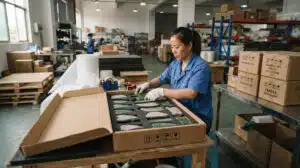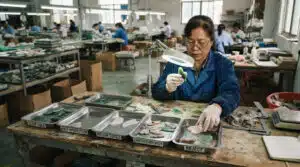
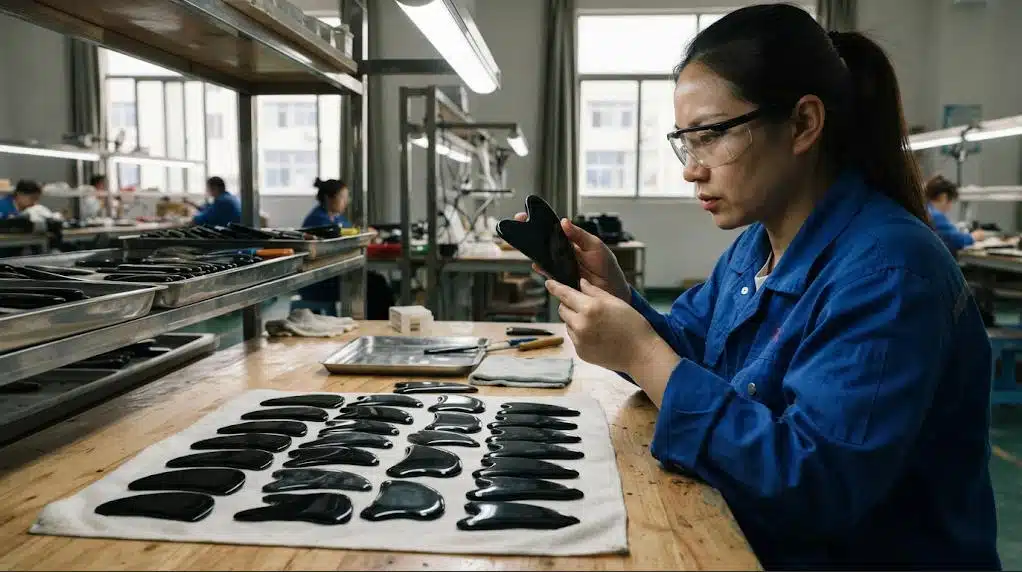
If you buy polished stone tools, water stains are the defect you will meet first. In gua sha production, tap water above 180 mg/L of hardness, which the USGS classes as “very hard,” leaves mineral deposits behind whenever a wet board dries. After more than 12 years on the workshop floor, Yan Cheng ranks obsidian as the material where those marks show up most, followed by crystal, agate and serpentine jade.
This article lays out where those marks come from, what a controlled gua sha process looks like, and which questions you should ask any gua sha manufacturer before a guasha wholesale order. Think of it as a walk through the workshop with a colleague: plain talk, real numbers, no sales pitch. Ready to see what your supplier might be missing?
- How Do You Keep Water Stains Out of Gua Sha Production? A Five-Stage Control System
- What Causes Water Stains in Gua Sha Production? Five Root Causes
- How Does a Gua Sha Manufacturer Tell Water Stains From Other Defects?
- How Do You Fix Gua Sha Boards That Already Have Water Stains?
- Which Materials Show Water Stains Most in Gua Sha Production?
- What Should Buyers Check Before a Guasha Wholesale Order? A Factory Audit Checklist
- Why Are Water Stains Often Overlooked in Gua Sha Production?
How Do You Keep Water Stains Out of Gua Sha Production? A Five-Stage Control System

The short answer is that you control five points, in order: process water, the first wash after polishing, the final rinse, drying, and the inspection before packing. Miss one and the stain returns, because each stage removes a different cause. A gua sha factory that documents all five gives you something you can audit, while a factory that only wipes finished boards gives you a promise. This means you can ask for five records instead of one reassurance.
Why Does Water Quality Matter More Than Extra Wipers in Gua Sha Production?
Water is the root cause, so it comes first. During cutting, grinding and polishing, the stone sits in water for hours, and when that water dries it leaves behind whatever it carried. The USGS puts water at 0 to 60 mg/L (as calcium carbonate) in the soft band, 61 to 120 as moderately hard, 121 to 180 as hard, and anything above 180 as very hard. Those bands give you a yardstick, so ask your supplier which one their rinse water falls into.
Adding wipers to the line treats symptoms. A person with a cloth can remove marks that already formed, but cannot lower how many form, so labor cost climbs while the defect rate stays flat. Testing hardness and TDS at the tap, then treating the water, attacks the cause in gua sha production instead of the result. This means you can judge a supplier by their water test records rather than by the headcount at the wiping table.
How Do You Match Filtered, Softened, RO and DI Water to Each Step?
Not every step needs pure water, which is good news for your unit price. Softened water lowers calcium and magnesium, while deionized (DI) water reduces dissolved ions further, so the two are not interchangeable. Rough cutting and coarse grinding can run on treated process water, and the final rinse is where RO or DI earns its cost. This means you can ask for RO or DI at the last stage without paying for it across the whole line.
Where Does Gua Sha Production Fail After the Final Rinse?
A clean rinse can still fail within minutes. Drops left in grooves, finger holes and edges evaporate unevenly and deposit what they carry, so boards go straight to drying: lint-free cloth first, clean compressed air for the recesses, and controlled warm air only when needed. In workshop practice, natural crystal and jade skip fast, hot drying, because sudden temperature swings can stress stones that already hold fine internal cracks. GIA’s rose quartz care guide lists warm soapy water as a safe method and advises avoiding steam and ultrasonic cleaners, a good reminder that aggressive equipment has no place near finished stone.
Before packing, each board goes under daylight or a raking lamp, and the checker looks at grooves, edges, holes and contact faces. Anything still damp stays out of the bag, because moisture sealed in plastic condenses into new marks. If you wonder where the gua sha risks start, a sealed bag with one damp groove is a typical answer. This means you can request a photo of the inspection station, and one look will tell you whether the gua sha process is controlled or improvised.
What Causes Water Stains in Gua Sha Production? Five Root Causes

In gua sha production, five causes account for the water marks that turn up on finished boards, and each one leaves a different fingerprint. Sorting them matters because every cause needs its own fix, and a gua sha manufacturer that guesses wrong spends on rework that changes nothing. Here they are, grouped the way a quality checker would sort them.
Why Do Hard Water and Late Drying Leave Marks in Gua Sha Production?
Hard water is the most typical culprit in gua sha production. As a wet board dries, calcium and magnesium stay behind as white dots, thin films or rings, and they gather along edges, grooves, finger holes and curves. Wipe them off and the surface looks clean, then the marks return once it dries again. Dark stones such as green jade and amethyst make them easier to spot.
Late drying creates a second pattern. When boards wait on a bench after washing, drops evaporate at different speeds, and the stain lands wherever the last drop dried. Stacked boards, thick sides and recessed areas hold water longest. This means you can diagnose a drying problem by checking whether the same recesses show marks on every piece in a batch.
How Do Polish Residue and Dirty Tanks Mimic Water Stains?
Not every white mark is a water stain. Leftover polishing powder leaves a gray-white or milky film that a dry cloth does not lift, and it tends to repeat in the same spots across one batch. Tanks cause the same trouble from the other side: stone dust settles at the bottom, recirculated water carries it back onto clean boards, and scale builds up in pipes and spray nozzles. The USGS water-quality table notes that hard water forms scale in boilers, water heaters and pipes, so hard-water scale deserves a look inside every nozzle on the line.
A gua sha factory can hide this problem for months if nobody drains, scrubs and refills the wash tanks on a schedule. Cloths and trays matter too, because a dirty cloth wipes yesterday’s residue onto today’s stone. This means you can ask for the tank cleaning log and the cloth replacement rule, and a written record will tell you more than a confident answer.
Why Does Moisture Show Up Inside Sealed Bags?
A board can feel dry and still hold water in a groove. Sealed in plastic or foam, that trace turns to vapor, condenses and leaves a mark or a damp patch by the time the carton reaches you. The mechanism differs from mineral deposits, so the cure differs too: longer drying and a pre-pack check, not a finer water filter. Among the quieter gua sha risks in export shipments, this one stands out, since the damage appears after the goods leave the workshop.
Would you spot it on a pallet of guasha wholesale cartons, where many pieces share one box? Probably not until a customer complains. A gua sha process that skips the pre-pack drying check moves that complaint from the workshop to your inbox. This means you can protect your returns by making “dry before bagging” a written acceptance rule across every gua sha production batch, not a habit.
How Does a Gua Sha Manufacturer Tell Water Stains From Other Defects?

Not every white mark is a water stain, and the label you give it decides what happens next. Call a polish film a water stain and the board goes back through the rinse, comes out with the same film, and your lead time grows for nothing. A gua sha manufacturer that sorts marks first spends less on rework, and you can use the same logic on a sample from any gua sha production run.
How Can You Test a Mark Before Gua Sha Production Rework Begins?
Start with the simplest test: wipe the mark with a damp cloth, dry the board, and watch. If white spots or rings come back after drying, the cause is mineral deposit from the water. If a gray-white or milky film survives a plain wipe and shows up in the same spots on the whole batch, suspect polishing residue. Uneven patches that sit in grooves, edges and finger holes point to drying, while moisture marks that only appear inside the bag point to packing.
Each result sends the board to a different fix, so a gua sha factory with defect categories on its inspection sheet wastes fewer boards than one with a single box labeled “stain.” This means you can ask for those categories in writing before your order starts.
What Does Haze That Survives Cleaning Mean?
Here is the mark worth worrying about: a hazy patch that stays after proper cleaning and comes with a dull, lower-gloss look. A cloth will not fix it, because the problem may sit in the surface itself. Acidic or alkaline cleaners can etch a polished face, and a weak polishing step in gua sha production can leave the same look. Check it under a raking lamp, and if the gloss has dropped, stop wiping and review the gua sha process upstream. This means you can catch surface damage early instead of paying for a third rinse that cannot reach it.
Why Do Vinegar and Citric Acid Create Gua Sha Risks on Natural Stone?
It is tempting to reach for vinegar or citric acid on stubborn white spots, because both are cheap and dissolve mineral scale. Stones that contain calcium carbonate can lose gloss or etch when acid touches them, which turns a removable stain into permanent damage. GIA’s jade care guide notes that jade can be affected by warm acids, and it recommends warm soapy water as the safe default. Serpentine jade, one of the materials used for boards, is a different mineral from the jadeite and nephrite GIA covers, so treat that guidance as a warning sign, not a clearance.
Among the gua sha risks you can control, an untested cleaner ranks near the top, since one wrong bottle can ruin a full batch of guasha wholesale stock. The safe rule in gua sha production is to test any cleaner on offcuts or rejected pieces of the same stone first. This means you can require a written offcut test from your supplier, which protects your delivery date and your unit cost.
How Do You Fix Gua Sha Boards That Already Have Water Stains?

Match the fix to the severity and you save both stone and money. In gua sha production, light marks need a re-clean, stubborn deposits need a method chosen by stone type, and only a damaged polish face justifies re-polishing. A gua sha manufacturer that jumps straight to re-polishing burns material on a problem a rinse could have solved.
How Do You Re-Clean Minor Water Marks in Five Steps?
First, rewash the board in clean water. Second, give it a final rinse in low-mineral water (filtered, RO or DI) so the rinse does not add new deposits. Third, blot the surface with a lint-free nonwoven cloth. Fourth, push clean compressed air through grooves and edges, and fifth, check the board under daylight or a raking lamp before it returns to the line. This routine suits boards with light marks and no polish damage, and it keeps your gua sha process short. This means you can expect minor marks in gua sha production to be cleared without anyone touching the polish.
How Do You Treat Stubborn Deposits Without Damaging the Stone?
Dried-on deposits resist a simple wipe, so identify them first, because mineral scale, polish residue and etching call for different handling. Every stone in gua sha production reacts differently, so choose the method by material and run it on an offcut before the real board. Skipping that test turns a cleaning job into one of the gua sha risks nobody budgeted for, such as lost gloss on a finished batch. This means you can ask your supplier which stone-specific method they use for stubborn marks, and where that method is written down.
What Does Re-Polishing Cost in Gua Sha Production, and When Does It Pay Off?
Re-polishing is the last resort. Every re-polish also eats lead time, so rework in gua sha production costs you days as well as dollars. Fine grinding removes a thin layer of stone, so each pass adds labor, wears material and risks size drift on a finished board. If the stain is mineral scale from the water, re-polishing only resets the clock, because the same water will mark the board again. Reserve it for confirmed damage to the polished face.
Now run the numbers with your own figures. Here is an illustration with hypothetical values, not Yan Cheng data: on a 10,000-piece order with 4% marked boards, 400 pieces need rework, and at $1.00 per piece for re-cleaning, re-inspection and re-packing, that is $400 per order. Cut the mark rate to 1% and the bill falls to $100, a saving of $300 per order. Divide the quoted cost of water treatment by that saving and you get the payback in orders. For guasha wholesale buyers, that is the question to put to every quote, and a gua sha factory that can show its own mark rate before and after a water fix has already done the homework. This means you can compare suppliers on payback, not on promises.
Which Materials Show Water Stains Most in Gua Sha Production?

From Yan Cheng’s own workshop data, the order runs obsidian first, then crystal, then agate, then serpentine jade (southern jade and xiuyu). This is a field ranking built on years of inspection, not an industry standard, so use it to plan your checks rather than to quote as fact. The pattern behind it in gua sha production is simple: the glossier and darker the face, the louder the stain.
Why Is Obsidian the Hardest Material to Keep Stain-Free?
Obsidian takes a near-mirror polish and sits on a black base, so a gray mineral mark has nowhere to hide. GIA’s Gems & Gemology describes obsidian as a volcanic glass with an amorphous structure that makes it hard and brittle, a good reason to treat a finished face gently. Under a raking lamp, even a thin film shows. This means you can ask for a lamp check on every black board and a photo record of the final rinse for each gua sha production batch.
How Do Crystal and Agate Compare on Water Mark Visibility?
Both materials belong to the quartz family. GIA lists amethyst as quartz (SiO₂) with a Mohs hardness of 7, and its chalcedony feature explains that agate is made of tiny quartz crystals too small to see without magnification. Crystal polishes to a sharp finish, though its translucence softens how a mark reads, so it ranks below obsidian. Agate feels warmer and less sharp, and marks look shallower on it. Within crystal, dark amethyst zones show white marks most clearly, and rose quartz needs a consistency check across its translucent areas.
A gua sha factory that applies one acceptance rule to all of these is ignoring its own data. This means you can request a material-specific inspection standard, with tighter limits for obsidian and amethyst than for agate, because gua sha production of dark, glossy stone leaves less room for error.
Where Else Does Gua Sha Production Need Material-Specific Checks?
Serpentine jade does not reach a mirror finish, so its surface scatters light and hides marks better. That advantage disappears if someone reaches for an untested acid cleaner, one of the gua sha risks worth ruling out in writing. Stainless steel plays by different rules: trapped water, cleaner residue and surface contamination can leave rust spots or patchy areas, so drying and cleaner rinsing matter more than polish clarity.
For a gua sha manufacturer, the practical result is a different checklist per material, and for you, a better view into how a gua sha process is really run. If you source mixed guasha wholesale lots, ask which material gets which check, and you will learn quickly how closely the workshop watches its own output in gua sha production.
What Should Buyers Check Before a Guasha Wholesale Order? A Factory Audit Checklist

Before you sign a guasha wholesale order, audit three things: the records behind the water and drying controls, the nickel test report for any stainless steel item, and the product safety paperwork for your market. None of this replaces advice from your own compliance specialist, since rules differ by country. It does give you a short list of gua sha risks to raise on the supplier call, starting with how the supplier runs gua sha production.
Which Records Prove Gua Sha Production Is Under Control?
Ask for the water hardness and TDS test results, the type of water used in the final rinse, and the cleaning log for wash tanks and spray nozzles. Add a look at the drying area and a few photos from the pre-pack inspection station. The most useful number is the mark rate per batch, because it shows whether gua sha production improves or just survives. A gua sha factory that tracks that rate can also show the payback math from the previous chapter. This means you can verify control from paper and photos before a single carton ships.
Is a Stainless Steel Gua Sha Board Compliant With the EU Nickel Rule?
For stainless steel items sold in the EU, entry 27 of REACH Annex XVII bars nickel in articles intended for direct and prolonged skin contact if release exceeds 0.5 µg/cm² per week, per the ECHA text. The same ECHA document proposes defining “prolonged” as more than 10 minutes on three or more occasions within two weeks, or 30 minutes on one occasion. A gua sha routine can pass that mark easily, so do not assume the rule skips your product. The Commission lists EN 1811:2023 as the reference test method. This means you can ask for an EN 1811 nickel release report per steel grade, and let your advisor decide whether the rule applies to your gua sha production line.
What Does EU Product Safety Law Ask From a Gua Sha Manufacturer?
The General Product Safety Regulation (EU) 2023/988 has applied since 13 December 2024, and the Commission’s business guidelines state it covers products on the EU market regardless of where they are made. Under it, a gua sha manufacturer carries out an internal risk analysis and keeps technical documentation, and an EU-based responsible operator must stand behind each product, whichever gua sha factory made it. Document control is part of gua sha production, not an afterthought. Missing paperwork is one of the gua sha risks that surfaces at customs or after a complaint, not on the factory floor. This means you can request the risk analysis summary, batch identification, and the EU responsible person’s contact details before you commit to a gua sha process and a shipping date.
Why Are Water Stains Often Overlooked in Gua Sha Production?

Water stains hide in plain sight. A white ring looks like dirt, a hazy patch looks like a polishing flaw, and a dark board with spots looks like a bad stone, so each mark gets blamed on something else. Wiping the finished board clears the symptom for a day and leaves the cause running in the tanks. In gua sha production, the real problem usually sits upstream of the wiping table, and that is why the habit costs you more than it appears to.
What Three Principles Should Every Gua Sha Manufacturer Follow?
The first principle is that water quality beats extra wipers. The USGS calls water above 180 mg/L “very hard,” so a treated final rinse prevents marks instead of chasing them. The second is that each material gets its own cleaning rule, because obsidian, quartz, agate, serpentine jade and steel react differently to cleaners, heat and drying. The third is to sort the mark before you fix it, since mineral deposit, polish film, drying marks and etching need different cures.
A gua sha manufacturer that follows all three spends less on rework and ships fewer disputed boards. This means you can use these principles as a one-page scorecard when you compare a gua sha factory against your current supplier.
How Should You Read the Numbers in This Gua Sha Production Guide?
Treat each type of evidence on its own terms. The material ranking comes from Yan Cheng’s internal field experience, not from independent testing. The cost example uses hypothetical values, so replace them with your own mark rate and rework cost. The regulatory section covers EU rules only, and whether the nickel entry applies to a given tool is a question for your compliance advisor. GIA, USGS and EU sources support general facts about stone, water and law, not the performance of any single gua sha process.
This means you can separate what is measured from what is experience, and give each the weight it deserves before a guasha wholesale commitment. Missing that step is one more of the gua sha risks that quietly turns a good supplier call into a bad surprise in gua sha production.
About Yan Cheng
Yan Cheng has processed, designed, manufactured and sold crystal, jade and stainless steel gua sha tools for more than 12 years. If you want to compare your supplier’s water, drying and inspection records with the checklist above, you can ask the Yan Cheng team for its process documents and sample boards. This means you can test the claims in this article against real boards in gua sha production, with your own inspection lamp.