
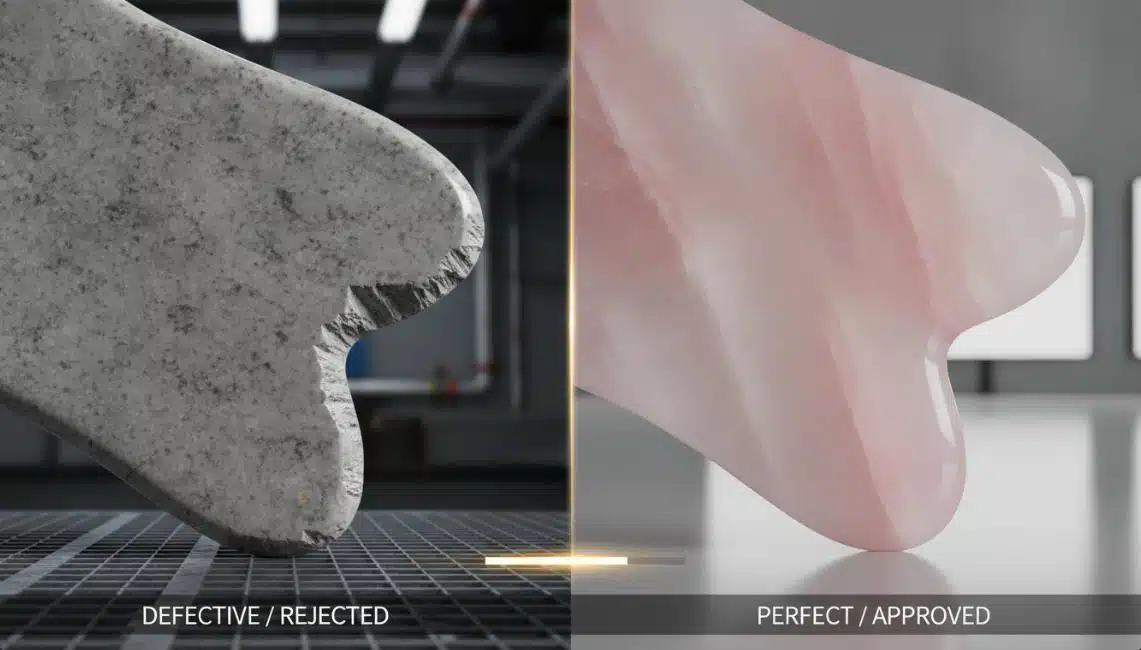
When you inspect a gua sha tool for the first time, your eyes are drawn to the overall silhouette — the curves, the polish, the translucency of the stone. What you are far less likely to examine, and what most suppliers will never volunteer information about, is the inner corner zone. Not the concave angle itself, but the two ridge lines where the tool’s front and back faces meet the side edge within that inner corner area. As a professional gua sha manufacturer with over 12 years of stone processing experience, we have documented what happens when those ridge lines are left sharp and unaddressed: the result is a tool that looks finished, passes visual inspection, and injures the people who use it.
Here is the fact that should anchor every purchasing decision you make about stone gua sha tools: during the shaping phase of gua sha production, the side edge of the tool within the inner corner zone is ground to its final profile before any surface finishing takes place. The transition between that side edge and the front or back face of the tool — the ridge line running along the inner corner — emerges from shaping as a sharp, unrelieved edge. It is not a manufacturing defect in the traditional sense. It is a structural inevitability of how stone is shaped. What separates a professional gua sha supplier from a volume producer is whether that ridge line is systematically chamfered into a smooth r-angle before the tool reaches your customer.
- Why This Ridge Line Is More Dangerous Than It Looks
- Why the Inner-Corner Ridge Line Cannot Be Fixed in Polishing
- Why a Standard Grinding Wheel Cannot Chamfer Inner-Corner Ridge Lines
- How a Professional Gua Sha Manufacturer Chamfers Inner-Corner Ridge Lines
- 3 Inner-Corner Chamfering Defects Most Likely to Reach Your Customers
- A Practical Buyer's Guide to Evaluating Gua Sha Manufacturer Inner-Corner Quality
- Why Inner-Corner Ridge Line Quality Is a Business Decision, Not Just a Technical One
- Faqs About Gua Sha Production Inner Corner
Why This Ridge Line Is More Dangerous Than It Looks
The inner corner of a gua sha tool is a zone of curvature change. When a stroke passes through this area, the skin and underlying soft tissue do not respond uniformly — they are drawn inward by the geometry of the stroke, increasing contact pressure precisely at the points where the front and back faces meet the side edge. Contact mechanics research on curved mineral surfaces, including frameworks discussed in IGS resources on gemstone physical properties, consistently identifies angular ridge transitions as zones where localized contact force is disproportionately concentrated relative to what the surface appearance suggests. A ridge line that appears smooth under overhead lighting can generate meaningfully higher contact pressure than the surrounding curved surface during directional stroking — enough to mark skin under sustained use even when the rest of the tool surface causes no discomfort whatsoever.
The 5-Second Step That Changes Everything
Inner-corner chamfering — the process of grinding those two ridge lines from a sharp transition into a smooth, continuous r-angle — takes no more than 5 seconds per tool in the hands of a trained technician working with the correct equipment. Yet it is one of the most inconsistently performed steps across the gua sha stone factory landscape, particularly among manufacturers where inner-corner work is absorbed into the polishing phase rather than treated as an independent production stage. If your current gua sha tool manufacturer cannot describe this process to you in technical detail — specifying what equipment they use, what contact parameters they follow, and how they verify the result — that gap in their answer is information. This article explains exactly what the process involves, where it fails, and what you should be asking before your next order is confirmed.
Why the Inner-Corner Ridge Line Cannot Be Fixed in Polishing

To understand why inner-corner chamfering is a mandatory, dedicated stage in professional gua sha production, you need to understand the manufacturing sequence that creates the problem in the first place. Stone gua sha tools are shaped through a process of progressive material removal: rough cutting defines the gross form, intermediate shaping refines the profile and establishes the tool’s characteristic curves, and polishing brings the surface to its final finish. This sequence is deliberately structured so that each stage removes less material than the one before it. Polishing, by design, is a surface refinement operation — it smooths and brightens what is already there. It does not change geometry.
How the Ridge Line Forms During Gua Sha Production
During the shaping stage, the outer curves of a gua sha tool — the long convex sides and rounded tips — are addressed by grinding passes that move continuously along open, accessible surfaces. The inner corner presents a fundamentally different geometry. The side edge within the inner corner is narrower, more confined, and approached from an angle that limits the grinding wheel’s range of motion. As a result, the transition between the side edge and the front or back face — the ridge line — is the last feature to be refined in shaping, and it is typically the least refined. What the tool carries out of the shaping phase is a side edge that has been brought to its correct profile, front and back faces that have been smoothed to near-finished condition, and two ridge lines along the inner corner that remain as sharp, angular intersections between those surfaces.
This geometry cannot be corrected in polishing. Polishing wheels and compounds work by removing microscopic surface irregularities from surfaces they can access and conform to. The ridge line in the inner corner is not a surface irregularity — it is a geometric transition between two surfaces, and polishing does not change the angle of that transition. A gua sha stone factory that relies on polishing to address inner-corner ridge lines will produce tools with a high-gloss, beautifully finished surface and unrelieved sharp edges precisely where users apply the most directional pressure. The polish makes the problem harder to detect, not easier to avoid.
How the Ridge Line Affects Skin and Tissue During Use
The gua sha stroke is a sustained, directional movement that applies lateral pressure along the skin’s surface. When that stroke enters the inner corner zone, the geometry of the tool causes soft tissue to be drawn inward — a predictable response to the changing curvature of the surface the tool is pressing against. At the moment of maximum inward displacement, the skin is in closest contact with the inner corner area, and the two ridge lines — where the front and back faces meet the side edge — become the primary contact points between the tool and the tissue.
A sharp ridge line concentrates that contact into a very narrow zone. GIA’s published research on the physical and surface characteristics of polished gemstones provides a framework for understanding how surface geometry at the microscopic and macroscopic level affects the behavior of polished stone under applied force — and the core principle is consistent: angular transitions concentrate stress in ways that smooth curved surfaces do not. In practical terms for gua sha production, this means that an unrelieved ridge line transition will concentrate contact force in a way that a smooth r-angle distributes uniformly across the transition zone. For your end customers, this manifests as unexplained redness, linear marking along the inner corner path, or skin abrasion that the customer attributes to technique when the actual cause is tool geometry. Every professional gua sha manufacturer supplying tools for therapeutic or retail use should be able to document that this geometry has been controlled. If they cannot, you are carrying the risk.
Why a Standard Grinding Wheel Cannot Chamfer Inner-Corner Ridge Lines
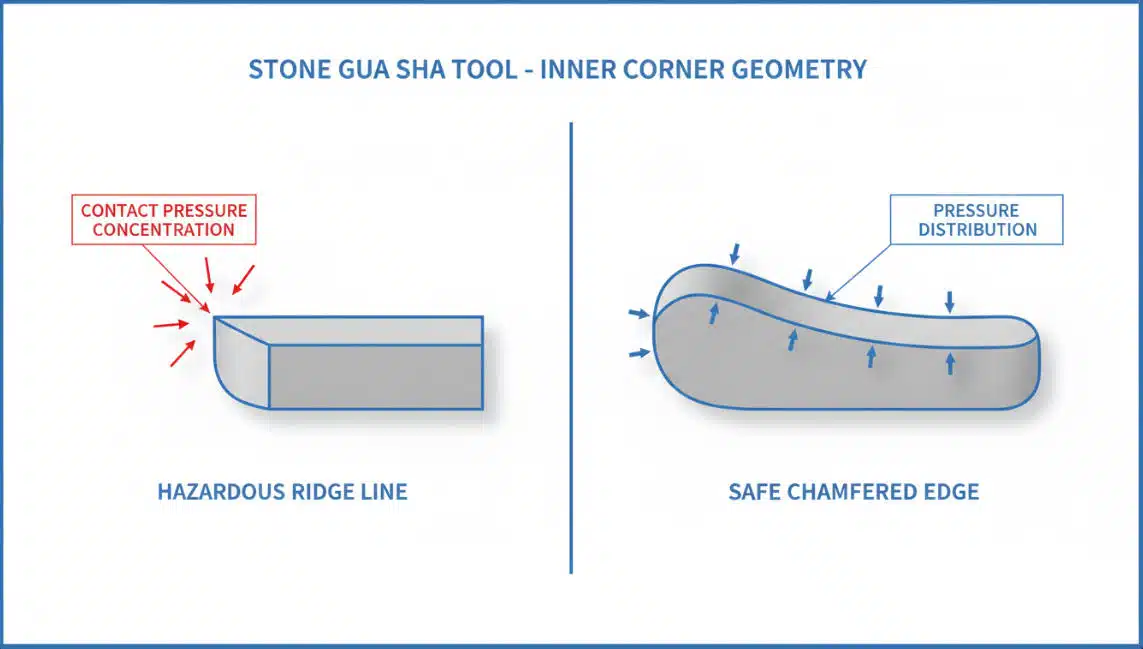
The question that most buyers ask at this point is a reasonable one: if the inner-corner ridge line is just a narrow edge, why can’t a standard grinding wheel handle it? The answer lies in the geometry of the inner corner and the spatial constraints it creates for any grinding tool trying to reach the ridge line without disturbing the surrounding surfaces. This is one of the most concrete technical distinctions between a gua sha manufacturer that has invested in the right equipment and one that has not.
The Access Problem in the Inner Corner Zone
A standard flat or uniformly rounded grinding wheel works well on open, convex surfaces where the wheel can approach the workpiece from a clear angle and maintain consistent contact across its working face. The inner corner of a gua sha tool creates a concave recess that denies this access. The two ridge lines that need to be chamfered — front face to side edge, and back face to side edge — are located at the deepest part of that recess, tucked against the side edge surface. A standard wheel, approaching from outside the inner corner, will make contact with the front or back face of the tool before it can reach the ridge line. The result is that the surrounding surface is ground before the target ridge line is addressed, distorting the tool’s profile while leaving the actual problem unresolved.
Any gua sha stone factory attempting inner-corner chamfering with standard equipment is therefore working at a geometric disadvantage that produces one of two outcomes: the surrounding surface is damaged in the attempt to reach the ridge line, or the ridge line is left partially or entirely unaddressed because the wheel cannot safely reach it. Neither outcome is acceptable in professional gua sha production. The only solution is a wheel with a profile specifically designed to reach and address the inner-corner ridge line without making prior contact with the surrounding surfaces.
Why Inner-Corner Ridge Lines Are Prone to Fracture Under Incorrect Grinding
The inner corner zone is not only geometrically difficult to access — the ridge line within it is also the most mechanically vulnerable part of the stone. Ridge lines and edge transitions in natural gemstones are stress concentration zones: when grinding pressure is applied, the force is distributed across whatever contact area the wheel can establish, and at a sharp ridge line, that contact area is extremely small. The result is that the local stress within the stone at the ridge line is significantly higher than at the surrounding flat or curved surfaces under the same applied grinding force.
Natural gemstones respond to this stress concentration in different ways depending on their mineral structure. Nephrite jade, with its interlocking fibrous crystal structure, is relatively resistant to fracture under localized stress and can tolerate the chamfering process across a wider range of conditions. Rose quartz and aventurine, which have more defined crystallographic cleavage planes, are more susceptible to propagating microfractures when local stress exceeds the material’s tensile limit at a cleavage plane. The GIA Gem Encyclopedia entries on quartz and jade document these structural differences in detail, and the implications for gua sha production are direct: the contact parameters used during inner-corner chamfering must be adjusted to the specific material being processed, not applied uniformly across all stone types. A gua sha tool manufacturer that applies the same wheel profile and the same contact time to rose quartz as to jade is ignoring a material property difference that directly affects fracture risk at the inner corner ridge line. This means that material-matched tooling and parameters are not a premium feature — they are a basic technical requirement for consistent, safe production across a multi-material catalog.
How a Professional Gua Sha Manufacturer Chamfers Inner-Corner Ridge Lines
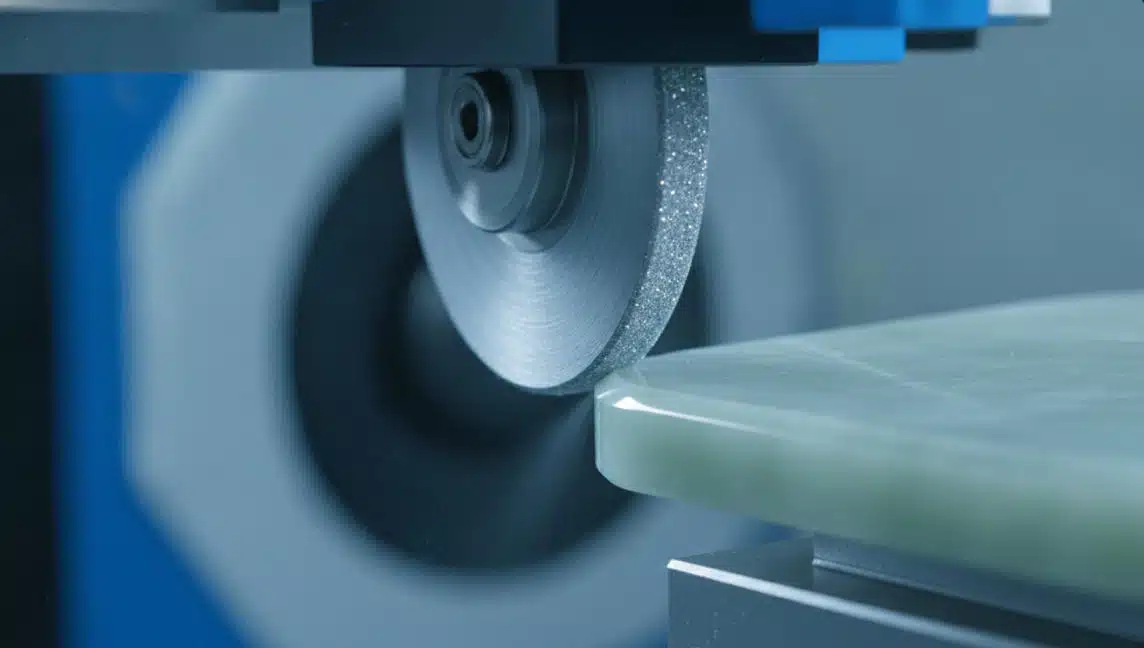
The grinding wheel used for inner-corner chamfering on gua sha tools has a cross-sectional profile that is purpose-designed for the geometry of the task. Rather than a flat or uniformly rounded working surface, it features a raised central ridge flanked by concave recesses on either side. Understanding why this profile works requires mapping it directly to the geometry of the inner corner zone.
The raised central section of the wheel corresponds to the side edge surface within the inner corner — the narrow face that runs along the depth of the tool between the two ridge lines. The concave recesses on either side of that raised section correspond to the front and back faces of the tool as they approach the inner corner. When the wheel engages the inner corner, the raised section contacts the side edge while the concave recesses simultaneously conform to the front and back face surfaces adjacent to the ridge lines. This geometry allows the wheel to address both ridge lines — front face to side edge, and back face to side edge — in a single controlled engagement, without making damaging contact with the surrounding surface geometry.
Any gua sha stone factory that cannot specify what wheel profile they use for inner-corner chamfering, or cannot demonstrate that the wheel profile is matched to the specific tool geometry being processed, is operating this step without the precision it requires. This means that wheel profile specification is one of the first questions you should ask any potential gua sha supplier when evaluating their chamfering capability.
Gua Sha Manufacturer 1 — Initial Ridge Line Contact at 45 Degrees
The first step in the chamfering process establishes the geometry of the chamfer on both ridge lines. The technician brings the inner corner zone of the tool into contact with the raised central section of the wheel, positioning the tool so that the side edge meets the wheel at a 45-degree angle. At this angle, the wheel simultaneously engages both ridge lines — the transition from the front face to the side edge, and the transition from the back face to the side edge — applying equal, controlled grinding pressure to both.
Angle consistency is the critical variable in this step. If the tool is held at a deviation from 45 degrees, one ridge line receives more grinding pressure than the other, producing an asymmetric chamfer that will be detectable in the finished product by touch. Contact time during this step is held to approximately one second per engagement. Based on Deyi Gems’ internal material testing across jade, rose quartz, and aventurine production runs over 12 years, sustained contact beyond approximately three seconds at this stage consistently produces over-grinding at the ridge line — the edge becomes thin, loses its structural backing, and the risk of chipping during subsequent polishing increases significantly. Buyers who wish to review the underlying material testing records for specific stone types can request this documentation through our standard pre-shipment QC package. This time constraint is enforced in qualified gua sha manufacturer facilities through technician training and in-process timing protocols — not left to operator judgment under production speed pressure.
2 — Transitioning from Ridge Line to Face Surface
Once the initial chamfer geometry has been established on both ridge lines, the second step addresses the transition from the chamfered ridge line into the front and back face surfaces on either side. Using the concave recesses of the wheel rather than its central raised section, the technician works the wheel outward from the ridge line in both directions — toward the front face and toward the back face — maintaining the same 45-degree angle and moving from the center of the inner corner zone outward toward its ends.
The purpose of this step is to ensure that the chamfer does not produce a discrete, visible bevel that abruptly meets the surrounding face surface. A chamfer that terminates abruptly creates a secondary ridge line — smaller than the original, but functionally similar in its effect on skin contact. The transition from the chamfered zone into the surrounding face surface must be gradual and blended. Speed control is the key technical variable here. Moving too quickly through this step leaves insufficient material removal at the transition zone, resulting in a detectable step between the chamfer and the face surface. Moving too slowly removes too much material from the face surface, distorting the tool’s overall geometry. A skilled technician at a professional gua sha stone factory develops the feel for this pace through repetition with specific materials — it is a form of tacit knowledge that cannot be transferred through written specification alone, which is why hands-on production experience at your gua sha supplier is a relevant quality indicator.
3 — Rolling to a Continuous R-Angle Finish
The third step transforms the geometric result of steps one and two — which at this point consists of two flat bevel planes meeting the side edge at 45 degrees, with transitions into the front and back face surfaces — into a single, continuous curved transition: the r-angle. A flat bevel, even a well-executed one, still presents an angular geometry when examined carefully. Under the pressure of a gua sha stroke, a flat bevel with sharp transition edges at its boundaries will still concentrate contact force at those boundaries. The r-angle eliminates this by creating a smooth, radius-controlled curve that distributes contact pressure uniformly across the entire transition zone.
The rolling technique used to create the r-angle involves rocking the tool across the wheel’s working surface in a controlled sweep, allowing the wheel’s geometry to blend the bevel planes into a continuous curve. The Swiss Gemmological Institute SSEF, which publishes standards for polished gemstone surface quality assessment, provides a consistent reference point: a properly finished curved transition on a polished stone surface presents no detectable angular change under tactile examination and no visible edge discontinuity under oblique lighting. These criteria apply directly to the inner-corner r-angle on a finished gua sha tool. When you evaluate a sample from any gua sha tool manufacturer, these two criteria — fingertip feel under light lateral pressure, and oblique light observation — are sufficient to determine whether the rolling step was executed correctly. This means that you do not need laboratory equipment to enforce this standard in your supply chain. You need the right evaluation method and the willingness to apply it consistently.
3 Inner-Corner Chamfering Defects Most Likely to Reach Your Customers
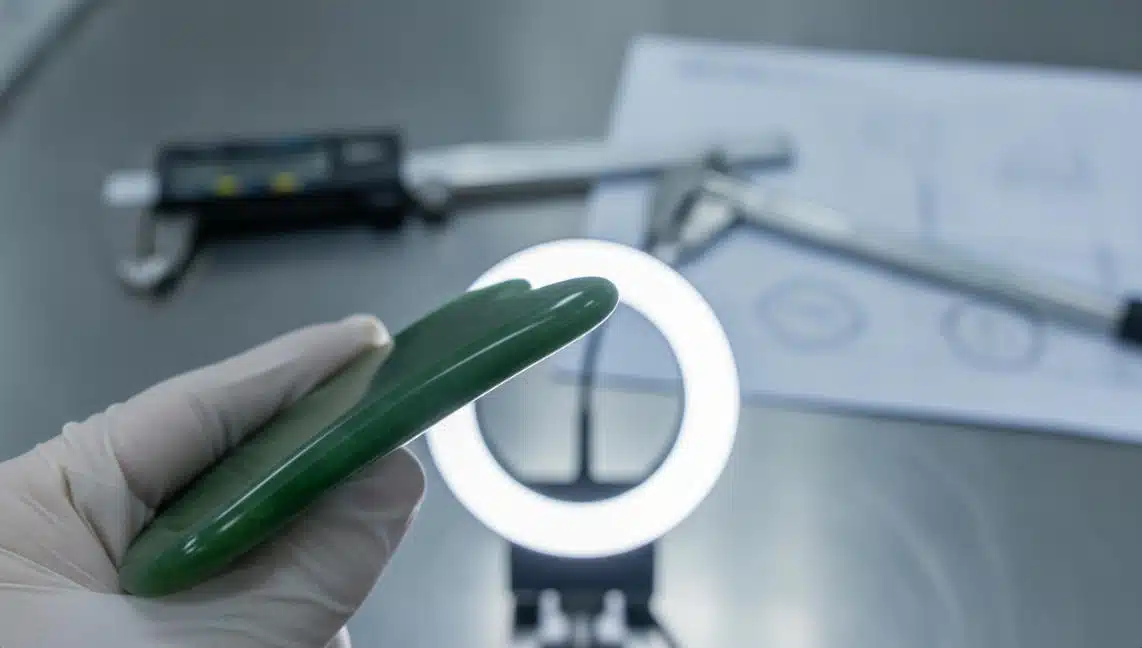
This section exists because the most common quality problems in the gua sha supply chain are not random. They follow predictable patterns that are directly linked to specific process failures at the gua sha manufacturer level. Understanding these patterns allows you to ask better questions, evaluate samples more effectively, and make sourcing decisions that reduce rather than transfer risk. The three defects below account for the majority of inner-corner related quality complaints, return requests, and skin injury reports in the retail and professional gua sha market — a pattern consistent with Deyi Gems’ internal QC audit findings across 12 years of gua sha production, records for which are available to qualified buyers upon request.This section exists because the most common quality problems in the gua sha supply chain are not random. They follow predictable patterns that are directly linked to specific process failures at the gua sha manufacturer level. Understanding these patterns allows you to ask better questions, evaluate samples more effectively, and make sourcing decisions that reduce rather than transfer risk. The three defects below account for the majority of inner-corner related quality complaints, return requests, and skin injury reports in the retail and professional gua sha market.
1 — Over-Chamfering and Thin-Edge Failure at the Inner Corner
Over-chamfering occurs when the grinding contact time at the inner corner ridge line exceeds the material’s tolerance for localized material removal. The result is a ridge line zone where the stone has been ground to a thickness that can no longer provide structural backing for the edge. This thinned zone does not typically fail during chamfering itself — the failure point is the polishing stage that follows. Polishing wheels apply rotational force to the tool surface, and the thin edge at an over-chamfered inner corner is particularly vulnerable to this force. The result is microchipping at the inner corner edge — small stone particles that detach during polishing and, in cases where the thinning is detected but not rejected, during customer use.
The risk of over-chamfering is highest in gua sha production environments where chamfering is performed under time pressure, where technicians are evaluated on output volume rather than process compliance, and where there is no in-process check between chamfering and polishing to verify edge integrity. A professional gua sha manufacturer prevents this through maximum contact time limits per engagement, edge-thickness checks on sampled units after chamfering, and a clear hold-and-inspect protocol for any unit that shows visible over-grinding at the inner corner. When you ask a potential gua sha supplier whether they perform QC checks between chamfering and polishing, the answer tells you directly whether this defect category is managed or unmanaged in their facility.
2— Under-Chamfering and Residual Ridge Line Sharpness
Under-chamfering is, based on Deyi Gems’ internal production QC records spanning 12 years — available to qualified buyers upon request — consistently the most frequently identified defect category in inner-corner quality audits across the gua sha tools we have inspected and processed. It occurs when the grinding contact at the ridge line is insufficient to fully relieve the angular transition — the ridge line is softened but not eliminated, and the finished tool retains a residual sharpness that is functionally significant even if it is not visually obvious. Under-chamfering is particularly difficult to detect through visual inspection on polished stone surfaces, because the high-gloss finish of jade or rose quartz reflects light in a way that masks edge geometry. The tool looks finished. The inner corner looks smooth. The residual sharp transition becomes apparent only when the tool is used — at which point the customer feels it and the brand absorbs the consequence.
The standard detection method for under-chamfering is tactile, not visual. Running a fingertip slowly along the inner corner zone under light lateral pressure — the same pressure and direction that a gua sha stroke applies — will reveal any residual angular transition that the polish has obscured. A correctly chamfered and finished r-angle presents a uniformly smooth curve with no detectable change in surface character along the entire transition zone. An under-chamfered ridge line produces a faint but perceptible catch at the point where the flat bevel meets the face surface — exactly the catch your customer will feel during use. The fact that this defect is visually undetectable on a high-gloss surface makes pre-shipment tactile inspection a non-negotiable part of any quality control process for stone gua sha tools sourced from any gua sha stone factory.
3 — Wheel Mismatch and Profile Deviation Across Product Geometries
Wheel mismatch is the most technically specific of the three defect categories, and it is one that is almost impossible to detect by evaluating a single sample in isolation. It occurs when the profile of the chamfering wheel does not correspond to the specific inner corner geometry of the tool being processed. Because gua sha tools come in multiple shapes — heart, wing, comb, contour, multi-function — the inner corner geometry varies between product types. The width of the side edge, the angle of the inner corner, and the radius of the adjacent face surfaces all influence what wheel profile will correctly address the ridge lines without making damaging contact with the surrounding geometry.
A wheel that produces a correctly proportioned chamfer on a standard heart-shaped tool will produce an asymmetric or over-wide chamfer on a contour tool with a narrower side edge or a tighter inner corner angle. When wheel mismatch occurs, the chamfer geometry deviates from the intended specification, and the finished product does not conform to the approved sample. For OEM and private-label buyers, this is a batch-level consistency issue — every unit processed with the mismatched wheel will show the same deviation, and because the problem is geometric rather than surface-level, it cannot be corrected in polishing. A professional gua sha tool manufacturer maintains a documented set of wheel profiles matched to each product geometry in their catalog, and records which specification was used for each production batch. When you introduce a new tool shape into your range, ask your gua sha manufacturer specifically which wheel profile they will use and whether it has been validated against your approved sample before production begins.
A Practical Buyer’s Guide to Evaluating Gua Sha Manufacturer Inner-Corner Quality
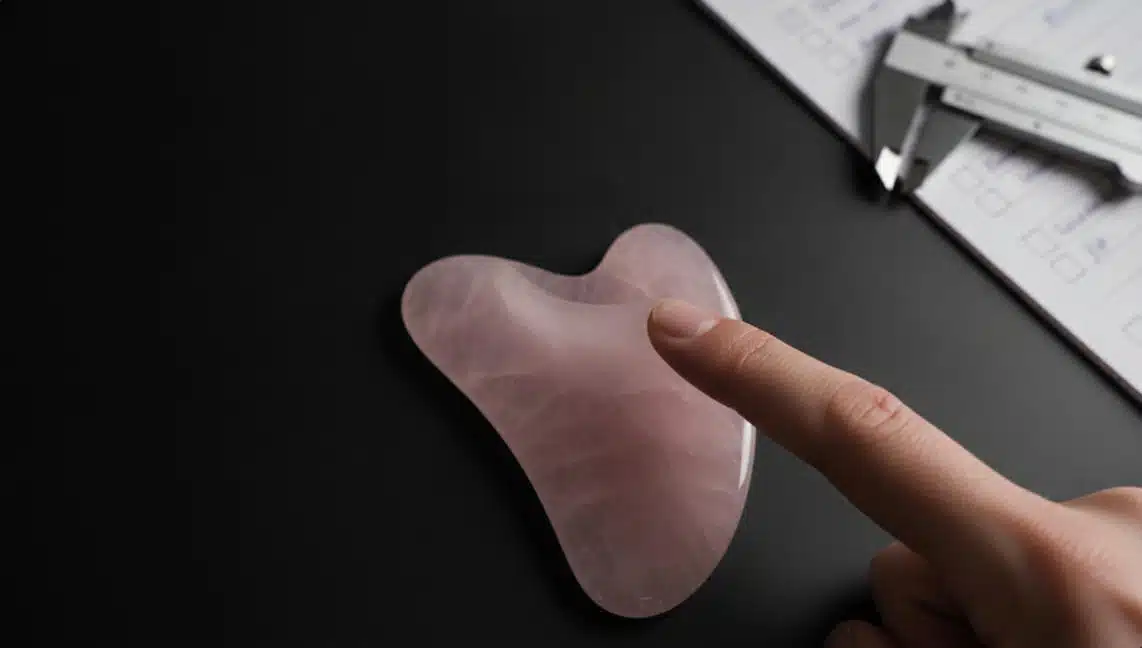
You do not need specialist equipment to evaluate inner-corner chamfering quality on gua sha tool samples. The methods described below require only a directional light source and your fingertip, and they should be applied to every pre-production sample you receive from any gua sha supplier before approving bulk production.
The 3 Check Method for Assessing Inner-Corner Ridge Line Quality
The first check is tactile and targets the ridge line directly. Hold the tool with the inner corner facing you and position your fingertip so that it rests across the inner corner zone — not along it, but across it, bridging the front face, the ridge line, and the side edge simultaneously. Apply light lateral pressure and draw your finger slowly along the full length of the inner corner, from one end of the zone to the other. You are feeling for continuity: a correctly chamfered and finished r-angle presents a smooth, uninterrupted curve from the face surface through the transition to the side edge. Any detectable change in surface character — a catch, a step, a faint line of resistance — indicates an incompletely resolved ridge line. This check should be performed on both the front face side and the back face side of the inner corner, because the two ridge lines are processed separately and can show different results.
The second check is optical and targets the geometry of the r-angle finish. Position the tool under a directional light source and rotate it slowly while observing the inner corner zone under oblique illumination — the light should strike the surface at a shallow angle rather than from above. A correctly executed r-angle finish reflects a smooth, continuous highlight that follows the contour of the inner corner without interruption or directional change. A flat bevel — indicating that the rolling step was incomplete — shows a distinct change in the highlight angle at the transition from the bevel plane to the face surface. A residual sharp ridge line shows a bright, narrow highlight line that runs along the edge — the optical signature of an angular transition that polishing has brightened but not resolved.
The third check is specific to batch orders and cannot be performed on a single sample. Request a minimum of five units pulled from different positions in the production run — not five consecutive units from the same batch position. Inner-corner chamfering quality can degrade across a production run as wheel wear progresses, and sampling from a single position will not reveal this variation. Applying the first two checks across all five units gives you a measure of process consistency rather than just product quality at a single point. A professional gua sha stone factory controls this variation through scheduled wheel inspection and replacement intervals. If your five-unit sample shows variation between units, you are seeing evidence of insufficient process control — and that variation will scale directly with your order quantity.
Questions to Ask Your Gua Sha Manufacturer Before Committing to Production
The conversation you have with a potential gua sha manufacturer before production begins is itself a quality indicator. Four questions should be part of every pre-production discussion that involves inner-corner chamfering. First: is inner-corner chamfering documented as a separate production stage in your workflow, with its own process parameters, or is it performed as part of polishing preparation? Second: what wheel profile specification do you use for each tool geometry in your catalog, and how do you verify that the wheel profile is matched to the specific product being processed? Third: what is the maximum contact time per engagement during the initial ridge line chamfering step, and how is that limit enforced at the production level? Fourth: at what stage in the production sequence do you perform inner-corner QC checks — before or after polishing?
A gua sha supplier who can answer all four questions specifically, consistently, and without consulting documentation in real time is demonstrating that inner-corner chamfering is a genuinely integrated part of their production system. A supplier who responds with general reassurances about product quality or deflects to certification documents is demonstrating that the process exists informally at best. The quality of this conversation is a direct proxy for the quality of the chamfering process — and it costs nothing to have it before you commit to a production order.
Why Inner-Corner Ridge Line Quality Is a Business Decision, Not Just a Technical One
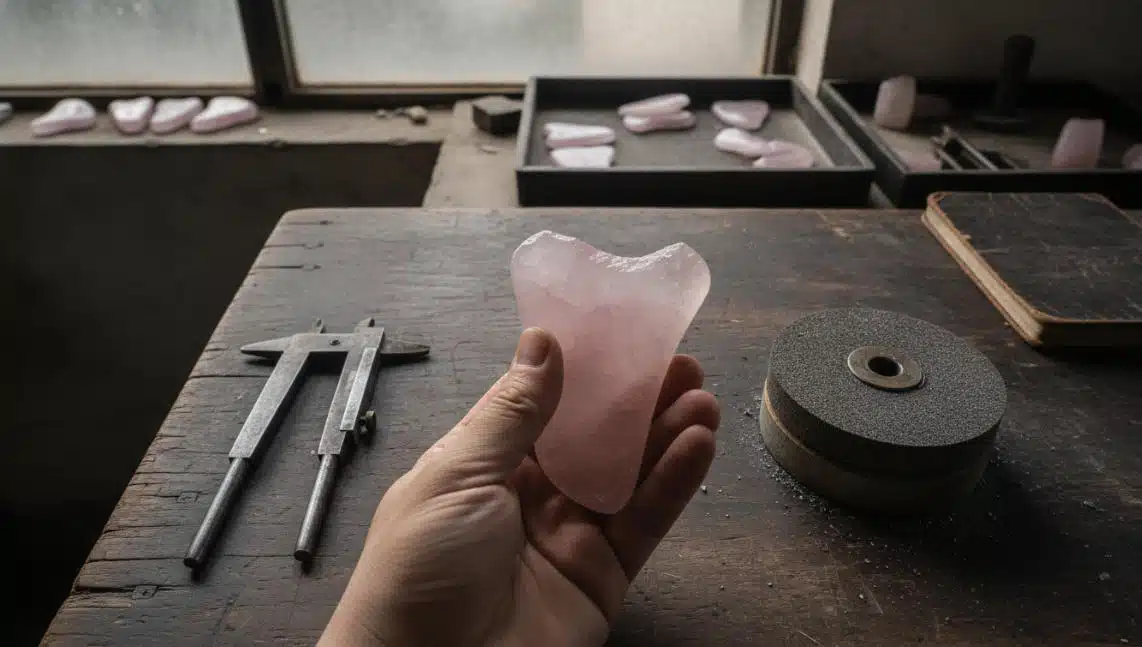
The safety argument for inner-corner chamfering is straightforward: unrelieved ridge lines injure skin, and injured customers create liability. But for buyers weighing the economics of sourcing from a higher-precision gua sha manufacturer against a lower-cost alternative, the case needs to be made in commercial terms as well. The compliance and risk dimensions below are the ones that make inner-corner quality a supply chain priority, not just a product specification.
Regulatory Compliance Requirements for Gua Sha Tool Importers
Gua sha tools sold in major consumer markets — the United States, the European Union, the United Kingdom, and Australia — are subject to general product safety regulations that require goods to be free from defects that could cause reasonably foreseeable harm during normal use. In the EU, this obligation falls under the General Product Safety Directive (GPSD) and its successor framework. In the United States, the Consumer Product Safety Commission (CPSC) enforces equivalent requirements under the Consumer Product Safety Act — and its public recall database documents the category of personal care and wellness tools as one of the more active areas for safety-related enforcement actions in recent years.
A gua sha tool with unrelieved inner-corner ridge lines that causes skin injury to an end user during normal use is not a quality complaint under these frameworks — it is a safety incident. Depending on the severity and jurisdiction, it can trigger mandatory reporting obligations, import holds, and civil liability exposure for the importer and retailer, not just the gua sha stone factory of origin. The logistical, legal, and reputational costs associated with a product safety incident in the wellness and beauty category are well-documented in CPSC enforcement records and EU RAPEX safety notifications — and in every case, they substantially exceed the per-unit cost difference between a supplier that controls inner-corner chamfering and one that does not. Treating inner-corner ridge line quality as a cost variable rather than a compliance requirement is a decision that transfers a substantial contingent liability onto your balance sheet in exchange for a per-unit saving that is typically marginal.
The Revenue Case for Sourcing from a Precision Gua Sha Manufacturer
Beyond liability avoidance, there is a positive commercial case for inner-corner ridge line quality that applies directly to brands operating in the premium wellness market. Consumer reviews of stone gua sha tools consistently identify in-use comfort — and specifically the feel of the tool through the inner corner zone during a stroke — as a primary differentiator in repeat purchase decisions and review ratings. This is not a hypothesis: it is a pattern visible in public review data on major e-commerce platforms for any stone gua sha product category, where reviews mentioning smoothness and comfort at the inner corner correlate with higher ratings and more frequent repeat purchase language than reviews focused on appearance alone.
For a brand building a product line in the $30 to $80 retail price range, the commercial implication is direct. A tool that earns repeat customers through consistent in-use comfort generates compounding revenue at a cost of zero incremental marketing spend. A tool that generates comfort complaints — even mild ones that do not rise to the level of injury reports — generates returns, negative reviews, and customer attrition that are expensive to reverse. The manufacturing decision that drives this outcome is not material selection, not packaging, and not price point. It is whether the gua sha tool manufacturer you source from controls the inner-corner ridge line geometry on every unit, every batch, consistently over time.
Documentation Available from Deyi Gems Upon Request
At Deyi Gems, inner-corner chamfering is a documented, independently verifiable production stage applied to every product across the catalog — jade, rose quartz, aventurine, obsidian, and stainless steel — before the polishing phase begins. Wheel profiles are matched to each product geometry and recorded per batch. Contact time limits are set per material type and enforced through technician training and in-process timing. Edge-thickness checks are performed on sampled units after chamfering and before polishing. Wheel profile validation against approved samples is required before any new product geometry enters gua sha production.
The following documentation is available to qualified buyers upon request through our standard pre-shipment QC package or third-party audit coordination: batch-level chamfering process parameter records; contact time logs by material type and product geometry; edge-thickness verification data by batch; wheel profile specifications matched to each SKU in the catalog; and third-party QC audit coordination through your preferred inspection partner. If you are currently sourcing from a gua sha supplier who cannot provide equivalent documentation, the technical framework in this article gives you the baseline to have that conversation — and to make a more informed decision about where your next production run is placed.
Faqs About Gua Sha Production Inner Corner
1. Why does inner-corner chamfering require a specialized grinding wheel?
Standard wheels cannot reach the ridge lines where the face meets the side edge inside the inner corner. A purpose-profiled wheel with a raised central ridge accesses this geometry without damaging surrounding surfaces.
2. How do I check if a gua sha tool’s inner corner is properly chamfered?
Draw your fingertip slowly across the inner corner zone under light lateral pressure. A correctly finished r-angle feels uniformly smooth with no detectable catch, step, or angular transition at any point.
3. Can polishing fix an unchamfered inner-corner ridge line?
No. Polishing refines surfaces — it does not change geometry. An unrelieved ridge line will remain sharp regardless of polish quality, and the high-gloss finish will make it harder to detect visually.
4. What is the most common inner-corner defect in gua sha production?
Under-chamfering — where the ridge line is softened but not fully resolved — is consistently the most frequently identified inner-corner defect in quality audits, and it is undetectable through visual inspection alone.
5. Does stone type affect how inner-corner chamfering is performed?
Yes. Rose quartz and aventurine have defined cleavage planes that increase fracture risk under concentrated grinding pressure. Contact parameters must be adjusted per material — a single universal setting is insufficient for a multi-stone catalog.
References:
• International Gem Society — Hardness and Toughness of Gemstones
• Gemological Institute of America — Gem Encyclopedia
• Swiss Gemmological Institute SSEF — Research and Standards
• EU General Product Safety Directive
• US Consumer Product Safety Commission — Recall Database