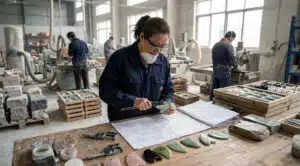
If you’ve ever requested a gua sha custom shape from a supplier and received a quote with a mold fee attached, your first instinct might be to negotiate it down — or skip it entirely. Before you do, here’s what you actually need to know: based on Deyi Gems’ internal data from 45 completed gua sha mold custom orders (tracked through June 2026), that fee breaks down into three distinct cost categories — shape tooling at 65.2%, engineering development at 21.5%, and sample materials at 13.3%. This isn’t a vague “setup charge.” Every dollar has a destination, and understanding where it goes is the fastest way to protect your sourcing budget and avoid costly surprises mid-project.
Most buyers approach gua sha tool custom projects the same way: they send a reference image, ask for a price, and expect the factory to handle the rest. That process works fine — until the mold fee shows up and nobody can explain what it covers. The goal of this article is to change that. Whether you’re placing your first custom order or you’ve been sourcing from a gua sha factory for years, a transparent cost breakdown gives you the leverage to ask better questions, compare quotes fairly, and make smarter purchasing decisions.
⚠️ All internal data cited in this article is sourced from Deyi Gems’ production records and is intended for reference purposes only. It does not represent industry-wide averages or authoritative benchmarks.
- Why Two-Thirds of Your Gua Sha Custom Budget Goes to One Component
- The Part of Gua Sha Custom Development That Rarely Gets Explained
- Why Gua Sha Tools Are Harder to Engineer Than Most Products
- Why Material Type Changes Everything About Your Tooling Cost
- Why Suppliers Charge a Mold Fee at All — And What It Actually Protects
- Faqs About Gua Sha Custom Mold Fee
Why Two-Thirds of Your Gua Sha Custom Budget Goes to One Component
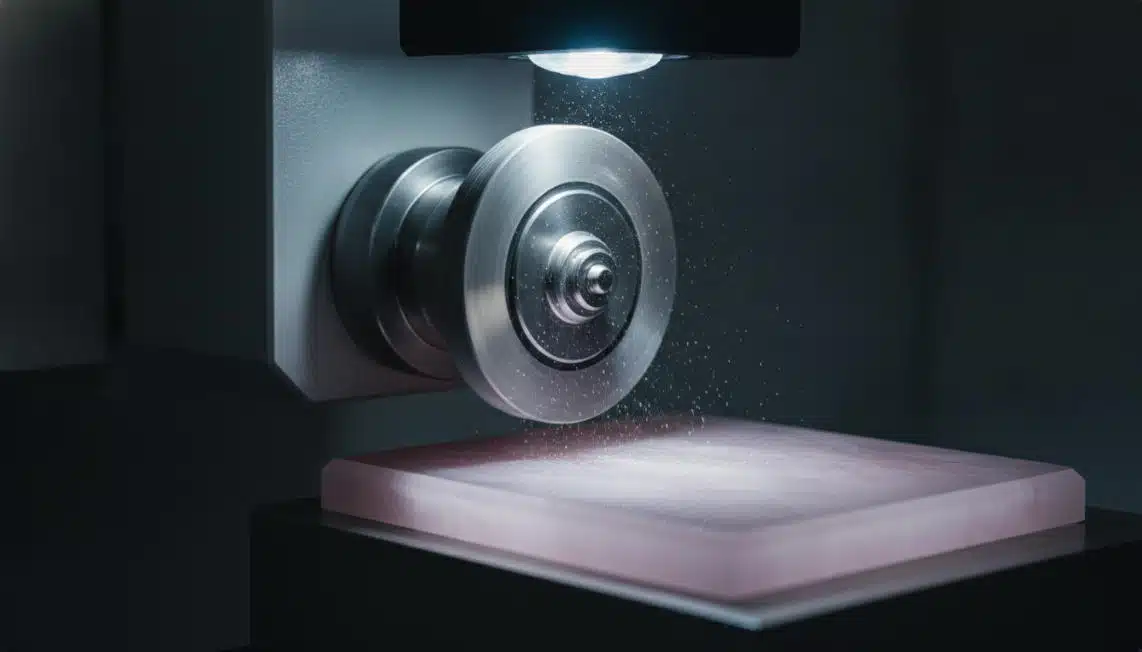
When buyers first see a mold fee breakdown, the tooling line item is almost always the one that raises eyebrows. Sixty-five percent feels like a lot — until you understand what’s actually being built. In a gua sha custom production workflow, creating a new shape doesn’t mean a technician sketches an outline and starts grinding. It means engineering an entirely new mechanical component from scratch, one that will define every single unit produced in your bulk order. That component is called a profile grinding wheel, and it’s the reason tooling dominates the cost structure.
The Profile Grinding Wheel: The Component Most Buyers Never Hear About
A profile grinding wheel — known in Chinese manufacturing as a 定形砂轮 — is a precision-machined part that controls the movement trajectory of the grinding machine. Think of it as a physical template embedded into the production equipment itself. When the machine operates, it follows the exact path carved into that wheel, reproducing your gua sha custom shape consistently across hundreds or thousands of units. Without a correctly engineered profile wheel, the machine has no reference point. It cannot replicate a compound curve, a beveled edge, or a concave facial contour with any reliability.
This is why you cannot simply send a photo to a gua sha factory and expect the tooling cost to be minimal. The factory isn’t just cutting stone — they’re building a dedicated mechanical guide that encodes your shape into the production line itself. Every curve, every edge angle, every thickness transition has to be translated from your design file into a physical grinding path. That engineering process, and the machined component it produces, is where your 65.2% goes.
Manual Samples vs. Machine Production: A Trade-Off Worth Understanding
Here’s a decision point that catches many buyers off guard. You do have an option to request a handmade sample first, before committing to the full profile wheel cost. A skilled artisan can approximate your gua sha tool custom design by hand, giving you a physical reference to evaluate the shape, proportions, and feel. This approach reduces your upfront investment, which makes sense if you’re still in early concept validation and not yet ready to commit to tooling.
However, there’s a real risk embedded in that choice. A handmade sample and a machine-produced unit are not the same object. The handmade version is shaped by a craftsperson’s judgment — their hand pressure, their grinding angle, their interpretation of your reference. The machine-produced version is shaped by the profile wheel, which operates on fixed mechanical parameters. When you approve a handmade sample and then move to bulk production, the final product will almost certainly differ from what you approved. For buyers with strict consistency requirements — particularly those supplying professional clinics, spa brands, or retail chains — that gap can be a serious quality control problem.
The better path for most gua sha manufacturer relationships at scale is to invest in the profile wheel upfront, validate the shape at the tooling stage, and enter bulk production with a mechanically verified reference. It costs more at the start, but it eliminates the consistency gap entirely. This means you can present a sample to your retail buyers or end customers with full confidence that every unit coming off the line will match it exactly.
Why Modern Gua Sha Manufacturing Is No Longer a Handcraft Industry
There’s a persistent assumption in the market that gua sha tools are artisanal products — shaped by hand, finished by eye, and inherently variable from piece to piece. That image made sense twenty years ago. It does not reflect how a functioning gua sha factory operates in 2025. The shift toward CNC-assisted grinding, automated edge finishing, and precision tooling wasn’t driven by a desire to industrialize a traditional craft. It was driven by demand — specifically, by buyers who needed 5,000 units to look identical for a product launch, or 10,000 units to pass a retail chain’s incoming quality inspection.
Pure handcraft production introduces variability at every stage: grinding pressure, finishing time, individual artisan skill level. At small volumes, that variability is manageable. At the order sizes that make a gua sha custom project commercially viable for most brands, it becomes a liability. CNC-guided production with proper tooling removes the human variable from the shaping process, while still leaving room for skilled hand finishing at the polishing stage. The result is a product that meets modern retail consistency standards without abandoning the material quality that makes natural stone gua sha worth sourcing in the first place. This means you get the aesthetic authenticity your customers expect — backed by the dimensional consistency your QC process demands.
The Part of Gua Sha Custom Development That Rarely Gets Explained
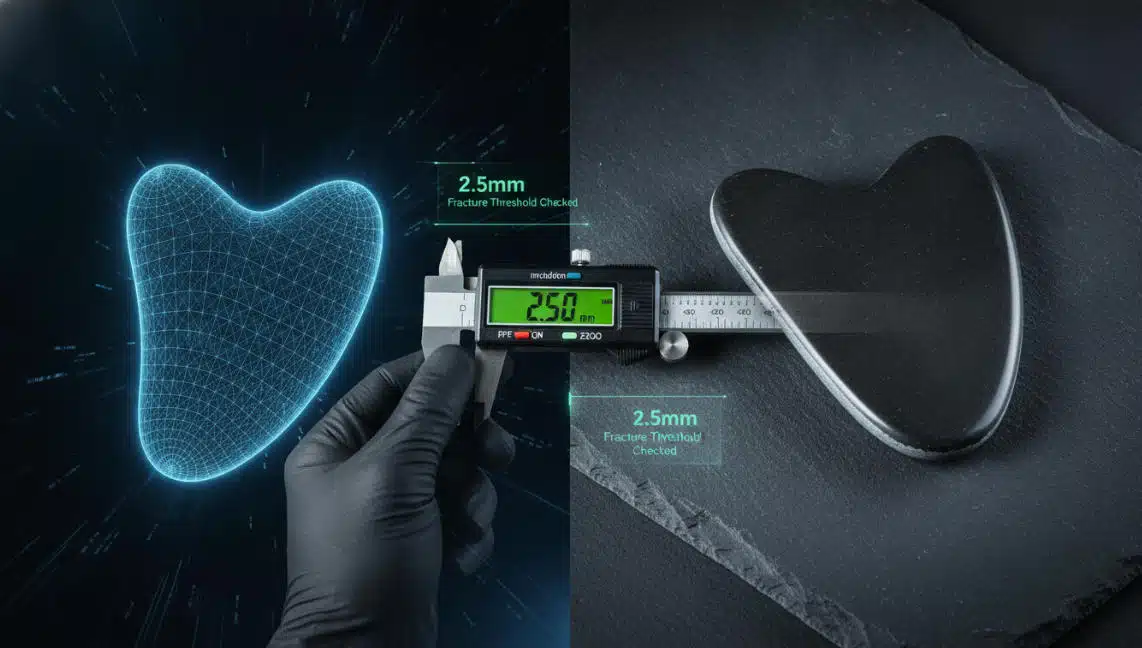
Ask most buyers what the engineering fee covers, and you’ll get a shrug. It’s the line item that feels the most abstract — no physical component, no tangible deliverable you can hold in your hand. But of the three cost categories in a gua sha mold custom project, engineering development is the one most likely to determine whether your product actually works as intended. At 21.5% of the average mold fee, it’s not a minor charge. And unlike tooling, which produces a specific mechanical part, engineering development produces something less visible but equally critical: a manufacturable design.
The disconnect usually starts before the first email is sent. Most buyers arrive at a gua sha factory with a reference — a photograph of a competitor’s product, a hand-drawn sketch, an AI-generated rendering, or a flat PDF diagram. These are useful starting points for a conversation. They are not useful inputs for a CNC machine. A photograph tells an engineer what a product looks like. It tells them nothing about wall thickness, edge geometry, internal stress points, or whether the shape can be reproduced in stone without fracturing during grinding. Translating a visual reference into a manufacturable 3D file is a skilled technical process, and that process is what you’re paying for in the engineering portion of your gua sha custom mold fee.
What Your Reference Image Cannot Tell a Factory
To understand why engineering costs exist, it helps to understand the gap between what buyers provide and what production actually requires. When a buyer sends a JPEG or a sketch, the factory’s engineering team has to reconstruct the entire geometry of the product from scratch. That means building a precise 3D solid model — typically in STEP, STP, or IGES format — that captures every surface, every curve transition, and every dimensional relationship in the design. This model becomes the authoritative reference for CNC programming, tooling fabrication, and quality inspection. Without it, there is no reliable way to produce consistent units or verify that finished products meet the approved specification.
For most product categories, this process is straightforward. A rectangular phone case, a flat tile, a cylindrical container — these shapes have simple geometry and well-understood manufacturing constraints. A gua sha tool custom design is none of those things. Gua sha tools are defined by compound curves: concave facial surfaces, beveled edges, contoured handles, and asymmetric profiles that need to feel correct in the hand while performing a specific therapeutic motion against the skin. Every one of those curves has to be modeled accurately, and every transition between surfaces has to be engineered to avoid stress concentration points that could cause the stone to crack during production or use.
What Gua Sha Engineering Development Actually Covers
The engineering phase of a gua sha custom project typically includes six distinct workstreams, each of which contributes to the final 3D model and CNC plan. The first is shape modeling — building the initial 3D geometry from the buyer’s reference material. The second is curve and arc optimization, where the engineering team refines the modeled curves to match both the aesthetic intent of the design and the mechanical constraints of stone grinding. This step often involves multiple iterations, particularly for designs with tight radius curves or complex multi-surface profiles.
Edge thickness adjustment is the third workstream, and it’s one of the most practically important. Natural stone has a fracture threshold — edges that are too thin will chip or break during grinding, during shipping, or during use. A skilled gua sha manufacturer will identify these risk zones early and adjust the geometry before tooling is cut, rather than discovering the problem after the first batch of samples fractures at the edge. Ergonomic correction is the fourth workstream, which involves validating that the modeled shape will actually perform correctly in a user’s hand — the grip angle, the contact surface, the pressure distribution during a typical scraping motion.
The fifth workstream is mold feasibility analysis, where the engineering team assesses whether the designed shape can be reproduced reliably with the available tooling and CNC equipment. Some designs that look straightforward in a rendering are actually very difficult to hold in a fixture without movement during grinding — and movement during grinding means dimensional variation in the finished product. The sixth workstream is CNC path planning, which maps the precise cutting sequence the machine will follow to produce the shape efficiently while minimizing material loss and fracture risk. Taken together, these six workstreams represent a significant technical investment — and they’re what separates a gua sha factory that can reliably reproduce your design from one that’s essentially guessing.
Why Gua Sha Tools Are Harder to Engineer Than Most Products
It’s worth being direct about this: gua sha tools are among the more technically demanding products to engineer in the natural stone category. The reason isn’t complexity in the sense of mechanical moving parts or electronic components — it’s complexity in the sense of surface geometry combined with material brittleness. According to the Gemological Institute of America’s guidelines on lapidary work and stone processing, natural stone behaves very differently from metals or plastics under machining stress. Fracture propagation along natural crystal planes, variable hardness across a single piece of material, and the absence of grain direction predictability all create engineering challenges that simply don’t exist when you’re molding plastic or stamping metal.
For a gua sha tool custom project, this means the engineering team has to anticipate fracture risk at every point in the design — not just at the obvious thin edges, but at internal curve transitions where stress concentrates during grinding. They have to design a CNC path that approaches each surface at the correct angle and speed to avoid inducing micro-fractures that might not be visible at inspection but will cause the product to chip during customer use. They have to specify fixturing that holds irregular natural stone blanks securely without applying the kind of clamping pressure that would crack the material. None of this appears in the buyer’s reference image. All of it has to be engineered before a single piece of stone is touched. This means that investing in proper engineering upfront directly reduces your defect rate in bulk production — and your defect rate in bulk production directly affects your landed cost per sellable unit.
Why Material Is the Smallest Cost at the Sample Stage — And the Largest at Scale
If you’ve been following the cost breakdown so far, the 13.3% material figure probably feels anticlimactic. After tooling at 65.2% and engineering at 21.5%, sample materials seem almost negligible. And at the sample stage, they genuinely are. Even if your gua sha custom design calls for premium amethyst — one of the more expensive natural stone options in the market — the material consumed during a sample run represents a small fraction of the total mold fee. A single sample piece uses a limited amount of raw stone, and that stone cost is simply too small relative to the tooling and engineering investment to move the needle significantly on total project cost.
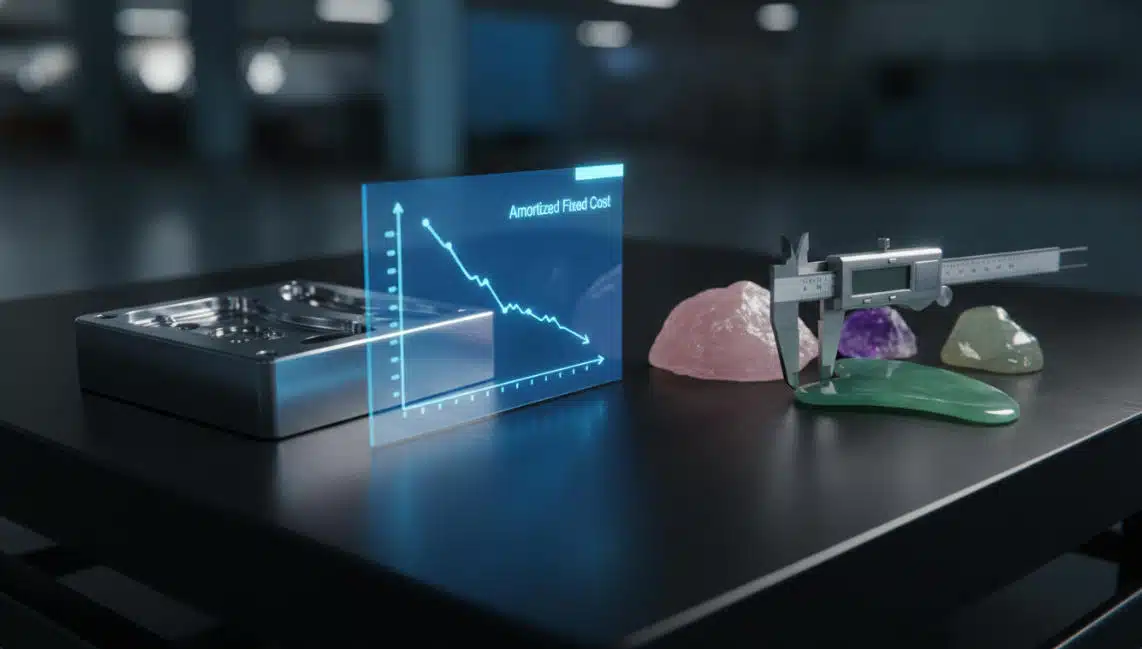
But here’s the dynamic that changes everything once you move into bulk production. Tooling and engineering are one-time fixed costs. Once the profile grinding wheel is machined and the 3D model is validated, those costs are fully amortized — spread evenly across every unit in your order. If you produce 1,000 units, the tooling and engineering costs are divided by 1,000. If you produce 10,000 units, they’re divided by 10,000. The per-unit contribution of those fixed costs shrinks steadily as your order volume grows, eventually becoming almost invisible in your unit economics. This is one of the core financial advantages of scaling with a single gua sha manufacturer over multiple production runs.
The Cost Curve That Every Buyer Should Understand Before Placing a Bulk Order
Material cost does not follow this curve. Every unit requires its own raw stone, and that stone is priced individually regardless of how many units are in the order. A piece of rose quartz costs what it costs. A piece of green aventurine costs what it costs. Whether you’re ordering 500 units or 50,000 units, the material cost per piece remains essentially constant. This creates a cost structure where fixed costs (tooling, engineering) decline sharply per unit as volume increases, while variable costs (material) stay flat. The practical implication is that as your order scales up, material becomes progressively dominant in your per-unit cost — not because material gets more expensive, but because everything else gets cheaper.
For buyers sourcing from a gua sha factory at commercial volumes, this means material selection deserves far more attention during the product development phase than most buyers give it. When you’re evaluating a sample, the material cost difference between standard rose quartz and premium amethyst might feel like a rounding error. When you’re running a 5,000-unit bulk order, that same per-unit difference multiplied across the full order becomes a significant line item in your landed cost calculation. According to the International Gem Society’s reference data on gemstone pricing and valuation, price differentials between stone grades can vary by a factor of three to ten times within the same mineral family — a range that translates directly into meaningful cost variation at bulk production volumes.
How to Use the Sample Stage to Make Better Material Decisions
The sample stage is your lowest-cost opportunity to evaluate material options side by side. Because the fixed costs are already sunk into the tooling and engineering, producing comparison samples in two or three different stone varieties adds only the incremental material cost — which, as established, is a small number. If you’re working with a gua sha tool custom project and you have genuine uncertainty about whether to specify rose quartz, clear quartz, or jade for your design, the sample stage is exactly the right moment to resolve that uncertainty. Requesting parallel samples in multiple materials costs a fraction of what a material change would cost after bulk production has started.
There’s a practical framework for making this decision efficiently. First, establish your retail price point and work backwards to your maximum allowable material cost per unit. Second, request samples in the materials that fall within that cost range, plus one option above it if there’s a compelling aesthetic or marketing reason. Third, evaluate those samples not just on appearance but on surface finish quality, edge durability, and how the material responds to the grinding and polishing process specific to your design. Some stone varieties that look identical in a rough form will produce very different surface qualities after polishing — and that surface quality is what your end customer will see and feel. A knowledgeable gua sha manufacturer should be able to guide you through these trade-offs based on their direct production experience with each material type.
A Note on Gemstone Quality Standards and What They Mean for Your Product
If your gua sha custom project involves stones that carry any kind of quality or authenticity claim — natural jade, genuine amethyst, certified rose quartz — it’s worth understanding how quality is assessed and communicated in the gemstone industry. Institutions such as the Gemological Institute of America (GIA) and the Swiss Gemmological Institute (SSEF) have established grading and identification frameworks that provide an objective basis for evaluating stone quality. While gua sha tools are therapeutic and aesthetic products rather than investment gemstones, the underlying quality factors — mineral composition, inclusion density, color consistency, surface finish potential — are directly relevant to your product’s perceived value and your customers’ satisfaction.
For buyers supplying wellness brands, spa retailers, or premium gift markets, being able to reference credible quality standards in your product descriptions and sourcing documentation adds a layer of credibility that generic supplier claims cannot provide. It also gives you a basis for quality verification when receiving bulk shipments — rather than relying solely on visual inspection, you can specify measurable quality parameters that align with established gemological frameworks. This means you can build a quality narrative around your gua sha tool custom product that stands up to scrutiny from sophisticated retail buyers and end customers alike, which is increasingly important in a market where material authenticity claims are under growing consumer scrutiny.
Why Material Type Changes Everything About Your Tooling Cost
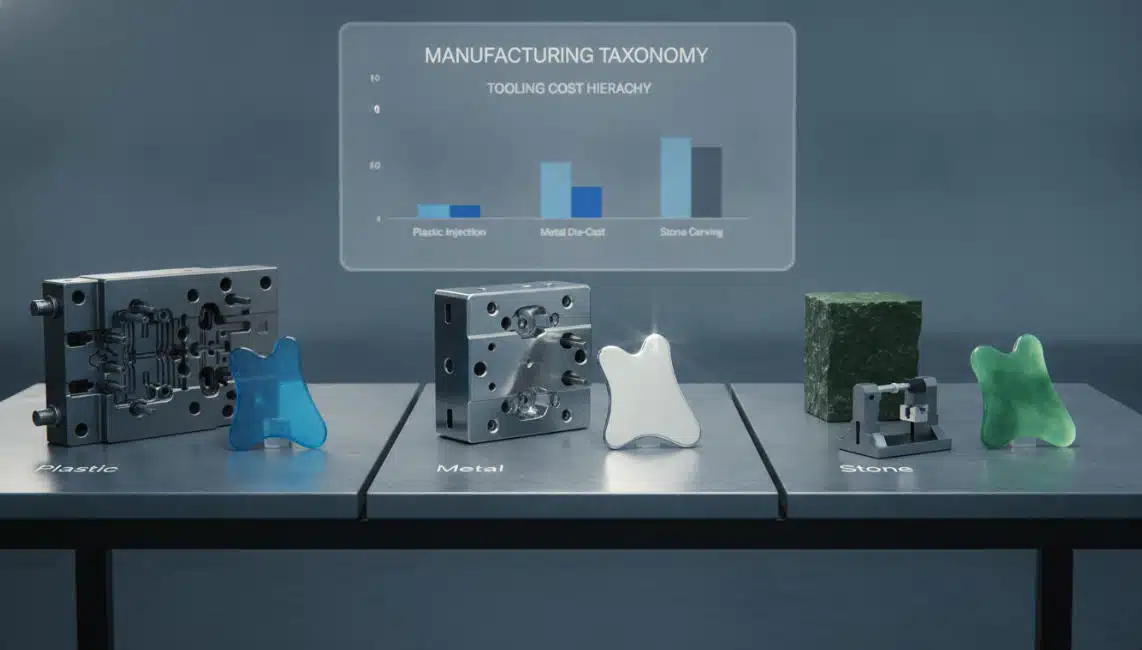
One of the most common mistakes buyers make when budgeting a gua sha custom project is assuming that mold fees are roughly similar across material types. They’re not. The tooling logic, the manufacturing process, and the cost structure for a plastic gua sha tool are fundamentally different from those for a metal one — and both are different again from natural stone. Understanding these differences isn’t just useful for budgeting. It’s essential for making an informed decision about which material type actually fits your product concept, your target market, and your production economics. Across all the gua sha mold custom orders processed at Deyi Gems, the spread between the lowest and highest tooling costs runs from approximately $50 at the low end of natural stone development to over $3,000 for complex plastic injection mold structures — a sixty-fold range driven almost entirely by material type and manufacturing process.
Plastic Gua Sha Tools: The Highest Mold Cost, and the Reasons Behind It
Of the three major material categories in the gua sha tool custom market, plastic consistently carries the highest mold fee. The reason is the manufacturing process itself. Plastic gua sha tools are produced through injection molding — a process that requires a complete, precision-engineered steel mold capable of withstanding thousands of production cycles under high pressure and temperature. These molds are not simple shapes cut from a block of steel. They are complex assemblies that include hot runner systems to control material flow, ejector pin mechanisms to release finished parts without marking the surface, cooling water channels to manage heat dissipation, and in many cases spark erosion finishing to achieve the surface texture required for the final product.
The steel grades used for injection molds in a professional gua sha factory reflect this complexity. P20 steel is the standard for medium-run molds where moderate hardness and good machinability are the priority. S136 steel offers significantly higher corrosion resistance, which matters when the molding material or operating environment introduces moisture. NAK80 is selected for applications requiring high mirror-surface finish quality — relevant for gua sha tools where the aesthetic of the product surface is a key selling point. Each of these grades costs more to machine than standard tool steel, and each requires more precision in the CNC milling and finishing process. According to manufacturing industry data published by the Society of Plastics Engineers, the cost of injection mold fabrication is heavily influenced by steel grade selection, mold complexity, and the number of cavities — all of which scale upward for consumer wellness products that require high cosmetic surface quality.
For a straightforward plastic gua sha custom shape without electronic components or multi-part assembly, typical mold fees run from $500 to $1,500. Add functional complexity — an EMS stimulation module, integrated LED elements, or a multi-component assembly that requires secondary molds — and that range extends to $3,000 or beyond. The key insight for buyers is that plastic tooling is a substantial upfront investment, but one that amortizes aggressively at high volumes. If your business model supports order quantities in the tens of thousands, the per-unit tooling contribution becomes negligible, and plastic’s advantage in per-unit material cost and production speed makes a strong economic case. This means that for high-volume, price-competitive retail channels, plastic tooling investment can deliver a lower total landed cost per unit than any other material option.
Metal Gua Sha Tools: Mid-Range Complexity With Specific Engineering Demands
Metal gua sha tools occupy the middle position in the mold cost hierarchy, with typical development fees ranging from $200 to $2,000 depending on the metal type, the manufacturing process, and the complexity of the design. The most common metals in the gua sha tool custom market are stainless steel, zinc alloy, and copper — each of which has different machining characteristics and different tooling requirements. Stainless steel is the most demanding to work with due to its hardness and work-hardening tendency, which places high stress on cutting tools and molds. Zinc alloy is more forgiving and is commonly used for die-casting applications where complex shapes need to be produced at moderate cost. Copper sits between the two, offering good machinability but requiring careful surface treatment to achieve the finish quality buyers expect.
The tooling types for metal gua sha mold custom projects vary with the production process. Stamping dies are used for flat or lightly contoured metal gua sha shapes, where a sheet of metal is pressed into form under high tonnage. Stretch dies are used when the design requires deeper forming — pulling the metal into a more pronounced three-dimensional profile. Die-casting molds are used when the design has complex geometry that cannot be achieved through stamping, requiring molten metal to be injected into a mold under pressure. Each of these processes has distinct tooling cost drivers: stamping dies are relatively straightforward but require precise edge geometry to avoid tearing the metal; die-casting molds require careful mold flow analysis to ensure the molten metal fills the cavity completely without porosity or cold shut defects.
One specific cost factor that buyers often overlook in metal gua sha custom development is surface finishing tooling. A mirror-polished stainless steel gua sha tool — the type that photographs well for premium brand positioning — requires not just the primary forming tooling but also dedicated polishing fixtures and jigs that hold the part in the correct orientation during each stage of the polishing process. These fixtures are custom-made for each design and represent an additional tooling cost that doesn’t always appear in the initial quote. If your design calls for a high-mirror finish on a complex curved surface, ask your gua sha manufacturer explicitly whether polishing fixtures are included in the quoted mold fee — or whether they’ll appear as a separate line item later in the project. This means that getting a fully itemized tooling quote before committing to a metal design can save you from budget surprises that are genuinely difficult to absorb mid-project.
Natural Stone Gua Sha Tools: The Lowest Mold Cost, But a Different Kind of Engineering
Natural stone is where most buyers in the gua sha custom market start, and it carries the lowest typical mold development cost — ranging from approximately $50 to $800 for standard designs. But it’s important to understand that “lowest mold cost” doesn’t mean “simplest engineering.” It means that the tooling logic for natural stone is fundamentally different from injection molding or metal forming, and that difference cuts in both directions — lower cost on some dimensions, but unique challenges on others that don’t exist in synthetic material manufacturing.
Natural stone gua sha tools don’t use traditional steel injection molds. The production process is subtractive rather than formative — you start with a rough stone blank and remove material through grinding and polishing until the desired shape is achieved. The tooling investment for this process centers on three elements: CNC programming, custom fixtures and jigs, and polishing tooling. CNC programming defines the cutting paths and machine parameters for shaping each piece. Custom fixtures hold the irregular natural stone blank securely during grinding without cracking it — a non-trivial engineering challenge, since every rough stone blank has a slightly different shape and the fixture has to accommodate that variation while maintaining consistent positioning. Polishing tooling includes the shaped grinding wheels and polishing heads that give the finished product its surface quality.
The fundamental challenge with natural stone that doesn’t exist in plastic or metal is material variability. Every piece of rough stone is different. Its hardness varies across the piece, its internal structure includes natural inclusions and crystal planes that influence how it responds to grinding, and its shape before processing is irregular in ways that a plastic pellet or a metal sheet simply isn’t. According to gemological research published by the Gemological Institute of America on mineral properties and lapidary techniques, the fracture and cleavage characteristics of common gua sha stone materials — including nephrite jade, rose quartz, and aventurine — vary significantly and must be accounted for in CNC path planning to avoid inducing fractures during processing. A gua sha factory working with natural stone has to build this material variability into its production process at the engineering stage, which is reflected in the programming and fixture development costs that make up the majority of natural stone mold fees. This means that while your upfront tooling investment for natural stone is the lowest of the three material categories, the engineering expertise required to execute it reliably is anything but minimal — and choosing a manufacturer with genuine stone processing experience is more important than the fee itself.
Why Suppliers Charge a Mold Fee at All — And What It Actually Protects

If you’ve worked through the cost breakdown in this article — 65.2% tooling, 21.5% engineering, 13.3% materials — you might still have a lingering question: why does the fee exist as a separate charge at all? Why doesn’t the gua sha manufacturer simply build these costs into the unit price and quote a higher per-piece rate? The answer has everything to do with how commercial sourcing actually works in practice, and understanding it will change how you evaluate mold fee policies across different suppliers.
When a brand or distributor begins a gua sha custom project, they rarely approach just one supplier. The standard sourcing process involves sending the same design brief to three, five, sometimes eight different factories simultaneously — requesting samples, tooling quotes, and unit price estimates from each. Some of those factories will invest in engineering development, machine a profile grinding wheel, produce sample pieces, and ship them for evaluation. Others will receive the same brief, do the same work, and never hear back. The buyer selects one gua sha factory to proceed with and moves to bulk production. Every other factory that invested in tooling and engineering absorbs that cost with no return.
Without a mold fee, this dynamic creates a serious structural problem for manufacturers. A gua sha factory that produces ten custom tooling sets in a month and converts only three of them into bulk orders is effectively subsidizing the sourcing process for every buyer who chose a different supplier. The mold fee shifts a portion of that risk back to the buyer — not as a profit center, but as a mechanism that ensures both parties have genuine skin in the game. Buyers who pay a mold fee are demonstrably more committed to the project than those who aren’t. Manufacturers who receive a mold fee can invest in proper engineering without the financial pressure of knowing that the work might produce nothing. According to industry sourcing practices documented by the International Trade Centre, risk-sharing mechanisms in custom manufacturing procurement are standard practice precisely because they align incentives between buyer and supplier at the development stage — and aligned incentives produce better outcomes for both sides.
The Long-Term Partner Exception — And What It Means for Your Sourcing Strategy
There is one significant exception to the standard mold fee structure: established commercial partnerships. Buyers who have a documented history of repeat orders with a gua sha manufacturer — consistent volume, reliable payment terms, predictable product categories — are often offered mold fee waivers or credits as part of the commercial relationship. This isn’t charity. It’s a rational business decision by the manufacturer, who has enough transaction history to assess the buyer’s conversion probability with confidence. A buyer who has placed four bulk orders over two years represents a fundamentally different risk profile than an unknown buyer approaching a gua sha factory for the first time with a new design.
If you’re early in your sourcing relationship with a new supplier, you shouldn’t expect a mold fee waiver — and being surprised or offended by the charge is a sign of misaligned expectations rather than supplier bad faith. What you can reasonably expect from a transparent gua sha manufacturer is a clear, itemized breakdown of what the mold fee covers, which is exactly what this article has been unpacking. If a supplier quotes you a mold fee but cannot explain the allocation between tooling, engineering, and materials, that’s a more legitimate concern than the fee’s existence. Opacity in cost structure at the development stage tends to predict opacity in production — and opacity in production is where sourcing relationships go wrong at scale.
Minor Cost Factors: What’s Missing From the Three-Category Breakdown
The tooling, engineering, and material costs covered in this article account for the vast majority of a gua sha custom mold fee — but they don’t account for everything. Labor, utilities, equipment depreciation, and administrative overhead all contribute to the true cost of running a sample development program. In Deyi Gems’ internal cost accounting, these factors are tracked but not separately quoted in the mold fee structure, because their individual contribution at the sample stage is small enough that breaking them out would add complexity without meaningfully improving the buyer’s understanding of where their money goes.
It’s worth noting, however, that these costs do not disappear in bulk production. A gua sha factory that absorbs overhead into its sample fee structure will recover those costs through bulk unit pricing — which is the appropriate place for them, since per-unit overhead is a function of production volume and efficiency. The reason they’re excluded from the mold fee discussion is that mold fees are fixed development costs, while overhead is a variable production cost, and mixing the two in the same conversation creates more confusion than clarity. For buyers who want to understand the full cost structure of a gua sha tool custom project from sample to bulk delivery, the right approach is to request a complete cost breakdown at each stage separately — development costs, sample costs, unit production costs, and logistics costs — rather than trying to reconcile everything from the mold fee quote alone.
How to Use This Breakdown When Evaluating Supplier Quotes
Now that you understand where the mold fee goes, you’re in a position to evaluate gua sha mold custom quotes with a level of specificity that most buyers never reach. Here’s a practical framework for applying this knowledge. When you receive a mold fee quote, ask the supplier to break it down into its component categories. You should see a tooling line item that represents the majority of the fee — if a supplier quotes you a mold fee but has no tooling component, that’s a signal that they’re either using a non-standard production process or bundling costs in a way that makes comparison difficult. You should see an engineering or design development line item that reflects the actual work of translating your reference into a manufacturable file. And you should see a material line item that corresponds to the stone or material consumed during sample production.
Compare these allocations across suppliers, not just the total fee. A gua sha factory quoting $400 with 80% allocated to tooling and 20% to engineering is telling you something different about their process than a factory quoting the same $400 with 50% to tooling and 50% to a vague “design fee.” The allocation reveals the cost structure of the operation — and the cost structure reveals how the factory actually works. If the engineering allocation seems low for a complex design, ask what’s included. If the tooling allocation seems high for a simple shape, ask why. These questions don’t make you a difficult buyer. They make you a prepared one — and prepared buyers get better outcomes from gua sha custom supplier relationships than those who treat the mold fee as an opaque entry barrier to be minimized.
A Final Note on Risk, Investment, and Getting Custom Right
Custom product development is inherently an investment with uncertain returns. You’re spending money on tooling and engineering before a single sellable unit exists, based on a prediction that the final product will perform well enough in your market to justify the expenditure. That uncertainty is real, and the mold fee is part of it. But the way to manage that uncertainty isn’t to minimize the development investment — it’s to make sure the development investment is spent correctly.
A well-engineered gua sha tool custom project — one where the tooling is properly designed, the 3D model accurately captures your design intent, and the material is selected with bulk production economics in mind — gives you a product that can be reproduced reliably, scaled predictably, and defended on quality. A poorly executed development process, regardless of how low the mold fee was, gives you a sample that diverges from bulk production, a tooling setup that introduces dimensional variation, and a material specification that creates cost surprises at scale. The mold fee, understood correctly, is not a barrier. It is the price of entry into a development process that either sets your product up for success or doesn’t — and knowing what it covers is the first step toward making sure it does the former.
Faqs About Gua Sha Custom Mold Fee
1. What is a gua sha custom mold fee?
A mold fee covers the cost of engineering, tooling, and sample materials required to produce your custom gua sha shape. Most manufacturers charge $50–$800 for natural stone designs before bulk production begins.
2. Why does the shape mold cost the most?
The profile grinding wheel — a precision mechanical component — must be custom-machined for every new gua sha custom shape. This single part accounts for approximately 65.2% of the total mold fee.
3. Can I skip the mold fee by requesting a handmade sample?
Yes, but with a trade-off. Handmade samples cost less upfront, but the final machine-produced bulk units may not match the approved sample exactly, creating consistency risks at scale.
4. Which material has the highest gua sha custom mold cost?
Plastic injection molds are the most expensive, ranging from $500 to $3,000+. Natural stone tooling is the lowest, typically $50–$800, though it requires specialized CNC programming and fixturing.
5. Is the mold fee refundable if I don’t place a bulk order?
Typically no. The mold fee compensates the manufacturer for real development costs already incurred. It functions as a risk-sharing mechanism, not a deposit against future orders.