If you buy gua sha wholesale in bulk, here is the disclosure you need before your next purchase order goes out: almost none of the “white jade” boards moving through catalogs today are actual nephrite. After more than 12 years cutting, grading, and polishing white stone for gua sha production, we’ve watched this pattern repeat order after order. A lower-cost substitute stone ships under the jade name, and under bright light, at a thinned edge, some batches of that substitute look close enough to white quartz gua sha wholesale stock that even experienced buyers second-guess themselves. This isn’t automatically a fraud story. It’s a structural one — and once you understand the physics behind it, you stop guessing from a listing photo and start buying on evidence.
That distinction matters more than most sourcing guides admit. You can lose margin two different ways here: paying a jade price for a stone that never was jade, or rejecting a genuinely dense, well-processed batch because it happens to glow like quartz under your inspection lamp. Neither mistake is really about honesty. Both come down to whether you know what you’re looking at on a structural level, which is the gap this disclosure is built to close.
Why White Jade Gua Sha Can Look Like White Quartz
Two Different Ways Light Moves Through Stone
Here’s the part most wholesale conversations skip entirely. White quartz gua sha wholesale material is a single continuous crystal. Silicon and oxygen atoms lock into one repeating lattice, so when light enters the stone it keeps traveling in a fairly consistent direction before it exits. GIA’s own gemological documentation on quartz describes this as an open, ordered atomic framework, and that ordering is exactly why rock crystal quartz tends to show ice-like cracking, cloud-like zoning, and directional light bands rather than an even, all-over glow.
White stone used as a jade substitute works on a completely different principle. It’s a granular aggregate — thousands of tiny mineral grains packed together rather than one continuous lattice. GIA’s material on jadeite structure notes that this kind of interlocking, fine-grained texture is what scatters light and produces jade’s smooth, waxy look rather than a crystal’s directional shine, and you can read their breakdown of that texture-to-luster relationship directly on GIA’s jade quality page. Each grain in that structure reflects and scatters light independently. There’s no single path for light to follow, so instead of a directional shine you get a soft, even, pearl-like glow.
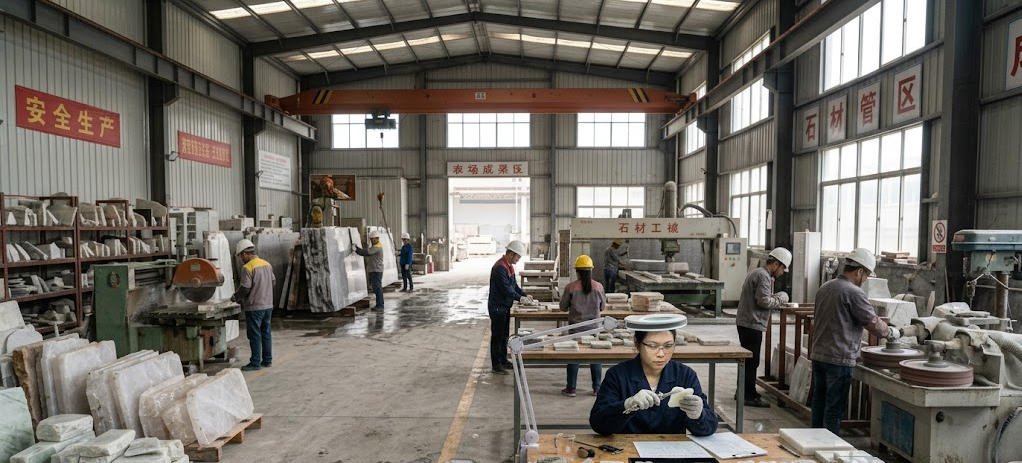
So what does that mean at the workbench, not just in a textbook? It means the “transparency test” your quality control team has probably been using is the wrong test entirely. Translucency alone tells you almost nothing about whether a board is quartz or jade-substitute white stone — both can be genuinely see-through. The question that actually separates them is whether the light inside the stone travels with direction and continuity, or whether it scatters into a flat, pearly haze. This single reframe is the difference between a QC checklist that catches mislabeled batches and one that just measures how much light gets through, which every polished stone will pass regardless of what it actually is.
Why Some Gua Sha Wholesale Batches Develop a Crystal-Like Glow
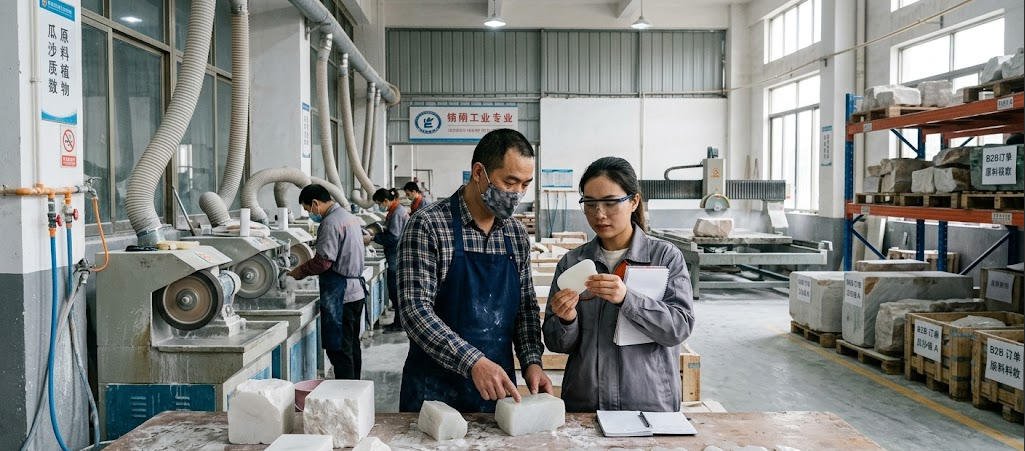
If the difference between quartz and jade-substitute white stone really is structural, the next question is practical: why does that difference get blurry on the factory floor and in a trade-show showroom? The answer sits in two places — the raw block before it’s ever touched by a wheel, and the polish grade applied afterward. Both stages decide whether a gua sha wholesale batch ends up looking chalky and flat, or develops the icy, semi-transparent glow that gets mistaken for quartz.
Raw Material Grading Decides Almost Everything Before Polishing Starts
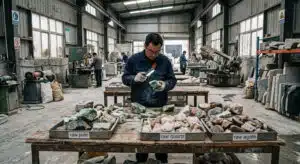
Not all white stone entering a workshop is equal, and this is where most buyers lose visibility once material changes hands through a middleman. The blocks that end up looking closest to quartz share four traits: fine mineral grain, high density, low impurity content, and an even white base with no gray or yellow undertone. A GIA study on nephrite from Italy’s Val Malenco district measured individual tremolite fibers packed at roughly 10 to 20 micrometers, bundled in dense, randomly oriented clusters — a useful reference point for just how fine “fine-grained” actually means at the mineral level, and you can review that data directly in GIA’s Gems & Gemology archive. Coarser, more porous blocks never reach that glow no matter how they’re finished afterward.
This is exactly the grading step that separates ordinary construction-grade white stone from gua sha material worth cutting into a finished tool. So what does that mean for your purchase order? It means the visual difference you’re judging on a sample photo was largely decided weeks earlier, at the quarry sorting table, long before anyone picked up a polishing wheel — which is also why two batches labeled identically by a trading company can perform completely differently once they reach your customers.
The Polish Grade That Creates the Illusion
Grading gets you halfway there; the finishing step does the rest. Once a dense, fine-grained block is polished at a high grit count, light entering the stone scatters internally between grains, bounces back as a soft pearl-like reflection, and transmits through as a diffuse, milky glow rather than a sharp shine. The International Gem Society’s material on quartz varieties notes how differently structured quartz types — from milky to aventurescent — each interact with light in distinct, recognizable ways, which is a useful comparison point when you’re trying to separate a true white quartz gua sha wholesale batch from a stone dressed to resemble one; their full breakdown is available on IGS’s quartz reference page.
This is precisely why the same raw stone can look completely different depending on where you inspect it. Thin edges, curved surfaces, and bright showroom lighting all amplify that scattered-glow effect, which is why a board that looked convincingly “crystal” on the trade-show table can look noticeably duller under your own warehouse lighting a month later. It’s not a different stone — it’s the same gua sha material photographed under conditions engineered to flatter it. Once you know that, you stop trusting booth lighting and start asking your supplier to show you the piece under neutral daylight instead.
The Substitution Myth: What White Jade Gua Sha Wholesale Actually Replaces
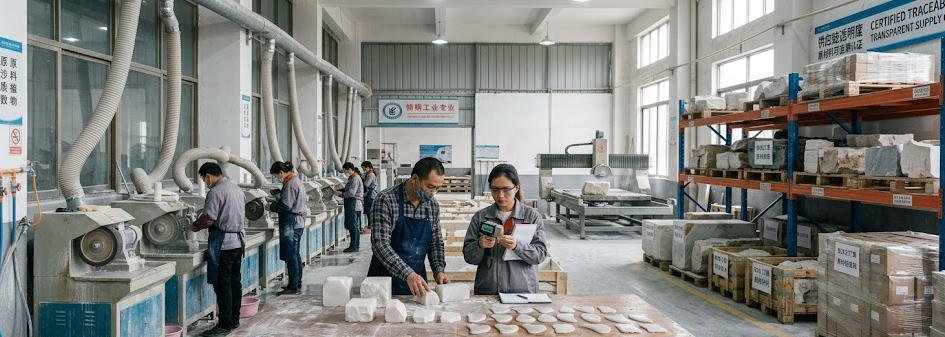
Ask most buyers why white stone shows up labeled as jade, and you’ll hear the same assumption every time: it must be cheaper than quartz, so factories swap it in to save money. That assumption is backwards, and it’s costing people money in both directions — buyers who overpay for “jade” that never was jade, and buyers who walk away from a genuinely good gua sha manufacturer because they misdiagnosed the material.
White Jade vs. White Quartz Gua Sha: Why the Wrong Comparison Gets Made
Here’s the substitution chain that actually plays out across most white jade gua sha wholesale sourcing. Natural nephrite is scarce, its quality varies enormously between deposits, and top-grade rough is expensive before it’s even cut. Certain white stones can deliver a warm, oily-feeling surface, strong whiteness, and a jade-like visual weight at a fraction of that cost. So the real chain runs: natural white jade, down to a jade-substitute white stone, down to ordinary undifferentiated white stone. Quartz never enters that chain at all, because quartz was never the thing sellers were trying to imitate in the first place.
This is why the white jade vs white quartz gua sha comparison that shows up in so many buying guides is actually the wrong frame. You’re not choosing between two versions of the same fake. You’re choosing between two entirely different categories of product with different cost structures, different tactile properties, and different customer expectations — and treating them as interchangeable is exactly how mislabeled inventory ends up on a shelf. Two gua sha tools different in mineral origin can be photographed under identical lighting and look nearly the same, which is precisely why relying on a supplier’s product photo instead of a material declaration puts the burden of proof on the wrong party.
So what does that mean for the way you write your purchase orders? It means the material name on your PO should describe mineral origin, not marketing category. “White jade-substitute stone” and “white quartz” are not two flavors of the same claim — they’re two separate facts, and conflating them is where sourcing risk actually starts.
Why Getting the Name Right Is a Compliance Question, Not a Marketing Choice
This isn’t only a quality issue — in markets like the United States, it’s a legal one. The Federal Trade Commission’s Jewelry Guides require that sellers truthfully represent the type, kind, and character of a gemstone material, and that a simulant’s true identity be disclosed clearly rather than implied through a similar-sounding name; you can review the current guidance directly on the FTC’s Jewelry Guides page. Those rules apply at every level of trade, including wholesale, which means the label your supplier puts on a carton can become your liability the moment you resell it downstream.
You don’t need a law degree to stay on the right side of that rule. You need a supplier willing to name the mineral honestly on the invoice, not just on the marketing sheet — jade-substitute white stone as jade-substitute white stone, quartz as quartz. Independent labs like SSEF apply that same discipline at a scientific level, identifying jade strictly by mineralogical and chemical parameters rather than by trade appearance, as described on SSEF’s jade testing page. That’s the standard worth holding your own paperwork to, long before a customs officer or a retail customer ever asks the question for you.
How to Verify Your Gua Sha Wholesale Order Before It Ships
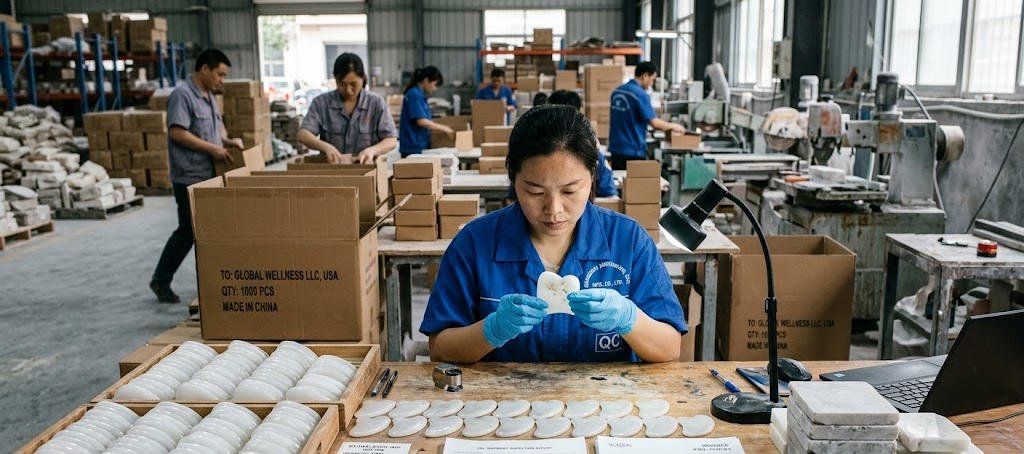
Everything covered so far is diagnostic. Here’s where it becomes actionable, because knowing the physics behind white jade gua sha wholesale substitution only helps you if you can apply it before a container leaves the dock, not after your customer opens a return case.
The Four-Point Field Check Every Gua Sha Manufacturer Should Support
You don’t need a gemological lab to run this check, and you shouldn’t need to trust a listing photo either. A supplier acting as a genuine gua sha manufacturer — not just a trading middleman — should be willing to let you inspect against these four points before confirming a bulk order.
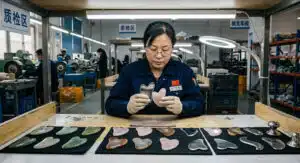
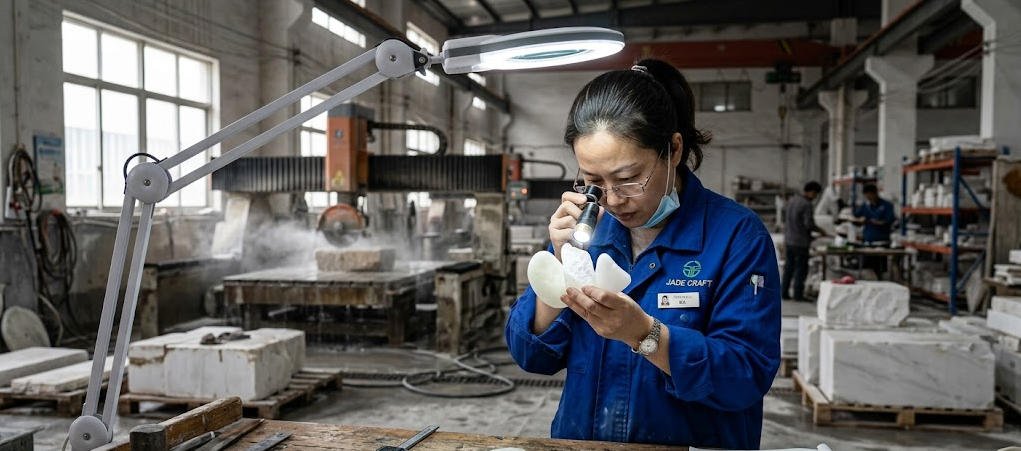
First, look at how light travels through the piece, not just whether it passes through. Hold the board at an angle under a single point-source light rather than diffuse showroom lighting. Quartz tends to show a directional band or a cloudy streak that moves as you tilt the stone; jade-substitute white stone shows an even, all-over softness that barely shifts. Second, check the internal texture at the thinnest edge, since that’s where structural differences show up most honestly — crystal zoning and ice-like fracturing point to quartz, while a uniform, grainy softness points to jade-substitute stone. Third, ask for the material name in writing on the commercial invoice, not only on the marketing sheet, since that single line of paper is what protects you if a customs authority or a retail customer ever asks a naming question later. Fourth, request rough-stone and in-process photos rather than only finished-piece photos, because processing and polish can visually flatten differences that were obvious in the raw block.
So what does running this check actually get you? It gets you a defensible paper trail. If a batch is ever questioned by a retail customer or a compliance review, you’re the buyer who asked for the material name in writing — not the one who assumed a photo was proof.
White Jade vs. White Quartz Gua Sha: A Side-by-Side Reference
The table below is the version of this comparison worth keeping next to your sourcing checklist. It’s the practical answer to the white jade vs white quartz gua sha question stripped of marketing language.
| White Quartz Gua Sha | Jade-Substitute White Stone | |
|---|---|---|
| Structure | Continuous crystal lattice | Granular mineral aggregate |
| Light behavior | Directional, banded | Scattered, even glow |
| Surface texture | Cool, glass-like | Warm, waxy |
| Typical selling point | Crystal clarity, “energy” positioning | Jade-like warmth, cost efficiency |
| What it substitutes for | Nothing — sold as itself | Natural white jade (nephrite) |
| Verification priority | Check light direction and internal banding | Check density, grain uniformity, and supplier naming |
Notice what the table doesn’t say: it doesn’t say one material is better than the other. A gua sha wholesale buyer stocking a crystal-and-wellness line has good reason to want genuine quartz’s directional shine. A buyer serving a mass-market spa or gift channel may have equally good reason to want jade-substitute stone’s warmth and price point. The failure mode isn’t choosing one category — it’s not knowing which one you actually received, and pricing or marketing it as the wrong one downstream.
This is also where the gua sha tools different in structure stop being an abstract gemology lesson and start being a line item on your margin sheet. A board that costs you a jade-substitute price but tests out as low-grade undifferentiated stone isn’t a quartz problem or a jade problem — it’s a grading failure further up your supply chain, and it’s exactly what the four-point check above is built to catch before it becomes your inventory.
The Real Cost of Gua Sha Wholesale Mislabeling
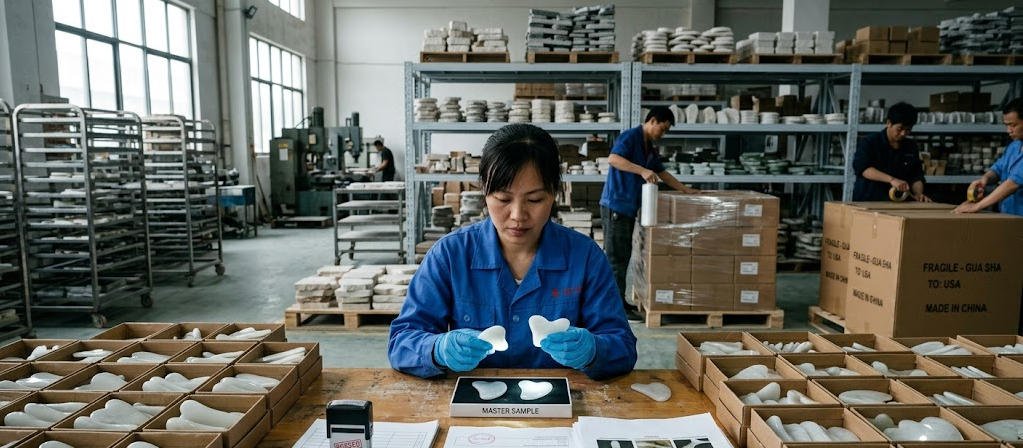
Everything up to this point has been about identification. Now let’s talk numbers, because a structural difference only matters commercially if it shows up on your P&L — and in gua sha wholesale sourcing, it shows up in three specific places: chargebacks, return rates, and repeat-order pricing.
Where Your Margin Actually Leaks in White Jade Gua Sha Wholesale Sourcing
Picture a batch of 5,000 pieces sold as white jade gua sha wholesale stock at a jade-tier price, where a portion of that batch is actually undifferentiated white stone that never should have cleared grading. You won’t see that mistake on arrival. You’ll see it three to six months later, when your retail customers start returning pieces that “don’t feel like the others” or when a spa-chain buyer runs a side-by-side comparison and flags inconsistency across cartons from the same PO number. At that point the cost isn’t just the replacement units — it’s the freight to bring them back, the credit you issue, and the buyer relationship you now have to rebuild from a weaker position.
Compare that to the cost of catching the same problem before shipment. A pre-shipment inspection against the four-point check covered earlier — light direction, edge texture, invoice naming, and rough-stone photos — typically adds a small, fixed cost per batch. Set against a full container of gua sha material that could otherwise come back partially rejected, that inspection cost is not overhead. It’s the cheapest insurance line item on your entire purchase order, and it’s the one most buyers skip because it feels like friction at exactly the moment they’re eager to close the deal.
So what does that trade-off actually mean for your margin? It means the batches that look identical in a listing photo can carry very different total costs of ownership — one priced correctly and verified, one priced correctly but unverified and quietly exposed to a return spike you haven’t budgeted for yet.
Compliant Naming as a Gua Sha Wholesale Cost-Avoidance Strategy
There’s a second cost that’s easier to miss because it doesn’t show up as a return — it shows up as a customs hold or a compliance letter. When a gua sha manufacturer ships cartons labeled simply “jade” without disclosing that the material is a jade-substitute white stone, the exposure doesn’t stay with the factory. It travels with the goods, and it lands on whoever sells them next under the same name. Under frameworks like the FTC’s Jewelry Guides referenced earlier, that exposure applies at the wholesale level just as much as retail, which means the label on your carton is really a liability document, not just a packing detail.
This is why correct naming belongs in your cost model, not just your ethics policy. Two gua sha tools different in mineral origin but identically labeled “jade” create identical downstream risk, regardless of which one you actually received — because the paperwork, not the stone, is what a regulator or a customer dispute will look at first. Buyers who push suppliers for accurate material names on the invoice aren’t adding cost. They’re removing a liability that was already priced into every unverified carton, whether anyone had noticed it yet or not.