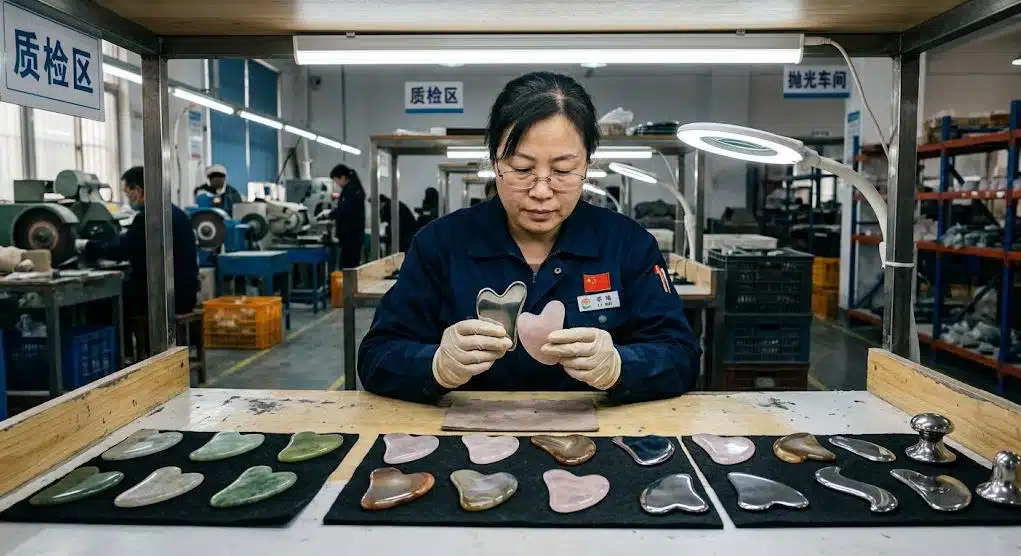
If you’ve ever compared two gua sha stones side by side and wondered why one glides while the other catches slightly under your fingertip, the answer is rarely a single polishing step. As a gua sha manufacturer working with both natural stone and stainless steel, here is the core number worth knowing before your next order: quartz-family stones such as rose quartz and agate sit at roughly 7 on the Mohs hardness scale, jade-family stones can run as low as 6 to 6.5, and surgical-grade stainless steel does not register on that scale at all because it is not a mineral. That hardness gap is the single biggest reason two tools polished on the same line can still finish with different surface results. If you buy gua sha wholesale without knowing which side of that gap your order sits on, you risk judging “smooth enough” by the wrong standard entirely.
The Material Ceiling: Why Every Gua Sha Manufacturer Starts With Raw Stone, Not Polish

Natural material is where most buyers underestimate the problem, and it’s also where most disputes start. Quartz, jade, and agate aren’t manufactured to a spec sheet the way steel is; every block carries its own hardness distribution, crystal structure, grain size, and microscopic cracks or pockets of softer mineral. Run identical parameters on two blocks from the same quarry and you can still get two different surface results, because the raw material was never identical to begin with. This isn’t a processing error in gua sha production — it’s geology.
When a stone contains a softer pocket, mechanical polishing tends to leave that spot looking dull, slightly sunken, or textured like orange peel next to the surrounding gloss. You aren’t looking at a defect the factory introduced — you’re looking at the stone’s own internal map. Natural stone carries a smoothness ceiling that no amount of extra buffing time will remove, while 316 stainless steel, being metallurgically uniform, gives a guasha factory a much easier baseline to hold steady across a full gua sha production run.
Hardness, Crystal Structure, and the Smoothness Ranking You Should Know
Based on comparable polishing cycles, the typical smoothness ranking across common gua sha materials runs stainless steel, then obsidian, then rose quartz, then agate, then xiuyan jade — closely tracking the Mohs hardness order these minerals occupy. Obsidian, as volcanic glass with no crystal grain at all, polishes almost as evenly as steel despite sitting lower on the hardness scale. Xiuyan jade, by contrast, is a fibrous mineral aggregate rather than a single crystal, so it holds a slightly lower ceiling almost by definition.
| Material | Approx. Mohs Hardness | Typical Surface Behavior |
|---|---|---|
| Stainless steel | Not mineral-rated | Most uniform, highest achievable polish |
| Obsidian | 5–5.5 | Glassy, no grain, very even |
| Rose quartz | 7 | Even, but batch-dependent |
| Agate | 6.5–7 | Banding can affect uniformity |
| Xiuyan jade | 6–6.5 | Fibrous structure, lower ceiling |
This means you can use this order as a rough sourcing filter: if a supplier quotes an unusually high polish grade on jade, ask for a sample before committing to a full container.
What This Tells You When You Compare a Gua Sha Manufacturer‘s Samples
When two samples from two suppliers look different under the same light, your first question shouldn’t be “which factory has worse equipment,” but “are these even the same grade of stone.” A gua sha manufacturer quoting rose quartz at one price and obsidian at a similar finish level isn’t comparing like with like, even if both photos look glossy in a listing. Ask any gua sha manufacturer you’re vetting to confirm the exact material grade behind a sample, not just the material name, because “rose quartz” alone tells you almost nothing about which quarry — and therefore which hardness profile — you’re actually buying.
Upstream Processing and Grit Progression: The Hidden Cost Behind Gua Sha Production

Polishing never starts from a perfectly flat surface, whatever a spec sheet implies. Before a blank reaches a buffing wheel, it has already been through cutting, rough grinding, shaping, CNC profiling, and fine grinding — and each step can leave its own signature behind. CNC tool marks, coarse grinding scratches, uneven height across a face, chipped edges, and chatter-vibration marks are the five defects that show up most often in a gua sha manufacturer‘s upstream audit. None of these are visible in product photos, which is exactly why they cause disputes after the container has already shipped.
Why a Gua Sha Manufacturer Can’t Just “Polish Longer” to Fix Deep Scratches
Here’s a principle worth writing down before your next quality argument: polishing removes shallow surface defects, but it can’t reliably remove deep ones left by an earlier grinding stage. If a scratch was cut into the surface during rough grinding, extra minutes on the polishing wheel will smooth the edges of that scratch without eliminating it — the tool will simply look shinier around a mark that’s still there. So what does that mean for you? When a gua sha manufacturer promises to “polish more” to fix a rejected sample, ask which upstream step actually caused the mark, because polishing time alone rarely solves a grinding-stage problem.
How Gua Sha Polishing Is Actually Built, Step by Step
Surface smoothness is built in stages, not produced in one pass. A typical sequence runs coarse grinding, then medium grinding, then fine grinding, then superfine grinding, and only then final polishing, with each stage shrinking the scratch depth left by the one before it. Jump straight from coarse grinding to a fine polishing compound and you can end up with a surface that looks glossy under normal light but reveals a network of fine scratches the moment you tilt it under a raking light. Ask your supplier to show you a mid-process piece at each grit stage, not just the finished sample — the transition between grits is where most gua sha polishing quality is actually won or lost, and it’s also where a rushed guasha factory quote tends to cut corners first.
Polishing Parameters, Shape, and Heat: The Execution Layer of a Gua Sha Manufacturer‘s Line

Once grit progression is right, the finishing result still depends on a long list of execution variables: compound or slurry type, abrasive particle size, wheel or pad material, spindle speed, applied pressure, dwell time, cooling, slurry concentration, and how evenly the workpiece contacts the polishing medium. Stainless steel typically runs on a metal-specific abrasive system, while jade, quartz, and agate run on a route built around mineral hardness instead. Mixing the two systems — applying a metal recipe to a stone blank because it’s faster — is one of the more common shortcuts inside a rushed gua sha production run, and it rarely holds up under a raking-light check.
Compound, Wheel Material, Speed, and Pressure
Every one of those variables interacts with the others, so a single number rarely tells the full story. A wheel speed that works well on a flat cabochon can over-polish a thin edge on the same piece within seconds, because pressure and contact time don’t distribute evenly across a curved surface. This means you can reasonably ask a supplier for a fixed parameter sheet — spindle speed, pressure range, dwell time per stage — rather than accepting “we polish it well” as an answer, because a documented parameter set is what protects your reorder from drifting six months later.
Why Complex Shapes Break Consistency Before They Break Shine
Shape is the variable buyers notice last and manufacturers worry about first. A large flat face on a gua sha board is relatively easy to keep in uniform contact with a polishing pad, and a generous rounded edge isn’t much harder. Deep grooves are a different story — they create dead zones a wheel physically can’t reach at full pressure, while sharp points tend to over-polish because they concentrate contact force into a tiny area. That’s exactly why gua sha polishing quality can look excellent on a flat panel and slightly rougher on a carved edge of the same board, and it isn’t automatically a sign of a careless guasha factory — it can simply be geometry doing what geometry does.
Heat adds one more layer, mainly on metal tools: high-speed grinding generates real friction, and if it isn’t managed, you can end up with discoloration, uneven polish, or micro surface changes that weren’t there before the final pass. A faster spindle isn’t automatically a better one — for metal gua sha production, speed without cooling control tends to trade shine for consistency.
Contamination vs. Roughness: A Distinction Every Gua Sha Wholesale Buyer Must Learn

Here’s a distinction that saves a surprising number of rejected shipments: a tool that looks foggy, spotted, grainy, or locally dull straight out of the box isn’t automatically a roughness failure. Leftover polishing wax, buffing compound residue, fine metal particles, stone dust, or a trace of processing oil can all sit on the surface after production and create exactly the same visual symptoms as a genuine defect. The two problems look nearly identical under a phone camera, but one is solved with a proper clean and the other can’t be solved without reworking the piece. Add this one question to any incoming QC checklist for a gua sha wholesale order: has this piece actually been cleaned to spec, or has it only been inspected?
Would you reject an entire pallet over a wax film that comes off with isopropyl alcohol and a soft cloth? Buyers do it more often than you’d expect, simply because nobody asked the right question first. A disciplined guasha factory keeps these two categories separate on its own inspection sheet — surface roughness in one column, surface cleanliness in another — because conflating them leads to wasted rework on parts that were never actually defective.
A simple wipe test settles the question in under a minute: clean the suspect area with isopropyl alcohol on a lint-free cloth, then look again under the same light. If the haze lifts, you were looking at contamination, not a manufacturing defect, and the piece should be accepted. If the texture is still there, you’re looking at a genuine surface issue, and that’s where a fair return or credit conversation begins. Skipping this thirty-second test is one of the more expensive habits in gua sha wholesale sourcing, because it turns a cleaning issue into a shipping dispute neither side needed to have. Once contamination is ruled out, the next question is whether the roughness you’re seeing is a one-off sample issue or something built into how the gua sha manufacturer runs equipment across a full batch.
Equipment Repeatability: The Real Test of a Gua Sha Manufacturer

A single beautiful sample tells you almost nothing about what a factory can deliver across a thousand-piece order. Spindle runout, worn polishing wheels, machine vibration, inconsistent pressure control, fixture positioning error, and slow parameter drift on automated equipment are the six most common reasons a batch comes out uneven — where one piece is glossy, the next is merely acceptable, and a third has a locally foggy patch nobody planned for. None of these six causes show up in a product photo, and most are invisible even in a small sample box, because a sample box is, by definition, not a batch.
What Causes Piece-to-Piece Variation
This is the core idea worth repeating: batch production should never be judged by how good one sample looks, but by how repeatable the equipment stays across a gua sha production run that spans multiple shifts. A machine with early-stage spindle runout can produce a flawless first fifty pieces and a noticeably rougher next fifty, simply because wear accumulates faster than it shows. So what does that mean for you? The sample box a supplier ships before an order is a starting point for negotiation, not proof of what a full container will look like.
How to Audit a Gua Sha Manufacturer‘s Repeatability (Step-by-Step)
If you want a real answer instead of a reassuring one, there’s a straightforward way to get it. First, ask for photos or samples pulled from three points in a single production run — start, middle, and end — rather than one curated sample. Second, request the batch’s Ra measurement log if the factory tracks one, since a repeatable gua sha manufacturer will have numbers, not just opinions, to show you. Third, ask how often polishing wheels and pads are replaced on that line, because wheel wear is one of the fastest ways consistency quietly erodes. Fourth, request a pre-shipment inspection report covering a random sample size, not just the pieces the factory chose to photograph. None of these four steps cost you anything beyond a follow-up email, and any gua sha manufacturer confident in its own process should answer all four without hesitation. A supplier that resists this kind of question is telling you something about repeatability whether it intends to or not.
Operator Skill vs. Standardized Process: How a Gua Sha Manufacturer Reduces Variation

Natural stone is where operator skill shows up the most, because a machine can’t fully compensate for how a person reads raw material. Give the same equipment and abrasive to two experienced operators, and you can still get different results, driven by how much pressure each applies, how long they dwell in one spot, the angle they hold the piece at, how they judge scratch depth by eye, and when they decide to switch abrasive grit. None of this is a skill problem in the negative sense — it’s simply the reality of working a material that behaves differently block to block.
Turning Experience Into Fixed Parameters
A factory that has done this long enough tends to move in one direction: converting operator judgment into fixed abrasive choices, fixed parameters, fixed dwell times, and a fixed inspection standard that doesn’t depend on which shift produced the piece. This isn’t about removing skilled people from the process — it’s about making sure their judgment gets written down instead of living only in their hands. Ask yourself: if your usual operator called in sick tomorrow, would today’s order still meet yesterday’s standard? For a gua sha manufacturer, the honest answer to that question says more about long-term reliability than any single sample ever could.
This matters more the longer your relationship with a supplier runs, not less. A first order can ride on one operator’s good week; a fifth reorder eighteen months later can’t, because staff turnover and busy seasons are inevitable in any guasha factory. Ask a prospective supplier directly how much of its process still depends on individual judgment versus documented parameters, and treat a vague answer as useful information in itself.
Final Inspection Standards and Two Risk Profiles: Natural Stone vs. Stainless Steel

“Smooth” is a word everyone agrees on and almost nobody defines the same way, and that gap is where most quality disputes actually live. Without a written standard, a buyer and a gua sha manufacturer can hold the exact same piece and reach opposite conclusions, not because either side is wrong, but because neither side ever agreed on what they were checking for. Fixing this costs nothing more than a shared checklist, agreed on before production starts rather than argued about after a shipment lands.
A Practical Inspection Checklist
| Inspection Point | What to Check |
|---|---|
| Touch | Any perceptible roughness or burr under a bare fingertip |
| Visual | Obvious scratches or matte fogging under normal light |
| Raking light | Fine machining lines invisible under direct light |
| Edges | Chipping, burrs, or sharp unfinished transitions |
| Surface roughness | Instrument-measured Ra value where precision matters |
| Cleanliness | Residual wax, dust, or oil film |
For orders where finish is part of the specification rather than a subjective impression, ask for an actual Ra measurement rather than a visual sign-off before you finalize a gua sha polishing standard in writing. Surface roughness measurement follows internationally recognized methodology under ISO 21920, the same framework precision manufacturing uses to specify a Ra value on paper rather than in adjectives. This means you can put a number in your purchase contract instead of a description — and a number is much harder to argue about after the fact, for every gua sha wholesale order going forward.
Two Risk Profiles, One Sourcing Decision
Step back, and the two material families you’re sourcing from carry genuinely different risk profiles. Natural stone runs through raw material variation, shaping, grinding, and polishing before its own internal structure has the final say in surface smoothness — so material grading at the sourcing stage matters as much as anything that happens on the wheel. Stainless steel runs through material specification, stamping or CNC, deburring, grinding, fine polishing, and cleaning, and because the raw material itself is uniform, process control on the line carries most of the weight. When you’re vetting stone, ask harder questions about raw material grading; when you’re vetting steel, ask harder questions about process documentation. Neither risk profile is worse than the other — they simply point you toward different parts of the supply chain, and a gua sha manufacturer who understands that distinction is usually worth a longer relationship.
Cost, ROI, and Compliance: What This Means for Your Sourcing Budget

Quantifying the Cost of Skipping QC Steps
Skipping the checks above is rarely free — it just moves the cost downstream, to a point where it’s harder to recover. Rework data across small-batch stone and metal goods commonly puts full-batch reprocessing at 15 to 30 percent of unit cost once a shipment has already left the factory, compared with a 2 to 5 percent cost of catching the same defect during in-line inspection. A pre-shipment inspection covering a random sample typically adds a modest, fixed cost per order, while a customer return driven by a surface complaint can carry shipping, replacement stock, and reputation cost that runs several multiples higher. This means a documented inspection step isn’t an added expense — it’s the cheapest insurance available against the most expensive outcome in gua sha wholesale sourcing: a return.
Put simply, the math almost always favors catching a surface problem before it ships rather than after. A buyer who negotiates inspection checkpoints into a purchase order isn’t adding friction to the relationship — they’re removing the single most common source of post-shipment disputes with any guasha factory running high-volume gua sha production.
Compliance and Documentation to Expect From a Gua Sha Manufacturer
Compliance for gua sha tools is less about a single certificate and more about documentation proving what a piece is made of and how it was tested. For metal tools intended for prolonged skin contact, nickel release testing under EN 1811 is the relevant European reference method, tied to the REACH nickel restriction, and it’s worth requesting a test report rather than a verbal assurance that a tool is “nickel-free.” For natural stone, request a written material declaration confirming mineral type and origin, since “jade” and “quartz” are used loosely across the trade, and a declaration is what actually protects you if a customer later asks for proof. A gua sha manufacturer that keeps these records on file, batch by batch, is giving you something a sample photo never can: a paper trail. None of this documentation is exotic or expensive to request — it’s simply the difference between sourcing on trust alone and sourcing on trust plus evidence.
Risk Disclosure Summary: What to Verify Before Choosing a Gua Sha Manufacturer

None of the variables covered in this guide operate alone, which is exactly why a single glossy sample can never tell you the whole story. Before you commit to a gua sha manufacturer, or move a gua sha wholesale order from sample stage to full production, it’s worth confirming the material grade behind your sample, evidence of a proper grit progression rather than a single polishing pass, a documented parameter sheet for pressure and speed, batch-level Ra data or repeatability records rather than one beautiful piece, and the compliance documentation relevant to your market. Each of these costs you nothing more than a direct question, and each one closes off a different way an order can go wrong months after it ships from a guasha factory floor.
This guide reflects manufacturing conditions across natural stone and stainless steel gua sha polishing lines, and individual results will still vary by material batch, tool geometry, and order specification — that variability is the entire point of a risk disclosure. At Deyi Gems, these are the same questions our own process is built to answer, and you’re welcome to ask us any of them directly before your next order.