A gua sha custom order carries a setup cost that every piece you buy has to share. On a custom tool Deyi Gems developed in April 2025, mold cost plus raw-material loss came to about $300, which adds $0.60 to each piece at 500 pieces and $0.15 at 2,000. A gua sha manufacturer does not set a minimum to push you into a bigger purchase. Mold work, material loss, programming and first-piece inspection cost the same whether you order 100 pieces or 2,000.
The good news is that you control more of this than you think. If you choose a gua sha logo custom job on an existing shape, use stock materials and accept standard packaging, you can often bring a private label gua sha order down to a size that fits a first market test. The sections below give you the real numbers, the risks and the steps for your gua sha custom order.
- The Math Behind Every Gua Sha Custom MOQ
- Need Only 100 Pieces? 4 Ways to Lower a Gua Sha Custom MOQ
- Why a Gua Sha Custom MOQ Differs by Customization Type
- The 5 Hidden Factors Behind Every Gua Sha Custom MOQ
- How to Judge a Fair Gua Sha Custom MOQ From a Gua Sha Manufacturer
- Gua Sha Custom MOQ FAQ: Quick Answers on Cost, Steps and Compliance
The Math Behind Every Gua Sha Custom MOQ

What You Pay for Before the First Gua Sha Custom Piece Exists
Before a single tool leaves the line, the factory has already spent money on work that has nothing to do with your quantity. Someone reviews your drawing, writes the CNC program, tests the machine settings and inspects the first piece. Sample making comes next, and every one of these steps takes hours from skilled staff. None of it shrinks because you ordered 100 pieces instead of 1,000. This means you can read a gua sha custom MOQ as a cost-recovery number rather than a sales target.
A stock product works differently. It already has proven tooling, tested machining parameters and a packing method, so you pick a style and a quantity and the factory ships from inventory or schedules a run. Change even one dimension and part of that preparation starts again. That is why 100 stock pieces and 100 brand-new custom gua sha tools are two different orders, even when the headcount on the purchase order looks identical. This means you can expect lower minimums when you stay close to a design the factory already runs.
A $300 Setup Fee Spread Across 100 to 2,000 Pieces
In April 2025, Deyi Gems developed a custom tool for a client, and the mold cost plus raw-material loss came to about $300. That figure belongs to one project, not a price list, because setup depends on the shape, the material and the finish you ask for. The tool’s materials and labor cost about $1.30 per piece. Here is how the $300 spreads, and what each piece costs once it is added:
| Order quantity | Setup cost | Setup cost per piece | Unit cost per piece (materials, labor and setup) |
|---|---|---|---|
| 100 pieces* | $300 | $3.00 | $4.30 |
| 500 pieces | $300 | $0.60 | $1.90 |
| 1,000 pieces | $300 | $0.30 | $1.60 |
| 2,000 pieces | $300 | $0.15 | $1.45 |
*The 100-piece row is calculated from the same $300. The other rows are the project’s actual figures.
Going from 100 to 1,000 pieces cuts the setup share of each piece by 90%, from $3.00 to $0.30. At 500 pieces the setup is 32% of the unit cost, and at 2,000 pieces it is 10%. This is why a factory may accept 1,000 pieces at one unit price and refuse to make 100 pieces at the same price. This means you can ask any supplier to quote two quantities side by side and see the setup gap for yourself.
What a Gua Sha Custom MOQ Does to Your Unit Cost
Look at what the table does to the price you pay. A 100-piece order costs $4.30 per piece, 2.7 times the $1.60 of a 1,000-piece order, and moving from 500 to 2,000 pieces cuts the unit cost from $1.90 to $1.45, a drop of 24%. The wholesale price on this project was set at the unit cost plus 30%, which gives you $2.47 per piece at 500, $2.08 at 1,000 and $1.89 at 2,000. The lowest MOQ is not automatically the cheapest way to launch a private label gua sha line, and the highest MOQ is not automatically the safest one. This means you can compare total cash out against units you can realistically sell in the first few months.
Risk Disclosure: When a Gua Sha Custom Order Costs You More
A lower unit price on a gua sha custom order only helps if you sell the extra stock. Would you rather pay $2.70 more per piece on 100 tools than on 1,000, or hold 900 extra pieces you committed to buy? Setup cost also varies by shape, material and finishing method, so treat the $300 above as one project’s result and ask your supplier for yours in writing.
Natural stone adds a second variable to custom gua sha tools. The Gemological Institute of America (GIA) describes jade as a generic term for nephrite, jadeite and, under certain conditions, green omphacite, so two boards sold as “jade” can be different minerals with different color and texture. GIA also lists color and texture among the main value factors for jade, which is why a sample you approve may not match every piece in the batch. This means you can protect yourself by asking which exact material your sample uses and what color and texture range you accept before you pay a deposit on your gua sha custom run.
Need Only 100 Pieces? 4 Ways to Lower a Gua Sha Custom MOQ

Many brands that ask about gua sha custom orders want to start at 100 pieces, because 100 pieces is what a market test can afford. At that size the $300 setup from the previous section adds $3.00 to every tool. A flat refusal solves nothing for either side, so the useful question is how to shrink the preparation work or change who carries it. The four routes below do exactly that, and you can stack them. This means you can walk into a quote request with options instead of a single fixed number.
Step 1: Order Gua Sha Logo Custom on an Existing Shape
For a gua sha custom project, start with a shape the factory already runs and change only the mark on it. The tooling, machine settings and material routine are already tested, so the new work shrinks to a laser engraving or printing setup, a placement check and an inspection standard for the logo. Send a vector file, the logo size and the exact position, then ask for a photo of an engraved sample before you approve the run. A small mark on a curved edge needs different settings from a larger mark on a flat face, so expect questions about both. This means you can launch a gua sha logo custom line with a fraction of the development work a new design needs, and a MOQ that depends on the logo process rather than a new shape.
Step 2: Use Stock Material and Standard Sizes in Your Gua Sha Custom Order
Natural stone is where small gua sha custom orders get stuck. A special thickness, color or texture means buying rough material for you alone, and part of it turns into waste during cutting, shaping and polishing. If you pick a stone and size that a gua sha manufacturer already holds, that special purchase disappears. Natural stone does not always carry a strict raw-material minimum either: when suitable stock exists, or your design allows regular sizes, the starting quantity can drop.
Ask for the stone’s name in writing, because GIA’s buyer’s guide states that jade can be dyed, bleached, heated, waxed and impregnated, and a vague label hides what you actually receive. The International Gem Society also keeps a nephrite reference page covering value factors and origins, which is worth five minutes before you choose. Stock does not mean identical, since natural stone still varies in color and texture, so agree on an accepted range with sample photos. This means you can remove special-material risk from your gua sha custom order and verify the stone before you pay a deposit.
Step 3: Customize the Tool and Standardize the Box in Your Gua Sha Custom Order
Packaging often sets the real minimum. Printed boxes need plates, inner trays need molds or new sizes, and insert cards, pouches and gift boxes each come from suppliers with their own purchase floors. One packaging supplier Deyi Gems works with requires at least ¥3,000 per order, and with gift boxes at ¥2.45 each, that floor equals about 1,225 boxes (3,000 ÷ 2.45). If you order 500 custom gua sha tools, the same ¥3,000 spreads over 500 boxes and lifts the box cost to ¥6 each, about 2.4 times the ¥2.45 price.
Ask for three separate numbers: product MOQ, logo MOQ and packaging MOQ. Then ship your first order in a standard box with your brand sticker or an insert card, and save the custom box for the reorder. This means you can keep your private label gua sha launch small and spend packaging money only after the tool has sold.
Step 4: Order One Production Batch and Split the Delivery for Your Gua Sha Custom Line
Suppose you expect to sell 1,000 pieces of a gua sha custom design this year but only want 250 at a time. You can ask the factory to produce all 1,000 in one run and deliver four lots of 250. The setup share then stays at $0.30 per piece, the 1,000-piece figure, instead of the $1.20 a 250-piece run carries.
The deal only works on paper that is clear: agree in writing on the payment schedule, who owns the stock while it waits, storage fees and the deadline for collecting the last lot. If any of those four points stays vague, a split delivery turns into a dispute. This means you can get 1,000-piece pricing on a private label gua sha program while your delivery schedule follows your sales rate.
Combine Steps 1 to 3 and the three biggest preparation costs (shape development, special stone buying and custom packaging) drop away together, leaving a gua sha logo custom order the factory can run on lines it already knows. Add Step 4 only when your sales forecast supports it. The trade-off is plain: you give up a unique shape and a branded box in exchange for a smaller commitment. This means you can start small without pushing the factory into a loss, and that is what keeps the quote honest.
Why a Gua Sha Custom MOQ Differs by Customization Type

One number cannot describe every gua sha custom request. Adding a mark to a finished shape is a different job from developing a new profile, and sourcing a special stone is a different job from polishing a steel finish. If a supplier quotes the same MOQ for all six gua sha custom cases, the quote is either padded or the question was not understood. The table below separates the cases by where their cost actually comes from. This means you can spot a flat quote and ask for a breakdown.
Six Gua Sha Custom Types and What Moves Each MOQ
| Customization type | Main cost source | What moves the MOQ |
|---|---|---|
| Existing shape + gua sha logo custom | Engraving or printing, a separate process step | Logo method, order quantity |
| Existing shape, new size | Machining parameter changes, material yield | Size of the change, machine setup |
| Brand-new shape | Programming, sampling, test machining | Shape complexity, development fee |
| Special natural stone selection | Rough material purchase, grading, cutting loss | Stone supply, usable rough |
| Special stainless steel finish | Machining, polishing, outsourced processing | Process batch, outsourced minimum charge |
| Full brand customization | Product, logo, packaging and accessories | The single largest MOQ in the chain |
The last row of this gua sha custom table deserves your attention. In a full brand project the MOQ is set by the largest limit in the chain, and a packaging supplier may set that limit in money rather than pieces. With a ¥3,000 minimum order and ¥2.45 gift boxes, you either buy about 1,225 boxes, or you order 500 and pay ¥6 each. If you take the 1,225 boxes and use 500 of them, 725 boxes (59%) wait for your reorder.
Stainless steel adds its own wrinkle, because outsourced finishing often carries a minimum charge the factory cannot waive. This means you can lower a full-brand MOQ only by finding the tallest link and changing that one, whether you are ordering custom gua sha tools in stone or steel.
One Spec Sheet, Three MOQs: Quoting Your Gua Sha Custom Project
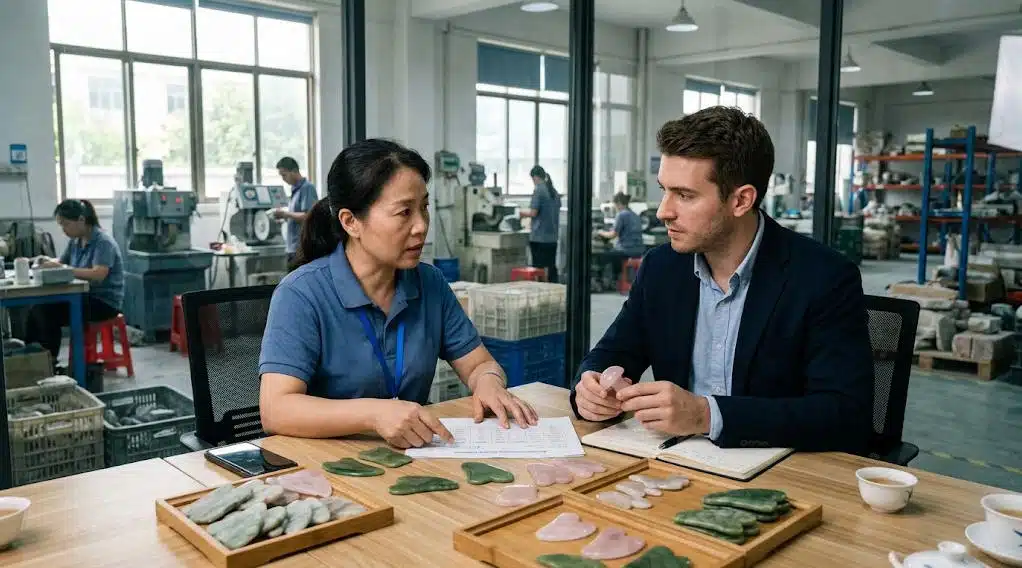
Send a one-page gua sha custom spec before you ask for a price. Name the product type, material, size, logo method and position, packaging type and target quantity. Ask the gua sha manufacturer to answer with three separate MOQs, one each for product, logo and packaging, plus the setup fee in dollars. Then request the same quote at two quantities, such as 100 and 500, so the per-piece gap shows up on paper.
A reply that blends everything into one figure hides which part you could change. This means you can compare two suppliers on equal terms instead of comparing two guesses.
Compliance: What Your Gua Sha Custom Labels Can Safely Claim
Compliance starts with the words printed on your box. The Federal Trade Commission Act prohibits deceptive or unfair acts in commerce, and the FTC’s Jewelry Guides, revised effective August 16, 2018, explain how that rule applies to claims about gemstones and metals. The Guides include § 23.24 on disclosing gemstone treatments and § 23.27 on the words “real,” “genuine” and “natural”. Whether a gua sha tool counts as jewelry under those Guides is a legal question this article cannot settle, so treat them as your benchmark and confirm the rules for each market you sell in. A regulator or a buyer will judge your gua sha custom claims by the same test: would a reasonable customer be misled?
Put that test to work on three words. Use “jade” only when the factory confirms in writing that the stone is nephrite or jadeite, since GIA treats jade as a generic name covering more than one mineral. Use “natural” only when you can document that the stone is untreated, and disclose dyeing or waxing if it applies. Keep a dated material record and the approved sample photos for every batch of your private label gua sha line. This means you can back every word on your packaging with a document, which costs far less than a relabeling run.
Disclosure: this section reflects industry experience, not legal advice.
The 5 Hidden Factors Behind Every Gua Sha Custom MOQ

The setup fee is the headline, but five quieter factors decide where a gua sha custom MOQ lands. None of them shows up on a price sheet, and each one can move the minimum by hundreds of pieces. Once you know them, you can ask sharper questions and negotiate on facts instead of feelings. This means you can tell a fair minimum from a padded one before you sign anything.
Factor 1: Material Yield Decides How Much Stone Your Gua Sha Custom Order Needs
A natural-stone gua sha custom board does not start life as a finished board. Rough material has to meet your thickness, color and texture, and part of it is lost during cutting, shaping and polishing. On the 2025 order behind this article’s numbers, 81.3% of the raw material became sellable pieces, so 100 finished tools needed about 123 blanks and 500 needed about 615, and the yield on your own material and shape will differ. Leftover rough then sits in inventory and ties up cash long after your order has shipped.
Natural stone does not always carry a strict raw-material MOQ, though. If the factory already holds suitable rough, or your design fits regular sizes, the number can drop. This means you can ask which blanks are on hand and design around them, which lowers your gua sha custom minimum without loosening your standards.
Factor 2: Machine Changeover Hits Small Runs Hardest
Stainless steel gua sha custom tools often pass through CNC machining, stamping, grinding, surface treatment or laser engraving, and each step may need a new program, fixture, parameter set or inspection standard when the product changes. Take an illustrative three-hour setup at 20 pieces per hour. A 40-piece run takes two hours, so setup eats 60% of the five hours on the machine. A 400-piece run takes 20 hours, and the same setup shrinks to 13% of 23 hours.
Changeover cost on a gua sha custom job also varies by process, so one MOQ should not be copied across stone boards, steel finishes and laser marking. A gua sha logo custom job on a stone board and a mirror-polish finish on steel custom gua sha tools do not need the same preparation. This means you can expect a lower minimum where the process switches quickly and a higher one where it does not, and a fair quote shows you which is which.
Factor 3: Packaging Suppliers Set Their Own Floor for Gua Sha Custom Boxes
Printed boxes need plates, inner trays need molds or custom sizes, and insert cards, pouches and gift boxes each come with their own minimum purchase. A tool can be ready at 500 pieces while the box supplier’s ¥3,000 minimum order still equals about 1,225 gift boxes at ¥2.45 each. That is why the packaging MOQ, not the tool, sometimes decides the size of your first order. This means you can keep your private label gua sha minimum from being set by a cardboard supplier by starting with a standard box and a branded insert.
Factor 4: Small Batches Interrupt the Whole Line
Every small gua sha custom order slipped into the schedule adds a changeover, breaks a continuous run and can push back orders already in line. A MOQ lets the factory group the same shape, the same material and the same process into one batch. A gua sha manufacturer that ignores this trades your small order for someone else’s late delivery. Would you want your reorder to be the one that stops the line? This means you can read a reasonable MOQ as protection for your own delivery date.
Factor 5: Quality Risk Does Not Shrink With Your Gua Sha Custom Quantity
A gua sha custom order with complex finishes and tight standards still requires sample approval, production standards, batch processing and final inspection, even at 100 pieces. A MOQ gives the factory enough volume to schedule that work, but it does not guarantee quality. A clear spec, an approved sample, process checks and an acceptance rule do. For stone, look closely at surfaces and edges: GIA’s Gems & Gemology reported nephrite bracelets with filled cavities made to mimic natural skin, a reminder that a finish can hide what is underneath.
How to Inspect a Gua Sha Custom Batch Before You Pay the Balance
Put the following into your purchase agreement so acceptance is a checklist rather than an argument:
- Keep one signed sample, with photos from several angles, as the reference for the whole batch.
- Write down accepted ranges for color, texture, size tolerance and logo position.
- Ask for photos or video from the middle of the run, not only at the end.
- Compare finished pieces with the signed sample before you release the balance.
- Record in writing how defects are handled, including who pays for replacements.
Each item turns a promise into something you can check. This means you can release payment only when the gua sha custom batch matches the sample you signed.
How to Judge a Fair Gua Sha Custom MOQ From a Gua Sha Manufacturer

A fair gua sha custom MOQ is not the smallest number on the table. It is a number you can trace back to real costs. A gua sha manufacturer who explains the figure is easier to work with than one who only states it, so this section gives you a yardstick for any gua sha custom quote. This means you can test a quote with a basic spreadsheet before you reply.
A Fair Gua Sha Custom MOQ Moves With the Level of Customization
In a gua sha custom price list, stock products should carry the lowest threshold, because the tooling, machining parameters and packing method already exist. The factory can ship from inventory or fit your order into a run it already planned. Light customization, such as a logo on an existing shape, should be priced from the logo process, the packaging and the preparation cost.
Deep customization, such as a new shape, a special stone or a new finish, has to cover development, material purchase, setup, material loss and quality checks. If a supplier quotes one figure for all three levels, ask why. This means you can expect a ladder of minimums and choose the rung that fits your cash.
Gua Sha Custom ROI: 500, 1,000 and 2,000 Pieces
Numbers make the trade-off visible for custom gua sha tools. Take the April 2025 project: wholesale prices of $2.47, $2.08 and $1.89 per piece at 500, 1,000 and 2,000 pieces, and a client who resells the tool at about $13 on their own website and sells an average of 538 pieces a month. The figures below ignore shipping, duties, marketing and platform fees, so read the profit as gross.
| Scenario | Your cost | Revenue at $13 | Gross profit | Unsold stock (at your cost) |
|---|---|---|---|---|
| 500 pieces, all sold | $1,235 | $6,500 | $5,265 | 0 |
| 1,000 pieces, all sold | $2,080 | $13,000 | $10,920 | 0 |
| 2,000 pieces, all sold | $3,770 | $26,000 | $22,230 | 0 |
| 2,000 pieces, 1,000 sold | $3,770 | $13,000 | $9,230 | 1,000 pieces ($1,885) |
Break-even arrives early: you recover $1,235 after 95 sales at 500 pieces, $2,080 after 160 sales at 1,000 pieces and $3,770 after 290 sales at 2,000 pieces. At 538 pieces a month, 2,000 pieces is about 3.7 months of stock, so the largest order is reasonable for that client. The same 2,000 pieces would be 40 months of stock for a hypothetical brand selling 50 a month, and that brand should start at 500 or fewer. Would you rather save about $0.58 per piece by ordering 2,000 instead of 500, or keep that cash free for marketing? This means you can plug your own resale price and monthly sales into the table and see your break-even before you commit to a gua sha custom order.
Trial Orders and Long-Term Gua Sha Custom Programs
A factory can sometimes accept a smaller gua sha custom trial order if you pay a reasonable extra fee instead of meeting the full threshold. That fee covers the setup the small order would otherwise leave unpaid, and it gives you real market data before a bigger commitment. Repeat buyers have more room: annual forecasts, order history and payment record can support a framework order, one production batch with split deliveries, or a standing schedule for a private label gua sha program. A supplier who has seen you pay on time has less reason to price in risk. This means you can trade commitment for price, and you can do it in steps as your custom gua sha tools start selling.
Red Flags: When a Gua Sha Custom MOQ Looks Too High
A high gua sha custom MOQ is not automatically wrong, because raw stone and packaging floors are real costs. Still, some signs suggest a number is padded:
- The supplier refuses to separate product, logo and packaging MOQs.
- Every customization type gets the same minimum.
- The minimum rises after you ask for a sample, with no new cost explained.
- There is no discussion of stock material, standard packaging or split delivery.
Ask yourself whether the number is high because the costs are high, or because a padded quote is easy to defend. A higher MOQ also says nothing about quality, since only a clear spec, an approved sample and an acceptance rule protect that. The goal is not the lowest minimum on any gua sha custom order, but an order the factory can run at a reasonable price, quality and lead time. This means you can ask for a written cost breakdown, and a supplier who gives one has already passed the first test.
Gua Sha Custom MOQ FAQ: Quick Answers on Cost, Steps and Compliance
1. Why Do Gua Sha Manufacturers Set a MOQ on Gua Sha Custom Orders?
A gua sha custom order carries setup work that does not shrink with quantity: drawing review, CNC programming, sampling and first-piece inspection. Material loss, machine changeovers and packaging floors add to it. In the April 2025 project, a $300 setup adds $0.60 per tool at 500 pieces and $0.15 at 2,000. This means you can treat a MOQ from any gua sha manufacturer as a cost-recovery figure and ask for the breakdown behind it.
2. How Do I Order Private Label Gua Sha at a Low Gua Sha Custom MOQ?
Make three moves. First, pick an existing shape and a stock stone, so the factory skips new development and special material buying. Second, send a vector logo file with its size and position, and approve a photo of an engraved sample. Third, ask for product, logo and packaging MOQs separately, and start with a standard box and a branded insert. This means your private label gua sha quote shows which of the three limits you can negotiate first, and the real project figures in this article start at 500 pieces.
3. Is Gua Sha Logo Custom Cheaper Than a New Design?
Usually it costs less to prepare, because gua sha logo custom work reuses tested tooling, machine settings and material routines. The new work is the engraving or printing setup and the logo inspection. A new shape adds programming, sampling and test machining, which is why its development fee and minimum climb. Ask for both quotes at 100 and 500 pieces to see the gap in dollars. This means you can keep your gua sha custom budget small by changing the mark first and the shape on your reorder.
4. Do Natural Jade and Crystal Gua Sha Custom Orders Always Need a High MOQ?
No. Natural stone pushes a minimum up when rough material must be bought for your order alone, since part of every blank is lost in cutting and polishing. When the factory holds suitable stock, or your design fits regular sizes, the number can fall. Before you print “jade” or “natural” on a label, confirm the mineral, and read the International Gem Society’s jadeite reference page, which separates jadeite from the broader word “jade.” This means you can lower a gua sha custom minimum on stone without risking a claim you cannot document.
5. Are Product MOQ and Packaging MOQ the Same?
No. Product, logo and packaging can each carry their own minimum, because box printers, tray makers and card printers set purchase floors that have nothing to do with the tool. A tool may be ready at 500 pieces while the box supplier’s ¥3,000 minimum order equals about 1,225 gift boxes, so a full-brand MOQ follows the largest limit. Order your custom gua sha tools in a standard box first and brand the box on the reorder. This means you can launch with the tool and spend on packaging only after it sells.