
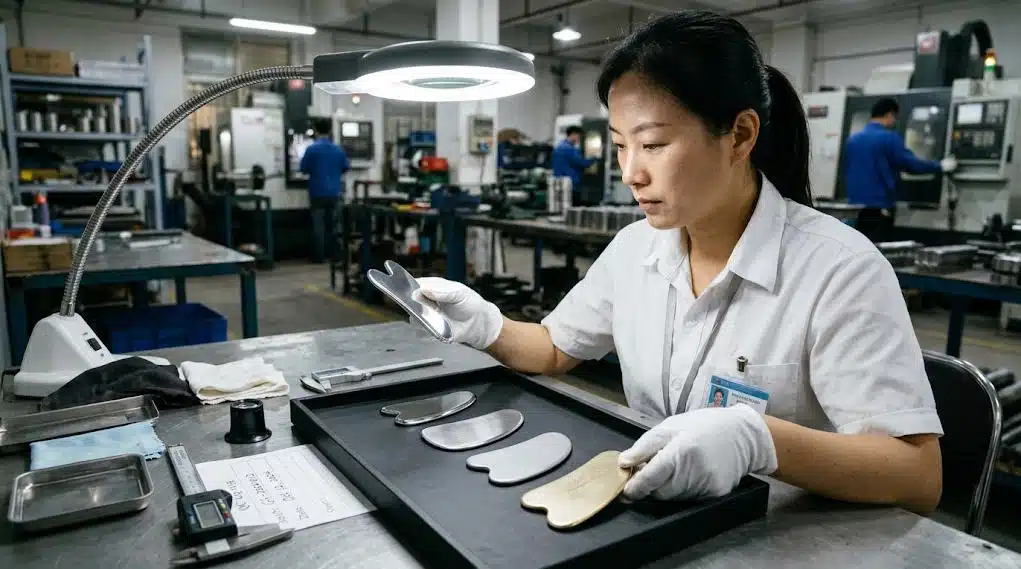
After more than 12 years of making jade, crystal and metal gua sha tools, one pattern keeps repeating: buyers lose money on the finish, not on the steel. A stainless steel gua sha manufacturer can deliver four finish families (mirror, brushed, matte and PVD color), yet PVD sits on top of the other three and cannot repair a scratch beneath it. That single fact decides most metal gua sha wholesale outcomes. This guide gives you five inspection points and a six-item quote checklist, so your stainless steel gua sha custom order arrives in the color you approved. This means you can start your next supplier call knowing which questions protect your margin.
A quick disclosure from a stainless steel gua sha manufacturer: everything below comes from production experience and the public standards linked in the text. It contains no invented test results. Where a number depends on your product shape, your volume or your lab, you will see a note telling you to confirm it with your supplier.
- What Should You Decide First When Briefing a Stainless Steel Gua Sha Manufacturer?
- Why Does a Stainless Steel Gua Sha Manufacturer Warn You That PVD Cannot Hide Defects?
- Which Compliance Questions Should You Ask a Stainless Steel Gua Sha Manufacturer?
- How Does a Stainless Steel Gua Sha Manufacturer Take a Tool From Raw Steel to Finished Color?
- What Does a Stainless Steel Gua Sha Manufacturer’s Quote Include, and Which Checks Pay for Themselves?
- How Do You Write an RFQ a Stainless Steel Gua Sha Manufacturer Can Quote Accurately?
- Stainless Steel Gua Sha Manufacturer FAQ: Finish, Color and Order Questions
What Should You Decide First When Briefing a Stainless Steel Gua Sha Manufacturer?

Every brief you send to a stainless steel gua sha manufacturer contains two decisions, not one. The first is the surface the bare steel will have. The second is whether that surface receives a colored coating. Mixing the two up is the most common reason a sample looks right on screen and wrong in your hand, so how do you keep them apart?
Why a Stainless Steel Gua Sha Manufacturer Quotes Base Finish and Color Separately
Mirror, brushed and matte describe how light behaves on bare steel. PVD, short for physical vapor deposition, is a vacuum coating process that deposits a thin colored film on top of that surface. In the stainless steel gua sha process, a gold mirror tool is therefore two jobs: polish the steel to a mirror, then coat it gold. A black brushed tool is also two jobs: build a consistent grain, then coat it black. This means you can ask your stainless steel gua sha manufacturer to price and inspect each job on its own line.
The split matters because the film follows whatever sits underneath it. A pit or a deep scratch on a polished base shows up again in gold or black, and the coating does not fill it. Stainless steel is defined by at least 10.5% chromium, according to World Stainless, but that number describes corrosion resistance, not smoothness. This means you can add a separate base-surface approval before any coating run starts, and ask your stainless steel gua sha manufacturer to show you that approval record.
Which Finish Fits Entry-Level, Gift-Tier and Differentiated Lines?
Three product tiers cover most metal gua sha wholesale catalogs. Entry-level lines usually suit a silver brushed or fine matte finish, because both read as clean metal and the grain or low reflection makes some fine marks less visible, depending on grain direction. Gift-tier lines usually pair gold or rose gold PVD with a mirror base, which looks striking but exposes every defect under the film. Differentiated lines often pair black PVD with a brushed or fine matte base, which looks modern but needs checks for fingerprints, polished-through spots from rubbing and edge wear. This means you can pick one finish per tier and know in advance what a stainless steel gua sha manufacturer can hold consistent across a batch.
One rule applies to all three tiers: treat photos and screens as mood references, never as a color standard. Color shifts with the steel grade, the base texture, the coating system and the equipment settings, so only a physical golden sample settles it. Before you sign off, ask your stainless steel gua sha manufacturer which steel grade made the sample and whether the production batch will match it. This means you can protect a stainless steel gua sha custom program from the “it looked different in the photo” dispute.
Why Does a Stainless Steel Gua Sha Manufacturer Warn You That PVD Cannot Hide Defects?

Here is the uncomfortable part of the job. A stainless steel gua sha manufacturer regularly gets briefs that say “just coat it gold, the polish doesn’t matter.” It matters more than anything else in the chain, because PVD does not replace polishing and does not repair damage. So what does the coating actually do, and what does it leave untouched?
How Thin Is a Decorative PVD Film, and Why Does That Matter?
The Society of Vacuum Coaters notes that decorative PVD coatings are generally about 0.2 to 0.5 microns thick and replicate the surface finish they are deposited on. A film that thin follows every pit, scratch and polishing wave beneath it. A polished base stays bright under the film, and a honed or blasted base stays matte. This means you can judge the final look of a coated tool by inspecting the uncoated base under the same light.
The thin film also explains why color moves from batch to batch. Steel grade, base texture, coating system and equipment settings all shift the result, which is why gold on a mirror base and gold on a brushed base never look identical. Skipping base inspection is the costliest shortcut in the stainless steel gua sha process, because the film locks every flaw in place. This means you can request a separate golden sample for each base-and-color pairing instead of assuming one approval covers both.
What a Stainless Steel Gua Sha Manufacturer Checks Before Coating Starts
A mirror base needs the most checking because it amplifies defects instead of hiding them. The sequence runs from forming and deburring through coarse, medium and fine grinding, then polishing compound, cleaning and inspection, and each step should erase the marks the previous one left. Inspectors look for pinholes, pits, waviness and uneven reflection, and they spend the most time on contours, curved transitions and grooves. This means you can ask your stainless steel gua sha manufacturer for base-surface photos taken before the coating run, so a defect is caught while it is still cheap to fix.
Catching a flaw early is also a cost decision. Fixing it before coating usually costs one more pass at the polishing station, while fixing it afterward usually means re-polishing a finished part and re-running a vacuum batch. Confirm your supplier’s rework policy in writing, because it differs by factory. This means you can prevent a metal gua sha wholesale order from turning into a pile of coated parts nobody wants to ship.
Where PVD Coverage Fails First: Edges, Grooves and Curves
Coating material travels from the source toward the part, so the fixture has to expose every area, and deep recesses can still end up with a different film than open surfaces. Edges, grooves, back faces and tight curves deserve a dedicated check on every stainless steel gua sha custom design, especially tools with a notch or a contoured channel. Hardness is the other trap. A hard film does not guarantee a tool that never scratches or fades, because base condition, adhesion, film system and rubbing conditions all play a part. This means you can write an acceptance rule that names the exact areas to inspect, instead of accepting a vague “looks fine.”
The practical takeaway for your next brief is short. Ask a stainless steel gua sha manufacturer to approve the base, then the coating, then the edges, in that order and with photos at each stage.
Which Compliance Questions Should You Ask a Stainless Steel Gua Sha Manufacturer?

Compliance is the topic buyers raise last in a stainless steel gua sha manufacturer relationship and regret first. A gua sha tool presses against bare skin, so the real question is which rules apply in the market where you sell. This chapter uses the EU nickel restriction as a worked example, because its numbers are public and its test method is standardized. It is general information, not legal advice, so confirm scope with a qualified adviser for your product and market.
What Does the EU Nickel Restriction Say About Coated Skin-Contact Items?
Entry 27 of REACH Annex XVII limits nickel release to 0.5 μg/cm² per week for articles intended for direct and prolonged skin contact, and to 0.2 μg/cm² per week for post assemblies inserted into pierced body parts, according to ECHA’s published restriction text. The examples listed there are earrings, necklaces, watch cases and similar items. Gua sha tools are not named, and the text does not define “prolonged” contact. That gap is why scope needs an adviser’s opinion, and this means you can avoid assuming that your tool is either exempt or covered.
One clause matters for every colored tool you plan to sell. For articles that fall under the restriction, paragraph 1(c) requires a coated item to stay under the 0.5 μg/cm² per week limit for at least two years of normal use. A PVD film that wears through at an edge therefore turns a compliance question into a durability question. This means you can ask your stainless steel gua sha manufacturer to test the finished, coated tool rather than a bare steel sample, and to explain how the coating holds up at edges and grooves.
How Does a Stainless Steel Gua Sha Manufacturer Prove Nickel Release in Practice?
The reference method is EN 1811, and the 2023 edition states that its purpose is checking compliance with REACH entry 27. The method soaks the sample in artificial sweat for one week and then measures what came out. It measures release, not the steel recipe, so a grade name is neither a pass nor a fail by itself. Four questions turn this into a request you can send today:
- Which steel grade and which lot did the tested sample come from?
- Did the lab test the finished, coated tool?
- Which lab issued the report, and which EN 1811 edition did it use?
- Does the report cover each finish and color you plan to sell?
Color and base texture change the film, so ask whether one report covers the other finishes in a stainless steel gua sha custom range. The answer comes from the lab and your adviser, not from an assumption. This means you can build a compliance file before the first container ships, instead of scrambling after a customs or marketplace query.
Edges, Burrs and Jade or Crystal Lines: What Else Belongs in Your File?
Chemical limits cover only half of skin-contact safety. The other half is mechanical: edge radius, burr removal and an unbroken contact surface, and no coating can fix any of them. Deburring happens early in the stainless steel gua sha process, and polishing then refines the edge, so the final inspection should record both. Put those records next to the nickel report in one folder. This means you can show a reviewer that the tool was checked for how it feels on skin, not only for what it releases.
If you also source jade or crystal tools, apply the same disclosure habit. GIA states that jade can be dyed, bleached, heated, waxed and impregnated, so ask suppliers to name any treatment in writing. This means you can hand a distributor one complete file covering metal, jade and crystal SKUs in a metal gua sha wholesale catalog. Any stainless steel gua sha manufacturer you shortlist should be able to assemble that file without hesitation, and hesitation is useful information in itself.
How Does a Stainless Steel Gua Sha Manufacturer Take a Tool From Raw Steel to Finished Color?

Knowing the sequence lets you ask for evidence at the right moment. A stainless steel gua sha manufacturer runs a different route for each finish, and each route has its own failure points. Below is the route for each surface and what you can ask to see at every stage. Where a step is easy to skip on paper, that is flagged too.
How Do You Check a Mirror Finish Stage by Stage?
Mirror work runs through seven stages: forming and deburring, coarse grinding, medium grinding, fine grinding, polishing compound, cleaning and inspection. Each grinding stage must remove the marks the earlier stage left, which is why skipping a grade shows up later as swirls or waviness. The check at each stage is simple: wipe the tool, hold it under one fixed light and look for leftover marks from the stage before. This means you can ask for photos after fine grinding and again after final polish, so you see where a defect first appeared.
Mirror also reflects problems that a duller surface would blur. Pits, ripples and uneven reflection show up fastest on contours, curved transitions and grooves, so inspect those first. This part of the stainless steel gua sha process rewards patience, and rushed polishing is the usual reason a batch fails inspection. This means you can set a rule that no mirror tool moves to coating until contours and grooves pass a light-box check.
How Do You Keep Brushed and Matte Finishes Consistent Across a Batch?
Brushed finishes depend on four variables: abrasive grit, pressure, feed speed and the angle at which the tool meets the belt. The target is a grain that runs the same direction, with the same fineness and depth, from one end of the tool to the other. Complex curves, edges and dished areas are where the grain tends to break or change direction. This means you can approve a grain direction on your drawing and ask for edge and curve close-ups in the first-article report.
Matte is a description of low reflection, not one single method. Fine grinding, sandblasting and bead blasting each produce a different feel, so name the one you want and approve a physical sample. For blasted matte, media type, grit, pressure, nozzle distance and coverage all change the result, and uneven coverage appears as patchy sheen. A smooth satin and a visibly grainy blast are both “matte” on a quote sheet. This means you can avoid a surprise by writing the surface feel into your stainless steel gua sha custom specification, not just the word “matte.”
What Should a Stainless Steel Gua Sha Manufacturer Show You at the PVD Stage?
The coating route starts after the base finish is complete. The tool is cleaned and degreased, surface-activated when needed, loaded on a fixture, coated in a vacuum chamber and then inspected. Four questions help at this stage: was the base approved first, how were the tools fixtured, which areas were checked after coating, and does the finished color match the golden sample under the same light? Deep recesses and back faces deserve a close look because film coverage can differ there. This means you can request post-coating photos of edges, grooves and reverse sides, not only the front face.
Many buyers wonder whether one coating run can fix a mismatched base. It cannot, because the film copies what lies beneath it. For a metal gua sha wholesale program, the safest order is base approval, coating approval, then packing approval, with a signed record at each gate. Any stainless steel gua sha manufacturer that resists documenting those three gates is telling you something about how disputes will be handled. This means you can treat the paperwork as part of the product, since it protects your margin the same way the polish protects the finish.
What Does a Stainless Steel Gua Sha Manufacturer’s Quote Include, and Which Checks Pay for Themselves?

Price questions arrive first in most inquiries, yet the cheapest line on a quote often costs the most after delivery. A stainless steel gua sha manufacturer builds a price from several layers, and each layer maps to a process step you can see. This chapter shows where the money goes and gives you a simple way to test whether an extra inspection gate earns back its cost.
What Drives the Price of Each Finish?
No finish carries a fixed rank on cost. Mirror takes more labor when the shape has contours and grooves, because each stage must reach those areas. Brushed depends on how strict your grain requirements are. Matte depends on whether you choose fine grinding or blasting. PVD adds a vacuum coating step plus cleaning and surface preparation before it. Shape complexity, order quantity, surface grade, equipment and the supplier’s capability all shift the final number. This means you can compare finishes only when every quote describes the same shape, quantity and surface grade.
The extra steps explain why one gold tool costs more than a plain silver one. The gold tool passes through the base finish and then the coating route, so it collects labor from both. A metal gua sha wholesale buyer who compares a coated price with an uncoated one is comparing two different jobs. This means you can ask for the base finish and the coating priced on separate lines, which shows what the color itself costs.
How Should a Stainless Steel Gua Sha Manufacturer Break Down Your Quote?
Ask for five items in writing: unit price, surface-treatment surcharge, sampling fee, production lead time and minimum order quantity. A stainless steel gua sha manufacturer that bundles them into one figure hides the part you most need to negotiate. Also ask how the quote changes if you switch from mirror to brushed, or from gold to black, since a switch changes the route and the price with it. This means you can test whether a revised design saves money before you commit to tooling or samples.
Quote lines should also state the quality terms that apply: acceptable surface defects, burr and edge requirements, coating adhesion and wear test methods, and the rule for rejected units. Price without these terms is an incomplete offer. A stainless steel gua sha custom order with terms attached lets either side settle a dispute by reading the paper, not by arguing over photos. This means you can compare two suppliers on equal footing.
Worked Example: Is a Base-Surface Gate Worth the Money?
The figures below are hypothetical placeholders for illustration only. Replace them with numbers from your own quote.
| Item | Without base gate | With base gate |
|---|---|---|
| Order size | 2,000 tools | 2,000 tools |
| Unit price + coating surcharge | $4.00 + $0.60 = $4.60 | $4.60 |
| Gate cost | $0 | $0.10 per tool = $200 |
| Defect rate after coating | 5% = 100 tools | 1% = 20 tools |
| Value of defective tools | $460 | $92 |
The gate costs $200 and removes $368 of defective value, a net gain of $168, which is an 84% return on the $200. The example leaves out freight, returns handling and replacement shipping, all of which would raise the savings. Your own defect rates will differ, so ask your stainless steel gua sha manufacturer for its historical first-pass rate per finish. This means you can decide whether a gate belongs in the stainless steel gua sha process by plugging in two numbers and reading the result.
A question to take away: would you rather pay $0.10 per tool before coating or discover the defects after shipping? Run the arithmetic on your own order, and let the answer set which checks go into the contract.
How Do You Write an RFQ a Stainless Steel Gua Sha Manufacturer Can Quote Accurately?

A request that says “gold PVD, matte black” gives a stainless steel gua sha manufacturer almost nothing to price. The supplier has to guess the base finish, the color standard, the steel grade and the inspection rules, and every guess becomes a variable in the quote. A complete RFQ removes those guesses. This means you can receive quotes that compare cleanly, instead of quotes that differ because each factory assumed something different.
The Six-Item RFQ Checklist for Stainless Steel Gua Sha Custom Projects
Six items cover almost everything a factory needs to quote a tool properly:
- Base finish: mirror, brushed, fine matte or blasted, with grain direction, gloss level and the visual difference you can accept.
- Final color: a physical sample or an agreed color standard, plus your batch-consistency requirement.
- Material and structure: steel grade, tool shape, edges and grooves.
- Quality terms: surface defects, burrs, edge radius, coating adhesion and the wear test method.
- Quote structure: unit price, surface-treatment surcharge, sampling fee, lead time and MOQ.
- Acceptance: golden sample, batch sampling method and the rule for rejected units.
Attach your drawing to every stainless steel gua sha custom request and mark which items are fixed and which are open to the supplier’s suggestion. A stainless steel gua sha manufacturer that receives all six can return a priced answer on the first reply, not a list of questions. This means you can cut a full round of clarifying emails out of every sourcing cycle.
Why a Golden Sample Beats Any Photo or Color Name
A golden sample is a physical reference tool that you and the factory both approve and both keep. Your stainless steel gua sha manufacturer holds one half of the pair, and you hold the other. It settles color, grain direction, gloss level and edge feel in a way no screen can, because screens shift color and a name like “rose gold” covers many different results. Steel grade, base texture, coating system and equipment settings all move the shade, so one approval covers one combination only. This means you can approve each base-and-color pairing separately and avoid arguments over which “gold” was agreed.
The sample must come from the real production route, not a one-off hand finish. If a stainless steel gua sha manufacturer polishes a sample by hand and then runs production on a machine, the two will not match, however carefully the color is specified. Ask for the sample to go through the same stainless steel gua sha process the batch will follow, and label it with the date, the base finish and the coating run. This means you can compare production units against a reference that is actually achievable.
How a Stainless Steel Gua Sha Manufacturer Handles Batch Inspection and Rejects
Agree the inspection method before production starts, since arguing about it afterward helps nobody. A stainless steel gua sha manufacturer should state how many units are pulled from each batch, which plan governs that sampling (many buyers reference the ISO 2859-1 attribute sampling plans), and what each defect category covers: pits, scratches, burrs, color shift and coating flaws at edges and grooves. Also settle what happens to a rejected unit: rework, replacement or credit. This means you can turn a vague promise of quality into terms that either side can check.
Write all of it into the purchase order. In a metal gua sha wholesale contract, a clause that names the golden sample, the sampling plan and the reject rule lets you resolve a dispute by reading the paper. Who would you rather negotiate with after a bad batch: a supplier with written terms or one with a verbal promise? This means you can hold a stainless steel gua sha manufacturer to terms it already accepted.
Stainless Steel Gua Sha Manufacturer FAQ: Finish, Color and Order Questions
1. Does a Mirror Finish Mean the Edge Is Burr-Free?
No. A mirror surface describes gloss and a coating describes color, so neither one guarantees a rounded, burr-free edge. Edge radius and burr removal belong to deburring and polishing, and they need their own inspection. A stainless steel gua sha manufacturer should record the edge check separately from the surface check. This means you can ask for a close-up photo of the contact edge in every first-article report.
2. How Do You Confirm Final Color on a Stainless Steel Gua Sha Custom Order?
Approve a physical golden sample, then ask your stainless steel gua sha manufacturer to check production units against it under one agreed light. A screen image or a color name is a mood reference only. Because the shade changes with each base-and-coating pairing, repeat the approval for every pairing in your stainless steel gua sha custom range. This means you can lock the color before tooling and fixture costs begin.
3. What MOQ and Lead Time Should You Expect From a Stainless Steel Gua Sha Manufacturer?
There is no single figure, because finish, shape, sampling rounds and coating schedules all change both numbers. Ask each stainless steel gua sha manufacturer to quote MOQ and lead time per base-and-color pairing, and to list sampling time separately from production time. For metal gua sha wholesale programs, also ask whether a mid-run color change alters the minimum. This means you can plan launch dates from written commitments instead of a general estimate.
4. Is Hardness a Reliable Guide to Scratch Resistance?
Not on its own. A hard coating can still scratch or fade, because base condition, adhesion, film system and rubbing conditions all influence wear. Ask the stainless steel gua sha manufacturer for tests that match real use: repeated rubbing, cleaning agents, sweat and skin-oil exposure. This means you can accept a finish based on how it behaves after use, not on a hardness number.