
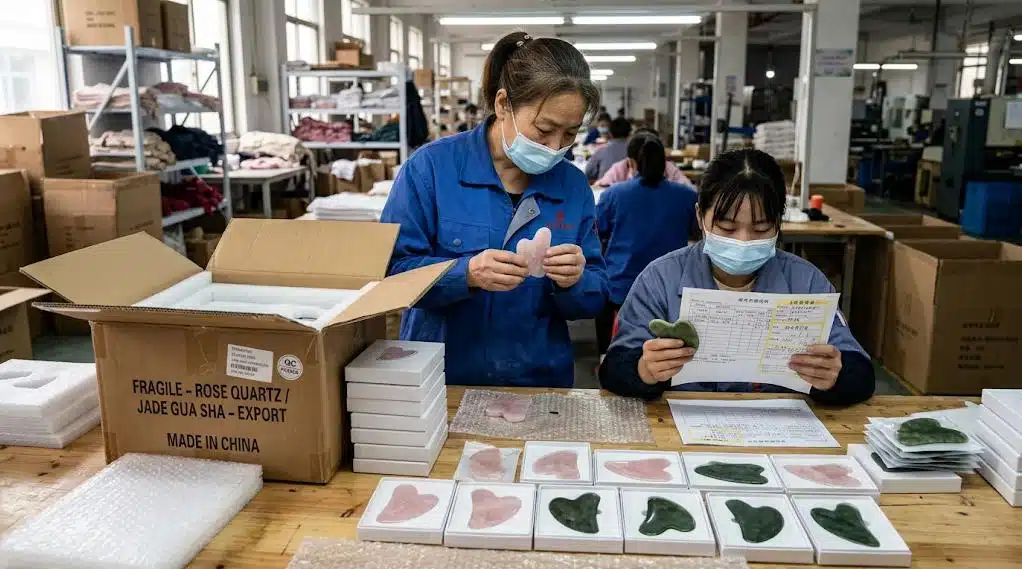
A gua sha manufacturer you can hold to account puts three things in writing before you pay a deposit: who covers each defect type, how a wrong or damaged carton gets fixed, and how the factory stops the same fault from returning. After 12+ years of making jade and crystal tools, the pattern is clear. Post-delivery disputes fall into eight categories, three fixes resolve a mixed-up shipment, and a first reply within 24 hours decides whether you stay calm or start shopping for another supplier.
This article shows you what gua sha after sale terms look like in practice, what to do when guasha shipping goes wrong, and which checks you can run on any gua sha manufacturer before placing a gua sha wholesale order. Because it is a risk disclosure, it also shows what a gua sha factory cannot promise, such as identical natural stone from one batch to the next.
- What a Gua Sha Manufacturer Should Disclose Before You Pay a Deposit
- Guasha Shipping Risks: What Should a Gua Sha Manufacturer Do When the Wrong Carton Arrives?
- Gua Sha After Sale: How Should a Gua Sha Manufacturer Handle a Complaint in Six Steps?
- Is Your Gua Sha Wholesale Order Compliant? What a Gua Sha Manufacturer Cannot Skip
- Natural Stone Risk: What Can a Gua Sha Manufacturer Promise, and What Can’t It?
- What Does Gua Sha After Sale Cost? Quantifying the Return on Choosing a Gua Sha Manufacturer With Written Terms
- FAQ for Gua Sha After-Sales
What a Gua Sha Manufacturer Should Disclose Before You Pay a Deposit

Most disputes start long before the first stone is cut. When you request a quote from a gua sha manufacturer, the unit price tells you very little about what happens after cartons reach your warehouse. Cracked stones, wrong logos, and mixed-up boxes all cost money, and the only open question is who pays. A supplier that states its rules at the quoting stage saves both sides an argument later.
Disclosure matters most on custom orders. Your engraved logo, your box size, and your stone grade belong to you, so another supplier cannot replace them on short notice. If a gua sha factory ships a 2,000-set order with a misspelled logo, the sets may work perfectly and still be unsellable. That is why custom gua sha wholesale buyers should request remedy terms in writing before approving a sample. This means you can compare suppliers on risk, not only on price.
How a Gua Sha Manufacturer Separates Defects From Natural Stone Variation
Natural stone never repeats itself, and a gua sha manufacturer who promises otherwise is setting you up for a dispute. GIA’s jade description explains that jadeite and nephrite are metamorphic rocks built from tiny interlocking crystals, which makes them exceptionally tough, and that their colour is often unevenly distributed. A pale vein in a green jade tool is therefore variation, while a hairline crack across the edge is a defect. This means you can approve a colour and pattern range at the sample stage and reject only what falls outside it.
In practice, a defect is anything that breaks the agreed standard: a crack, a chip that affects use, a pit beyond the approved surface grade, a size outside tolerance, or a wrong logo. Everything else is measured against the signed golden sample, which acts as your yardstick at inspection. Ask for it in writing, and keep your own copy. How else will you prove what was approved?
Who Pays When Something Breaks: The Remedy Rules
A gua sha manufacturer with a fair policy matches remedies to severity instead of defaulting to a refund. For a few broken pieces, a replacement shipment or a credit on your next order is the usual answer. For a batch with cracks, the factory should isolate the batch, find the cause, and remake it. Light polish flaws call for re-polishing, and a wrong logo means rework or a remake depending on whether the engraving can be corrected. Refunds and negotiated compensation sit behind these options for cases where rework cannot save the order.
The unit price of a defective piece rarely equals your real loss. A logo error can force you to repack, store, and delay a launch, so a gua sha after sale policy that offers only a replacement unit covers a fraction of the cost. Ask your gua sha manufacturer to put the claim window, the evidence rules, and the remedy scope into the contract before production starts. This means you can settle a small problem in days instead of letting it grow into a long dispute.
Guasha Shipping Risks: What Should a Gua Sha Manufacturer Do When the Wrong Carton Arrives?

Picture the worst case: tracking says delivered, yet the carton on your dock holds another buyer’s order. Neither of you did anything wrong, and the mistake usually happens at the carrier’s sorting step, when a label is scanned or stuck on the wrong box. A gua sha manufacturer that takes ownership still steps in, because telling you to chase the carrier alone leaves you paying for a mistake you did not make. In guasha shipping, “delivered” only proves that a carton arrived, not that the right goods did.
Three Fixes for a Guasha Shipping Mix-Up
Three fixes cover the common mix-ups, and the right one depends on order value and freight cost. In the first, the factory ships the correct goods again and you return the wrong carton as the factory or carrier arranges. In the second, two buyers who received each other’s cartons swap them directly through the carrier, which skips the trip back to the factory. In the third, you keep the wrong carton and the factory reships your order, which makes sense when return freight would cost more than the goods inside. The responsible carrier pays the extra freight in all three, and the gua sha manufacturer coordinates the process so quantities and models match your order. This means you can get the right goods without paying for freight twice.
Choose by value. A high-value custom order with specific logos usually justifies a reshipment, while a low-value order crossing borders often fits keep-and-reship, because return freight, re-sorting, and customs paperwork can exceed what the goods are worth. Whichever path you pick, ask the gua sha manufacturer to file the carrier claim with handover photos and waybill records. Why should you carry the paperwork for a sorting error you never made?
Why Incoterms Decide Who Pays for Transit Damage
A mix-up is the carrier’s fault, but transit breakage is a contract question. The ICC’s Incoterms 2020 rules name a place of delivery, and for every rule except the C group that place marks where risk passes from seller to buyer. A gua sha manufacturer still owns the condition of the goods at handover, meaning packed to the agreed spec, labelled correctly, and photographed. This means you can read your trade term and know, before the order ships, which side carries the loss if a stone cracks in transit.
Three records settle most breakage disputes: packing photos taken at loading, the carrier’s damage note at delivery, and the insurance terms. Insurance deserves more attention than most buyers give it, because Incoterms 2020 sets different minimum insurance cover for CIF and CIP. Prevention also costs little. A gua sha factory that gives each order its own carton label, photographs that label at carrier pickup, and keeps same-day orders in separate zones removes most mislabeling at the source. Ask your gua sha manufacturer to describe its handover routine, and expect specifics instead of adjectives. This means you can judge a supplier’s shipping discipline in one email.
Gua Sha After Sale: How Should a Gua Sha Manufacturer Handle a Complaint in Six Steps?

A complaint handled from memory is a complaint you will handle twice. When a gua sha manufacturer relies on one salesperson’s inbox, evidence goes missing, causes get guessed, and the same defect returns on your next order. A written gua sha after sale workflow fixes that by giving every claim a record, an owner, and an end date. It also gives you something concrete to check before you sign.
How a Gua Sha Manufacturer Logs, Tests, and Closes a Complaint
Any gua sha manufacturer can describe its process in six steps, and each step should produce a document you can request. Step one is intake: order number, model, quantity, problem description, and date found go into a complaint record. Step two is evidence, meaning photos or video of the damage, the outer carton, the count affected, and a physical sample when needed. Step three is root-cause analysis, where sales, production, inspection, and technical staff decide whether the fault came from raw stone, machining, inspection, packing, transit, or use.
Step four is the corrective action plan, which names the remedy: resend, rework, remake, refund, or another agreed option. Step five is execution, backed by proof such as photos, inspection records, or a tracking number. Step six is the one buyers rarely ask about: a corrective and preventive action (CAPA) report that feeds the finding back into the process and then checks whether the change worked. That logic follows the corrective-action approach in ISO 9001, which investigates the cause, acts on it, keeps records, and verifies the result. This means you can ask a gua sha manufacturer for the closing report on any claim and see whether anything actually changed.
Batch traceability makes steps three and four faster. If a gua sha factory can trace each batch to a raw-stone lot, a sample version, a machining record, an inspection result, and a ship date, it can confine a problem to one batch instead of re-investigating the whole run. This means you can expect a smaller recall scope and a shorter wait for your replacement.
Response Times You Can Ask For, by Severity
A gua sha manufacturer should sort claims by severity, because a label typo and a cracked batch do not deserve the same clock. For minor issues such as a few cosmetic flaws or a label error, ask for a first reply within 24 hours and a fix within 3–5 working days. For larger problems such as batch size deviations or logo errors, expect a reply within 1 working day and a fix within 5–10 working days. Batch cracking and other serious failures get priority handling, with the fix date set by the investigation and remake cycle. Safety concerns trigger an immediate risk response and follow-up until the risk is under control. These are internal service targets a supplier can adopt, not limits set by ISO or any regulator.
First response does not mean final resolution. A written gua sha after sale clock should have the supplier confirm receipt, say an investigation is under way, and name the time of the next update, even before blame is clear. If a possible safety problem is reported, the factory should pause shipments from the affected batch and agree isolation or recall steps with you. Why wait for blame to be settled while stock is still moving? This means you can hold a supplier to a visible clock instead of a promise to “look into it.”
Is Your Gua Sha Wholesale Order Compliant? What a Gua Sha Manufacturer Cannot Skip

Compliance answers a different question from quality: may you legally sell this product, and with which words on the box and the listing? Two areas matter for most gua sha wholesale buyers, general product safety rules in the EU and truthful-advertising rules in the US. Most stone and steel gua sha tools sit under general consumer-product rules unless a more specific law applies, so confirm the category for your product before you rely on anything below. This section is general information, not legal advice, and it works best as a list of questions to put to your gua sha manufacturer.
EU Rules: What the GPSR Means for a Gua Sha Wholesale Importer
The EU’s General Product Safety Regulation applies from 13 December 2024 and covers consumer products that other specific EU safety laws do not already cover. If your gua sha wholesale shipments reach EU shoppers, EUR-Lex’s summary of the regulation says each product needs a responsible economic operator in the EU, such as an importer or an authorised representative. A gua sha manufacturer exporting to Europe must also provide safety and traceability information on the product or packaging, give contact details for complaints, and keep an internal register of the complaints it receives.
The record-keeping clock is long. On request, authorities can ask for product information such as risks, complaints, and corrective measures covering 10 years, plus supply-chain traceability covering 6 years. When a product is recalled, consumers must be offered at least two of three remedies: repair, replacement, or an adequate refund. That is why the six-step complaint log from the previous section matters beyond good manners; it is the paper trail a regulator may ask you to show. This means you can use your gua sha manufacturer’s batch records to meet your own importer duties.
US Rules: How the FTC Treats Claims About Gua Sha Benefits
In the US, the FTC’s rule of thumb is simple: advertising must be truthful, and you need adequate support for objective claims before you publish them. The FTC’s Health Products Compliance Guidance says health and safety claims generally need competent and reliable scientific evidence, and it treats packaging, social media, and influencer posts as advertising, with action possible against distributors and retailers as well as marketers. A listing that promises a gua sha tool will “detox” skin or “cure” a condition invites exactly that scrutiny. Safer copy describes the tool, its stone, and how to use it, not a medical outcome.
The guidance is business guidance rather than law, and it offers no safe harbour, so check your claims with counsel. In practice, agree with your gua sha manufacturer who writes the packaging copy and who approves it before printing. Wrong claims on a box become your problem at import and at retail. This means you can avoid reprinting a pallet of cartons by approving every claim up front.
How to Check That Your Gua Sha Manufacturer Supports Your Compliance Records
Five steps turn the rules above into a supplier check:
- Ask your gua sha manufacturer for batch records that link raw-stone lot, production, inspection, and ship date.
- Request its complaint register format and how long it keeps complaint and corrective-action files.
- Confirm that products and cartons carry the manufacturer’s name and address, a model or batch ID, and the responsible-person details your market requires.
- Agree in writing who approves packaging claims, and keep the approved artwork.
- Add a clause requiring prompt notice of any safety issue found on shipped stock, plus the guasha shipping handover records for each order.
A supplier that answers all five in one email has probably done this before. This means you can show an importer, a marketplace, or an authority your paper trail quickly, instead of rebuilding it after a complaint arrives.
Natural Stone Risk: What Can a Gua Sha Manufacturer Promise, and What Can’t It?

Every honest risk disclosure has a section nobody enjoys writing, and this is it. A gua sha manufacturer works with stone that formed over geological time, and no factory controls what sits inside a block until the block is cut. That limits what any supplier can promise about colour, pattern, and hidden flaws. What a gua sha manufacturer can promise is a process: grading, sample approval, inspection, and a clear remedy when a finished piece breaks the agreed standard. This means you can judge a supplier by its process instead of by the confidence of its sales copy.
Jade, Look-Alikes, and Names: What GIA Says
Start with the word “jade.” GIA says gemologists use it as a generic term for nephrite, jadeite, and under certain conditions green omphacite, and it warns that the name has sometimes been misapplied to look-alike materials and even manmade equivalents. It also says green omphacite can look and test like fine jadeite, and that identifying it requires Raman spectra. So “jade” on a product page is a family name, and two sets sold under it can differ in mineral, colour range, and price. A visual check will not settle which one you have. This means you can ask your gua sha manufacturer to state the exact material on the quote and the packing list.
Names also shift by region. GIA notes that Fei Cui is a traditional Chinese term for jadeite jade that is not universally accepted, and that in many parts of Asia the word now covers several materials. A buyer in Europe and a mill in Asia may therefore use one word for two different stones. Why leave that to chance? Put the mineral name, not just the trade name, in every purchase order you send a gua sha manufacturer.
Rose Quartz: Colour Source, Fading, and Misleading Names
Rose quartz carries its own disclosure list. The International Gem Society reports that rose quartz has a hardness of 7 and no cleavage, which makes it durable, that its pink comes from fibrous inclusions, and that large pieces seldom show transparency. Those inclusions explain why bigger pieces often look milky instead of clear, so a see-through pink tool deserves a second look. This means you can set buyer expectations on translucence, and ask a gua sha manufacturer for a real sample, before your product photos go live.
Two more points belong in your risk file. IGS describes a rarer “pink quartz” that can lose colour rapidly under UV light, says the more common rose quartz does not share that sensitivity, and notes that rose quartz is sometimes sold under misleading names such as “American Ruby” or “Bohemian Ruby.” So ask your gua sha factory which of the two materials is in your tool, and whether the pink has been tested for light stability. For cleaning, IGS advises warm water, detergent, and a soft brush instead of mechanical cleaners, which belongs on your care card. This means you can print the right care instructions in every box and avoid a fading complaint that no remedy clause can fix.
When to Ask a Gua Sha Factory for Lab Testing (SSEF and CIBJO)
Lab testing costs money, so use it where the risk justifies it. SSEF is an independent Swiss non-profit foundation in Basel that tests coloured gemstones, diamonds, and pearls and offers report verification online. It is a gemstone test house, not an inspector of finished tools, so confirm that it accepts your material and submit a representative stone sample when a material claim sits behind your pricing. This means you can back a “natural jadeite” claim from your gua sha manufacturer with a report instead of a promise.
Know the limits of a report as well. CIBJO’s 2025 gemmology report says labs have sometimes issued different findings on the same stones, that few rules govern who may call itself a gem testing laboratory, and that LMHC Information Sheet No. 11 gives harmonised definitions, test procedures, and report wording for jade. Before you pay for anything, agree with your gua sha manufacturer which lab, which test, and which wording counts as final. A report describes one stone on one day, not every piece in a large order. This means you can avoid paying for a report that your supplier will not accept.
What Does Gua Sha After Sale Cost? Quantifying the Return on Choosing a Gua Sha Manufacturer With Written Terms

Buyers often treat gua sha after sale terms as a free extra, but a clear policy has a price, and so does its absence. The cost of having none shows up as remakes, extra freight, labour, and delayed launches, which means you can put numbers on it before you sign with a gua sha manufacturer. The example below uses invented figures, so swap in your own order data. The method matters more than the numbers.
A Worked Cost Example for a Gua Sha Wholesale Buyer
Here is an illustration with made-up numbers. You order 3,000 custom-logo sets from a gua sha manufacturer at USD 6.00 each, a USD 18,000 order, and a logo-position error hits 10% of them, or 300 sets. Without written terms, you may carry the product value of those sets (300 × USD 6.00 = USD 1,800), repacking labour at USD 0.50 per set (USD 150), and about USD 900 in storage and rush freight, a total exposure of USD 2,850, or roughly 15.8% of the order. Now suppose a written remedy clause that covers the remake and your handling costs adds 1% to the unit price, which is USD 180 across the order. Protecting USD 2,850 for USD 180 returns about 15.8 times the premium in this single event. This means you can compare two quotes by adding expected remedy costs to the unit price, whichever gua sha manufacturer you ask.
Make the maths yours in three moves. Multiply your own defect rate by order value, add handling, storage, and any return guasha shipping, then add what a week of delay costs your launch. Compare that total with the price gap between a gua sha factory that offers written terms and one that does not. On a gua sha wholesale margin, a few percent of leakage matters, so if the gap is small, which supplier is really cheaper?
How to Vet a Gua Sha Manufacturer in Five Steps
First, send every shortlisted gua sha manufacturer the same three scenario questions: a cracked batch, a wrong logo, and a mixed-up carton. Second, ask for a sample complaint file with names and prices removed, so you can see the evidence, root-cause, and CAPA fields in a real record. Third, pick one past order and ask the supplier to show the stone lot, inspection record, and ship date behind it. This means you can tell a working system from a slide deck in a few exchanges.
Fourth, get the claim window, evidence rules, remedy scope, and response targets written into the purchase contract. Fifth, run a pilot order before the large one, ask for guasha shipping handover photos, and log how fast the gua sha factory answers even a small question. Treat the pilot as a test of the supplier’s after-sales system, not just of the product. This means you can learn how a gua sha manufacturer behaves under pressure for the price of one small order.
The Bottom Line for Gua Sha Wholesale Buyers
You are not choosing a factory that never has a problem, because natural stone, guasha shipping partners, and engraving machines all fail occasionally. You are choosing a gua sha manufacturer that answers within a day, owns the fix, and changes its process afterwards. A fast reply, a written remedy, and a prevention loop separate a gua sha manufacturer you can grow with from one you replace after the second claim. Yan Cheng, a jade and crystal gua sha manufacturer with 12+ years of production, aims to run its gua sha after sale service on these lines, and you can test that claim with the five steps above. This means you can start your next supplier comparison with questions instead of a price list.
FAQ for Gua Sha After-Sales
1. How fast should a gua sha manufacturer reply to a quality complaint?
A reasonable internal target is a first reply within 24 hours for minor issues and within 1 working day for larger ones, with fixes in 3–5 and 5–10 working days. These are service targets a supplier can adopt, not regulatory limits.
2. What happens if my gua sha shipment arrives with another buyer’s goods?
There are three common fixes: reship and return the wrong carton, swap cartons directly between the two buyers, or keep the wrong carton while the factory reships. The responsible carrier should cover the extra freight.
3. Is natural jade or rose quartz guaranteed to look identical across batches?
No. Natural stone varies in colour and pattern, so agree a colour range and a signed golden sample at the approval stage and measure shipments against it.
4. What records should a gua sha supplier keep for EU sales?
Under the EU’s General Product Safety Regulation, authorities can request complaint and corrective-measure information for 10 years and supply-chain traceability data for 6 years. Ask your supplier for batch records that link stone lot, production, inspection, and ship date.