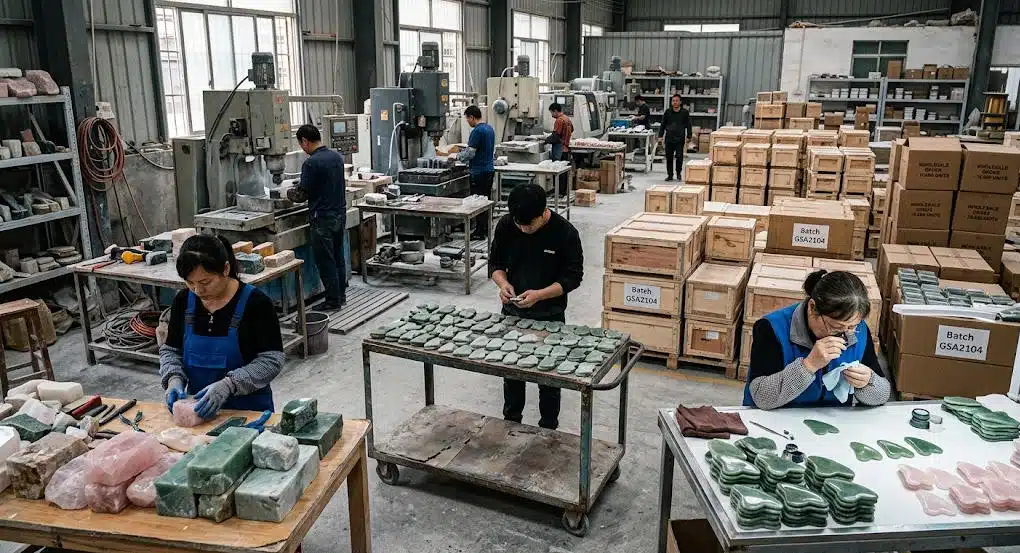
In gua sha wholesale sourcing, a “10-day production” quote almost never means your order lands on your dock 10 days after you place it. Pull apart a typical order and the real number usually runs between 23 and 49 days once material sourcing, sampling, quality control, packaging, and freight are all counted honestly. That gap between what buyers hear and what actually happens is where most gua sha wholesale risks live, and it is rarely caused by a factory simply “being slow.” From the production floor, a missed date is almost always the sum of several smaller, measurable problems — raw material variability, sample-approval delays, scheduling pressure from other orders, and quality standards that were never written down clearly enough to hold anyone to. This article breaks those problems apart one at a time, from the perspective of a working gua sha manufacturer, so you can plan around a realistic timeline instead of a hopeful sales quote.
- What "Late" Really Means in Gua Sha Wholesale Production
- The 9 Real Reasons Behind Late Gua Sha Wholesale Deliveries
- How to Reduce Gua Sha Wholesale Risks Before You Place an Order
- What a Responsible Manufacturer Does When a Gua Sha Wholesale Delay Happens
- Seven Questions Worth Asking When Your Gua Sha Wholesale Order Is Late
- Who's Responsible? Mapping Delay Accountability in Gua Sha Wholesale Orders
- Setting Clear Delivery Milestones for Every Gua Sha Wholesale Order
- The Real Lead-Time Formula Behind Every Gua Sha Wholesale Order
What “Late” Really Means in Gua Sha Wholesale Production
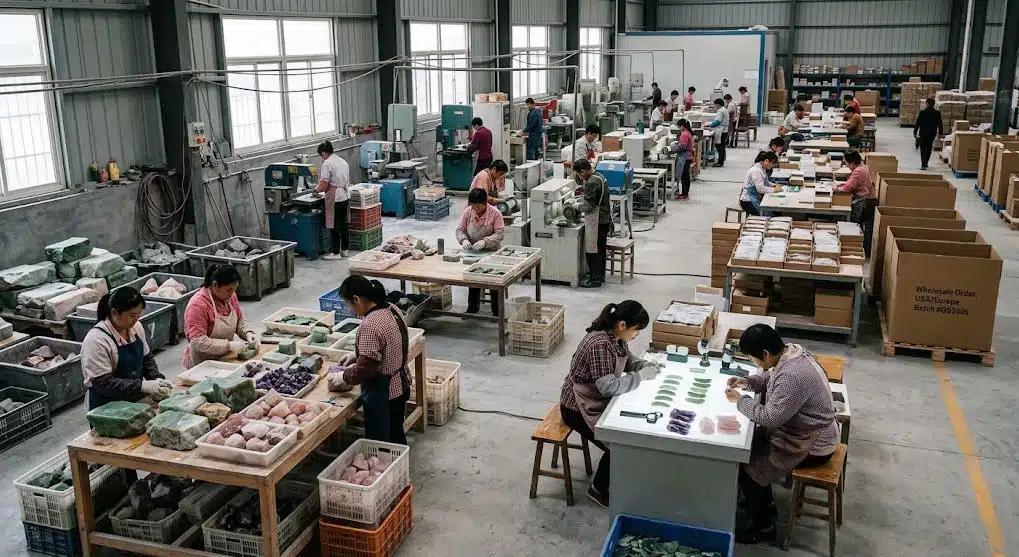
Before you can manage a delay, you need to know what “delivery” is actually made of. A single gua sha wholesale order does not move in one block from “ordered” to “shipped.” It passes through seven distinct stages: order confirmation, raw material preparation, sampling and approval, mass production, quality control, packaging, and finally shipment. Skip any one of these when you’re building your own project calendar, and the calendar is wrong before production even starts.
The Seven Stages Behind Every Gua Sha Wholesale Shipment
Most buyers hear “production takes 10 days” and assume that number covers the entire journey from PO to delivery. In practice, that figure usually describes only the mass-production stage — the part where raw blanks are actually shaped, ground, and polished. It does not include the 5 to 10 days a gua sha manufacturer typically needs to source and pre-sort raw material, the 3 to 7 days sampling and your own approval require, the 2 to 5 days quality control and rework take, or the 3 to 7 days packaging needs once the pieces themselves are done. Add freight on top of that, and a “10-day” order can easily stretch into a 23 to 49 day total. This means any quoted “production time” should be treated as one slice of the calendar, not the whole thing.
A Realistic Lead-Time Breakdown, Stage by Stage
Written out as a formula, total lead time equals preparation time, plus production time, plus quality control and rework time, plus packaging time, plus shipping time. Each of those five components carries its own risk, and in gua sha wholesale work the first one — material preparation — is usually the least predictable, because it depends on geology rather than machinery. A stainless-steel or injection-molded tool has almost no material variability once the mold is cut and approved. A jade or crystal piece does, and that single difference is the biggest reason natural-stone guasha tools wholesale programs run later than standardized ones on average. Buyers who plan their launch date around the production number alone are, in effect, working from a partial schedule and calling it complete.
The 9 Real Reasons Behind Late Gua Sha Wholesale Deliveries
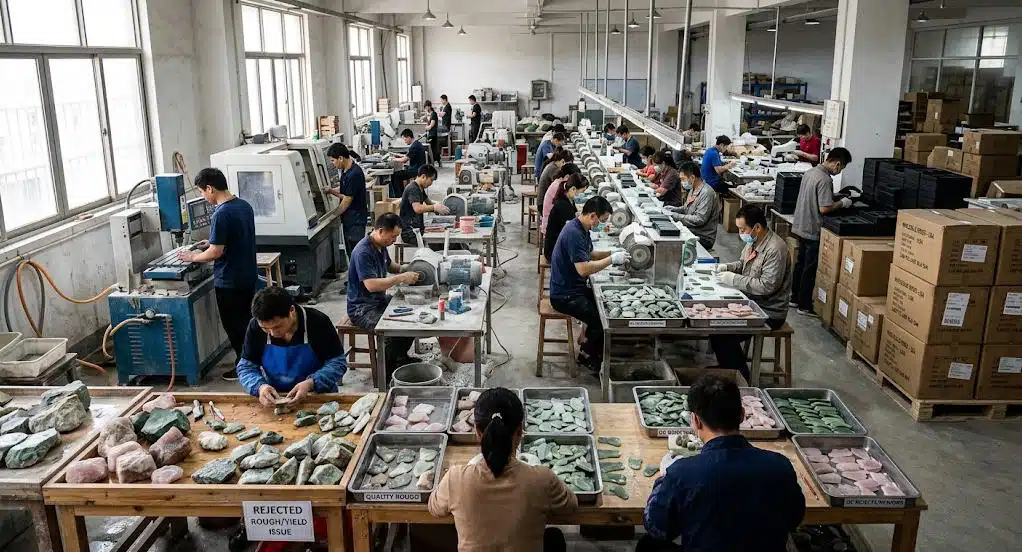
A missed date on a gua sha wholesale order is rarely caused by one single failure. It’s usually two or three of the following nine issues stacking on top of each other, and knowing which ones apply to your order lets you ask sharper questions than a vague “why are you late.” Because gua sha production touches raw material, machinery, and people all at once, a single weak link anywhere in that chain can delay the entire batch.
Raw Material Yield Rate: The Hidden Variable in Gua Sha Wholesale Risks
Natural jade and crystal rough varies by color, texture, internal fracture pattern, size, and clarity, and a gua sha manufacturer genuinely cannot know how many finished pieces a batch of rough will yield until cutting begins. According to the International Gem Society, factory-cut yields from rough gem material typically fall between 15% and 25%, with custom cutting reaching 25% to 33% in better cases — and gua sha blanks, cut from irregular rough rather than pre-formed slabs, often sit toward the lower end of that range. If a batch yields 60% instead of the 70% used to quote the order, a 1,000-piece order suddenly needs roughly 1,667 workable units instead of 1,429, and the factory has to return to the material market mid-schedule. That single gap can turn a 20-day production plan into 20 days of production plus 7 more days of resourcing. This means your gua sha wholesale quote should always ask what yield rate the factory used to size your order, not just what the finished production time is. This is also why a gua sha manufacturer with steady raw-material relationships, the kind Deyi Gems maintains across its jade and crystal suppliers, tends to absorb yield swings faster than one sourcing spot-market rough order by order. One recent example from our own scheduling logs: a 3,000-piece rose quartz program was quoted against a 65% yield estimate; the actual batch came in closer to 55%, and resourcing the shortfall added nine days to a program originally quoted at nineteen. That gap is exactly the kind of thing a milestone schedule catches early instead of on the ship date.
Slow Sample Approval Quietly Eats Your Gua Sha Wholesale Timeline
Every custom gua sha wholesale order needs a confirmed sample before mass production can start, and the clock on that step belongs to both sides, not just the factory. If a factory sends sample photos on August 1st and the buyer doesn’t sign off until August 5th, real production can’t begin until August 6th at the earliest, no matter what the original quote assumed. Asking for a delivery date measured from final approval, rather than from the day you first sent an inquiry, removes one of the most common sources of gua sha wholesale risks disputes before it can even start.
Overpromised Capacity and the Gap Between Sales and Production
A sales team chasing a new account will sometimes quote 15 or 20 days without confirming what the production floor can absorb that month. This usually isn’t dishonesty so much as poor coordination between sales and planning, but the effect on you is identical either way: a date that was never realistic to begin with. A gua sha manufacturer worth working with should be able to show current order volume and CNC or polishing capacity before confirming your date, not only after you’ve already signed the purchase order. This is one reason Deyi Gems shares current backlog numbers with buyers before confirming a gua sha wholesale date, rather than after the paperwork is already signed.
Large Orders Reshuffle the Queue for Small Gua Sha Wholesale Buyers
Picture a factory running a 10,000-piece order, a 5,000-piece order, and your 500-piece order at the same time. When the largest client asks for an earlier ship date, smaller orders are often the ones pushed back, sometimes turning a 20-day promise into 27 days without anyone flagging it until it’s already obvious. Rather than asking only “how many pieces can you make per day,” it is more useful to ask “when does my order actually enter the production queue” — that second answer matters more to your gua sha wholesale date than raw daily capacity ever will.
Mid-Production Design Changes Reset the Clock
Custom guasha tools wholesale programs typically move through 3D design, manufacturability review, sampling, your approval, tooling, and mass production, in that order. A change to the logo, shape, color, or packaging at any point in that sequence doesn’t just add a day of work — it can send the factory back to an earlier stage of the whole sequence. This means even a small, well-intentioned revision request deserves a direct follow-up question: does this reset the schedule, or can it run alongside what’s already in motion? Confirming this upfront is standard practice for any serious guasha tools wholesale program, custom or catalog.
Equipment Bottlenecks in Polishing and CNC
Gua sha production runs through cutting, rough grinding, shaping, CNC, fine grinding, polishing, cleaning, quality control, and packing, and any one of those stages can become the ceiling for the entire gua sha wholesale order. Polishing is a particularly common bottleneck for natural stone, since it is the slowest, most operator-dependent step in the whole sequence. If every earlier stage finishes on time but the polishing line is already backed up, your order simply waits behind it, regardless of how efficiently cutting went. Factories that build extra polishing capacity relative to their cutting capacity tend to protect gua sha production schedules better than those that don’t, simply because polishing is where natural stone spends the most unpredictable time.
Quality Control Failures and the Rework Loop
When a finished batch fails inspection — cracks, out-of-spec dimensions, uneven polish, or a color mismatch — some portion of it has to be reworked or remade, and if there isn’t spare raw material sitting on hand, that becomes a rework, then resource, then reproduce, then requalify loop. Higher quality standards do raise this risk, but the fix isn’t lowering the bar; it’s defining that bar precisely, in writing, before the gua sha wholesale order starts. Vague language like “good polish” or “consistent color” leaves room for disagreement at exactly the moment you can least afford it. A written specification also gives gua sha production staff a fixed target instead of a moving one, which is often the real difference between a batch that clears QC the first time and one that doesn’t.
Packaging Timelines Run on a Separate Clock in Gua Sha Wholesale Orders
The gua sha pieces themselves can be completely finished while EVA trays, gift boxes, magnetic packaging, printed pouches, or instruction cards are still weeks from ready, especially since packaging suppliers often carry their own minimum order quantities that don’t match your unit count at all. Product completion is not the same milestone as order completion, and treating the two as one date is one of the more common planning mistakes buyers make in gua sha wholesale sourcing. Deyi Gems treats packaging lead time as its own line item on the same schedule as production, specifically to avoid this trap.
Shipping Time Is Not Production Time
A factory finishing production on August 20th does not mean you receive the goods on August 25th — those are two separate clocks, Production Lead Time and Shipping Lead Time, and conflating them is one of the most avoidable errors in the entire ordering process. Ask your supplier to state both a Production Completion Date and a separate estimated transit time, so a freight delay doesn’t get quietly blamed on the factory floor, or a factory delay doesn’t get blamed on the freight forwarder. Clear separation of the two is a basic expectation for any guasha tools wholesale shipment crossing an ocean, not an unusual request.
How to Reduce Gua Sha Wholesale Risks Before You Place an Order

Most of what determines whether your gua sha wholesale order ships on time gets decided before production even begins — in how the delivery question is asked, what gets written into the purchase order, and how much buffer sits in your own project plan. Buyers who ask sharper questions upfront consistently see fewer gua sha wholesale risks show up later in the schedule.
Ask About Lead Time After Approval, Not From Inquiry
Instead of asking “how long until I get my order,” ask specifically: what is the production lead time after final sample or design approval? That rephrasing separates sampling time, your own approval time, and material sourcing time from the number that actually matters for your launch date, and it’s the fastest way to get an honest, workable quote out of any gua sha manufacturer. This question matters even more for a guasha tools wholesale program using jade or crystal, where sampling and material sourcing typically take longer than for standardized tools.
Request a Full Production Milestone Schedule
A one-line delivery date tells you almost nothing useful on its own. A milestone schedule — PO confirmed, material ready, golden sample approved, mass production started, semi-finished goods complete, QC complete, packing complete, shipped — tells you exactly where a delay originated the moment one happens. This means you can diagnose a problem in a single conversation instead of arguing about it for a week. Deyi Gems issues this kind of schedule as a standard attachment to every confirmed gua sha wholesale purchase order, precisely so a delay can be traced to one stage instead of blamed on the whole process.
Build In a Safety Buffer
If a factory quotes 20 to 25 days, don’t build your own project plan around 20 days flat. Planning around roughly 30 days leaves room for minor rework, a material top-up, brief equipment downtime, or a packaging delay — all of which show up often enough in gua sha wholesale production that they should be treated as ordinary risk, not bad luck. It’s a small planning habit, but it absorbs most of the ordinary gua sha wholesale risks covered above before they ever touch your launch date.
Don’t Anchor Your Launch Date to the Factory’s Last Possible Day
If your product has to launch September 1st and the factory is shipping August 28th, that plan is fragile by design — production, QC, packing, freight, customs, and warehouse receiving all still have to happen inside those three days, and any single one of them slipping breaks the launch. A steadier approach reserves at least one full shipping cycle as buffer before the date you actually need goods in hand, which keeps a gua sha wholesale launch plan from depending on everything going perfectly at once.
What a Responsible Manufacturer Does When a Gua Sha Wholesale Delay Happens

“Sorry, we’re delayed” is not an answer — it’s the start of one. A factory that has already confirmed a delay internally but hasn’t told the buyer yet is making the single most damaging mistake in gua sha wholesale sourcing, worse in most cases than the delay itself. Deyi Gems‘ internal rule is simple: flag a slip the moment it’s identified internally, not the week the ship date was supposed to arrive.
Explain the Cause, the Length, and the Fix
A useful delay notice covers three things without being asked: why it happened (for example, actual material yield came in below the estimate the quote was based on), how long the new timeline runs (the original completion date stated next to the new one), and what’s being done about it (prioritizing the polishing line, adding a shift, finishing QC ahead of packaging so shipping isn’t pushed further). You should walk away from that conversation knowing what the problem is, when it resolves, and who owns fixing it, rather than just knowing that something went wrong somewhere. Buyers rightly expect this kind of transparency from gua sha production partners, not just an apology.
The Four-Level Early Warning System
A factory that tracks its own schedule seriously usually sorts risk into rough tiers: on track, at risk of a one-to-three-day slip, likely running three-to-seven days late, or looking at more than a week of delay. The first two tiers call for a simple heads-up notification; the last two call for a real conversation about overtime, added production lines, adjusted packaging, or a partial shipment. None of this prevents every delay — natural material will always carry some unpredictability, and no gua sha wholesale promise can fully remove that — but it does prevent a delay from arriving as a surprise on the exact date the goods were supposed to ship. Applying this kind of tiered tracking to every gua sha production run, rather than only the largest accounts, is what keeps small gua sha wholesale buyers from being the last to know about a slip.
Seven Questions Worth Asking When Your Gua Sha Wholesale Order Is Late
When a gua sha wholesale order runs late, the least useful question is “why are you late” — it invites a vague apology instead of information you can actually use. A more productive conversation moves through specifics: how much of the gua sha wholesale order is genuinely finished right now, how much is still outstanding, and which single stage — cutting, CNC, polishing, QC, or packing — the bottleneck sits in today. From there, ask what caused that specific bottleneck, how much additional time it genuinely needs, and whether a partial shipment or an adjusted packaging and freight method could get part of the order to you sooner. Close by asking for one number, a new confirmed completion date, rather than a range you’ll have to chase again next week.
Put these answers in writing, even if it’s only a short email thread, because a verbal promise about a “new” date carries the same weight as the original promise that was already missed — none, unless it’s tied to a specific, verifiable stage of production. If a supplier can answer all of the questions above clearly and quickly, that alone is a reasonably strong sign you’re working with a gua sha manufacturer that manages its own schedule actively rather than reactively. If the answers stay vague after being asked directly, treat that vagueness as useful information too, and factor it into how you plan your next gua sha wholesale order with that supplier. A supplier that can answer these questions without hesitation is usually one that treats gua sha production as a tracked process rather than a black box.
Who’s Responsible? Mapping Delay Accountability in Gua Sha Wholesale Orders

Not every delay belongs to the factory, and pretending otherwise doesn’t actually get your gua sha wholesale order shipped any faster. Splitting responsibility honestly is more useful for both sides, because it points at what actually needs to change going forward.
Some causes sit squarely with the supplier: quoting capacity the factory doesn’t actually have, accepting an order while already overloaded, sourcing raw material incorrectly, letting a quality problem slip through and create rework, or unplanned equipment failure. Other causes sit with the buyer: repeated design changes mid-production, slow sample sign-off, raising quality standards after the order has already started, adding quantity late in the schedule, or leaving packaging artwork unconfirmed for weeks at a time. A third category — ordinary, foreseeable variation in natural material such as color range, texture, or fracture rate — belongs to neither side alone, and it works best when it’s agreed on in writing before production starts rather than argued about after the fact. Gua sha wholesale risks tied to natural material are the clearest example of this shared category, since neither side controls what the earth actually produced. This means the most useful pre-order conversation in gua sha wholesale sourcing isn’t really about price; it’s about which of these categories your specific gua sha wholesale order is most exposed to, and who’s on the hook if that particular risk shows up.
Freight and customs delays sit in their own gray zone, and responsibility there usually comes down to what the purchase order actually specifies about shipping terms and who controls the transit leg. This is exactly the kind of detail that belongs in a contract rather than in a phone call after the fact — spelling out a Production Completion Date, a Shipment Date, and who owns each leg of transit turns a potential argument into a simple lookup instead of a dispute.
Setting Clear Delivery Milestones for Every Gua Sha Wholesale Order

The single biggest source of avoidable conflict in gua sha wholesale sourcing isn’t the delay itself — it’s two sides using the word “delivered” to mean two different dates.
A buyer who hears “August 20th” often assumes that’s the day goods arrive at their own warehouse. A factory that says “August 20th” is frequently describing the day production finishes, with QC, packing, and freight still ahead of it. Closing that gap just takes eight defined dates written into the gua sha wholesale order before work begins: Order Confirmation Date, Material Ready Date, Sample Approval Date, Mass Production Start Date, Production Completion Date, QC Completion Date, Packing Completion Date, and Shipment Date. None of this requires special software or a formal management system — it fits on a single page, and it turns a vague promise into something you can check against reality at any point in a gua sha wholesale order’s life cycle.
Where jade or crystal grading is involved, borrowing language from established gemological standards helps close that same gap on the quality side, not just the schedule side. Organizations such as the Gemological Institute of America publish structured grading criteria for color and clarity that go well beyond a vague “good quality,” and referencing a comparable standard in your own purchase order — even informally — gives quality control something specific to check an order against instead of a subjective impression. The same logic applies to independent verification bodies such as the Swiss Gemmological Institute (SSEF) and detailed buying references from the International Gem Society on jade’s translucency, texture, and color-distribution factors, which exist precisely because “trust me, it’s good material” was never a standard either side could actually verify. This means writing a measurable quality definition into a gua sha wholesale order protects you the same way a milestone date does — it turns a potential dispute into a checklist. Deyi Gems applies this same written-standard approach to every guasha tools wholesale order it quotes, so quality expectations are as clearly dated and defined as the shipping milestones themselves.
The Real Lead-Time Formula Behind Every Gua Sha Wholesale Order
Put everything above into a single line, and a realistic gua sha wholesale lead time reads like this: base production time, plus raw material risk, plus customization complexity, plus quality rework risk, plus scheduling risk, plus packaging time, plus shipping time, plus a safety buffer. For natural stone specifically, material yield rate, color and texture consistency, fracture rate, and polishing yield carry the most weight in that formula. On your side of the equation, design-approval speed, how clearly quality standards are written down, packaging confirmation, and how far in advance you place the order carry just as much weight. That formula holds regardless of order size, because every stage of gua sha production carries the same categories of risk whether you’re ordering 500 pieces or 50,000. Whether you’re comparing quotes for a guasha tools wholesale program or reordering from an existing supplier, this same checklist is worth running through before you sign anything. Ask any gua sha manufacturer for this level of detail before you commit to a gua sha wholesale purchase order — the answer you get back tells you almost everything about how the rest of the order will go.
Deyi Gems has spent more than 12 years cutting, shaping, and finishing jade and crystal gua sha tools from raw material through to finished, packaged product, and that end-to-end setup is what makes it possible to hand over a full milestone schedule — not just a single delivery date — before your order goes into production. If you’re sourcing a gua sha wholesale program built around natural stone, the more specific your quality and timeline questions are upfront, the more accurately any manufacturer, Deyi Gems included, can tell you what to actually expect, stage by stage, before you commit to a purchase order.
Sources referenced in this article: International Gem Society, “What is the Average Gemstone Faceting Yield?” · Gemological Institute of America, “GIA 4Cs: Clarity” · Swiss Gemmological Institute, SSEF · International Gem Society, “Jade Buying Guide”
The scheduling examples, yield figures, and delay-tier framework described above come from our own production planning records at Deyi Gems and are shared for buyer education. Questions about a specific order should go to your sales or production contact directly, since individual factory capacity and material availability change month to month.
A note on how this article was put together: the above-mentioned, yield-rate math, and delay-tiering system below reflect how orders actually move through our own factory floor, not a generic industry template. Where a claim touches gemological grading or material science rather than our internal scheduling, it’s linked to an outside, checkable source — the Gemological Institute of America, the International Gem Society, or the Swiss Gemmological Institute (SSEF) — rather than stated as our own authority. You’ll find that full source list at the end of the article. We’re a manufacturer, not an independent research body, so we’d rather be upfront about that than pretend otherwise: read this as operational experience from one factory, cross-checked where possible, not as a neutral industry survey.
Written and reviewed by the Deyi Gems production planning and quality control team, drawn from scheduling data across our own jade and crystal gua sha production lines. Last updated August 2026.