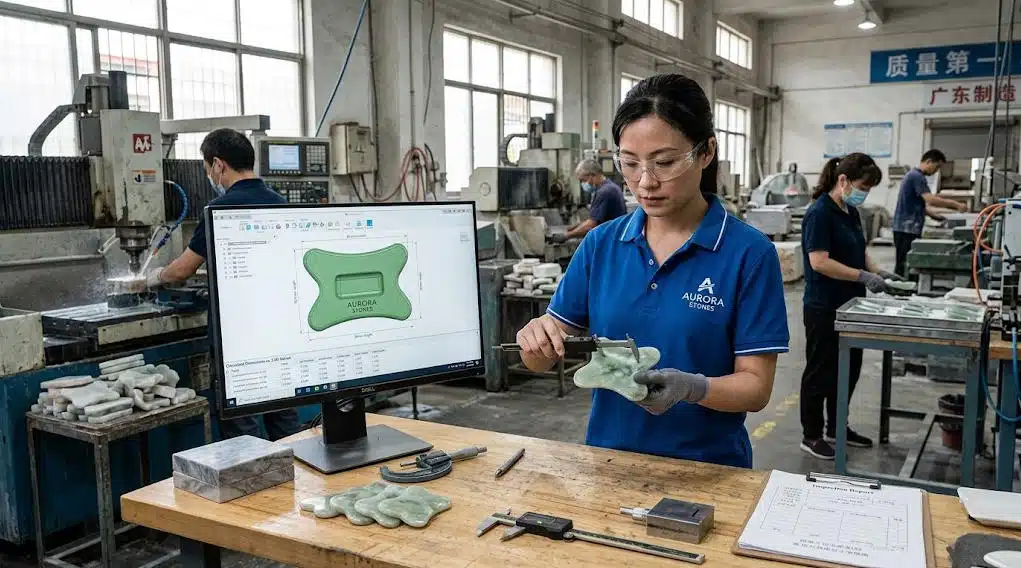
If you’ve ever placed a gua sha custom order and lined the finished stone up next to your 3D rendering, you already know the honest answer to “will it look exactly like the picture?” Geometry can match almost perfectly. Color and internal texture almost never will — and that gap is not a manufacturing defect, it’s physics. On a CNC-machined gua sha custom order, overall shape, dimensional ratios, and logo placement can typically be held within roughly ±0.05mm to ±0.13mm of the CAD file, a tolerance band consistent with standard CNC machining benchmarks published by Protolabs and Modus Advanced. What almost never lines up 1:1 is the color, cloud pattern, and translucency inside a piece of natural stone. This article lays out exactly what you can expect, what you can’t, and how a gua sha manufacturer actually closes that gap before your order enters mass production.
- What "Matching the 3D Design" Actually Means in Gua Sha Custom Manufacturing
- Why a 3D Rendering Is Not a Risk-Free Promise for Gua Sha Custom Orders
- From 3D File to Production-Ready Gua Sha Custom Package
- The Manufacturability Risk Behind Every Gua Sha Custom Order
- How to Get Your Gua Sha Custom Shape Closer to the 3D Model
- What Gua Sha Wholesale and OEM Buyers Should Budget For in a Gua Sha Custom Order
- Risk Disclosure: What You Confirm Before a Gua Sha Custom Order Enters Mass Production
- Quality Control Checkpoints You Can Ask to See on Any Gua Sha Custom Order
- About Deyi Gems — 12 Years as a Source Gua Sha Manufacturer
- FAQS About 3d Model Gua Sha Custom
What “Matching the 3D Design” Actually Means in Gua Sha Custom Manufacturing
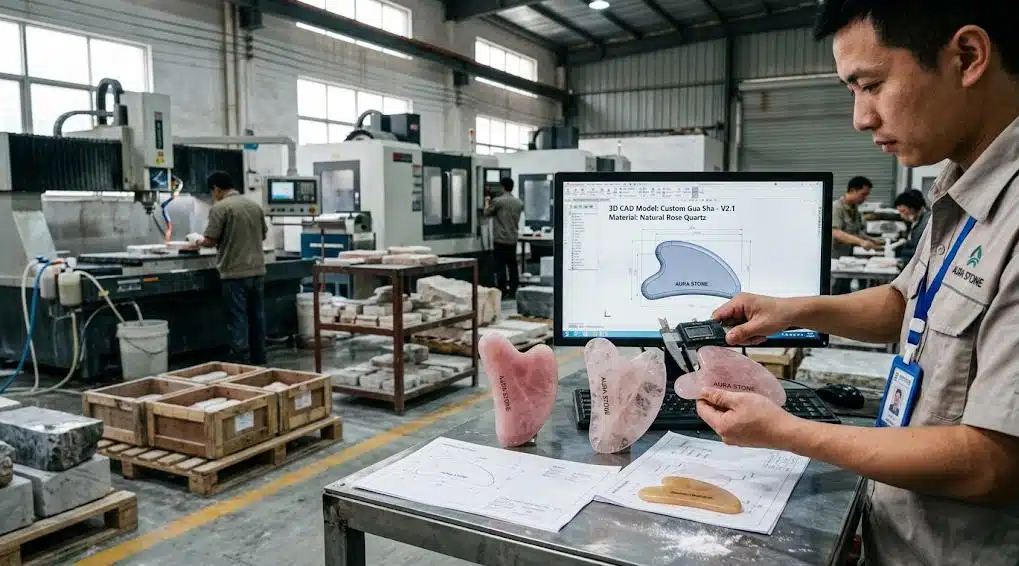
Where Gua Sha Custom Precision Is Guaranteed
You can reasonably expect five things to line up closely between your render and your finished gua sha custom piece: overall silhouette, dimensional ratios, logo or text placement, general surface finish, and — with much less certainty — color and internal texture. Shape and proportion are controllable because CNC toolpaths and mold cavities follow your CAD file directly, not an artist’s interpretation of it. Logo and text placement can be positioned to sub-millimeter accuracy because it’s driven by the same coordinate system as the rest of the cut. Surface finish sits a notch below that, since polishing is a semi-manual process and the final gloss depends on how long and how evenly a piece is buffed.
Dimensional ratios follow the same logic: if your design calls for a 2:1 length-to-width ratio, a properly toleranced gua sha custom drawing will hold that ratio across the whole production run, not just on the first sample. This means you can treat shape, size, and logo placement as commitments a factory should stand behind in writing, while treating color and texture as a documented range rather than a guarantee.
Where Natural Material Sets the Real Limit
Color and texture behave differently because they aren’t manufactured — they’re mined. Two blocks of rose quartz or jade cut from the same rough batch can still show different depth of color, cloud density, or clarity, simply because that’s how the mineral grew. This isn’t a guasha tools custom processing error; it’s the same natural variability that gemological labs spend their careers documenting. So what does that mean for your order? It means the geometry line item on your gua sha custom quote is a hard commitment, and the color/texture line item is a documented range you should sign off on before tooling — not an afterthought you discover on delivery.
Why a 3D Rendering Is Not a Risk-Free Promise for Gua Sha Custom Orders
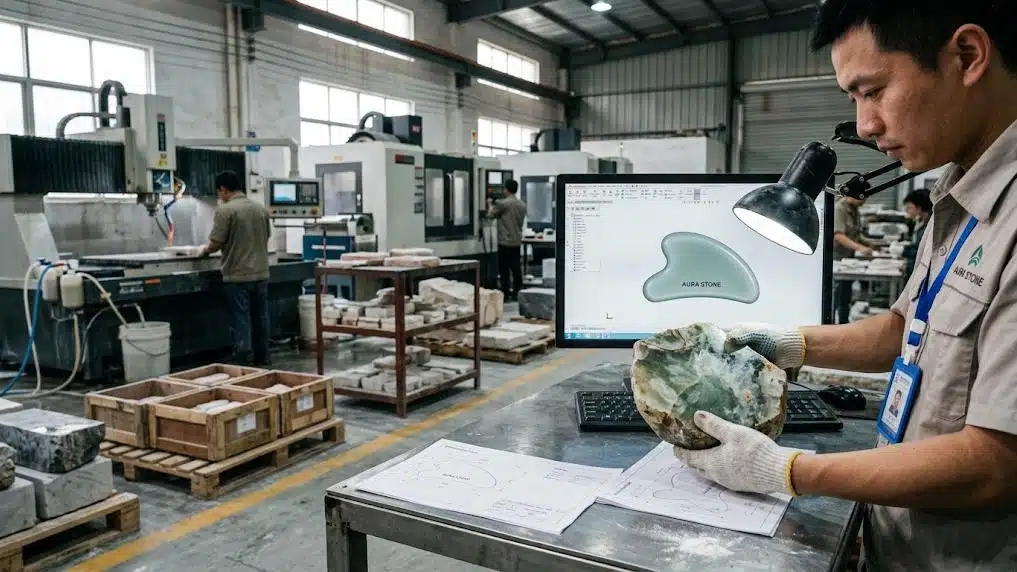
The Physics Behind Natural Stone Color and Texture
Rendering software can control color saturation, transparency, gloss, internal texture, lighting, shadow, and reflection with total precision — because none of that is real. A render can show a jade gua sha board as flawlessly even and glassy because the artist told it to be. Real crystal, jade, and agate carry depth variation, cloud-like inclusions, cotton, ice-crack patterns, internal texture, and zones of differing transparency, and none of that shows up until the rough is actually cut. GIA’s own gemology research points out that natural inclusion patterns are distinct from manufactured ones — natural stones show transparent, partially healed fracture textures that no rendering engine or lab-grown process quite reproduces. In plain terms: natural material looks natural precisely because it’s inconsistent, and that inconsistency is the entire reason your gua sha custom piece feels different from a mass-produced acrylic version.
What GIA and IGS Say About Natural Variation
This isn’t a fringe opinion inside the stone trade — it’s documented industry knowledge. GIA’s research on colored stone value factors explains color zoning as an uneven distribution of color within a gemstone caused by temperature shifts or uneven trace-element uptake during formation, common enough that stones like ametrine and multicolored tourmaline are prized specifically for it. On the processing side, the International Gem Society has documented real cases where a color zone inside natural rough created internal stress that fractured the stone mid-polish, even when the cutter had spotted the zone in advance and planned around it. That’s a useful data point for you as a buyer: yield loss on natural material isn’t always a quality-control failure, it can be the stone itself. If perfectly uniform color across a wholesale batch matters more to you than the material being 100% natural, resin, acrylic, or engineered stone will get you closer to the render than jade or crystal ever will on a gua sha custom order — and a manufacturer should tell you that upfront rather than let you find out after tooling.
From 3D File to Production-Ready Gua Sha Custom Package
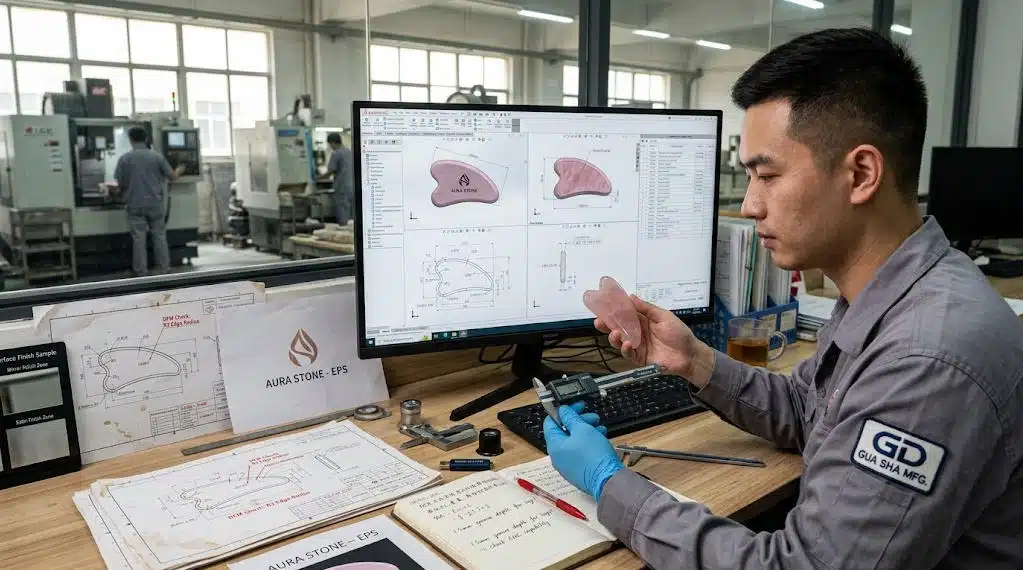
What a Real Gua Sha Custom Spec Package Includes
A polished 3D render usually can’t tell a factory which dimensions are critical, how thick the wall needs to be, how large the edge radius can go, how deep a groove should cut, how the curved surfaces blend into each other, how deep the logo engraving runs, whether a chamfer is allowed, which zones need mirror polish versus a matte finish, or what tolerance applies to each of those numbers. A render is a picture. A production package is instructions. For a gua sha custom order to actually reach the accuracy your render implies, it needs to be converted into five separate documents: a 3D CAD model, a 2D engineering drawing, a material specification, a surface treatment requirement, and a tolerance sheet, plus a vector logo file if branding is involved.
The Cost of Skipping the Engineering Drawing Step
Skipping straight from render to production sounds faster, and sometimes it is — for the first sample. It rarely stays faster once revisions start, because without a 2D drawing there’s no shared reference for what counts as “correct” when the sample doesn’t match expectations. This means that when you request a quote, the single most useful question you can ask isn’t “how fast can you sample this,” it’s “do you work from a full engineering package or just my rendering.” The answer tells you almost everything about how many rounds of sampling you should budget for before you get a gua sha custom piece that matches on the first real attempt.
The Manufacturability Risk Behind Every Gua Sha Custom Order
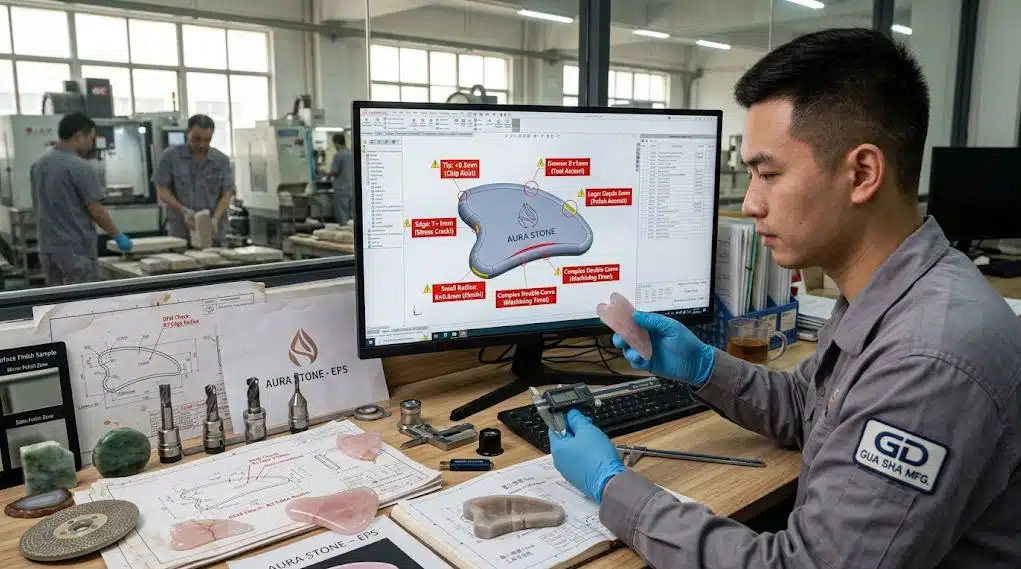
DFM Review for Gua Sha Custom and Guasha Tools Custom Design
3D software has no opinion about whether a shape can survive being cut out of a rock. A designer can draw an extremely thin point, a deep narrow groove, a tiny internal radius, a wide thin edge, a large thin wall, a compound double-curve, or a deep-cut logo, and the software will render it beautifully every time. Natural stone has other plans. Those same features can crack, chip at the corner, resist polishing, slow the machining cycle down significantly, and drag your yield rate lower than your quote assumed. A structured DFM (Design for Manufacturability) review is how a gua sha manufacturer catches this before it becomes your problem instead of the factory’s, and it’s the single review step that decides whether your gua sha custom design ships on schedule or bounces back for a redesign.
Common Failure Points Before They Reach the CNC Table
A proper DFM pass on guasha tools custom geometry checks minimum wall thickness, minimum internal radius, sharp unsupported points, deep narrow grooves, sudden curve transitions, tight interior zones, tool accessibility, and — separately — whether a polishing head can physically reach every surface the render shows as glossy. In standard CNC machining, tightening tolerance below roughly ±0.002in (±0.05mm) commonly increases cost by 25–50%, since that level of precision requires specialized equipment and stress-relief operations rather than a standard setup, according to engineering benchmarks published by Modus Advanced. Would you rather find that out on a quote, or on a rejected first sample three weeks into your production schedule? A DFM flag before tooling starts is how a manufacturer keeps that decision in your hands instead of forcing a redesign after the fact.
How to Get Your Gua Sha Custom Shape Closer to the 3D Model
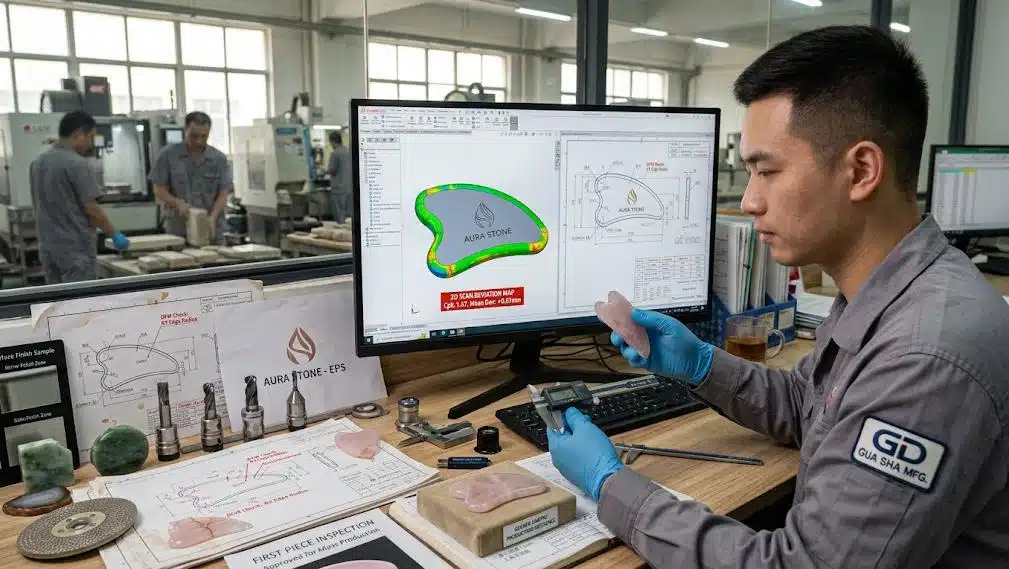
Lock Dimensions With a 2D Drawing, Not Just a Render
The first practical step is refusing to hand a factory only a rendering. Pair the 3D file with a 2D engineering drawing that locks length, width, thickness, edge radius, groove depth, and logo position, each with a stated tolerance rather than a vague “match the picture” instruction. The 3D model carries the overall surface and silhouette; the 2D drawing carries the numbers that actually get inspected on the shop floor. This two-document combination is the baseline for any gua sha custom order that needs to be repeatable across a production run, not just accurate on a single hand-finished sample.
Run DFM Before Tooling, Not After the First Rejected Sample
Before cutting a single piece, put the model through a manufacturability review that flags thin edges, sharp points, deep grooves, tight internal radii, and any zone a cutting or polishing tool physically can’t reach. This step exists specifically so a factory doesn’t quietly reshape your gua sha custom design to protect its own yield rate without telling you. For products with left-right symmetry — hearts, S-curves, wing shapes, crescent shapes — this is also the stage to define a shared centerline, datum face, or datum hole so every critical dimension gets measured from the same reference point instead of drifting from manual handling.
Confirm the Golden Sample Before Mass Production Starts
Don’t let the first sample go straight into a production run. The sequence that actually protects your gua sha custom design is: 3D design, DFM correction, sampling, first-piece comparison against the CAD file, revision, Golden Sample confirmation, then mass production. Once mass production begins, the standard you’re measuring against should shift — it’s no longer the original rendering, it’s the combination of the CAD file, the engineering specification, and the physical Golden Sample sitting on the shelf.
Use 3D Scan Overlay for Complex Curves
For compound curves, irregular arcs, and multi-segment surfaces that a 2D drawing genuinely can’t describe in full, a 3D scan of the first sample can be overlaid directly onto the original CAD model. That overlay shows exactly where the piece runs thick, where it runs thin, where the contour shifted, where the edge drifted, and whether left and right sides stayed symmetrical — information a caliper measuring three or four points simply can’t give you. This means you get a documented deviation map for your gua sha custom order that you can hand back to the machining program, rather than a subjective “it looks a little off” conversation with no data behind it.
What Gua Sha Wholesale and OEM Buyers Should Budget For in a Gua Sha Custom Order
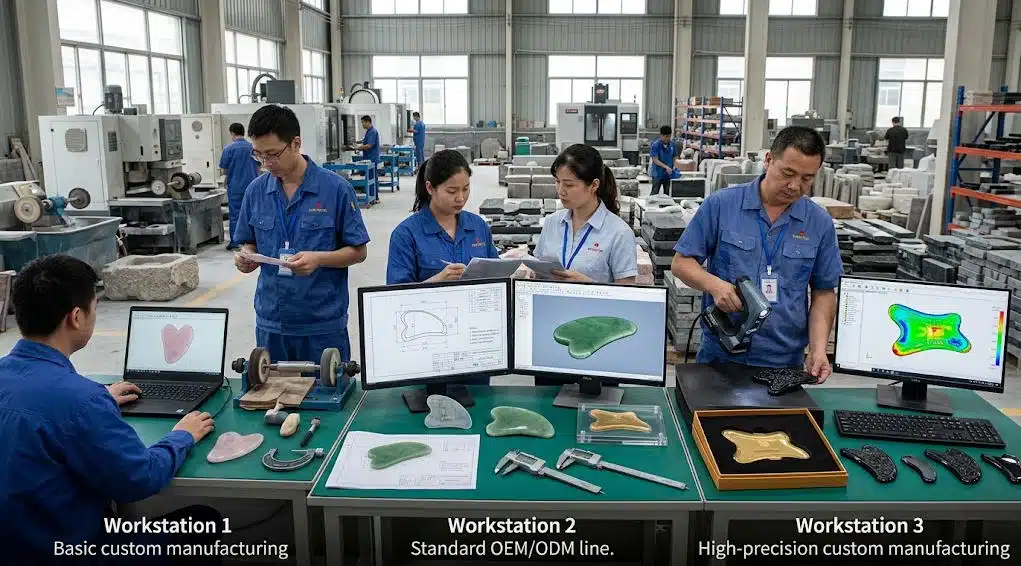
Three Gua Sha Custom Precision Tiers and Their Cost Logic
Not every gua sha custom order needs the same level of process control, and knowing which tier you’re paying for changes how you should read a quote.
| Tier | Typical workflow |
|---|---|
| Basic custom | 3D render → factory interpretation → hand sampling |
| Standard custom | 3D CAD → 2D drawing → DFM → CNC → Golden Sample |
| High-precision custom | 3D CAD → DFM → CNC → first sample → 3D scan → CAD overlay → correction → Golden Sample → production QC |
Basic custom is fast and inexpensive, and it’s a reasonable fit for simple, symmetrical, low-detail shapes where a small amount of hand-finishing variance won’t matter to your buyers. Standard custom is where most gua sha OEM and gua sha ODM orders with a logo, defined tolerance, and moderate curve complexity should sit. High-precision custom earns its cost on genuinely complex geometry — deep compound curves, tight branding placement, or a product line where every unit needs to look identical sitting side by side on a retail shelf.
The tier choice usually tracks with whether you’re running gua sha OEM or gua sha ODM. A gua sha OEM order starts from your own finished 3D file, so your budget mainly covers DFM correction and tolerance sign-off on a design you already own. A gua sha ODM order starts closer to the factory’s existing shape library, so part of your budget instead covers adapting proven guasha tools custom geometry to your branding and material choice — often a faster route to a sellable gua sha custom SKU if you don’t yet have a finished design of your own.
Where Your Tooling and Sampling Budget Actually Goes
For a gua sha wholesale buyer, the real ROI question isn’t “which tier is cheapest,” it’s “which tier is cheapest after you account for redesign cycles.” A DFM review typically adds a small, fixed cost to your sampling phase. A rejected first production batch — the kind that happens when a thin edge chips out at scale or a tight tolerance turns out to be unmachinable — costs considerably more, in both money and calendar time, than the review that would have caught it. Five-axis machining for complex curved geometry can run 300–600% more than standard three-axis machining, so knowing in advance whether your design actually requires that level of machining, or whether a simpler toolpath can hit the same shape, is itself a cost-control decision worth making at the DFM stage of any gua sha custom order rather than after tooling is cut.
Risk Disclosure: What You Confirm Before a Gua Sha Custom Order Enters Mass Production
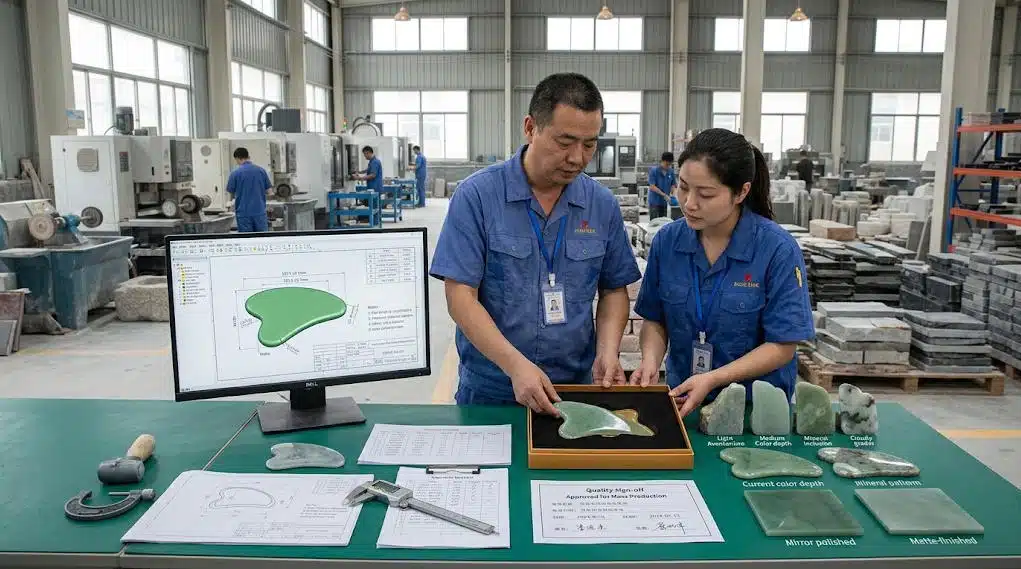
Tolerance Sign-Off Before Mass Production
Before any gua sha custom design moves from sample to production run, three things should be confirmed in writing, not implied by a rendering. First, key dimensions and their tolerances — length, width, thickness, edge radius, groove depth, logo position — each with a stated acceptable range rather than a single ideal number. Second, the surface treatment for each zone, since mirror polish and matte finish behave differently under light and can make an identical shape look like two different products. Third, and most overlooked, sign-off on the Golden Sample itself as the reference standard going forward, replacing the original render entirely.
Material Grade and Natural Variation Disclosure
Would you approve a run of a hundred pieces using only a screenshot as your quality benchmark? Most buyers wouldn’t say yes to that in writing, yet plenty still treat the original rendering as an unspoken contract. The gemstone trade has spent decades building independent infrastructure specifically to document natural material variation rather than pretend it doesn’t exist — SSEF, the Swiss Gemmological Institute, has operated as an internationally recognised, independent gemstone testing authority since 1972, precisely because natural stone characteristics need documented standards rather than visual guesswork. Applied to a gua sha custom or guasha tools custom production run, this means your risk disclosure conversation with a factory should cover material grade, expected color range, and acceptable inclusion characteristics before tooling starts — not as legal boilerplate, but as the same kind of documented range the gem trade has relied on for fifty years.
Quality Control Checkpoints You Can Ask to See on Any Gua Sha Custom Order
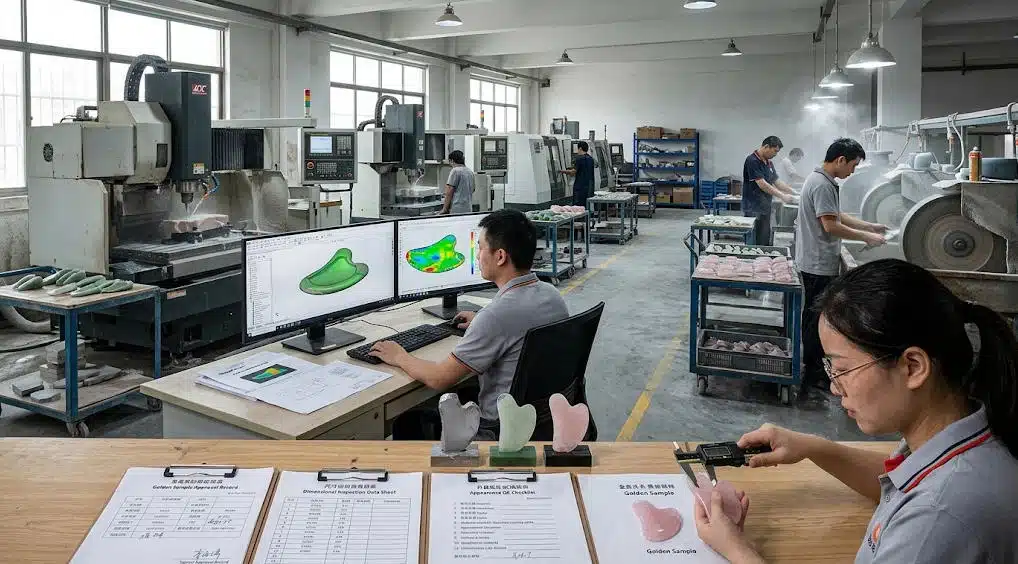
If your goal is getting a natural crystal or jade gua sha custom piece as close as physically possible to the 3D design, the control priorities, in order of impact, run: CAD model quality first, DFM manufacturability review second, CNC machining precision third, grinding and polishing process control fourth, first-piece 3D scan comparison fifth, Golden Sample confirmation sixth, and dimensional/appearance QC during mass production seventh. Notice that CNC precision — the step most buyers assume matters most — actually sits in the middle of that list, not at the top. A perfectly machined part built from a flawed CAD model is still a flawed part; it’s just a flawed part made very accurately.
You’re entitled to ask for documentation at each of those checkpoints, not just the finished pieces at the end. A DFM report, a first-piece scan-to-CAD overlay, and a signed Golden Sample record are all things a gua sha manufacturer should be able to hand over as part of your gua sha custom deliverable, the same way an engineering firm hands over inspection reports alongside a finished part. If a supplier can’t produce any of that documentation on request, that itself is useful information about which tier of process control you’re actually paying for.
About Deyi Gems — 12 Years as a Source Gua Sha Manufacturer
Deyi Gems has spent more than 12 years processing, designing, manufacturing, and supplying crystal and jade gua sha tools directly from source, which is the practical reason this article reads like a risk disclosure rather than a sales page — the gap between a render and a finished gua sha custom piece is something every long-running gua sha manufacturer like Deyi Gems has to manage honestly, order after order. As a source gua sha manufacturer, Deyi Gems runs DFM review, engineering-drawing sign-off, and Golden Sample confirmation as standard steps on gua sha OEM and gua sha ODM projects, rather than optional add-ons reserved for larger orders.
If you’re sourcing under a private label, the distinction between gua sha OEM and gua sha ODM matters for how much design work lands on your side of the table. Under a gua sha OEM arrangement, you bring the design and Deyi Gems executes the CAD-to-Golden-Sample process described above against your files. Under a gua sha ODM arrangement, Deyi Gems can also contribute shape development and material selection from existing tooling and molds, which shortens your timeline if you don’t already have a finished 3D file. Either path runs through the same DFM and tolerance sign-off checkpoints — the difference is only where the design originates, not how rigorously it gets manufactured.
For gua sha wholesale buyers building a private-label line, that process consistency is generally worth more over a full production run than any single sample looking perfect in isolation. A batch of a thousand units where every piece sits inside the same documented tolerance band protects your retail presentation far more than one flawless hero sample photographed for a catalog, which is why Deyi Gems tracks tolerance sign-off at the batch level rather than only on the first sample. If you’re evaluating a gua sha custom project right now — whether it’s a single guasha tools custom SKU or a full gua sha wholesale catalog — the workflow described above — CAD, DFM, tolerance sign-off, Golden Sample — is the same one you should expect to see from any gua sha manufacturer you’re comparing quotes against.
FAQS About 3d Model Gua Sha Custom
1. How close can a gua sha custom piece match my 3D design?
Shape, dimensions, and logo placement can be held within roughly ±0.05–0.13mm under CNC control. Natural stone color and internal texture, however, stay a documented range rather than an exact copy — that’s material physics, not a defect.
2. Why doesn’t the finished stone look exactly like my 3D rendering?
Rendering software can fake flawless, uniform color. Real jade, crystal, and agate carry natural cloud patterns, color zoning, and inclusions that only show up once the rough is actually cut — never before.
3. What does a DFM review actually catch before production?
DFM flags thin edges, deep grooves, sharp points, and tight radii that look fine in CAD but crack or chip in real stone. It’s how a gua sha manufacturer protects your yield before tooling, not after a rejected sample.
4. What’s the real difference between gua sha OEM and gua sha ODM?
OEM starts from your own finished 3D file — you own the design. ODM starts from the factory’s existing shapes and molds, which you customize. Both follow the same DFM and tolerance process once tooling begins.
5. How long does a gua sha custom sample typically take?
It depends on process tier. Jumping straight from render to production is faster upfront but often needs extra correction rounds. A DFM-first sample takes slightly longer initially but usually reaches a confirmed Golden Sample faster overall.