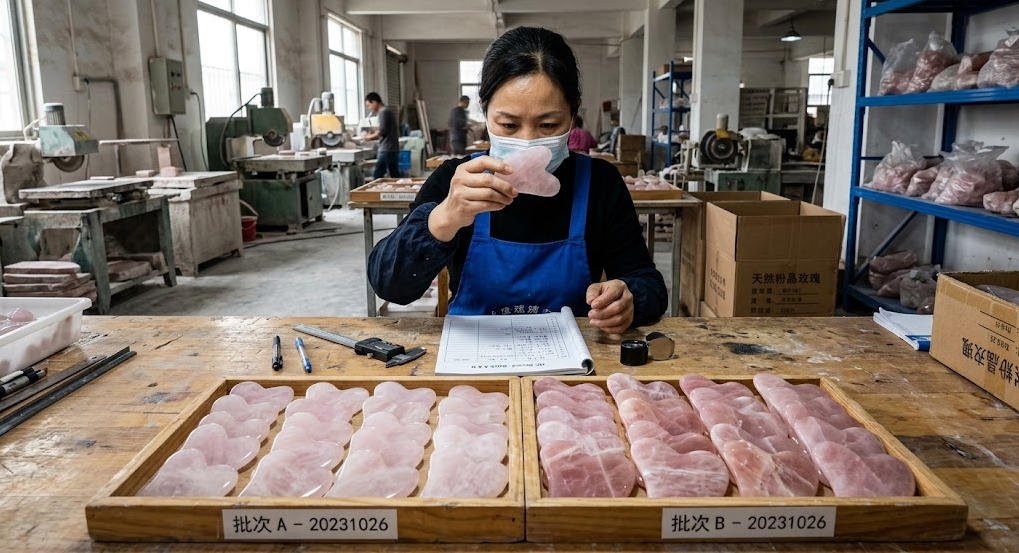
In gua sha wholesale sourcing, buyers regularly run into something a spec sheet cannot explain: the same product code, from the same guasha factory, in the same quantity, arrives one time with a slightly different surface appearance, a different unit price, or a longer delivery window than the previous order. This is not automatically a sign that a gua sha manufacturer has changed the design or cut corners. In natural-stone production — rose quartz, jade, agate, and similar gemstone tools — a fixed SKU defines a target geometry and material category. It does not freeze the exact input conditions of every production run. Raw material batches, machine and tooling wear, order backlog, and internal quality thresholds all shift over a calendar year, and each of these variables feeds into final price, visual consistency, and lead time. The practical risk for a wholesale buyer is treating “same SKU” as a guarantee of “same outcome” on every reorder. Without a shared tolerance range and a documented gua sha quality check standard agreed with the gua sha supplier, that assumption can turn into an unplanned cost increase, a rejected shipment, or a missed retail launch date.
- Raw Material Batch Variation Is the Largest Source of Difference
- Machine and Process Condition Drift Inside the Guasha Factory
- Gua Sha Production Scheduling, Not the Product, Drives Most Lead-Time Changes
- Geometric Consistency and Natural Appearance Consistency Are Two Different Things
- Packaging and Ancillary Materials Are a Frequently Overlooked Bottleneck
- When a "Repeat Order" Behaved Like a New One
- References
Raw Material Batch Variation Is the Largest Source of Difference
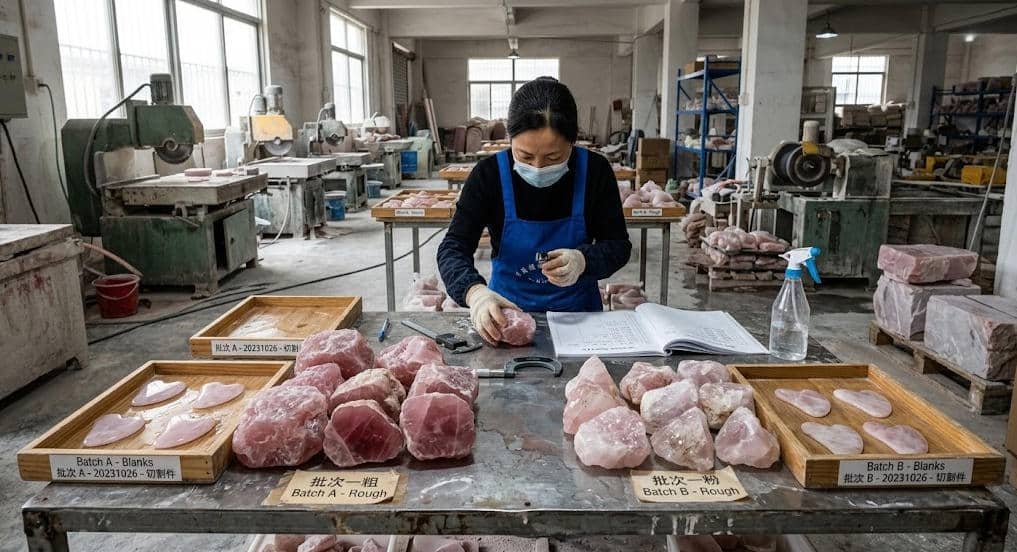
Natural stone is not a standardized industrial input in the way injection-molded plastic or extruded aluminum profile is. Even when a buyer specifies the same material category — for example, rose quartz — different mining locations, different extraction periods, and even different layers within the same deposit can produce rough material with different color saturation, internal texture, mineral inclusions, fracture density, hardness, brittleness, and usable yield. A guasha factory buying the same material grade from the same mine two purchasing cycles apart can still receive rough that behaves noticeably differently once it reaches the cutting stage.
This is not a claim unique to gua sha manufacturing, and it is one of the most common comparisons gua sha wholesale buyers make when two shipments are placed side by side. The Gemological Institute of America notes that rose quartz gets its pink hue from microscopic mineral inclusions, and that color zoning is common in this quartz variety, with some lots showing richer, more uniform color and others showing lighter or more textured material (GIA, Rose Quartz Quality Factors; GIA, Rose Quartz Description). In production, this is exactly what shows up when rough material is opened and cut: two lots purchased under the same nominal grade can separate very differently once cutting begins, because inclusion density and internal fracturing are not fully visible from the outside of the rough stone.
That variability moves through the entire production chain in a fairly direct line: color and texture consistency affects how many pieces from a batch look uniform enough to be graded together, which affects the yield of first-grade output, which affects how many pieces get rejected during gua sha quality check, which in turn affects unit cost and how long it takes to assemble a complete, matched order. So the practical implication for a buyer is straightforward — a visible difference between two shipments of the same SKU is often a raw-material batch effect, not evidence that the gua sha production process itself has degraded.
Raw Material Cost Adds Another Layer to Gua Sha Wholesale Pricing
The cost of a natural-stone gua sha tool is not fixed the way a plastic-molded product’s cost tends to be. Rough material pricing responds to mine output and extraction conditions, buyer demand across the broader gemstone and crystal market, supplier inventory positions, seasonal purchasing cycles, international freight rates, currency movement, and upstream labor and energy costs — the same forces that make gua sha wholesale price lists a moving target rather than a fixed catalog number. The U.S. Geological Survey tracks global supply and demand patterns for gemstone materials for exactly this reason — gemstone markets are subject to meaningful year-to-year and even month-to-month shifts in availability and pricing (USGS, Gemstones Statistics and Information).
As an industry practice observation rather than a fixed figure, raw material typically represents a substantial share of the total cost structure for natural-stone gua sha tools, often more than the labor or finishing steps combined. When that means a gua sha supplier requotes the same SKU at a different price a few months later, the change is frequently a pass-through of material cost movement rather than a margin adjustment. A buyer who assumes pricing should stay flat indefinitely on a natural-material product is working from an incorrect baseline; the more useful question to ask a gua sha supplier is not “why did the price change,” but “what portion of this change is material cost versus processing cost.”
Machine and Process Condition Drift Inside the Guasha Factory

A single guasha factory does not run in an identical state every day. CNC machines are shared across multiple customer orders and get booked in different sequences from month to month. Abrasive wheels and polishing pads wear down with use and get replaced on a schedule, not instantly. Different operators, with different levels of experience, may be assigned to a given gua sha production run. Equipment goes down for scheduled or unscheduled maintenance, and process parameters sometimes get fine-tuned in response to a prior batch’s results.
These factors matter more than they might appear to on paper. During grinding, a worn abrasive wheel removes material less predictably than a fresh one, which can produce slightly uneven edge rounding or minor thickness variation even when the CNC program itself has not changed. This is a mechanical reality of subtractive processing — cutting, rough grinding, fine grinding, and polishing each depend on the condition of a consumable tool, not only on the digital file behind the part.
Where dimensions are not called out with a specific tolerance on the drawing, many machine shops — including those working in stone and hard mineral processing — default to a general tolerance framework such as ISO 2768, which defines acceptable deviation ranges for linear and angular dimensions across several precision classes (ISO 2768 tolerance standard overview, Xometry Pro). That standard exists because “same mold” does not guarantee “identical part,” even in metal and plastic work, let alone when the process also has to cut natural stone with inconsistent internal density. The practical takeaway is that a buyer should ask which tolerance class or dimensional range applies to their product, rather than assuming zero variation is the default state.
Gua Sha Production Scheduling, Not the Product, Drives Most Lead-Time Changes

Lead time is often treated as if it belongs to the product — as if a 5,000-piece order of a specific gua sha board should always take the same number of days. In practice, lead time is closer to a function of “product plus current factory conditions.” If material is already in stock and the CNC line, polishing line, and QC queue are not backed up, a gua sha manufacturer can move an order through relatively quickly. If the same guasha factory is mid-backlog, waiting on a fresh material shipment, and running polishing at full capacity for several other clients, the identical order can take meaningfully longer.
As an illustrative range rather than a fixed rule, it is common in stone-based gua sha production for the same order to move through a low-demand period in roughly three to three and a half weeks and take four to five and a half weeks during a high-demand period — with the difference coming almost entirely from queueing and material readiness rather than a change in the manufacturing method. This is why lead time should be treated as a variable to confirm at the time of order, not a number that gets carried forward indefinitely from a previous purchase order.
Seasonal Demand Peaks Compound Scheduling Pressure
Beauty and skincare tool categories, including gua sha wholesale products, tend to have seasonal demand patterns tied to gifting periods and retail restocking cycles. When several brands place orders around the same window, a gua sha manufacturer can face simultaneous pressure across multiple stages at once: raw material purchasing increases, CNC capacity gets booked further out, polishing lines queue up, packaging material suppliers see their own order backlogs grow, QC staff handle a higher volume of inspection work, and outbound freight booking gets tighter.
The same order that might complete in three weeks during a slow month can take five to six weeks during a peak period. This is not evidence that a gua sha supplier’s process has gotten slower — it usually reflects a capacity utilization effect: the manufacturing method has not changed, but the queue in front of it has.
Geometric Consistency and Natural Appearance Consistency Are Two Different Things

For natural-stone gua sha tools, it is worth separating two concepts that buyers frequently treat as one: dimensional consistency and visual consistency. A guasha factory has real, engineerable control over external length, width, thickness, hole placement, edge curvature, and overall geometry, because these are governed by mold design, CNC programming, and a stated tolerance range. What a factory does not control — and cannot control through equipment alone — is the internal texture, crystal distribution, natural color banding, cloud-like inclusions, and color depth of each individual piece of stone, because those properties are set by how the mineral formed, not by how it is cut.
This is why a buyer might receive a rose quartz gua sha board this year that matches last year’s order in size within a stated tolerance, yet looks visually different in terms of color depth or internal cloudiness. That difference usually reflects natural batch variation rather than a manufacturing error. The practical implication for sourcing is to request two separate things from a gua sha supplier: a dimensional tolerance range for size and geometry, and a defined acceptance standard — often expressed against a physical Golden Sample — for natural texture, color range, and inclusion visibility. Treating a single product photo as if it defines both dimension and appearance for every future batch sets an expectation that natural material cannot reliably meet.
Gua Sha Quality Check Standards Are Not Static Either
It is easy to assume that once a guasha factory sets a quality threshold, it stays fixed. In practice, gua sha quality check criteria shift for two separate reasons. First, a gua sha manufacturer may tighten its own internal acceptance standard after seeing a pattern of customer complaints — for instance, moving from accepting minor natural texture as normal to rejecting anything with a visible surface crack or a strong color mismatch. Second, and just as commonly, the buyer’s own brand standards evolve — a company that once accepted a wide natural color range may later require closer matching to a Golden Sample as its retail presentation matures.
Either change has the same downstream effect: a stricter gua sha quality check reduces the pieces from any batch that pass inspection, lowering yield and raising unit cost, even if raw manufacturing capability has not measurably changed. This distinction matters for a buyer evaluating a price increase — the change may reflect a stricter inspection line rather than a less capable guasha factory. Asking whether the standard has changed, and requesting the current inspection checklist, is more useful than comparing only the final unit price.
Packaging and Ancillary Materials Are a Frequently Overlooked Bottleneck

Gua sha wholesale orders are rarely just a finished stone piece. Custom color boxes, EVA inner trays, velvet pouches, printed logos, barcodes, and instruction cards typically come from a separate supply chain than the core gua sha production line itself, and that chain has its own capacity constraints that move independently of the polishing schedule. A batch of EVA insert trays might be available in seven days in one production cycle and take fifteen days in the next simply because the packaging supplier is running at higher utilization for other clients during that period.
The practical consequence is that the finished gua sha piece can be sitting complete in the guasha factory while the order as a whole cannot ship, because packaging is the bottleneck rather than the stone itself. Evaluating lead time should account for the slowest component of the full order — packaging included — not only the processing time for the gua sha tool.
When a “Repeat Order” Behaved Like a New One

The following is an illustrative case study built from common patterns observed in natural-stone gua sha production. It does not describe a specific, identifiable customer order.
Situation. A wellness brand reordered a rose quartz gua sha board it had purchased successfully six months earlier — same SKU, same 5,000-piece quantity, same packaging artwork.
Production Condition. The reorder landed during a seasonal demand peak. Rose quartz rough had to be repurchased rather than pulled from existing stock, and the CNC and polishing lines were both running near capacity for other clients.
Risk. Because the buyer had only kept the previous shipment’s product photo and unit price as a reference, there was no documented tolerance range or Golden Sample on file to compare the new batch against.
Detection. During the buyer’s incoming gua sha quality check, a portion of the new batch showed noticeably lighter color and more visible internal cloudiness compared to the earlier shipment, prompting a quality dispute.
Root Cause. The new rough material batch had different natural inclusion density than the original lot — a raw material variation consistent with the mechanism described earlier, not a processing defect. Without a Golden Sample or a written color-range agreement, there was no objective standard either party could point to.
Corrective Action. The gua sha supplier and buyer jointly selected a Golden Sample from the current batch, defined an acceptable natural color and clarity range around it, and agreed on a documented dimensional tolerance for future orders, in addition to a defect standard covering cracks, chips, and scratches.
Result. Subsequent batches were evaluated against the agreed Golden Sample rather than against the memory of a prior shipment, which reduced disputes even though natural variation between batches continued to exist.
Lesson. For buyers and product developers, the underlying lesson is that a photo and a price are not a specification. A reorder of a natural-material gua sha product should be backed by a documented tolerance range, an agreed defect standard, and — where color or texture consistency matters to the brand — a physical Golden Sample kept on file by both parties.
A Framework for Understanding What Drives Price and Lead Time
As an illustrative framework rather than a literal invoice breakdown, it can help to think of the final gua sha wholesale price and lead time as sums of variable components rather than fixed numbers tied to a SKU:
Price ≈ raw material cost + processing cost + yield loss cost + surface finishing + quality inspection + packaging + logistics + factory margin
Lead time ≈ raw material preparation + queue/scheduling wait + processing time + yield-loss rework or replacement + surface finishing + quality inspection + packaging
Several of the inputs on both sides of these equations — material cost, yield, machine queue position, and QC pass rate — change over time even when the SKU, quantity, and design stay identical. That is the core reason a quote or lead time from six months ago should be treated as a starting reference point for a new negotiation, not as a locked-in figure that a gua sha manufacturer is expected to reproduce indefinitely regardless of current material and production conditions.
How Wholesale Buyers Can Reduce Time-Based Variance
Buyers who reorder the same gua sha wholesale product repeatedly get more consistent results by replacing “photo plus price” with a documented specification set, which typically includes:
- 2D/3D dimensional drawing with a stated tolerance range
- Material type and grade definition
- A physical Golden Sample confirmed with the gua sha supplier
- An agreed natural color-range or shade-variation standard
- A defined acceptance standard for natural texture, inclusions, or cloud-like structures
- A defect standard covering cracks, chips, and surface scratches
- Dimensional tolerance for critical features (thickness, edge radius, hole position)
- Surface finishing requirements (matte, polished, or a specified gloss level)
- Packaging specifications for boxes, inserts, and protective materials
- A written lead-time definition, including what counts as order confirmation and what counts as shipment-ready
None of this eliminates natural variation — it is not possible to require every batch of rose quartz to be visually identical, any more than it would be realistic to require every piece of wood grain to match. What a documented standard does is separate the things a factory can reliably control — dimensional accuracy, processing consistency, and defect thresholds — from the things that are inherent to natural material and were never going to be identical in the first place.
Written by the Manufacturing Content Team at Deyi Gems, drawing on production, quality control, and order-fulfillment observations from a natural crystal and jade gua sha processing operation. This article focuses on manufacturing mechanics and buyer decision-making rather than product promotion.
References
- Gemological Institute of America, “Rose Quartz Quality Factors” — https://www.gia.edu/rose-quartz-quality-factors
- Gemological Institute of America, “Rose Quartz Description” — https://www.gia.edu/rose-quartz-description
- U.S. Geological Survey, National Minerals Information Center, “Gemstones Statistics and Information” — https://www.usgs.gov/centers/national-minerals-information-center/gemstones-statistics-and-information
- Xometry Pro, “Standard Tolerances in Manufacturing: ISO 2768 & ISO 286” — https://xometry.pro/en/articles/standard-tolerances-manufacturing/