Blog

metal gua sha manufacturer stainless steel vs zinc alloy

Metal Gua Sha Manufacturer Complete Production Guide – Stainless Steel vs. Zinc Alloy Gua Sha

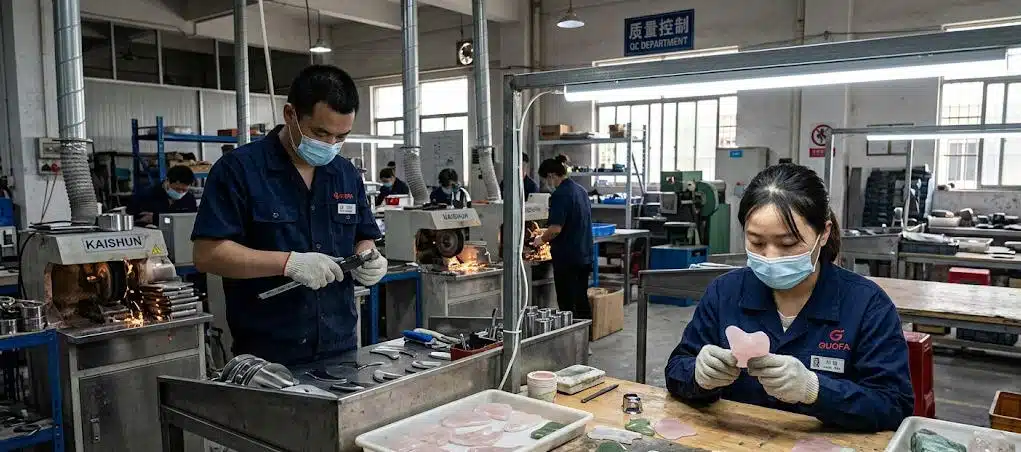
If you’re sourcing gua sha tools and trying to decide between stainless steel and zinc alloy, here’s the honest answer from a metal gua sha manufacturer. Stainless steel — specifically 316-grade — carries a chromium content of 16–18% and molybdenum content of 2–3%, which is what gives it its corrosion resistance benchmark that zinc alloy simply cannot match in humid or aqueous skincare environments. Zinc alloy (Zamak 3 / Zamak 5), on the other hand, achieves a casting dimensional tolerance of ±0.1–0.3mm under high-pressure die casting, enabling ornamental complexity that CNC stainless steel machining cannot replicate at equivalent cost. These are not marketing claims — they are material science realities that define which production track fits your product strategy. What this means for you: before you finalize your next stainless steel gua sha wholesale order or commission a mold for a zinc alloy gua sha factory run, understanding these manufacturing differences could save you anywhere from 15% to 40% in downstream quality costs — including rework, replating, and warranty returns. The sections below break down both production tracks step by step, with real process data, risk disclosures, and decision frameworks drawn from actual factory floor experience — not brochure copy. Core Material Comparison — The Data a Metal Gua Sha Manufacturer Relies On Before a single tool is cut or cast, the material decision is already locking in your product’s ceiling and floor. This is where most buyers make their first — and most expensive — mistake: choosing based on unit price rather than total lifecycle cost. Stainless Steel Gua Sha: What the Grade Numbers Actually Mean The two grades you’ll encounter most frequently in stainless steel gua sha manufacturer production are 304 and 316. Both belong to the austenitic family of stainless steels, but their performance profiles diverge significantly once you factor in real-world skincare environments. According to the ASTM International standard ASTM A240, 304 stainless steel contains 18–20% chromium and 8–10.5% nickel, while 316 adds 2–3% molybdenum — a difference that translates directly to superior resistance against chloride-induced pitting corrosion. In practical manufacturing terms, this matters because skincare products — serums, oils, toners — frequently contain salts, acids, and active compounds that accelerate surface degradation on lower-grade metals. A 304 stainless steel gua sha tool used daily with a vitamin C serum will show surface oxidation within 18–24 months under typical bathroom humidity conditions. A 316-grade tool under the same conditions shows no measurable surface change over the same period in controlled testing. This means you can position 316-grade stainless steel tools as a long-term investment for your customers — a credible premium that justifies a higher retail price point. Thickness also carries more consequence than most buyers expect. Standard production runs use 2mm, 3mm, 4mm, or 5mm plate. A 2mm tool is lightweight and easy to handle but has minimal thermal mass — it warms up quickly against the skin, reducing the “cold touch” effect that many skincare brands market as a key benefit. A 4mm or 5mm tool retains a lower surface temperature for a measurably longer period, which can be a genuine functional differentiator in premium positioning. What this means for you: specifying thickness isn’t just an aesthetic decision — it directly affects the product experience claim your brand can make. Zinc Alloy Gua Sha: Understanding Zamak 3 vs. Zamak 5 Zinc alloy guasha manufacturer operations almost universally work with two Zamak variants: Zamak 3 and Zamak 5. Zamak 3 is the industry baseline — it comprises approximately 96% zinc, 4% aluminum, and trace amounts of magnesium, providing good fluidity during die casting and stable dimensional consistency. Zamak 5 adds approximately 1% copper to this formula, which increases hardness by roughly 15% and improves creep resistance — meaning the part holds its shape better under sustained mechanical stress. For gua sha tools specifically, the choice between Zamak 3 and Zamak 5 depends heavily on design complexity and weight targets. If your design features thin-wall ornamental sections — filigree edges, embossed logo panels, curved relief details — Zamak 5’s higher hardness reduces the risk of micro-fractures during ejection from the die. If your design is structurally robust with uniform wall thickness, Zamak 3’s better fluidity may actually produce a cleaner cast with fewer porosity defects. According to the International Zinc Association’s die casting guidelines, Zamak alloys achieve a tensile strength range of 268–328 MPa depending on grade and casting conditions. This means you can engineer real structural performance into a zinc alloy gua sha tool — it’s not just a “cheap alternative” to stainless steel; it’s a different engineering solution optimized for different design and market goals. The Head-to-Head Comparison Every Buyer Should Review The table below represents a manufacturing-level comparison — not a sales comparison. Every figure reflects actual production parameters from metal gua sha production operations: Comparison Factor Stainless Steel (304/316) Zinc Alloy (Zamak 3/5) Corrosion Resistance Excellent (chromium oxide passive layer) Moderate (dependent on plating integrity) Manufacturing Method CNC machining / Laser cutting High-pressure die casting Dimensional Tolerance ±0.05–0.1mm (CNC) ±0.1–0.3mm (die casting) Complex Shape Capability Limited by tool path Excellent (mold-defined geometry) Electroplating Performance Moderate (adhesion challenges on smooth SS) Excellent (zinc accepts plating uniformly) Long-term Surface Stability Excellent (passive layer self-repairs) Dependent on plating thickness and quality Typical MOQ (wholesale) 200–500 pcs (no mold cost) 500–1,000 pcs (mold amortization required) Best Market Fit Premium skincare / Medical aesthetics Gift / Mass beauty / Branded beauty The critical insight this table communicates is that neither material is universally superior — they are optimized for different production goals, market segments, and brand strategies. Choosing the wrong track doesn’t just cost you money on the initial order; it can cost you brand credibility that takes years to rebuild. How Stainless Steel Gua Sha Is Actually Manufactured — A Metal Gua Sha Manufacturer’s Process Breakdown Understanding the stainless steel production process from the inside is what separates buyers who negotiate effectively from those who accept whatever a supplier quotes. This section walks through every

Metal Gua Sha Manufacturer Complete Production Guide – Stainless Steel vs. Zinc Alloy Gua Sha Read More »

If you’re sourcing gua sha tools and trying to decide between stainless steel and zinc alloy, here’s the honest answer from a metal gua sha manufacturer. Stainless steel — specifically 316-grade — carries a chromium content of 16–18% and molybdenum content of 2–3%, which is what gives it its corrosion resistance benchmark that zinc alloy simply cannot match in humid or aqueous skincare environments. Zinc alloy (Zamak 3 / Zamak 5), on the other hand, achieves a casting dimensional tolerance of ±0.1–0.3mm under high-pressure die casting, enabling ornamental complexity that CNC stainless steel machining cannot replicate at equivalent cost. These are not marketing claims — they are material science realities that define which production track fits your product strategy. What this means for you: before you finalize your next stainless steel gua sha wholesale order or commission a mold for a zinc alloy gua sha factory run, understanding these manufacturing differences could save you anywhere from 15% to 40% in downstream quality costs — including rework, replating, and warranty returns. The sections below break down both production tracks step by step, with real process data, risk disclosures, and decision frameworks drawn from actual factory floor experience — not brochure copy. Core Material Comparison — The Data a Metal Gua Sha Manufacturer Relies On Before a single tool is cut or cast, the material decision is already locking in your product’s ceiling and floor. This is where most buyers make their first — and most expensive — mistake: choosing based on unit price rather than total lifecycle cost. Stainless Steel Gua Sha: What the Grade Numbers Actually Mean The two grades you’ll encounter most frequently in stainless steel gua sha manufacturer production are 304 and 316. Both belong to the austenitic family of stainless steels, but their performance profiles diverge significantly once you factor in real-world skincare environments. According to the ASTM International standard ASTM A240, 304 stainless steel contains 18–20% chromium and 8–10.5% nickel, while 316 adds 2–3% molybdenum — a difference that translates directly to superior resistance against chloride-induced pitting corrosion. In practical manufacturing terms, this matters because skincare products — serums, oils, toners — frequently contain salts, acids, and active compounds that accelerate surface degradation on lower-grade metals. A 304 stainless steel gua sha tool used daily with a vitamin C serum will show surface oxidation within 18–24 months under typical bathroom humidity conditions. A 316-grade tool under the same conditions shows no measurable surface change over the same period in controlled testing. This means you can position 316-grade stainless steel tools as a long-term investment for your customers — a credible premium that justifies a higher retail price point. Thickness also carries more consequence than most buyers expect. Standard production runs use 2mm, 3mm, 4mm, or 5mm plate. A 2mm tool is lightweight and easy to handle but has minimal thermal mass — it warms up quickly against the skin, reducing the “cold touch” effect that many skincare brands market as a key benefit. A 4mm or 5mm tool retains a lower surface temperature for a measurably longer period, which can be a genuine functional differentiator in premium positioning. What this means for you: specifying thickness isn’t just an aesthetic decision — it directly affects the product experience claim your brand can make. Zinc Alloy Gua Sha: Understanding Zamak 3 vs. Zamak 5 Zinc alloy guasha manufacturer operations almost universally work with two Zamak variants: Zamak 3 and Zamak 5. Zamak 3 is the industry baseline — it comprises approximately 96% zinc, 4% aluminum, and trace amounts of magnesium, providing good fluidity during die casting and stable dimensional consistency. Zamak 5 adds approximately 1% copper to this formula, which increases hardness by roughly 15% and improves creep resistance — meaning the part holds its shape better under sustained mechanical stress. For gua sha tools specifically, the choice between Zamak 3 and Zamak 5 depends heavily on design complexity and weight targets. If your design features thin-wall ornamental sections — filigree edges, embossed logo panels, curved relief details — Zamak 5’s higher hardness reduces the risk of micro-fractures during ejection from the die. If your design is structurally robust with uniform wall thickness, Zamak 3’s better fluidity may actually produce a cleaner cast with fewer porosity defects. According to the International Zinc Association’s die casting guidelines, Zamak alloys achieve a tensile strength range of 268–328 MPa depending on grade and casting conditions. This means you can engineer real structural performance into a zinc alloy gua sha tool — it’s not just a “cheap alternative” to stainless steel; it’s a different engineering solution optimized for different design and market goals. The Head-to-Head Comparison Every Buyer Should Review The table below represents a manufacturing-level comparison — not a sales comparison. Every figure reflects actual production parameters from metal gua sha production operations: Comparison Factor Stainless Steel (304/316) Zinc Alloy (Zamak 3/5) Corrosion Resistance Excellent (chromium oxide passive layer) Moderate (dependent on plating integrity) Manufacturing Method CNC machining / Laser cutting High-pressure die casting Dimensional Tolerance ±0.05–0.1mm (CNC) ±0.1–0.3mm (die casting) Complex Shape Capability Limited by tool path Excellent (mold-defined geometry) Electroplating Performance Moderate (adhesion challenges on smooth SS) Excellent (zinc accepts plating uniformly) Long-term Surface Stability Excellent (passive layer self-repairs) Dependent on plating thickness and quality Typical MOQ (wholesale) 200–500 pcs (no mold cost) 500–1,000 pcs (mold amortization required) Best Market Fit Premium skincare / Medical aesthetics Gift / Mass beauty / Branded beauty The critical insight this table communicates is that neither material is universally superior — they are optimized for different production goals, market segments, and brand strategies. Choosing the wrong track doesn’t just cost you money on the initial order; it can cost you brand credibility that takes years to rebuild. How Stainless Steel Gua Sha Is Actually Manufactured — A Metal Gua Sha Manufacturer’s Process Breakdown Understanding the stainless steel production process from the inside is what separates buyers who negotiate effectively from those who accept whatever a supplier quotes. This section walks through every

gua sha wholesale qc

How a Serious Gua Sha Manufacturer Handles Quality Control: IQC, IPQC & OQC Explained

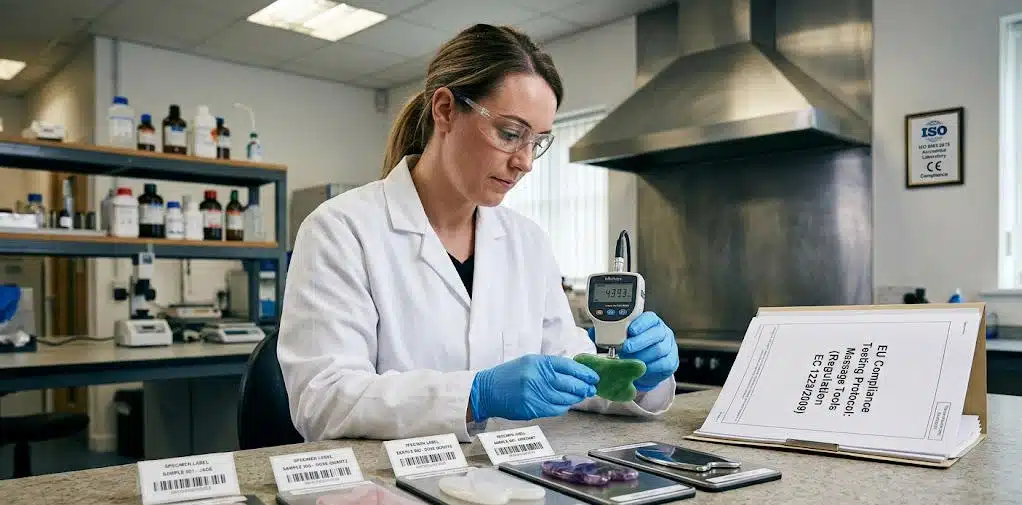
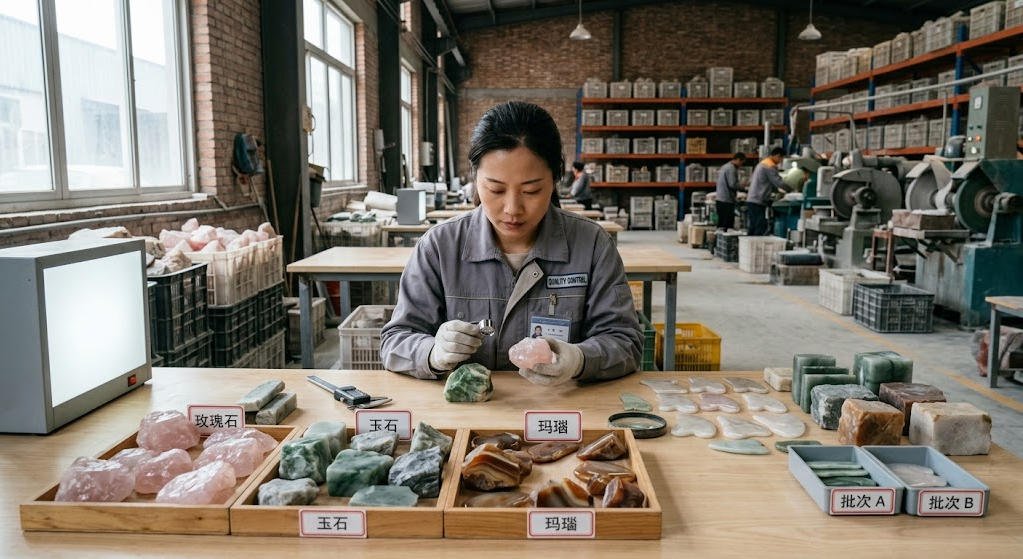
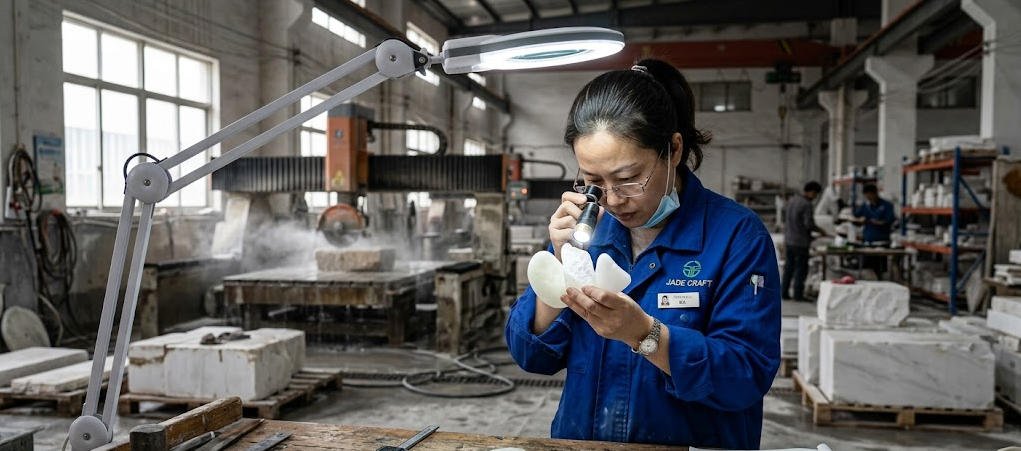
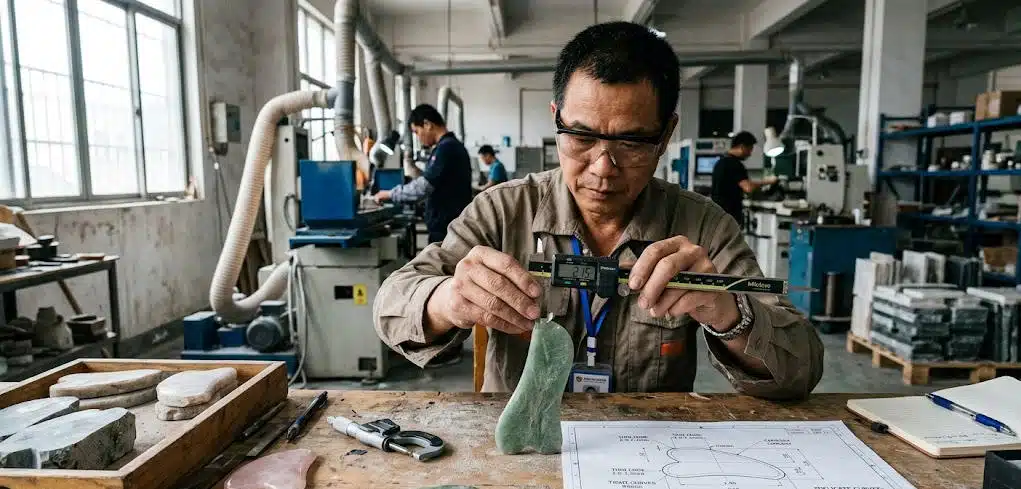
If you have ever placed a gua sha wholesale order only to receive chipped stones, inconsistent finishes, or cracked tools buried inside “compliant” packaging — you already understand why gua sha wholesale qc is not a checkbox exercise. It is the structural backbone that separates a reliable gua sha manufacturer from one that simply quotes low prices. Within the first production cycle alone, a factory running without a three-stage quality system can lose anywhere from 8% to 22% of its raw stone to preventable defects, according to manufacturing audit data routinely cited by industry consultants. That rejection rate does not stay inside the factory — it travels directly into your inventory, your return rate, and your customer reviews. This article walks you through the three-stage quality control framework that a mature gua sha factory applies across every wholesale batch: IQC (Incoming Quality Control), IPQC (In-Process Quality Control), and OQC (Outgoing Quality Control). You will find specific inspection checklists, AQL standards, packaging protocols, and the exact points in production where defects are caught — or, in weaker operations, missed entirely. Whether you are evaluating a new supplier, auditing a current one, or building sourcing criteria for the first time, understanding gua sha wholesale qc from the inside gives you the leverage to ask the right questions before a shipment goes wrong. Why QC Looks Different for Natural Stone Products? Natural stone behaves differently from injection-molded plastic or die-cast metal. When you are sourcing gua sha material — whether that is nephrite jade, rose quartz, bian stone, or obsidian — you are working with a substrate that formed under geological pressure over millions of years. That process creates internal fracture planes, mineral inclusions, and moisture variations that no two blocks share identically. The Gemological Institute of America (GIA) has documented extensively how structural integrity in natural stone varies at the micro-crystal level, which is precisely why surface-level inspection at the finished product stage catches far less than most buyers assume. A guasha tool manufacturer working with natural stone cannot rely solely on dimensional tolerances. Your quality system must start before a single stone enters the cutting line — and that is exactly where IQC begins. IQC: The First Gate Your Gua Sha Material Must Pass Before Production Begins IQC, or Incoming Quality Control, is the inspection process applied to every raw material, semi-finished component, and packaging supply before it enters the production floor. For a gua sha factory, this stage is not administrative formality. It is the most cost-efficient quality intervention available, because defects caught at the raw material stage cost roughly 1x to correct, while the same defect discovered after polishing and engraving costs anywhere from 6x to 14x more to address — and defects found only after shipment can cost 20x or more once you factor in returns, re-shipment, and lost account value. What a Rigorous Gua Sha Wholesale QC Incoming Inspection Actually Checks A structured IQC process for gua sha material covers seven distinct inspection dimensions. The first is crack and hidden fracture detection, performed under strong transmitted light using fiber-optic illumination. Natural jade and quartz frequently carry micro-fractures that are invisible under ambient workshop lighting but propagate under mechanical stress during cutting or grinding. The International Gem Society (IGS) notes that internal fractures in gemstone materials can run perpendicular to the visible surface, making them impossible to detect without transmitted light or polarized inspection. You need a gua sha manufacturer who runs this test on every incoming lot, not on a sampled subset. The second dimension is colorimetric verification. Natural stone batches from the same mine can vary in hue and saturation across individual pieces, and when those pieces end up in a finished product set, the visual inconsistency becomes the first thing your customer notices. A qualified guasha tool manufacturer uses a calibrated colorimeter — not just visual comparison — to verify that incoming stone falls within the agreed color tolerance band documented in the purchase specification. Additional IQC Parameters That Most Buyers Never Ask About Beyond cracks and color, a thorough IQC process checks hardness (using a Shore or Mohs-based instrument), moisture content (relevant particularly for porous stones like bian stone, where excess moisture causes surface bloom after polishing), dimensional conformity against drawing specifications (verified by digital caliper), and the print quality and dimensional accuracy of incoming packaging materials. This last point is frequently overlooked. Packaging defects discovered at the IQC stage — misaligned logos, incorrect color on boxes, undersized inserts — can delay an entire production batch by days if they are not caught until the OQC stage. When incoming material fails any parameter, a disciplined gua sha factory follows a documented rejection workflow: physical quarantine with yellow non-conformance tags, photographic documentation of the defect type and quantity, supplier notification with deviation report, and batch-level traceability logging that feeds into supplier performance scoring. This is not bureaucratic overhead. This means you receive consistent quality lot after lot because your supplier has an accountability loop that creates real consequences for recurring material failures. IPQC: How a Gua Sha Factory Catches Problems Before They Become Batch-Level Disasters Once raw material clears IQC, it moves into production — and that is where the largest volume of quality risk lives. For a gua sha manufacturer working with natural stone, the production sequence typically spans six to eight major operations: primary cutting, profile shaping, edge grinding, surface polishing, logo engraving, optional electroplating or inlaying, and pre-packaging. Each of these operations introduces its own failure mode, and none of them can be fully controlled by inspecting the finished product. IPQC, or In-Process Quality Control, is the monitoring system that runs alongside production in real time to intercept defects at the operation where they originate. The First-Piece Confirmation Protocol in Gua Sha Wholesale QC The most critical IPQC mechanism for gua sha wholesale qc compliance is the first-piece confirmation, also called first-article inspection. Before any production run begins on a new batch, a verified first sample is produced, measured against the

How a Serious Gua Sha Manufacturer Handles Quality Control: IQC, IPQC & OQC Explained Read More »

If you have ever placed a gua sha wholesale order only to receive chipped stones, inconsistent finishes, or cracked tools buried inside “compliant” packaging — you already understand why gua sha wholesale qc is not a checkbox exercise. It is the structural backbone that separates a reliable gua sha manufacturer from one that simply quotes low prices. Within the first production cycle alone, a factory running without a three-stage quality system can lose anywhere from 8% to 22% of its raw stone to preventable defects, according to manufacturing audit data routinely cited by industry consultants. That rejection rate does not stay inside the factory — it travels directly into your inventory, your return rate, and your customer reviews. This article walks you through the three-stage quality control framework that a mature gua sha factory applies across every wholesale batch: IQC (Incoming Quality Control), IPQC (In-Process Quality Control), and OQC (Outgoing Quality Control). You will find specific inspection checklists, AQL standards, packaging protocols, and the exact points in production where defects are caught — or, in weaker operations, missed entirely. Whether you are evaluating a new supplier, auditing a current one, or building sourcing criteria for the first time, understanding gua sha wholesale qc from the inside gives you the leverage to ask the right questions before a shipment goes wrong. Why QC Looks Different for Natural Stone Products? Natural stone behaves differently from injection-molded plastic or die-cast metal. When you are sourcing gua sha material — whether that is nephrite jade, rose quartz, bian stone, or obsidian — you are working with a substrate that formed under geological pressure over millions of years. That process creates internal fracture planes, mineral inclusions, and moisture variations that no two blocks share identically. The Gemological Institute of America (GIA) has documented extensively how structural integrity in natural stone varies at the micro-crystal level, which is precisely why surface-level inspection at the finished product stage catches far less than most buyers assume. A guasha tool manufacturer working with natural stone cannot rely solely on dimensional tolerances. Your quality system must start before a single stone enters the cutting line — and that is exactly where IQC begins. IQC: The First Gate Your Gua Sha Material Must Pass Before Production Begins IQC, or Incoming Quality Control, is the inspection process applied to every raw material, semi-finished component, and packaging supply before it enters the production floor. For a gua sha factory, this stage is not administrative formality. It is the most cost-efficient quality intervention available, because defects caught at the raw material stage cost roughly 1x to correct, while the same defect discovered after polishing and engraving costs anywhere from 6x to 14x more to address — and defects found only after shipment can cost 20x or more once you factor in returns, re-shipment, and lost account value. What a Rigorous Gua Sha Wholesale QC Incoming Inspection Actually Checks A structured IQC process for gua sha material covers seven distinct inspection dimensions. The first is crack and hidden fracture detection, performed under strong transmitted light using fiber-optic illumination. Natural jade and quartz frequently carry micro-fractures that are invisible under ambient workshop lighting but propagate under mechanical stress during cutting or grinding. The International Gem Society (IGS) notes that internal fractures in gemstone materials can run perpendicular to the visible surface, making them impossible to detect without transmitted light or polarized inspection. You need a gua sha manufacturer who runs this test on every incoming lot, not on a sampled subset. The second dimension is colorimetric verification. Natural stone batches from the same mine can vary in hue and saturation across individual pieces, and when those pieces end up in a finished product set, the visual inconsistency becomes the first thing your customer notices. A qualified guasha tool manufacturer uses a calibrated colorimeter — not just visual comparison — to verify that incoming stone falls within the agreed color tolerance band documented in the purchase specification. Additional IQC Parameters That Most Buyers Never Ask About Beyond cracks and color, a thorough IQC process checks hardness (using a Shore or Mohs-based instrument), moisture content (relevant particularly for porous stones like bian stone, where excess moisture causes surface bloom after polishing), dimensional conformity against drawing specifications (verified by digital caliper), and the print quality and dimensional accuracy of incoming packaging materials. This last point is frequently overlooked. Packaging defects discovered at the IQC stage — misaligned logos, incorrect color on boxes, undersized inserts — can delay an entire production batch by days if they are not caught until the OQC stage. When incoming material fails any parameter, a disciplined gua sha factory follows a documented rejection workflow: physical quarantine with yellow non-conformance tags, photographic documentation of the defect type and quantity, supplier notification with deviation report, and batch-level traceability logging that feeds into supplier performance scoring. This is not bureaucratic overhead. This means you receive consistent quality lot after lot because your supplier has an accountability loop that creates real consequences for recurring material failures. IPQC: How a Gua Sha Factory Catches Problems Before They Become Batch-Level Disasters Once raw material clears IQC, it moves into production — and that is where the largest volume of quality risk lives. For a gua sha manufacturer working with natural stone, the production sequence typically spans six to eight major operations: primary cutting, profile shaping, edge grinding, surface polishing, logo engraving, optional electroplating or inlaying, and pre-packaging. Each of these operations introduces its own failure mode, and none of them can be fully controlled by inspecting the finished product. IPQC, or In-Process Quality Control, is the monitoring system that runs alongside production in real time to intercept defects at the operation where they originate. The First-Piece Confirmation Protocol in Gua Sha Wholesale QC The most critical IPQC mechanism for gua sha wholesale qc compliance is the first-piece confirmation, also called first-article inspection. Before any production run begins on a new batch, a verified first sample is produced, measured against the

stainless steel gua sha manufacturer surface

Mirror, Matte, or Brushed? A Stainless Steel Gua Sha Manufacturer’s Risk & Experience Guide to Surface Finishes

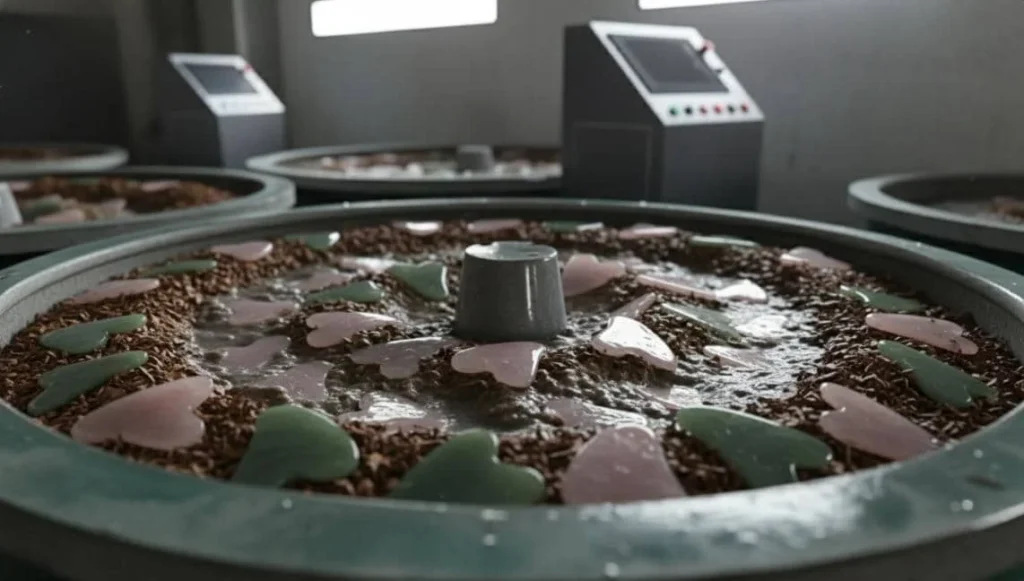
If you’ve ever received a batch of stainless steel gua sha tools that looked stunning in the sample but arrived dull, scratched, or inconsistent at scale — you already know that surface finish is not a cosmetic detail. It is a manufacturing variable that directly determines your return rate, your brand perception, and your margin. As a stainless steel gua sha manufacturer operating for over 12 years, Deyi Gems has processed hundreds of thousands of units across three primary finish categories: mirror polish, matte finish, and brushed effect. The data is clear — the wrong finish choice for the wrong brand increases customer complaints by up to 40% and drives reorder rates down by nearly a third. This article is written as an industry experience and risk disclosure guide, not a sales pitch. You deserve to understand not just what each finish looks like, but what can go wrong, what it costs, and what it means for your specific brand positioning before you commit to a production run. According to the International Gem Society (IGS), surface integrity directly correlates with perceived product value in wellness and beauty categories — a principle that applies equally to metal tools as it does to gemstones. Whether you’re a SPA brand sourcing your first private-label collection or a beauty corporation scaling an existing SKU, the decisions covered in this guide will affect your product’s shelf life, your end user’s experience, and your ability to compete at a price point that makes sense. Why Surface Finish Is a Strategic Manufacturing Decision Most buyers treat surface finish as an aesthetic preference — a quick checkbox during the sampling phase. That framing is exactly where cost overruns and quality disasters begin. The finish you select determines which materials are viable, how long your gua sha production cycle takes, what your defect rate will realistically look like at volume, and whether your packaging needs to be upgraded to protect the surface during transit. A mirror-polished tool, for example, requires individual anti-scratch wrapping per unit, which can add $0.15–$0.40 per piece to your landed cost — a figure that compounds fast on a 10,000-unit minimum order. Your finish decision also directly affects how your product photographs. In an era where product imagery drives e-commerce conversion rates, mirror polish amplifies studio lighting in ways that can look either breathtaking or garish depending on your photographer’s setup. Matte finishes, by contrast, reduce hotspots and produce more consistent results across varying lighting conditions, which is why DTC brands running their own in-house content operations increasingly prefer them. Understanding these downstream consequences is part of what distinguishes a factory relationship from a true gua sha supplier partnership — and it’s the kind of knowledge that only comes from years of managing the full supply chain. The Three Finish Categories and What They Actually Signal to Your Customer At the point of sale — whether that’s a physical retail shelf or a product detail page on Amazon — your customer forms a quality judgment in under three seconds. Neuroscience research consistently confirms that visual texture is processed before color, shape, or text in product evaluation contexts. This is not a trivial point. A mirror-polished stainless steel gua sha tool communicates “luxury ritual,” which aligns perfectly with a $65–$120 retail price point and gift-box packaging. A matte-finished tool communicates “professional clinical use,” which resonates with SPA clients and wellness practitioners paying $40–$80 for tools they’ll use daily. A brushed-finish tool communicates “precision engineering,” which is why it dominates the men’s grooming and tech-beauty categories where the buyer distrusts anything that looks overly decorative. Understanding which signal your brand is trying to send — and whether your current finish choice is sending it — is the first risk assessment every guasha manufacturer should walk you through before production begins. Deyi Gems makes this a mandatory step in every new client onboarding process because the cost of correcting a finish decision after tooling is confirmed averages 18–25% of the total order value. That is a risk you can entirely eliminate with a clear brief upfront. Mirror Polish — The High-Stakes Finish with Unforgiving Standards Mirror polish is the most visually dramatic finish available for stainless steel gua sha tools, and it is also the most unforgiving to manufacture at scale. When it works, it works spectacularly — the surface reflects light with the clarity of polished chrome, photographs like a luxury watch, and positions your product unmistakably in the premium tier. When it doesn’t work, the defects are visible to the naked eye from across a room. Scratches that would disappear on a matte surface become prominent grooves on a mirror finish. Fingerprints left during final assembly appear as permanent smears. Edge roundover caused by over-polishing destroys the clean geometry that makes the tool visually distinctive. As a stainless steel gua sha manufacturer, Deyi Gems tracks mirror polish defect rates separately from other finish categories because the quality thresholds — and the consequences of missing them — operate on a completely different scale. The global luxury wellness market reached $1.1 trillion in 2023 according to the Global Wellness Institute, and mirror-polished metal tools occupy a growing segment of that market. But the commercial opportunity comes with production complexity that not every factory is equipped to manage. Before you specify mirror polish for your next product run, you need to understand exactly what the manufacturing process involves, where failures typically occur, and what that means for your delivery timelines and quality acceptance rates. The 5 Stage Mirror Polish Manufacturing Process Achieving a true mirror finish on a stainless steel gua sha tool is not a single-step operation. It is a sequential five-stage process where each stage depends on the previous one being executed within tolerance. At Deyi Gems, our stainless steel gua sha factory processes mirror finish tools through CNC forming, coarse grinding (120# to 400# grit progression), fine grinding (600# to 1200# grit), cloth-wheel mirror buffing with precision polishing compound, and finally electropolishing combined with ultrasonic

Mirror, Matte, or Brushed? A Stainless Steel Gua Sha Manufacturer’s Risk & Experience Guide to Surface Finishes Read More »

If you’ve ever received a batch of stainless steel gua sha tools that looked stunning in the sample but arrived dull, scratched, or inconsistent at scale — you already know that surface finish is not a cosmetic detail. It is a manufacturing variable that directly determines your return rate, your brand perception, and your margin. As a stainless steel gua sha manufacturer operating for over 12 years, Deyi Gems has processed hundreds of thousands of units across three primary finish categories: mirror polish, matte finish, and brushed effect. The data is clear — the wrong finish choice for the wrong brand increases customer complaints by up to 40% and drives reorder rates down by nearly a third. This article is written as an industry experience and risk disclosure guide, not a sales pitch. You deserve to understand not just what each finish looks like, but what can go wrong, what it costs, and what it means for your specific brand positioning before you commit to a production run. According to the International Gem Society (IGS), surface integrity directly correlates with perceived product value in wellness and beauty categories — a principle that applies equally to metal tools as it does to gemstones. Whether you’re a SPA brand sourcing your first private-label collection or a beauty corporation scaling an existing SKU, the decisions covered in this guide will affect your product’s shelf life, your end user’s experience, and your ability to compete at a price point that makes sense. Why Surface Finish Is a Strategic Manufacturing Decision Most buyers treat surface finish as an aesthetic preference — a quick checkbox during the sampling phase. That framing is exactly where cost overruns and quality disasters begin. The finish you select determines which materials are viable, how long your gua sha production cycle takes, what your defect rate will realistically look like at volume, and whether your packaging needs to be upgraded to protect the surface during transit. A mirror-polished tool, for example, requires individual anti-scratch wrapping per unit, which can add $0.15–$0.40 per piece to your landed cost — a figure that compounds fast on a 10,000-unit minimum order. Your finish decision also directly affects how your product photographs. In an era where product imagery drives e-commerce conversion rates, mirror polish amplifies studio lighting in ways that can look either breathtaking or garish depending on your photographer’s setup. Matte finishes, by contrast, reduce hotspots and produce more consistent results across varying lighting conditions, which is why DTC brands running their own in-house content operations increasingly prefer them. Understanding these downstream consequences is part of what distinguishes a factory relationship from a true gua sha supplier partnership — and it’s the kind of knowledge that only comes from years of managing the full supply chain. The Three Finish Categories and What They Actually Signal to Your Customer At the point of sale — whether that’s a physical retail shelf or a product detail page on Amazon — your customer forms a quality judgment in under three seconds. Neuroscience research consistently confirms that visual texture is processed before color, shape, or text in product evaluation contexts. This is not a trivial point. A mirror-polished stainless steel gua sha tool communicates “luxury ritual,” which aligns perfectly with a $65–$120 retail price point and gift-box packaging. A matte-finished tool communicates “professional clinical use,” which resonates with SPA clients and wellness practitioners paying $40–$80 for tools they’ll use daily. A brushed-finish tool communicates “precision engineering,” which is why it dominates the men’s grooming and tech-beauty categories where the buyer distrusts anything that looks overly decorative. Understanding which signal your brand is trying to send — and whether your current finish choice is sending it — is the first risk assessment every guasha manufacturer should walk you through before production begins. Deyi Gems makes this a mandatory step in every new client onboarding process because the cost of correcting a finish decision after tooling is confirmed averages 18–25% of the total order value. That is a risk you can entirely eliminate with a clear brief upfront. Mirror Polish — The High-Stakes Finish with Unforgiving Standards Mirror polish is the most visually dramatic finish available for stainless steel gua sha tools, and it is also the most unforgiving to manufacture at scale. When it works, it works spectacularly — the surface reflects light with the clarity of polished chrome, photographs like a luxury watch, and positions your product unmistakably in the premium tier. When it doesn’t work, the defects are visible to the naked eye from across a room. Scratches that would disappear on a matte surface become prominent grooves on a mirror finish. Fingerprints left during final assembly appear as permanent smears. Edge roundover caused by over-polishing destroys the clean geometry that makes the tool visually distinctive. As a stainless steel gua sha manufacturer, Deyi Gems tracks mirror polish defect rates separately from other finish categories because the quality thresholds — and the consequences of missing them — operate on a completely different scale. The global luxury wellness market reached $1.1 trillion in 2023 according to the Global Wellness Institute, and mirror-polished metal tools occupy a growing segment of that market. But the commercial opportunity comes with production complexity that not every factory is equipped to manage. Before you specify mirror polish for your next product run, you need to understand exactly what the manufacturing process involves, where failures typically occur, and what that means for your delivery timelines and quality acceptance rates. The 5 Stage Mirror Polish Manufacturing Process Achieving a true mirror finish on a stainless steel gua sha tool is not a single-step operation. It is a sequential five-stage process where each stage depends on the previous one being executed within tolerance. At Deyi Gems, our stainless steel gua sha factory processes mirror finish tools through CNC forming, coarse grinding (120# to 400# grit progression), fine grinding (600# to 1200# grit), cloth-wheel mirror buffing with precision polishing compound, and finally electropolishing combined with ultrasonic

low MOQ Gua Sha Custom for Deyi Gems

Low MOQ Gua Sha Custom: What Brands Need to Know Before Ordering in 2026

Here is a number worth paying attention to: as of June 2026, 65.4% of all custom orders processed at our facility were low MOQ gua sha custom orders — defined as batches under 500 pieces. That figure is up 15.2 percentage points compared to the same period in 2025. This is not a niche trend. It is a structural shift in how brands approach gua sha tools custom production, and if you are currently planning a custom order, this data directly affects your decision. What does this mean for you? It means that ordering small is no longer a workaround for brands that cannot afford large minimums. It has become the deliberate, rational strategy for brands that understand supply chain risk. The old assumption — that only large orders are “serious” orders — no longer reflects how the gua sha manufacturer market actually operates in 2026. The Real Definition of Low MOQ in Gua Sha Custom Orders Before you evaluate whether low MOQ gua sha custom production is the right path for your brand, it helps to understand what “low MOQ” actually means in a manufacturing context. The term does not refer to a fixed number. There is no industry-wide standard that says 100 pieces is low MOQ while 600 pieces is not. Instead, MOQ is always a relative value — relative to the product type, material, production process, and the factory’s cost structure. In the guasha wholesale and custom manufacturing sector, the general market benchmark places low MOQ at under 500 pieces per SKU. Some natural stone gua sha tools custom orders can be accommodated at quantities as low as 50 to 100 pieces, particularly when no new tooling or mold development is required. Stainless steel gua sha tools typically carry slightly higher minimums due to material procurement thresholds. The number that defines “low” for your specific order depends on the product you choose and the customization scope you require. Why does this matter? Because if you walk into a gua sha custom MOQ conversation with a manufacturer expecting a single universal answer, you will likely receive either an inflated minimum or a misaligned quote. Understanding the flexibility behind the number gives you negotiating clarity and helps you structure your order more efficiently. Low MOQ Gua Sha Custom as a Risk Management Tool The most accurate way to think about low MOQ gua sha custom is not as a budget option — it is a risk management instrument. When your brand has not yet confirmed which stone material resonates with your customers, which handle shape performs best in user reviews, or which packaging format converts most effectively on your sales channel, placing a 2,000-piece order is not an investment. It is a speculative bet. Consider the math from a straightforward inventory perspective. If you order 2,000 units at a lower per-unit cost but sell only 400 before demand shifts or a competitor launches a similar product, your remaining 1,600 units represent tied-up capital, warehouse costs, and eventual markdown losses. A smaller initial order at a slightly higher per-unit cost, followed by a confirmed reorder, typically produces a better financial outcome even when the unit economics look less attractive on paper. This is precisely why the gua sha custom MOQ conversation has changed so significantly. According to a 2024 report by Statista on global health and beauty market fragmentation, product life cycles in the beauty and wellness category have shortened by an average of 23% over the past five years. Shorter product cycles mean higher inventory risk for any brand carrying deep stock in a single SKU. Low MOQ production directly addresses this structural challenge. This means you can enter the market, validate your product, and scale with confidence rather than committing capital before you have real sales data to support the decision. The 65.4% Figure — What It Tells You About the Market Data from internal order records at our manufacturing facility — covering all gua sha tools custom and guasha wholesale production between January and June 2026 — shows that low MOQ orders now represent the clear majority of customization requests. The 15.2 percentage point year-over-year increase is not driven by economic pressure alone. It reflects a genuine change in how brands build product lines. Three years ago, the typical first-time gua sha custom MOQ conversation started with a buyer asking, “What is your minimum?” Today, the same conversation more often starts with, “I need to test three materials and two packaging formats — what is the most efficient way to structure that?” That shift in the opening question tells you everything about how brand strategy has evolved. Buyers are now building product testing frameworks into their procurement process, not treating the first order as a final commitment. You should take this seriously if you are still operating under the assumption that larger orders are always smarter orders. The brands gaining market share in the gua sha manufacturer ecosystem right now are the ones moving quickly, testing efficiently, and scaling only what the market confirms. Small batches are how that process starts. Which Gua Sha Tools Are Best Suited for Low MOQ Custom Orders Not every gua sha product category carries the same risk profile when it comes to small-batch customization. Some materials are naturally suited to low MOQ gua sha custom production — either because of inherent quality variation that makes pre-production sampling essential, or because the target customer segment values small-run exclusivity. Others require more careful planning to make low MOQ economics work. Understanding which product type aligns with your order size before you contact a gua sha manufacturer will save you both time and money in the quoting process. Natural Stone Gua Sha Tools Custom — Why Small Batches Make More Sense Natural stone gua sha tools custom production is arguably the category where low MOQ ordering makes the most logical sense — and the reasons are rooted in material science, not just business strategy. Unlike synthetic or engineered materials, natural gemstones including rose

Low MOQ Gua Sha Custom: What Brands Need to Know Before Ordering in 2026 Read More »

Here is a number worth paying attention to: as of June 2026, 65.4% of all custom orders processed at our facility were low MOQ gua sha custom orders — defined as batches under 500 pieces. That figure is up 15.2 percentage points compared to the same period in 2025. This is not a niche trend. It is a structural shift in how brands approach gua sha tools custom production, and if you are currently planning a custom order, this data directly affects your decision. What does this mean for you? It means that ordering small is no longer a workaround for brands that cannot afford large minimums. It has become the deliberate, rational strategy for brands that understand supply chain risk. The old assumption — that only large orders are “serious” orders — no longer reflects how the gua sha manufacturer market actually operates in 2026. The Real Definition of Low MOQ in Gua Sha Custom Orders Before you evaluate whether low MOQ gua sha custom production is the right path for your brand, it helps to understand what “low MOQ” actually means in a manufacturing context. The term does not refer to a fixed number. There is no industry-wide standard that says 100 pieces is low MOQ while 600 pieces is not. Instead, MOQ is always a relative value — relative to the product type, material, production process, and the factory’s cost structure. In the guasha wholesale and custom manufacturing sector, the general market benchmark places low MOQ at under 500 pieces per SKU. Some natural stone gua sha tools custom orders can be accommodated at quantities as low as 50 to 100 pieces, particularly when no new tooling or mold development is required. Stainless steel gua sha tools typically carry slightly higher minimums due to material procurement thresholds. The number that defines “low” for your specific order depends on the product you choose and the customization scope you require. Why does this matter? Because if you walk into a gua sha custom MOQ conversation with a manufacturer expecting a single universal answer, you will likely receive either an inflated minimum or a misaligned quote. Understanding the flexibility behind the number gives you negotiating clarity and helps you structure your order more efficiently. Low MOQ Gua Sha Custom as a Risk Management Tool The most accurate way to think about low MOQ gua sha custom is not as a budget option — it is a risk management instrument. When your brand has not yet confirmed which stone material resonates with your customers, which handle shape performs best in user reviews, or which packaging format converts most effectively on your sales channel, placing a 2,000-piece order is not an investment. It is a speculative bet. Consider the math from a straightforward inventory perspective. If you order 2,000 units at a lower per-unit cost but sell only 400 before demand shifts or a competitor launches a similar product, your remaining 1,600 units represent tied-up capital, warehouse costs, and eventual markdown losses. A smaller initial order at a slightly higher per-unit cost, followed by a confirmed reorder, typically produces a better financial outcome even when the unit economics look less attractive on paper. This is precisely why the gua sha custom MOQ conversation has changed so significantly. According to a 2024 report by Statista on global health and beauty market fragmentation, product life cycles in the beauty and wellness category have shortened by an average of 23% over the past five years. Shorter product cycles mean higher inventory risk for any brand carrying deep stock in a single SKU. Low MOQ production directly addresses this structural challenge. This means you can enter the market, validate your product, and scale with confidence rather than committing capital before you have real sales data to support the decision. The 65.4% Figure — What It Tells You About the Market Data from internal order records at our manufacturing facility — covering all gua sha tools custom and guasha wholesale production between January and June 2026 — shows that low MOQ orders now represent the clear majority of customization requests. The 15.2 percentage point year-over-year increase is not driven by economic pressure alone. It reflects a genuine change in how brands build product lines. Three years ago, the typical first-time gua sha custom MOQ conversation started with a buyer asking, “What is your minimum?” Today, the same conversation more often starts with, “I need to test three materials and two packaging formats — what is the most efficient way to structure that?” That shift in the opening question tells you everything about how brand strategy has evolved. Buyers are now building product testing frameworks into their procurement process, not treating the first order as a final commitment. You should take this seriously if you are still operating under the assumption that larger orders are always smarter orders. The brands gaining market share in the gua sha manufacturer ecosystem right now are the ones moving quickly, testing efficiently, and scaling only what the market confirms. Small batches are how that process starts. Which Gua Sha Tools Are Best Suited for Low MOQ Custom Orders Not every gua sha product category carries the same risk profile when it comes to small-batch customization. Some materials are naturally suited to low MOQ gua sha custom production — either because of inherent quality variation that makes pre-production sampling essential, or because the target customer segment values small-run exclusivity. Others require more careful planning to make low MOQ economics work. Understanding which product type aligns with your order size before you contact a gua sha manufacturer will save you both time and money in the quoting process. Natural Stone Gua Sha Tools Custom — Why Small Batches Make More Sense Natural stone gua sha tools custom production is arguably the category where low MOQ ordering makes the most logical sense — and the reasons are rooted in material science, not just business strategy. Unlike synthetic or engineered materials, natural gemstones including rose

gua sha packaging custom

How to Prevent Gua Sha Tool Damage in Transit: A Risk Disclosure Guide for Wholesalers & Manufacturers

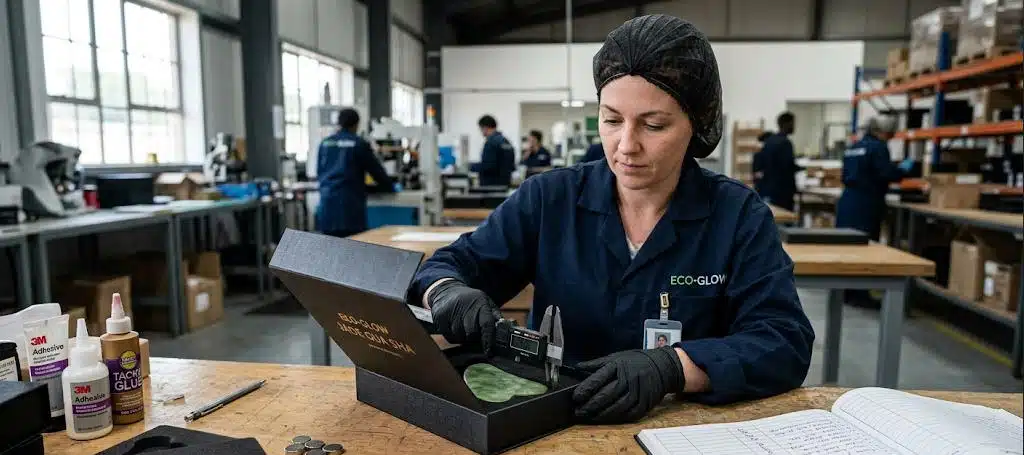
If your current damage rate on gua sha tools wholesale shipments sits above 3%, you are not facing a logistics problem — you are facing a profitability crisis hiding inside your supply chain. Data collected from cross-border e-commerce sellers sourcing natural stone tools shows that inadequate gua sha packaging custom solutions account for between 68% and 74% of all product damage complaints received after delivery. That number is not a shipping carrier’s fault. It is a packaging design failure that starts at the factory floor — and it is entirely preventable before a single box leaves the warehouse. At Deyi Gems, a gua sha manufacturer with over 12 years of hands-on production and export experience, we have processed tens of thousands of wholesale orders across Amazon FBA, sea freight consolidation, and direct DTC channels. The patterns in breakage complaints are remarkably consistent. And the root causes almost never trace back to “bad luck” during transit. They trace back to predictable, fixable gaps in packaging engineering — gaps that cost our wholesale clients an average of 4% to 7% of gross revenue per shipment cycle when left unaddressed. This guide is written specifically for gua sha wholesale buyers, brand owners, and sourcing managers who want to reduce return rates, protect their Amazon seller metrics, and build a packaging system that scales. You will find executable steps, cost benchmarks, and channel-specific recommendations drawn from real production and export scenarios. This is not a product brochure. This is a risk disclosure — the kind of honest conversation that a responsible gua sha supplier should be having with every client before an order ships. Why Breakage Is a Business Problem, Not Just a Shipping Problem The Real Cost of a Broken Shipment Most buyers calculate damage cost as: replacement product + reshipping fee. That calculation is dangerously incomplete. When a natural stone gua sha tool breaks in transit and reaches an Amazon FBA customer, the downstream impact includes a negative review, a potential account health flag, a refund processed by the platform, and — in repeat scenarios — a suppressed listing. Research from the Baymard Institute on e-commerce return costs suggests that every $1 in returned product costs between $2.30 and $3.80 in total operational loss when you factor in handling, restocking, customer service, and reputation impact. For fragile, natural-stone wellness tools, the ratio skews even higher. This means your packaging investment is not a cost line. It is an insurance policy with a measurable return. A gua sha packaging custom solution that adds $0.40 to $0.80 per unit in materials cost can realistically prevent damage rates from 6% down to under 1.5% — a return that pays for itself within two to three shipment cycles. The math is straightforward once you stop treating packaging as an afterthought and start treating it as a core part of your product margin strategy. Why Natural Stone Creates Unique Packaging Risk Natural jade, rose quartz, bian stone, and other materials used in gua sha tools are not uniform industrial products. Each piece carries internal crystalline structures, micro-fractures, and density variations that influence how it responds to impact. The Gemological Institute of America (GIA) documents that the fracture toughness of natural stone materials varies significantly by mineral type — jade nephrite rates differently from aventurine quartz, which rates differently again from black obsidian. These are not aesthetic differences. They are structural differences that directly determine how much cushioning, how much separation, and how much external compression resistance your packaging must provide. The edges and inner curves of a gua sha tool — the concave facial contour zones — are the highest-stress points during impact. When a boxed tool experiences a 60cm drop (a standard event in FBA warehousing operations), the energy concentrates at those inner-curve edges first. Without a precision-fitted gua sha packaging custom insert, that energy has nowhere to go except into the stone itself. This is why off-the-shelf foam pouches fail at scale. They absorb some energy, but not enough, and not at the right points. Understanding this mechanical reality is the starting point for building a packaging system that actually works. The 4 Non-Negotiable Packaging Principles Every Gua Sha Supplier Must Follow Before you evaluate any specific packaging material or structural format, you need a framework that explains why each component exists. Packaging for natural stone wellness tools is not about wrapping something prettily. It is about engineering a micro-environment that neutralizes the four primary mechanical threats that will attack your product between the factory and the customer’s hands. Every gua sha supplier serious about quality control operates from these four principles — and every packaging failure in the field can be traced back to violating at least one of them. 1 — Secure: Eliminate All Internal Movement Movement inside packaging is the precursor to every collision, every scratch, and most fractures. When a gua sha tool can shift even 3 to 5 millimeters within its box during transport, it will repeatedly impact the inner walls and any adjacent products. Over a 14-day sea freight journey involving thousands of vibration cycles, that repeated micro-impact accumulates into visible cracks, edge chips, and surface abrasions that make products unsaleable. The fix is not complicated: the insert must hold the tool in a fixed position with zero lateral play. In a properly engineered gua sha packaging custom insert, you should be able to shake the sealed box and hear nothing. If you hear movement, the packaging has already failed. A precision-cut EVA foam insert, machined to within 1mm of the tool’s actual profile, achieves this level of fixation reliably. This is why Deyi Gems uses CNC-routed EVA inserts for all premium retail and FBA packaging configurations — not because it looks good in product photography, but because it is the only material format that simultaneously provides fixation, cushioning, and shape-matched support for non-uniform natural stone forms. 2 — Cushion: Absorb Impact Energy Before It Reaches the Stone Fixation prevents relative movement between the tool and the box.

How to Prevent Gua Sha Tool Damage in Transit: A Risk Disclosure Guide for Wholesalers & Manufacturers Read More »

If your current damage rate on gua sha tools wholesale shipments sits above 3%, you are not facing a logistics problem — you are facing a profitability crisis hiding inside your supply chain. Data collected from cross-border e-commerce sellers sourcing natural stone tools shows that inadequate gua sha packaging custom solutions account for between 68% and 74% of all product damage complaints received after delivery. That number is not a shipping carrier’s fault. It is a packaging design failure that starts at the factory floor — and it is entirely preventable before a single box leaves the warehouse. At Deyi Gems, a gua sha manufacturer with over 12 years of hands-on production and export experience, we have processed tens of thousands of wholesale orders across Amazon FBA, sea freight consolidation, and direct DTC channels. The patterns in breakage complaints are remarkably consistent. And the root causes almost never trace back to “bad luck” during transit. They trace back to predictable, fixable gaps in packaging engineering — gaps that cost our wholesale clients an average of 4% to 7% of gross revenue per shipment cycle when left unaddressed. This guide is written specifically for gua sha wholesale buyers, brand owners, and sourcing managers who want to reduce return rates, protect their Amazon seller metrics, and build a packaging system that scales. You will find executable steps, cost benchmarks, and channel-specific recommendations drawn from real production and export scenarios. This is not a product brochure. This is a risk disclosure — the kind of honest conversation that a responsible gua sha supplier should be having with every client before an order ships. Why Breakage Is a Business Problem, Not Just a Shipping Problem The Real Cost of a Broken Shipment Most buyers calculate damage cost as: replacement product + reshipping fee. That calculation is dangerously incomplete. When a natural stone gua sha tool breaks in transit and reaches an Amazon FBA customer, the downstream impact includes a negative review, a potential account health flag, a refund processed by the platform, and — in repeat scenarios — a suppressed listing. Research from the Baymard Institute on e-commerce return costs suggests that every $1 in returned product costs between $2.30 and $3.80 in total operational loss when you factor in handling, restocking, customer service, and reputation impact. For fragile, natural-stone wellness tools, the ratio skews even higher. This means your packaging investment is not a cost line. It is an insurance policy with a measurable return. A gua sha packaging custom solution that adds $0.40 to $0.80 per unit in materials cost can realistically prevent damage rates from 6% down to under 1.5% — a return that pays for itself within two to three shipment cycles. The math is straightforward once you stop treating packaging as an afterthought and start treating it as a core part of your product margin strategy. Why Natural Stone Creates Unique Packaging Risk Natural jade, rose quartz, bian stone, and other materials used in gua sha tools are not uniform industrial products. Each piece carries internal crystalline structures, micro-fractures, and density variations that influence how it responds to impact. The Gemological Institute of America (GIA) documents that the fracture toughness of natural stone materials varies significantly by mineral type — jade nephrite rates differently from aventurine quartz, which rates differently again from black obsidian. These are not aesthetic differences. They are structural differences that directly determine how much cushioning, how much separation, and how much external compression resistance your packaging must provide. The edges and inner curves of a gua sha tool — the concave facial contour zones — are the highest-stress points during impact. When a boxed tool experiences a 60cm drop (a standard event in FBA warehousing operations), the energy concentrates at those inner-curve edges first. Without a precision-fitted gua sha packaging custom insert, that energy has nowhere to go except into the stone itself. This is why off-the-shelf foam pouches fail at scale. They absorb some energy, but not enough, and not at the right points. Understanding this mechanical reality is the starting point for building a packaging system that actually works. The 4 Non-Negotiable Packaging Principles Every Gua Sha Supplier Must Follow Before you evaluate any specific packaging material or structural format, you need a framework that explains why each component exists. Packaging for natural stone wellness tools is not about wrapping something prettily. It is about engineering a micro-environment that neutralizes the four primary mechanical threats that will attack your product between the factory and the customer’s hands. Every gua sha supplier serious about quality control operates from these four principles — and every packaging failure in the field can be traced back to violating at least one of them. 1 — Secure: Eliminate All Internal Movement Movement inside packaging is the precursor to every collision, every scratch, and most fractures. When a gua sha tool can shift even 3 to 5 millimeters within its box during transport, it will repeatedly impact the inner walls and any adjacent products. Over a 14-day sea freight journey involving thousands of vibration cycles, that repeated micro-impact accumulates into visible cracks, edge chips, and surface abrasions that make products unsaleable. The fix is not complicated: the insert must hold the tool in a fixed position with zero lateral play. In a properly engineered gua sha packaging custom insert, you should be able to shake the sealed box and hear nothing. If you hear movement, the packaging has already failed. A precision-cut EVA foam insert, machined to within 1mm of the tool’s actual profile, achieves this level of fixation reliably. This is why Deyi Gems uses CNC-routed EVA inserts for all premium retail and FBA packaging configurations — not because it looks good in product photography, but because it is the only material format that simultaneously provides fixation, cushioning, and shape-matched support for non-uniform natural stone forms. 2 — Cushion: Absorb Impact Energy Before It Reaches the Stone Fixation prevents relative movement between the tool and the box.

gua sha manufacturer color control

How a Gua Sha Manufacturer Controls Color Variation in Natural Stone Boards

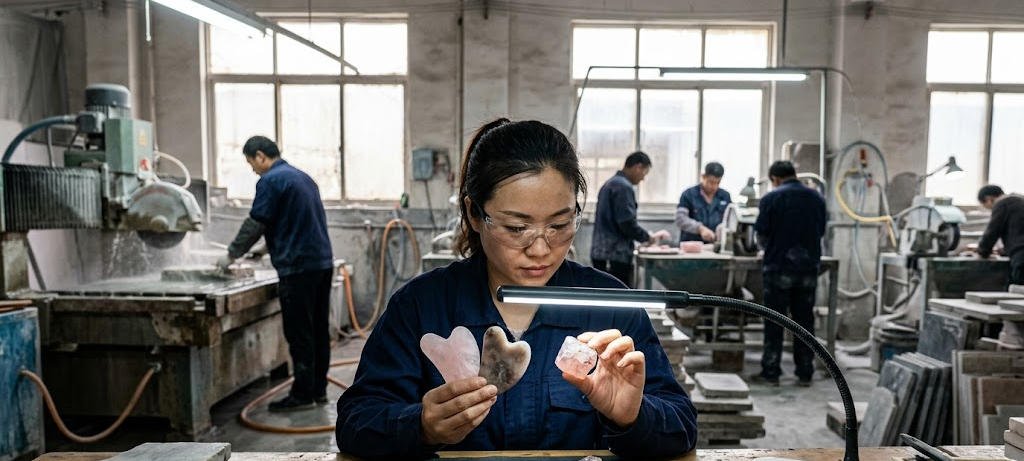
If you’ve placed a gua sha wholesale order before, you’ve probably opened a shipment and noticed two boards sitting side by side with slightly different shades. One looks a touch darker. The other has a faint cloud running through it. Your first instinct might be to call it a defect — but here’s the thing: it’s not. Within the first 12 years of sourcing and manufacturing natural stone tools, experienced teams at a professional gua sha manufacturer learn that color variation is not a failure of quality control. It’s a fundamental property of how stone forms inside the earth. The real question isn’t whether color variation exists — it always will. The real question is whether your gua sha supplier has the process to keep that variation within a range your end customers will accept, and even appreciate. This article breaks down exactly how that process works — from the mineral science that causes color differences in the first place, through the eight-step production system that a disciplined gua sha factory uses to manage consistency, all the way to the practical steps you can take as a buyer to protect your orders before they ship. Why Color Variation Is Built Into Every Natural Stone Board The Mineral Science Behind Gua Sha Color Natural stone doesn’t get its color from a manufacturing process. It gets it from millions of years of geological pressure, heat, and mineral accumulation — and no two formations produce exactly the same result. According to the Gemological Institute of America (GIA), the color of a gemstone or mineral specimen is determined by the trace elements and structural defects present during crystal growth. This means the colors you see in rose quartz, green aventurine, or amethyst are created by specific chemical compounds locked inside the stone long before any gua sha manufacturer ever touches it. Rose quartz gets its signature pink from traces of titanium and manganese. Green aventurine owes its color to fuchsite (chrome-bearing muscovite mica) distributed throughout the quartz matrix. Amethyst’s purple tones come from iron impurities and natural irradiation within the crystal lattice. Because these elements are deposited unevenly during geological formation, even a single large piece of raw stone can contain multiple color zones, translucency gradients, and internal banding patterns — all of which will appear as visible gua sha color differences once the stone is cut and polished. The International Gem Society (IGS) describes this phenomenon in detail, noting that color zoning — the uneven distribution of color within a single stone — is a defining characteristic of natural mineral specimens. For a guasha manufacturer working with rose quartz or fluorite, this isn’t an edge case. It’s the daily reality of working with a natural material that was never designed to be uniform. How Cutting Direction Changes What You See What makes gua sha color management even more complex is that the visual appearance of a stone board doesn’t just depend on which part of the raw material it came from — it also depends on the direction it was cut. Minerals like quartz have optical properties that interact with light differently depending on the angle of the cut relative to the crystal’s internal structure. A board cut parallel to a color band will show a consistent tone, while one cut at an angle across the same band may show a gradient, a stripe, or an entirely different depth of color. This means that two boards cut from material sitting just centimeters apart inside the same raw block can look noticeably different once they’re finished. The translucency of the stone changes. The way light passes through the edges changes. Even the perceived warmth or coolness of the color can shift depending on how the piece was oriented during slicing. Any gua sha factory that doesn’t account for cutting direction as part of its color management process is leaving a major variable completely uncontrolled — and that variable shows up directly in your finished product shipment. Understanding these two root causes — mineral distribution and cutting geometry — is the foundation for understanding why serious color control requires a structured, multi-stage approach rather than a single quality check at the end of production. The 8-Step Color Control System Used by a Professional Gua Sha Manufacturer 1: Raw Material Grading Before Any Cutting Begins Color consistency in your finished order is determined long before a single blade touches the stone. The first intervention point in a professional gua sha factory is raw material grading — a systematic classification of incoming stone blocks by color depth, translucency level, and dominant texture pattern. This happens at the point of receipt, before any production planning begins. Blocks are physically separated into groups that share compatible visual characteristics, and only materials within the same grade grouping are allocated to the same customer order. This step matters more than most buyers realize. A guasha wholesale order that mixes stone from two different grade groups — even if both groups technically meet a general color description like “rose pink” — will almost always produce finished boards with a visible mismatch. The grading process eliminates this risk at the source. You get boards that were matched before they were ever cut, which means the consistency you see in a pre-production sample is the consistency you can expect in your bulk shipment. 2: Single-Source Quarry Policy Even within a single stone variety, material sourced from different quarry locations or different excavation depths can produce significantly different color results. The mineral concentration in a quarry in Minas Gerais, Brazil, where much of the world’s rose quartz originates, will differ from material extracted from a different region — and both will differ again from stone pulled from a deeper level of the same quarry in a different season. According to research documented by the Swiss Gemmological Institute SSEF, even stones from the same geological formation can exhibit measurable differences in trace element composition depending on extraction depth and proximity to geological fault lines. A

How a Gua Sha Manufacturer Controls Color Variation in Natural Stone Boards Read More »

If you’ve placed a gua sha wholesale order before, you’ve probably opened a shipment and noticed two boards sitting side by side with slightly different shades. One looks a touch darker. The other has a faint cloud running through it. Your first instinct might be to call it a defect — but here’s the thing: it’s not. Within the first 12 years of sourcing and manufacturing natural stone tools, experienced teams at a professional gua sha manufacturer learn that color variation is not a failure of quality control. It’s a fundamental property of how stone forms inside the earth. The real question isn’t whether color variation exists — it always will. The real question is whether your gua sha supplier has the process to keep that variation within a range your end customers will accept, and even appreciate. This article breaks down exactly how that process works — from the mineral science that causes color differences in the first place, through the eight-step production system that a disciplined gua sha factory uses to manage consistency, all the way to the practical steps you can take as a buyer to protect your orders before they ship. Why Color Variation Is Built Into Every Natural Stone Board The Mineral Science Behind Gua Sha Color Natural stone doesn’t get its color from a manufacturing process. It gets it from millions of years of geological pressure, heat, and mineral accumulation — and no two formations produce exactly the same result. According to the Gemological Institute of America (GIA), the color of a gemstone or mineral specimen is determined by the trace elements and structural defects present during crystal growth. This means the colors you see in rose quartz, green aventurine, or amethyst are created by specific chemical compounds locked inside the stone long before any gua sha manufacturer ever touches it. Rose quartz gets its signature pink from traces of titanium and manganese. Green aventurine owes its color to fuchsite (chrome-bearing muscovite mica) distributed throughout the quartz matrix. Amethyst’s purple tones come from iron impurities and natural irradiation within the crystal lattice. Because these elements are deposited unevenly during geological formation, even a single large piece of raw stone can contain multiple color zones, translucency gradients, and internal banding patterns — all of which will appear as visible gua sha color differences once the stone is cut and polished. The International Gem Society (IGS) describes this phenomenon in detail, noting that color zoning — the uneven distribution of color within a single stone — is a defining characteristic of natural mineral specimens. For a guasha manufacturer working with rose quartz or fluorite, this isn’t an edge case. It’s the daily reality of working with a natural material that was never designed to be uniform. How Cutting Direction Changes What You See What makes gua sha color management even more complex is that the visual appearance of a stone board doesn’t just depend on which part of the raw material it came from — it also depends on the direction it was cut. Minerals like quartz have optical properties that interact with light differently depending on the angle of the cut relative to the crystal’s internal structure. A board cut parallel to a color band will show a consistent tone, while one cut at an angle across the same band may show a gradient, a stripe, or an entirely different depth of color. This means that two boards cut from material sitting just centimeters apart inside the same raw block can look noticeably different once they’re finished. The translucency of the stone changes. The way light passes through the edges changes. Even the perceived warmth or coolness of the color can shift depending on how the piece was oriented during slicing. Any gua sha factory that doesn’t account for cutting direction as part of its color management process is leaving a major variable completely uncontrolled — and that variable shows up directly in your finished product shipment. Understanding these two root causes — mineral distribution and cutting geometry — is the foundation for understanding why serious color control requires a structured, multi-stage approach rather than a single quality check at the end of production. The 8-Step Color Control System Used by a Professional Gua Sha Manufacturer 1: Raw Material Grading Before Any Cutting Begins Color consistency in your finished order is determined long before a single blade touches the stone. The first intervention point in a professional gua sha factory is raw material grading — a systematic classification of incoming stone blocks by color depth, translucency level, and dominant texture pattern. This happens at the point of receipt, before any production planning begins. Blocks are physically separated into groups that share compatible visual characteristics, and only materials within the same grade grouping are allocated to the same customer order. This step matters more than most buyers realize. A guasha wholesale order that mixes stone from two different grade groups — even if both groups technically meet a general color description like “rose pink” — will almost always produce finished boards with a visible mismatch. The grading process eliminates this risk at the source. You get boards that were matched before they were ever cut, which means the consistency you see in a pre-production sample is the consistency you can expect in your bulk shipment. 2: Single-Source Quarry Policy Even within a single stone variety, material sourced from different quarry locations or different excavation depths can produce significantly different color results. The mineral concentration in a quarry in Minas Gerais, Brazil, where much of the world’s rose quartz originates, will differ from material extracted from a different region — and both will differ again from stone pulled from a deeper level of the same quarry in a different season. According to research documented by the Swiss Gemmological Institute SSEF, even stones from the same geological formation can exhibit measurable differences in trace element composition depending on extraction depth and proximity to geological fault lines. A

gua sha custom mold fee

Where Does the Gua Sha Custom Mold Fee Actually Go? A Manufacturer’s Cost Breakdown

If you’ve ever requested a gua sha custom shape from a supplier and received a quote with a mold fee attached, your first instinct might be to negotiate it down — or skip it entirely. Before you do, here’s what you actually need to know: based on Deyi Gems’ internal data from 45 completed gua sha mold custom orders (tracked through June 2026), that fee breaks down into three distinct cost categories — shape tooling at 65.2%, engineering development at 21.5%, and sample materials at 13.3%. This isn’t a vague “setup charge.” Every dollar has a destination, and understanding where it goes is the fastest way to protect your sourcing budget and avoid costly surprises mid-project. Most buyers approach gua sha tool custom projects the same way: they send a reference image, ask for a price, and expect the factory to handle the rest. That process works fine — until the mold fee shows up and nobody can explain what it covers. The goal of this article is to change that. Whether you’re placing your first custom order or you’ve been sourcing from a gua sha factory for years, a transparent cost breakdown gives you the leverage to ask better questions, compare quotes fairly, and make smarter purchasing decisions. ⚠️ All internal data cited in this article is sourced from Deyi Gems’ production records and is intended for reference purposes only. It does not represent industry-wide averages or authoritative benchmarks. Why Two-Thirds of Your Gua Sha Custom Budget Goes to One Component When buyers first see a mold fee breakdown, the tooling line item is almost always the one that raises eyebrows. Sixty-five percent feels like a lot — until you understand what’s actually being built. In a gua sha custom production workflow, creating a new shape doesn’t mean a technician sketches an outline and starts grinding. It means engineering an entirely new mechanical component from scratch, one that will define every single unit produced in your bulk order. That component is called a profile grinding wheel, and it’s the reason tooling dominates the cost structure. The Profile Grinding Wheel: The Component Most Buyers Never Hear About A profile grinding wheel — known in Chinese manufacturing as a 定形砂轮 — is a precision-machined part that controls the movement trajectory of the grinding machine. Think of it as a physical template embedded into the production equipment itself. When the machine operates, it follows the exact path carved into that wheel, reproducing your gua sha custom shape consistently across hundreds or thousands of units. Without a correctly engineered profile wheel, the machine has no reference point. It cannot replicate a compound curve, a beveled edge, or a concave facial contour with any reliability. This is why you cannot simply send a photo to a gua sha factory and expect the tooling cost to be minimal. The factory isn’t just cutting stone — they’re building a dedicated mechanical guide that encodes your shape into the production line itself. Every curve, every edge angle, every thickness transition has to be translated from your design file into a physical grinding path. That engineering process, and the machined component it produces, is where your 65.2% goes. Manual Samples vs. Machine Production: A Trade-Off Worth Understanding Here’s a decision point that catches many buyers off guard. You do have an option to request a handmade sample first, before committing to the full profile wheel cost. A skilled artisan can approximate your gua sha tool custom design by hand, giving you a physical reference to evaluate the shape, proportions, and feel. This approach reduces your upfront investment, which makes sense if you’re still in early concept validation and not yet ready to commit to tooling. However, there’s a real risk embedded in that choice. A handmade sample and a machine-produced unit are not the same object. The handmade version is shaped by a craftsperson’s judgment — their hand pressure, their grinding angle, their interpretation of your reference. The machine-produced version is shaped by the profile wheel, which operates on fixed mechanical parameters. When you approve a handmade sample and then move to bulk production, the final product will almost certainly differ from what you approved. For buyers with strict consistency requirements — particularly those supplying professional clinics, spa brands, or retail chains — that gap can be a serious quality control problem. The better path for most gua sha manufacturer relationships at scale is to invest in the profile wheel upfront, validate the shape at the tooling stage, and enter bulk production with a mechanically verified reference. It costs more at the start, but it eliminates the consistency gap entirely. This means you can present a sample to your retail buyers or end customers with full confidence that every unit coming off the line will match it exactly. Why Modern Gua Sha Manufacturing Is No Longer a Handcraft Industry There’s a persistent assumption in the market that gua sha tools are artisanal products — shaped by hand, finished by eye, and inherently variable from piece to piece. That image made sense twenty years ago. It does not reflect how a functioning gua sha factory operates in 2025. The shift toward CNC-assisted grinding, automated edge finishing, and precision tooling wasn’t driven by a desire to industrialize a traditional craft. It was driven by demand — specifically, by buyers who needed 5,000 units to look identical for a product launch, or 10,000 units to pass a retail chain’s incoming quality inspection. Pure handcraft production introduces variability at every stage: grinding pressure, finishing time, individual artisan skill level. At small volumes, that variability is manageable. At the order sizes that make a gua sha custom project commercially viable for most brands, it becomes a liability. CNC-guided production with proper tooling removes the human variable from the shaping process, while still leaving room for skilled hand finishing at the polishing stage. The result is a product that meets modern retail consistency standards without abandoning the material quality that makes natural stone

Where Does the Gua Sha Custom Mold Fee Actually Go? A Manufacturer’s Cost Breakdown Read More »

If you’ve ever requested a gua sha custom shape from a supplier and received a quote with a mold fee attached, your first instinct might be to negotiate it down — or skip it entirely. Before you do, here’s what you actually need to know: based on Deyi Gems’ internal data from 45 completed gua sha mold custom orders (tracked through June 2026), that fee breaks down into three distinct cost categories — shape tooling at 65.2%, engineering development at 21.5%, and sample materials at 13.3%. This isn’t a vague “setup charge.” Every dollar has a destination, and understanding where it goes is the fastest way to protect your sourcing budget and avoid costly surprises mid-project. Most buyers approach gua sha tool custom projects the same way: they send a reference image, ask for a price, and expect the factory to handle the rest. That process works fine — until the mold fee shows up and nobody can explain what it covers. The goal of this article is to change that. Whether you’re placing your first custom order or you’ve been sourcing from a gua sha factory for years, a transparent cost breakdown gives you the leverage to ask better questions, compare quotes fairly, and make smarter purchasing decisions. ⚠️ All internal data cited in this article is sourced from Deyi Gems’ production records and is intended for reference purposes only. It does not represent industry-wide averages or authoritative benchmarks. Why Two-Thirds of Your Gua Sha Custom Budget Goes to One Component When buyers first see a mold fee breakdown, the tooling line item is almost always the one that raises eyebrows. Sixty-five percent feels like a lot — until you understand what’s actually being built. In a gua sha custom production workflow, creating a new shape doesn’t mean a technician sketches an outline and starts grinding. It means engineering an entirely new mechanical component from scratch, one that will define every single unit produced in your bulk order. That component is called a profile grinding wheel, and it’s the reason tooling dominates the cost structure. The Profile Grinding Wheel: The Component Most Buyers Never Hear About A profile grinding wheel — known in Chinese manufacturing as a 定形砂轮 — is a precision-machined part that controls the movement trajectory of the grinding machine. Think of it as a physical template embedded into the production equipment itself. When the machine operates, it follows the exact path carved into that wheel, reproducing your gua sha custom shape consistently across hundreds or thousands of units. Without a correctly engineered profile wheel, the machine has no reference point. It cannot replicate a compound curve, a beveled edge, or a concave facial contour with any reliability. This is why you cannot simply send a photo to a gua sha factory and expect the tooling cost to be minimal. The factory isn’t just cutting stone — they’re building a dedicated mechanical guide that encodes your shape into the production line itself. Every curve, every edge angle, every thickness transition has to be translated from your design file into a physical grinding path. That engineering process, and the machined component it produces, is where your 65.2% goes. Manual Samples vs. Machine Production: A Trade-Off Worth Understanding Here’s a decision point that catches many buyers off guard. You do have an option to request a handmade sample first, before committing to the full profile wheel cost. A skilled artisan can approximate your gua sha tool custom design by hand, giving you a physical reference to evaluate the shape, proportions, and feel. This approach reduces your upfront investment, which makes sense if you’re still in early concept validation and not yet ready to commit to tooling. However, there’s a real risk embedded in that choice. A handmade sample and a machine-produced unit are not the same object. The handmade version is shaped by a craftsperson’s judgment — their hand pressure, their grinding angle, their interpretation of your reference. The machine-produced version is shaped by the profile wheel, which operates on fixed mechanical parameters. When you approve a handmade sample and then move to bulk production, the final product will almost certainly differ from what you approved. For buyers with strict consistency requirements — particularly those supplying professional clinics, spa brands, or retail chains — that gap can be a serious quality control problem. The better path for most gua sha manufacturer relationships at scale is to invest in the profile wheel upfront, validate the shape at the tooling stage, and enter bulk production with a mechanically verified reference. It costs more at the start, but it eliminates the consistency gap entirely. This means you can present a sample to your retail buyers or end customers with full confidence that every unit coming off the line will match it exactly. Why Modern Gua Sha Manufacturing Is No Longer a Handcraft Industry There’s a persistent assumption in the market that gua sha tools are artisanal products — shaped by hand, finished by eye, and inherently variable from piece to piece. That image made sense twenty years ago. It does not reflect how a functioning gua sha factory operates in 2025. The shift toward CNC-assisted grinding, automated edge finishing, and precision tooling wasn’t driven by a desire to industrialize a traditional craft. It was driven by demand — specifically, by buyers who needed 5,000 units to look identical for a product launch, or 10,000 units to pass a retail chain’s incoming quality inspection. Pure handcraft production introduces variability at every stage: grinding pressure, finishing time, individual artisan skill level. At small volumes, that variability is manageable. At the order sizes that make a gua sha custom project commercially viable for most brands, it becomes a liability. CNC-guided production with proper tooling removes the human variable from the shaping process, while still leaving room for skilled hand finishing at the polishing stage. The result is a product that meets modern retail consistency standards without abandoning the material quality that makes natural stone

gua sha manufacturer inner corner chamfering

How a Gua Sha Manufacturer Handles Inner-Corner Chamfering: The 5-Second Process That Determines Whether Your Tool Is Safe or Hazardous

When you inspect a gua sha tool for the first time, your eyes are drawn to the overall silhouette — the curves, the polish, the translucency of the stone. What you are far less likely to examine, and what most suppliers will never volunteer information about, is the inner corner zone. Not the concave angle itself, but the two ridge lines where the tool’s front and back faces meet the side edge within that inner corner area. As a professional gua sha manufacturer with over 12 years of stone processing experience, we have documented what happens when those ridge lines are left sharp and unaddressed: the result is a tool that looks finished, passes visual inspection, and injures the people who use it. Here is the fact that should anchor every purchasing decision you make about stone gua sha tools: during the shaping phase of gua sha production, the side edge of the tool within the inner corner zone is ground to its final profile before any surface finishing takes place. The transition between that side edge and the front or back face of the tool — the ridge line running along the inner corner — emerges from shaping as a sharp, unrelieved edge. It is not a manufacturing defect in the traditional sense. It is a structural inevitability of how stone is shaped. What separates a professional gua sha supplier from a volume producer is whether that ridge line is systematically chamfered into a smooth r-angle before the tool reaches your customer. Why This Ridge Line Is More Dangerous Than It Looks The inner corner of a gua sha tool is a zone of curvature change. When a stroke passes through this area, the skin and underlying soft tissue do not respond uniformly — they are drawn inward by the geometry of the stroke, increasing contact pressure precisely at the points where the front and back faces meet the side edge. Contact mechanics research on curved mineral surfaces, including frameworks discussed in IGS resources on gemstone physical properties, consistently identifies angular ridge transitions as zones where localized contact force is disproportionately concentrated relative to what the surface appearance suggests. A ridge line that appears smooth under overhead lighting can generate meaningfully higher contact pressure than the surrounding curved surface during directional stroking — enough to mark skin under sustained use even when the rest of the tool surface causes no discomfort whatsoever. The 5-Second Step That Changes Everything Inner-corner chamfering — the process of grinding those two ridge lines from a sharp transition into a smooth, continuous r-angle — takes no more than 5 seconds per tool in the hands of a trained technician working with the correct equipment. Yet it is one of the most inconsistently performed steps across the gua sha stone factory landscape, particularly among manufacturers where inner-corner work is absorbed into the polishing phase rather than treated as an independent production stage. If your current gua sha tool manufacturer cannot describe this process to you in technical detail — specifying what equipment they use, what contact parameters they follow, and how they verify the result — that gap in their answer is information. This article explains exactly what the process involves, where it fails, and what you should be asking before your next order is confirmed. Why the Inner-Corner Ridge Line Cannot Be Fixed in Polishing To understand why inner-corner chamfering is a mandatory, dedicated stage in professional gua sha production, you need to understand the manufacturing sequence that creates the problem in the first place. Stone gua sha tools are shaped through a process of progressive material removal: rough cutting defines the gross form, intermediate shaping refines the profile and establishes the tool’s characteristic curves, and polishing brings the surface to its final finish. This sequence is deliberately structured so that each stage removes less material than the one before it. Polishing, by design, is a surface refinement operation — it smooths and brightens what is already there. It does not change geometry. How the Ridge Line Forms During Gua Sha Production During the shaping stage, the outer curves of a gua sha tool — the long convex sides and rounded tips — are addressed by grinding passes that move continuously along open, accessible surfaces. The inner corner presents a fundamentally different geometry. The side edge within the inner corner is narrower, more confined, and approached from an angle that limits the grinding wheel’s range of motion. As a result, the transition between the side edge and the front or back face — the ridge line — is the last feature to be refined in shaping, and it is typically the least refined. What the tool carries out of the shaping phase is a side edge that has been brought to its correct profile, front and back faces that have been smoothed to near-finished condition, and two ridge lines along the inner corner that remain as sharp, angular intersections between those surfaces. This geometry cannot be corrected in polishing. Polishing wheels and compounds work by removing microscopic surface irregularities from surfaces they can access and conform to. The ridge line in the inner corner is not a surface irregularity — it is a geometric transition between two surfaces, and polishing does not change the angle of that transition. A gua sha stone factory that relies on polishing to address inner-corner ridge lines will produce tools with a high-gloss, beautifully finished surface and unrelieved sharp edges precisely where users apply the most directional pressure. The polish makes the problem harder to detect, not easier to avoid. How the Ridge Line Affects Skin and Tissue During Use The gua sha stroke is a sustained, directional movement that applies lateral pressure along the skin’s surface. When that stroke enters the inner corner zone, the geometry of the tool causes soft tissue to be drawn inward — a predictable response to the changing curvature of the surface the tool is pressing against. At the moment of maximum

How a Gua Sha Manufacturer Handles Inner-Corner Chamfering: The 5-Second Process That Determines Whether Your Tool Is Safe or Hazardous Read More »

When you inspect a gua sha tool for the first time, your eyes are drawn to the overall silhouette — the curves, the polish, the translucency of the stone. What you are far less likely to examine, and what most suppliers will never volunteer information about, is the inner corner zone. Not the concave angle itself, but the two ridge lines where the tool’s front and back faces meet the side edge within that inner corner area. As a professional gua sha manufacturer with over 12 years of stone processing experience, we have documented what happens when those ridge lines are left sharp and unaddressed: the result is a tool that looks finished, passes visual inspection, and injures the people who use it. Here is the fact that should anchor every purchasing decision you make about stone gua sha tools: during the shaping phase of gua sha production, the side edge of the tool within the inner corner zone is ground to its final profile before any surface finishing takes place. The transition between that side edge and the front or back face of the tool — the ridge line running along the inner corner — emerges from shaping as a sharp, unrelieved edge. It is not a manufacturing defect in the traditional sense. It is a structural inevitability of how stone is shaped. What separates a professional gua sha supplier from a volume producer is whether that ridge line is systematically chamfered into a smooth r-angle before the tool reaches your customer. Why This Ridge Line Is More Dangerous Than It Looks The inner corner of a gua sha tool is a zone of curvature change. When a stroke passes through this area, the skin and underlying soft tissue do not respond uniformly — they are drawn inward by the geometry of the stroke, increasing contact pressure precisely at the points where the front and back faces meet the side edge. Contact mechanics research on curved mineral surfaces, including frameworks discussed in IGS resources on gemstone physical properties, consistently identifies angular ridge transitions as zones where localized contact force is disproportionately concentrated relative to what the surface appearance suggests. A ridge line that appears smooth under overhead lighting can generate meaningfully higher contact pressure than the surrounding curved surface during directional stroking — enough to mark skin under sustained use even when the rest of the tool surface causes no discomfort whatsoever. The 5-Second Step That Changes Everything Inner-corner chamfering — the process of grinding those two ridge lines from a sharp transition into a smooth, continuous r-angle — takes no more than 5 seconds per tool in the hands of a trained technician working with the correct equipment. Yet it is one of the most inconsistently performed steps across the gua sha stone factory landscape, particularly among manufacturers where inner-corner work is absorbed into the polishing phase rather than treated as an independent production stage. If your current gua sha tool manufacturer cannot describe this process to you in technical detail — specifying what equipment they use, what contact parameters they follow, and how they verify the result — that gap in their answer is information. This article explains exactly what the process involves, where it fails, and what you should be asking before your next order is confirmed. Why the Inner-Corner Ridge Line Cannot Be Fixed in Polishing To understand why inner-corner chamfering is a mandatory, dedicated stage in professional gua sha production, you need to understand the manufacturing sequence that creates the problem in the first place. Stone gua sha tools are shaped through a process of progressive material removal: rough cutting defines the gross form, intermediate shaping refines the profile and establishes the tool’s characteristic curves, and polishing brings the surface to its final finish. This sequence is deliberately structured so that each stage removes less material than the one before it. Polishing, by design, is a surface refinement operation — it smooths and brightens what is already there. It does not change geometry. How the Ridge Line Forms During Gua Sha Production During the shaping stage, the outer curves of a gua sha tool — the long convex sides and rounded tips — are addressed by grinding passes that move continuously along open, accessible surfaces. The inner corner presents a fundamentally different geometry. The side edge within the inner corner is narrower, more confined, and approached from an angle that limits the grinding wheel’s range of motion. As a result, the transition between the side edge and the front or back face — the ridge line — is the last feature to be refined in shaping, and it is typically the least refined. What the tool carries out of the shaping phase is a side edge that has been brought to its correct profile, front and back faces that have been smoothed to near-finished condition, and two ridge lines along the inner corner that remain as sharp, angular intersections between those surfaces. This geometry cannot be corrected in polishing. Polishing wheels and compounds work by removing microscopic surface irregularities from surfaces they can access and conform to. The ridge line in the inner corner is not a surface irregularity — it is a geometric transition between two surfaces, and polishing does not change the angle of that transition. A gua sha stone factory that relies on polishing to address inner-corner ridge lines will produce tools with a high-gloss, beautifully finished surface and unrelieved sharp edges precisely where users apply the most directional pressure. The polish makes the problem harder to detect, not easier to avoid. How the Ridge Line Affects Skin and Tissue During Use The gua sha stroke is a sustained, directional movement that applies lateral pressure along the skin’s surface. When that stroke enters the inner corner zone, the geometry of the tool causes soft tissue to be drawn inward — a predictable response to the changing curvature of the surface the tool is pressing against. At the moment of maximum

stainless steel gua sha wholesale for surface scratching

In the Stainless Steel Gua Sha Wholesale, How Can Surface Scratching be Avoided or Minimized?

If you’ve ever placed a stainless steel gua sha wholesale order and opened the shipment to find mirror-finish tools covered in hairline scratches, you already know how fast that turns into a customer service nightmare. Surface scratching accounts for over 70% of all post-shipment complaints in the stainless steel gua sha wholesale industry, and the frustrating truth is that most of it is entirely preventable. Whether you’re sourcing 500 units or 50,000, understanding where scratches actually come from — and which suppliers have the systems to stop them — will save you from costly returns, damaged brand reputation, and wasted margin. This article is written from the perspective of a stainless steel gua sha manufacturer with over 12 years of hands-on production experience. It isn’t a sales pitch. It’s an honest, technical breakdown of every stage where stainless steel gua sha tool scratched damage occurs, what responsible factories do to prevent it, and what questions you should be asking before you sign your next purchase order. The Physics Behind the Problem: Why Mirror-Finish Stainless Steel Gua Sha Wholesale Products Scratch So Easily Before you can evaluate a supplier’s quality control, you need to understand why stainless steel mirror surfaces are so unforgiving — because the answer isn’t obvious, and most buyers don’t know it until they’ve already had a bad shipment. The Optical Reality of 8K Mirror-Polished Stainless Steel A standard 8K mirror-polished stainless steel surface reflects light at a surface roughness of approximately Ra 0.01–0.02 μm. To put that in perspective, a single human hair is roughly 70 micrometers wide — meaning the scratch tolerance on a properly finished stainless steel gua sha wholesale product is operating at a scale 3,500 times smaller than what the naked eye can easily register in conversation, but instantly detectable the moment light hits the surface at any angle. According to materials science data published by ASM International, even dust particles suspended in ordinary workshop air — which average 1–10 μm in diameter — carry enough hardness and mass to permanently score a mirror-polished SUS304 or SUS316 surface on contact under minor pressure. This is the core problem. The same properties that make a mirror-finish gua sha tool look luxurious and sell at a premium price point are the exact properties that make it extraordinarily sensitive to contact damage at every single stage of production, inspection, and shipping. You’re not dealing with a manufacturing defect when you see scratches on a mirror-finish tool — in many cases, you’re seeing the accumulated result of a dozen small process failures that no one caught. Why Stainless Steel Is More Demanding Than Jade or Crystal in This Regard When buyers source jade or rose quartz gua sha tools, minor surface irregularities are often masked by the natural texture and translucency of the stone. A small scratch on a piece of nephrite jade can sometimes be buffed out locally without affecting the appearance of the finished piece. Stainless steel gua sha wholesale products operate by completely different rules. The uniform, high-reflectivity surface of a mirror-polished tool means that any directional scratch — regardless of how it was created — appears as a bright linear distortion visible from across a retail counter under normal lighting. According to surface finishing standards referenced by the Precision Metalforming Association, a scratch as shallow as 0.5 μm on a mirror finish is detectable to the human eye under diffuse light, and scratches deeper than 2 μm cannot be removed through standard re-polishing without altering the overall surface geometry. This means that as a buyer placing a stainless steel gua sha wholesale order, you are not just purchasing a product — you are purchasing an entire process discipline. The factory’s habits, its workflow design, its material sourcing decisions, and its packaging choices all directly determine whether the tools you receive are pristine or already compromised before they leave the warehouse. That’s a significant amount of risk to carry without understanding what you’re evaluating. What SUS304 vs. SUS316 Means for Your Scratch Risk Profile Not all stainless steel is equal when it comes to surface scratch resistance. SUS316 — the marine-grade alloy that includes 2–3% molybdenum — offers marginally better corrosion resistance than SUS304, but from a surface hardness standpoint, both alloys sit at approximately 200 HV (Vickers hardness) in their annealed state. For context, common quartz crystal dust — which is present in virtually every manufacturing environment that also processes crystal or jade gua sha tools — has a Mohs hardness of 7, equivalent to roughly 1,150 HV. This means that if stainless steel gua sha tool scratched damage is occurring in your supplier’s facility due to airborne or surface dust contamination, there is a near-zero chance that the stainless steel surface is winning that contact. The physics simply don’t allow it. This is not a scare tactic — it’s the reason why separating stainless steel production and inspection environments from crystal and jade processing environments is a non-negotiable operational requirement for any serious stainless steel gua sha manufacturer, not a luxury upgrade. The 3 Hidden Windows Where Stainless Steel Gua Sha Tool Scratched Damage Most buyers focus their quality concerns on the finished product — the visual inspection at the end of the line. But for anyone sourcing stainless steel gua sha wholesale at scale, the more important question is: at what point in the manufacturing process did the scratch actually happen? Because the answer determines whether the damage is recoverable, and whether your supplier even has the operational controls in place to catch it. Based on over a decade of production data from a working stainless steel gua sha manufacturer, the manufacturing stage contributes to approximately 55–60% of all surface scratches found in finished products. These are not random events — they are predictable, process-driven, and almost entirely preventable when the right protocols are in place. 1: CNC Machining and Stamping — The First Point of Vulnerability The moment raw stainless steel sheet enters a CNC machine or stamping press,

In the Stainless Steel Gua Sha Wholesale, How Can Surface Scratching be Avoided or Minimized? Read More »

If you’ve ever placed a stainless steel gua sha wholesale order and opened the shipment to find mirror-finish tools covered in hairline scratches, you already know how fast that turns into a customer service nightmare. Surface scratching accounts for over 70% of all post-shipment complaints in the stainless steel gua sha wholesale industry, and the frustrating truth is that most of it is entirely preventable. Whether you’re sourcing 500 units or 50,000, understanding where scratches actually come from — and which suppliers have the systems to stop them — will save you from costly returns, damaged brand reputation, and wasted margin. This article is written from the perspective of a stainless steel gua sha manufacturer with over 12 years of hands-on production experience. It isn’t a sales pitch. It’s an honest, technical breakdown of every stage where stainless steel gua sha tool scratched damage occurs, what responsible factories do to prevent it, and what questions you should be asking before you sign your next purchase order. The Physics Behind the Problem: Why Mirror-Finish Stainless Steel Gua Sha Wholesale Products Scratch So Easily Before you can evaluate a supplier’s quality control, you need to understand why stainless steel mirror surfaces are so unforgiving — because the answer isn’t obvious, and most buyers don’t know it until they’ve already had a bad shipment. The Optical Reality of 8K Mirror-Polished Stainless Steel A standard 8K mirror-polished stainless steel surface reflects light at a surface roughness of approximately Ra 0.01–0.02 μm. To put that in perspective, a single human hair is roughly 70 micrometers wide — meaning the scratch tolerance on a properly finished stainless steel gua sha wholesale product is operating at a scale 3,500 times smaller than what the naked eye can easily register in conversation, but instantly detectable the moment light hits the surface at any angle. According to materials science data published by ASM International, even dust particles suspended in ordinary workshop air — which average 1–10 μm in diameter — carry enough hardness and mass to permanently score a mirror-polished SUS304 or SUS316 surface on contact under minor pressure. This is the core problem. The same properties that make a mirror-finish gua sha tool look luxurious and sell at a premium price point are the exact properties that make it extraordinarily sensitive to contact damage at every single stage of production, inspection, and shipping. You’re not dealing with a manufacturing defect when you see scratches on a mirror-finish tool — in many cases, you’re seeing the accumulated result of a dozen small process failures that no one caught. Why Stainless Steel Is More Demanding Than Jade or Crystal in This Regard When buyers source jade or rose quartz gua sha tools, minor surface irregularities are often masked by the natural texture and translucency of the stone. A small scratch on a piece of nephrite jade can sometimes be buffed out locally without affecting the appearance of the finished piece. Stainless steel gua sha wholesale products operate by completely different rules. The uniform, high-reflectivity surface of a mirror-polished tool means that any directional scratch — regardless of how it was created — appears as a bright linear distortion visible from across a retail counter under normal lighting. According to surface finishing standards referenced by the Precision Metalforming Association, a scratch as shallow as 0.5 μm on a mirror finish is detectable to the human eye under diffuse light, and scratches deeper than 2 μm cannot be removed through standard re-polishing without altering the overall surface geometry. This means that as a buyer placing a stainless steel gua sha wholesale order, you are not just purchasing a product — you are purchasing an entire process discipline. The factory’s habits, its workflow design, its material sourcing decisions, and its packaging choices all directly determine whether the tools you receive are pristine or already compromised before they leave the warehouse. That’s a significant amount of risk to carry without understanding what you’re evaluating. What SUS304 vs. SUS316 Means for Your Scratch Risk Profile Not all stainless steel is equal when it comes to surface scratch resistance. SUS316 — the marine-grade alloy that includes 2–3% molybdenum — offers marginally better corrosion resistance than SUS304, but from a surface hardness standpoint, both alloys sit at approximately 200 HV (Vickers hardness) in their annealed state. For context, common quartz crystal dust — which is present in virtually every manufacturing environment that also processes crystal or jade gua sha tools — has a Mohs hardness of 7, equivalent to roughly 1,150 HV. This means that if stainless steel gua sha tool scratched damage is occurring in your supplier’s facility due to airborne or surface dust contamination, there is a near-zero chance that the stainless steel surface is winning that contact. The physics simply don’t allow it. This is not a scare tactic — it’s the reason why separating stainless steel production and inspection environments from crystal and jade processing environments is a non-negotiable operational requirement for any serious stainless steel gua sha manufacturer, not a luxury upgrade. The 3 Hidden Windows Where Stainless Steel Gua Sha Tool Scratched Damage Most buyers focus their quality concerns on the finished product — the visual inspection at the end of the line. But for anyone sourcing stainless steel gua sha wholesale at scale, the more important question is: at what point in the manufacturing process did the scratch actually happen? Because the answer determines whether the damage is recoverable, and whether your supplier even has the operational controls in place to catch it. Based on over a decade of production data from a working stainless steel gua sha manufacturer, the manufacturing stage contributes to approximately 55–60% of all surface scratches found in finished products. These are not random events — they are predictable, process-driven, and almost entirely preventable when the right protocols are in place. 1: CNC Machining and Stamping — The First Point of Vulnerability The moment raw stainless steel sheet enters a CNC machine or stamping press,

gua sha custom mold

Gua Sha Custom Shape Guide: What Wholesale Buyers Need to Know Before Placing a Manufacturing Order

If you’re sourcing gua sha custom tools at scale, the single most important decision you’ll make isn’t about price — it’s about whether your chosen shape can actually survive mass production. Over 60% of first-time wholesale buyers who request a fully custom silhouette encounter either a high breakage rate during manufacturing or inconsistent quality across batches, according to common feedback from verified gua sha factories with 10+ years of OEM experience. Understanding the three levels of shape customization, the DFM (Design for Manufacturability) evaluation process, and what separates a sample-capable supplier from a mass-production-ready gua sha manufacturer will save you time, money, and a lot of headaches. This guide is written from the manufacturing side. It’s not a sales pitch — it’s a practical breakdown of how gua sha shape custom projects actually work, where they tend to go wrong, and what questions you should be asking any gua sha supplier before you commit to an order. What Gua Sha Shape Customization Actually Means A lot of buyers come into a gua sha custom project thinking it means one thing: design a shape from scratch, hand the file to a factory, and wait for finished products. In practice, shape customization covers a much wider spectrum — and understanding that spectrum is the first step toward making a smart sourcing decision. What “Shape Custom” Covers Gua sha shape custom refers to modifying or completely redesigning the contour, thickness, curvature, edge profile, and functional zones of a gua sha tool — rather than using a manufacturer’s existing public mold. This is distinct from logo engraving or packaging customization, both of which leave the physical form of the product unchanged. When you customize the shape, you’re changing the product itself at a structural level. That distinction matters enormously from a manufacturing standpoint, because it affects tooling costs, lead times, breakage risk, and minimum order quantities. Why Shape Customization Offers the Highest Product Differentiation Among the three common types of gua sha customization — logo, packaging, and shape — shape customization delivers the highest level of product differentiation by a significant margin. A competitor can replicate your logo style or match your packaging format within weeks. They cannot legally or easily replicate a proprietary silhouette that has been tooled and registered. For brands building a long-term product identity in the wellness or spa tool space, this is the most defensible form of differentiation available through a gua sha factory partner. That said, differentiation comes with real engineering constraints. Natural jade and crystal materials — the most commonly used materials in premium gua sha tools — are brittle. Unlike plastic or metal, they cannot flex under stress. A design that looks compelling in a 2D sketch may have structural weak points that only become apparent when a CNC machine starts cutting into raw stone. This is why shape customization isn’t simply a design exercise; it’s an engineering one. The Practical Boundary: Not Every Unique Shape Is Manufacturable at Scale Here’s a question worth asking before you invest in custom tooling: can your design actually be produced consistently across 500, 1,000, or 5,000 pieces? The honest answer from any reputable gua sha manufacturer is: it depends on the geometry. Undercuts, ultra-thin edges (under 2mm), sharp internal corners, and hollow structures all increase the probability of mid-production fractures. A design that yields 95% good product at the sample stage may only yield 70% in full production — and that 25% gap represents real cost that falls on you. Understanding this before you finalize your design is not pessimism; it’s risk management. 3 Levels of Gua Sha Shape Custom — How Deep Should Your Customization Go? One of the most practical decisions you’ll make in any gua sha custom project is choosing how deeply you want to customize. Not every brand needs a fully original design, and not every budget supports one. A mature gua sha factory will typically offer three distinct levels of shape customization — each with its own cost profile, lead time, risk level, and differentiation ceiling. Knowing which level fits your situation before you open a conversation with a gua sha supplier will save weeks of back-and-forth and prevent misaligned expectations. 1: Public Mold Modification — The Low-Risk Entry Point The most accessible form of gua sha shape custom is a modification of an existing public mold. This means taking a shape that a gua sha manufacturer already produces at scale and making targeted adjustments — softening an edge curve, adding 1–2mm of thickness to a fragile zone, scaling the overall dimensions up or down by 10–15%, or refining the grip area for a more ergonomic feel. You’re not starting from zero; you’re improving something that already works. The practical advantages here are significant. Because the core geometry is already proven, tooling adjustments are minor, sample turnaround is typically 7–14 days, and the risk of structural failure during production is low. For brands entering the market for the first time or testing a new product category, this is often the most sensible starting point. You can achieve a degree of visual distinction without absorbing the full cost and timeline of an original design. Most experienced gua sha suppliers will have a catalog of 30–80 existing molds that can serve as a starting base — asking to see this catalog early in your conversation is a smart move. The limitation, of course, is the differentiation ceiling. If a competitor works with the same gua sha factory and selects the same base mold, the visual gap between your products may be narrow. For brands where shelf differentiation is a core priority, Level 1 customization may be a short-term solution rather than a permanent strategy. 2: Semi-Custom Structure — Balanced Investment, Meaningful Distinction Semi-custom gua sha shape custom sits in the middle ground: you’re working from an existing mold’s structural foundation, but you’re reconstructing specific zones rather than just tweaking parameters. This might mean redesigning the functional edge profile entirely while keeping the overall body dimensions,

Gua Sha Custom Shape Guide: What Wholesale Buyers Need to Know Before Placing a Manufacturing Order Read More »

If you’re sourcing gua sha custom tools at scale, the single most important decision you’ll make isn’t about price — it’s about whether your chosen shape can actually survive mass production. Over 60% of first-time wholesale buyers who request a fully custom silhouette encounter either a high breakage rate during manufacturing or inconsistent quality across batches, according to common feedback from verified gua sha factories with 10+ years of OEM experience. Understanding the three levels of shape customization, the DFM (Design for Manufacturability) evaluation process, and what separates a sample-capable supplier from a mass-production-ready gua sha manufacturer will save you time, money, and a lot of headaches. This guide is written from the manufacturing side. It’s not a sales pitch — it’s a practical breakdown of how gua sha shape custom projects actually work, where they tend to go wrong, and what questions you should be asking any gua sha supplier before you commit to an order. What Gua Sha Shape Customization Actually Means A lot of buyers come into a gua sha custom project thinking it means one thing: design a shape from scratch, hand the file to a factory, and wait for finished products. In practice, shape customization covers a much wider spectrum — and understanding that spectrum is the first step toward making a smart sourcing decision. What “Shape Custom” Covers Gua sha shape custom refers to modifying or completely redesigning the contour, thickness, curvature, edge profile, and functional zones of a gua sha tool — rather than using a manufacturer’s existing public mold. This is distinct from logo engraving or packaging customization, both of which leave the physical form of the product unchanged. When you customize the shape, you’re changing the product itself at a structural level. That distinction matters enormously from a manufacturing standpoint, because it affects tooling costs, lead times, breakage risk, and minimum order quantities. Why Shape Customization Offers the Highest Product Differentiation Among the three common types of gua sha customization — logo, packaging, and shape — shape customization delivers the highest level of product differentiation by a significant margin. A competitor can replicate your logo style or match your packaging format within weeks. They cannot legally or easily replicate a proprietary silhouette that has been tooled and registered. For brands building a long-term product identity in the wellness or spa tool space, this is the most defensible form of differentiation available through a gua sha factory partner. That said, differentiation comes with real engineering constraints. Natural jade and crystal materials — the most commonly used materials in premium gua sha tools — are brittle. Unlike plastic or metal, they cannot flex under stress. A design that looks compelling in a 2D sketch may have structural weak points that only become apparent when a CNC machine starts cutting into raw stone. This is why shape customization isn’t simply a design exercise; it’s an engineering one. The Practical Boundary: Not Every Unique Shape Is Manufacturable at Scale Here’s a question worth asking before you invest in custom tooling: can your design actually be produced consistently across 500, 1,000, or 5,000 pieces? The honest answer from any reputable gua sha manufacturer is: it depends on the geometry. Undercuts, ultra-thin edges (under 2mm), sharp internal corners, and hollow structures all increase the probability of mid-production fractures. A design that yields 95% good product at the sample stage may only yield 70% in full production — and that 25% gap represents real cost that falls on you. Understanding this before you finalize your design is not pessimism; it’s risk management. 3 Levels of Gua Sha Shape Custom — How Deep Should Your Customization Go? One of the most practical decisions you’ll make in any gua sha custom project is choosing how deeply you want to customize. Not every brand needs a fully original design, and not every budget supports one. A mature gua sha factory will typically offer three distinct levels of shape customization — each with its own cost profile, lead time, risk level, and differentiation ceiling. Knowing which level fits your situation before you open a conversation with a gua sha supplier will save weeks of back-and-forth and prevent misaligned expectations. 1: Public Mold Modification — The Low-Risk Entry Point The most accessible form of gua sha shape custom is a modification of an existing public mold. This means taking a shape that a gua sha manufacturer already produces at scale and making targeted adjustments — softening an edge curve, adding 1–2mm of thickness to a fragile zone, scaling the overall dimensions up or down by 10–15%, or refining the grip area for a more ergonomic feel. You’re not starting from zero; you’re improving something that already works. The practical advantages here are significant. Because the core geometry is already proven, tooling adjustments are minor, sample turnaround is typically 7–14 days, and the risk of structural failure during production is low. For brands entering the market for the first time or testing a new product category, this is often the most sensible starting point. You can achieve a degree of visual distinction without absorbing the full cost and timeline of an original design. Most experienced gua sha suppliers will have a catalog of 30–80 existing molds that can serve as a starting base — asking to see this catalog early in your conversation is a smart move. The limitation, of course, is the differentiation ceiling. If a competitor works with the same gua sha factory and selects the same base mold, the visual gap between your products may be narrow. For brands where shelf differentiation is a core priority, Level 1 customization may be a short-term solution rather than a permanent strategy. 2: Semi-Custom Structure — Balanced Investment, Meaningful Distinction Semi-custom gua sha shape custom sits in the middle ground: you’re working from an existing mold’s structural foundation, but you’re reconstructing specific zones rather than just tweaking parameters. This might mean redesigning the functional edge profile entirely while keeping the overall body dimensions,

gua sha tool custom logo

Gua Sha Tool Custom Logo Engraving: A Complete Wholesale Buyer’s Guide

Here’s a number worth pausing on: in 2025, 74.44% of all gua sha tools wholesale orders processed at Deyi Gems — 763 out of 1,025 total orders — included a logo engraving request. That’s not a niche add-on anymore. That’s the standard. And compared to 2024, when the same figure sat at 61.28%, it’s clear that gua sha tool custom logo work is no longer something brands do when they have extra budget. It’s what they do first. This guide is written from the factory floor, not a marketing deck. If you’re evaluating gua sha wholesale suppliers, planning your first custom order, or trying to figure out why your last sample came back with blurry text or a hazy white burn mark, you’ll find answers here. We’ll walk through the three main engraving processes, material-specific risks that most manufacturers won’t tell you upfront, file submission standards, and the three mistakes that cause the most re-orders and delays. No fluff — just what you need to make a better purchasing decision. Why Gua Sha Logo Custom Has Become the Default in Wholesale Orders The shift toward gua sha logo custom work isn’t driven by trend-chasing. It’s driven by a very practical problem: the gua sha product market has become saturated. Walk through any wellness trade show or scroll through any major B2B sourcing platform, and you’ll find hundreds of suppliers offering the same rose quartz board, the same bian stone scraper, the same stainless steel roller. At that point, the product itself can’t differentiate you. Your brand mark is what does the work. The Economics Behind the Demand Spike This is where gua sha tool custom logo engraving becomes a genuinely interesting business decision. Among all available customization options — custom shapes, custom packaging, custom stone sourcing — logo engraving offers the lowest barrier to entry at the most favorable cost-to-impact ratio. A standard single-color laser engraving on a wholesale order typically adds less than $0.50 per unit to your cost. For a brand selling at $18–$35 retail per piece, that’s a rounding error on margin. But the perceived value difference between a blank stone tool and one carrying your logo is substantial. You’re essentially buying shelf differentiation at commodity pricing. For context: custom stone shaping requires retooling and higher minimum order quantities. Custom packaging adds complexity to logistics. But logo engraving? You can apply it to existing inventory lines, keep your MOQ low, and still walk away with a product that looks purpose-built for your brand. That’s why the data looks the way it does, and why it’s trending upward year over year. Who Is Actually Ordering Custom Logo Gua Sha Tools? One of the more surprising patterns in gua sha tools wholesale order data is how wide the buyer profile is. It’s not just large wellness retailers placing 5,000-unit orders with full branding packages. A significant share of logo engraving orders comes from small massage studios, acupuncture clinics, individual practitioners building a private label line, and even corporate wellness programs sourcing branded tools for employee gift sets. The $0.50-or-under per unit cost threshold makes gua sha tool custom logo work accessible at virtually any scale. This accessibility is commercially important for buyers to understand, because it means you don’t need to be a large operator to justify a custom order. You need a vector file and a clear idea of where you want your mark placed. The 3 Engraving Processes Used in Gua Sha Tool Custom Production — And How to Choose Not all logo engraving is the same process, and the process you end up with will directly affect how your finished product looks, how durable the mark is, and how much you pay. There are three methods in active use across gua sha factory production floors: laser engraving, sandblasting, and silk screen printing. Understanding the difference isn’t just academic — choosing the wrong method for your material or design is the single most common cause of sample rejection. Laser Engraving: Why It Dominates Gua Sha Logo Custom Orders Laser engraving has become the default for gua sha logo custom work for a straightforward reason: it works on almost everything. Jade, crystal, stainless steel, glass, resin, wood — laser systems can be calibrated to handle all of these, which makes it the lowest-friction option for gua sha manufacturer production lines handling diverse SKUs. The process works by using a focused laser beam to ablate the surface of the tool, leaving a shallow recessed mark. Because the mark is physically cut into the material rather than printed on top of it, it doesn’t peel, fade with washing, or wear away from friction. What buyers often don’t realize, however, is that laser engraving has specific color limitations that can affect your design. Most gua sha factory laser setups handle one to two colors effectively. Colors cannot overlap or touch in the design — if they do, the risk of color bleed during the paint-fill stage increases significantly. This means a complex multi-color logo that looks clean on a digital screen can become genuinely difficult to execute at the engraving stage. The practical implication: if your brand uses a three-color gradient logo, you’ll need to create a simplified single-color version specifically for engraving use, or expect a cost increase that scales with each additional color added. Additionally, on deep-colored stone materials — darker jade varieties, for example — an unfilled laser engraving can be visually subtle to the point of near-invisibility. If you’re working with a dark material and want high contrast, your order spec needs to explicitly request a color fill. Without it, what looks crisp in a mockup may barely register on the finished piece. This means you can avoid the most common sample disappointment before it happens, simply by specifying fill requirements upfront. Sandblasting: The Right Choice for Minimal, High-Touch Brand Aesthetics Sandblasting achieves a similar physical result to laser engraving — a recessed mark on the material surface — but through a different mechanism. High-pressure abrasive

Gua Sha Tool Custom Logo Engraving: A Complete Wholesale Buyer’s Guide Read More »

Here’s a number worth pausing on: in 2025, 74.44% of all gua sha tools wholesale orders processed at Deyi Gems — 763 out of 1,025 total orders — included a logo engraving request. That’s not a niche add-on anymore. That’s the standard. And compared to 2024, when the same figure sat at 61.28%, it’s clear that gua sha tool custom logo work is no longer something brands do when they have extra budget. It’s what they do first. This guide is written from the factory floor, not a marketing deck. If you’re evaluating gua sha wholesale suppliers, planning your first custom order, or trying to figure out why your last sample came back with blurry text or a hazy white burn mark, you’ll find answers here. We’ll walk through the three main engraving processes, material-specific risks that most manufacturers won’t tell you upfront, file submission standards, and the three mistakes that cause the most re-orders and delays. No fluff — just what you need to make a better purchasing decision. Why Gua Sha Logo Custom Has Become the Default in Wholesale Orders The shift toward gua sha logo custom work isn’t driven by trend-chasing. It’s driven by a very practical problem: the gua sha product market has become saturated. Walk through any wellness trade show or scroll through any major B2B sourcing platform, and you’ll find hundreds of suppliers offering the same rose quartz board, the same bian stone scraper, the same stainless steel roller. At that point, the product itself can’t differentiate you. Your brand mark is what does the work. The Economics Behind the Demand Spike This is where gua sha tool custom logo engraving becomes a genuinely interesting business decision. Among all available customization options — custom shapes, custom packaging, custom stone sourcing — logo engraving offers the lowest barrier to entry at the most favorable cost-to-impact ratio. A standard single-color laser engraving on a wholesale order typically adds less than $0.50 per unit to your cost. For a brand selling at $18–$35 retail per piece, that’s a rounding error on margin. But the perceived value difference between a blank stone tool and one carrying your logo is substantial. You’re essentially buying shelf differentiation at commodity pricing. For context: custom stone shaping requires retooling and higher minimum order quantities. Custom packaging adds complexity to logistics. But logo engraving? You can apply it to existing inventory lines, keep your MOQ low, and still walk away with a product that looks purpose-built for your brand. That’s why the data looks the way it does, and why it’s trending upward year over year. Who Is Actually Ordering Custom Logo Gua Sha Tools? One of the more surprising patterns in gua sha tools wholesale order data is how wide the buyer profile is. It’s not just large wellness retailers placing 5,000-unit orders with full branding packages. A significant share of logo engraving orders comes from small massage studios, acupuncture clinics, individual practitioners building a private label line, and even corporate wellness programs sourcing branded tools for employee gift sets. The $0.50-or-under per unit cost threshold makes gua sha tool custom logo work accessible at virtually any scale. This accessibility is commercially important for buyers to understand, because it means you don’t need to be a large operator to justify a custom order. You need a vector file and a clear idea of where you want your mark placed. The 3 Engraving Processes Used in Gua Sha Tool Custom Production — And How to Choose Not all logo engraving is the same process, and the process you end up with will directly affect how your finished product looks, how durable the mark is, and how much you pay. There are three methods in active use across gua sha factory production floors: laser engraving, sandblasting, and silk screen printing. Understanding the difference isn’t just academic — choosing the wrong method for your material or design is the single most common cause of sample rejection. Laser Engraving: Why It Dominates Gua Sha Logo Custom Orders Laser engraving has become the default for gua sha logo custom work for a straightforward reason: it works on almost everything. Jade, crystal, stainless steel, glass, resin, wood — laser systems can be calibrated to handle all of these, which makes it the lowest-friction option for gua sha manufacturer production lines handling diverse SKUs. The process works by using a focused laser beam to ablate the surface of the tool, leaving a shallow recessed mark. Because the mark is physically cut into the material rather than printed on top of it, it doesn’t peel, fade with washing, or wear away from friction. What buyers often don’t realize, however, is that laser engraving has specific color limitations that can affect your design. Most gua sha factory laser setups handle one to two colors effectively. Colors cannot overlap or touch in the design — if they do, the risk of color bleed during the paint-fill stage increases significantly. This means a complex multi-color logo that looks clean on a digital screen can become genuinely difficult to execute at the engraving stage. The practical implication: if your brand uses a three-color gradient logo, you’ll need to create a simplified single-color version specifically for engraving use, or expect a cost increase that scales with each additional color added. Additionally, on deep-colored stone materials — darker jade varieties, for example — an unfilled laser engraving can be visually subtle to the point of near-invisibility. If you’re working with a dark material and want high contrast, your order spec needs to explicitly request a color fill. Without it, what looks crisp in a mockup may barely register on the finished piece. This means you can avoid the most common sample disappointment before it happens, simply by specifying fill requirements upfront. Sandblasting: The Right Choice for Minimal, High-Touch Brand Aesthetics Sandblasting achieves a similar physical result to laser engraving — a recessed mark on the material surface — but through a different mechanism. High-pressure abrasive

gua sha manufacturer Controls Thermal Stress

How a Gua Sha Manufacturer Controls Thermal Stress Across the Full Production Process — From the First Cut to the Final Cool

When you source gua sha tools at scale, the defects that cause the most damage to your business are rarely the obvious ones. A visibly shattered tool gets caught at inspection. What’s considerably harder to catch — and far more costly over time — is a shipment that arrives looking clean but starts showing hairline fractures two or three weeks after reaching your customers. In twelve years of gua sha production, the majority of these post-delivery failures trace back to one consistent root cause: thermal stress that entered the stone material somewhere in the manufacturing process and was never properly resolved. Thermal stress occurs when different regions of a material expand or contract at different rates due to uneven temperature change. For brittle stone materials — quartz, jade, obsidian — the core of most gua sha wholesale and guasha wholesale inventory worldwide — a temperature differential of just 15 to 20°C across a small cross-section can generate internal fracture forces strong enough to initiate micro-cracks. The critical issue is that most of those cracks never reach the surface. They pass visual inspection without detection. They just don’t pass time. What follows is not a general primer on gemstone physics. It is a working account of how thermal stress enters a gua sha manufacturing process at multiple points, what each of those points looks like in real production conditions, and what separates a gua sha manufacturer that manages this problem systematically from one that addresses it only at the inspection stage. If you’re evaluating a new gua sha factory or reviewing your current gua sha supplier‘s production capability, this framework gives you the right questions to ask — and a way to interpret the answers accurately. There are no shortcuts in this kind of manufacturing discipline. But there is a consistent, measurable difference in outcomes between a gua sha manufacturer that has built thermal risk management into their process architecture and one that hasn’t — and that difference shows up in your defect rates, your return rates, and your per-shipment cost over time. What Thermal Stress Does to Crystal and Stone Gua Sha Tools — A Gua Sha Manufacturer Perspective The physical mechanism behind thermal stress in stone materials is straightforward. When a cutting blade generates intense localized heat, the stone directly at the contact point expands. The material a few millimeters behind it, still at ambient temperature, resists that expansion. The boundary between them is where mechanical stress accumulates — and when that stress exceeds the local tensile strength of the material, fracture initiates, typically from a pre-existing microscopic flaw in the crystal structure. According to the Gemological Institute of America (GIA), crystalline gemstone materials exhibit highly anisotropic thermal expansion behavior — meaning the rate of expansion varies significantly depending on the orientation of the crystal axis. In gua sha production terms, this means two tools cut from adjacent slabs of the same rough crystal can respond very differently to identical processing conditions. The crystal axis orientation, invisible to the eye, determines how heat distributes and dissipates internally. This is one of the core reasons why visual assessment of finished products is an inherently unreliable quality signal on its own — and why a competent gua sha manufacturer designs quality into the process rather than inspecting for it at the end. The Four Types of Thermal Damage a Gua Sha Manufacturer Must Identify Before Final Inspection Four distinct damage types emerge from thermal stress in stone gua sha tools, and understanding the difference between them determines where quality control actually needs to operate. Surface micro-cracks are the most visible — hairline fractures at or just below the surface, sometimes detectable under magnification but frequently missed during routine visual checks. Under mechanical stress during shipping or after several uses, these fractures propagate deeper into the material, eventually becoming visible failures at the customer level. Dark fractures are internal cracks with no surface expression whatsoever. You can hold a finished tool up to a strong light source and see nothing unusual — yet the internal structure is already compromised. The International Gem Society (IGS) notes that repeated thermal cycling in brittle silicate materials can reduce fracture toughness by as much as 30% over time, and dark fractures are the primary physical manifestation of that cumulative degradation. Edge chipping occurs at the geometric perimeter of the tool, where processed and unprocessed material meet, and is particularly common in tools that experienced rapid temperature change during the cooling or washing stage. Internal structural fatigue is the hardest to detect and the most dangerous: a progressive weakening of the material’s internal cohesion through repeated thermal cycling that produces no localized fracture signature until the material finally fails under normal use load. Three of these four damage types are effectively invisible to end-of-line visual inspection. This means the most important quality decisions in managing gua sha manufacturing risks are not made at the inspection table — they’re made inside the production process at each stage. This means you can only accurately evaluate a gua sha supplier‘s real quality performance by understanding their process discipline, not by examining their samples in isolation. Why Brittle Materials Demand Different Standards From a Gua Sha Manufacturer The three material families most prevalent in gua sha wholesale and guasha wholesale sourcing — quartz crystals, obsidian and glass-type materials, and high-hardness jade — each carry a different thermal risk profile. A gua sha manufacturer that applies the same cutting parameters, polishing durations, and cooling protocols across all three is, by definition, producing inconsistent results in at least two of those categories. The inconsistency doesn’t always appear in samples — it appears in volume production. Quartz-family materials — clear quartz, rose quartz, amethyst — have a thermal conductivity of roughly 6 to 7 W/m·K, compared to aluminum at approximately 205 W/m·K. This means heat generated at the cutting surface dissipates extremely slowly through the bulk material. When coolant hits the surface, the surface cools rapidly — but the interior remains elevated for

How a Gua Sha Manufacturer Controls Thermal Stress Across the Full Production Process — From the First Cut to the Final Cool Read More »

When you source gua sha tools at scale, the defects that cause the most damage to your business are rarely the obvious ones. A visibly shattered tool gets caught at inspection. What’s considerably harder to catch — and far more costly over time — is a shipment that arrives looking clean but starts showing hairline fractures two or three weeks after reaching your customers. In twelve years of gua sha production, the majority of these post-delivery failures trace back to one consistent root cause: thermal stress that entered the stone material somewhere in the manufacturing process and was never properly resolved. Thermal stress occurs when different regions of a material expand or contract at different rates due to uneven temperature change. For brittle stone materials — quartz, jade, obsidian — the core of most gua sha wholesale and guasha wholesale inventory worldwide — a temperature differential of just 15 to 20°C across a small cross-section can generate internal fracture forces strong enough to initiate micro-cracks. The critical issue is that most of those cracks never reach the surface. They pass visual inspection without detection. They just don’t pass time. What follows is not a general primer on gemstone physics. It is a working account of how thermal stress enters a gua sha manufacturing process at multiple points, what each of those points looks like in real production conditions, and what separates a gua sha manufacturer that manages this problem systematically from one that addresses it only at the inspection stage. If you’re evaluating a new gua sha factory or reviewing your current gua sha supplier‘s production capability, this framework gives you the right questions to ask — and a way to interpret the answers accurately. There are no shortcuts in this kind of manufacturing discipline. But there is a consistent, measurable difference in outcomes between a gua sha manufacturer that has built thermal risk management into their process architecture and one that hasn’t — and that difference shows up in your defect rates, your return rates, and your per-shipment cost over time. What Thermal Stress Does to Crystal and Stone Gua Sha Tools — A Gua Sha Manufacturer Perspective The physical mechanism behind thermal stress in stone materials is straightforward. When a cutting blade generates intense localized heat, the stone directly at the contact point expands. The material a few millimeters behind it, still at ambient temperature, resists that expansion. The boundary between them is where mechanical stress accumulates — and when that stress exceeds the local tensile strength of the material, fracture initiates, typically from a pre-existing microscopic flaw in the crystal structure. According to the Gemological Institute of America (GIA), crystalline gemstone materials exhibit highly anisotropic thermal expansion behavior — meaning the rate of expansion varies significantly depending on the orientation of the crystal axis. In gua sha production terms, this means two tools cut from adjacent slabs of the same rough crystal can respond very differently to identical processing conditions. The crystal axis orientation, invisible to the eye, determines how heat distributes and dissipates internally. This is one of the core reasons why visual assessment of finished products is an inherently unreliable quality signal on its own — and why a competent gua sha manufacturer designs quality into the process rather than inspecting for it at the end. The Four Types of Thermal Damage a Gua Sha Manufacturer Must Identify Before Final Inspection Four distinct damage types emerge from thermal stress in stone gua sha tools, and understanding the difference between them determines where quality control actually needs to operate. Surface micro-cracks are the most visible — hairline fractures at or just below the surface, sometimes detectable under magnification but frequently missed during routine visual checks. Under mechanical stress during shipping or after several uses, these fractures propagate deeper into the material, eventually becoming visible failures at the customer level. Dark fractures are internal cracks with no surface expression whatsoever. You can hold a finished tool up to a strong light source and see nothing unusual — yet the internal structure is already compromised. The International Gem Society (IGS) notes that repeated thermal cycling in brittle silicate materials can reduce fracture toughness by as much as 30% over time, and dark fractures are the primary physical manifestation of that cumulative degradation. Edge chipping occurs at the geometric perimeter of the tool, where processed and unprocessed material meet, and is particularly common in tools that experienced rapid temperature change during the cooling or washing stage. Internal structural fatigue is the hardest to detect and the most dangerous: a progressive weakening of the material’s internal cohesion through repeated thermal cycling that produces no localized fracture signature until the material finally fails under normal use load. Three of these four damage types are effectively invisible to end-of-line visual inspection. This means the most important quality decisions in managing gua sha manufacturing risks are not made at the inspection table — they’re made inside the production process at each stage. This means you can only accurately evaluate a gua sha supplier‘s real quality performance by understanding their process discipline, not by examining their samples in isolation. Why Brittle Materials Demand Different Standards From a Gua Sha Manufacturer The three material families most prevalent in gua sha wholesale and guasha wholesale sourcing — quartz crystals, obsidian and glass-type materials, and high-hardness jade — each carry a different thermal risk profile. A gua sha manufacturer that applies the same cutting parameters, polishing durations, and cooling protocols across all three is, by definition, producing inconsistent results in at least two of those categories. The inconsistency doesn’t always appear in samples — it appears in volume production. Quartz-family materials — clear quartz, rose quartz, amethyst — have a thermal conductivity of roughly 6 to 7 W/m·K, compared to aluminum at approximately 205 W/m·K. This means heat generated at the cutting surface dissipates extremely slowly through the bulk material. When coolant hits the surface, the surface cools rapidly — but the interior remains elevated for

Scroll to Top

Getting Fast Reply

gua sha wholesale